ISRO refutes 'privatisation'; the IN-SPACe remark explained; Japan's JCR upgrades India to 'A-' after 35 years; UNEP: breaching 1.5°C is now unavoidable
Monday, 7 September 2026 · IST · National & International · 15 items · 2 MCQs
India's forex reserves hit an all-time high of $740.80 billion, up $11.47 billion in a week. Japan Credit Rating Agency upgrades India to 'A-' from 'BBB+' - its first upgrade in 35 years. UNEP says a 1.5°C overshoot is now unavoidable; best-case peak warming about 1.8°C.
Today at a glance — things to remember
India's forex reserves hit an all-time high of $740.80 billion, up $11.47 billion in a week.
Japan Credit Rating Agency upgrades India to 'A-' from 'BBB+' - its first upgrade in 35 years.
UNEP says a 1.5°C overshoot is now unavoidable; best-case peak warming about 1.8°C.
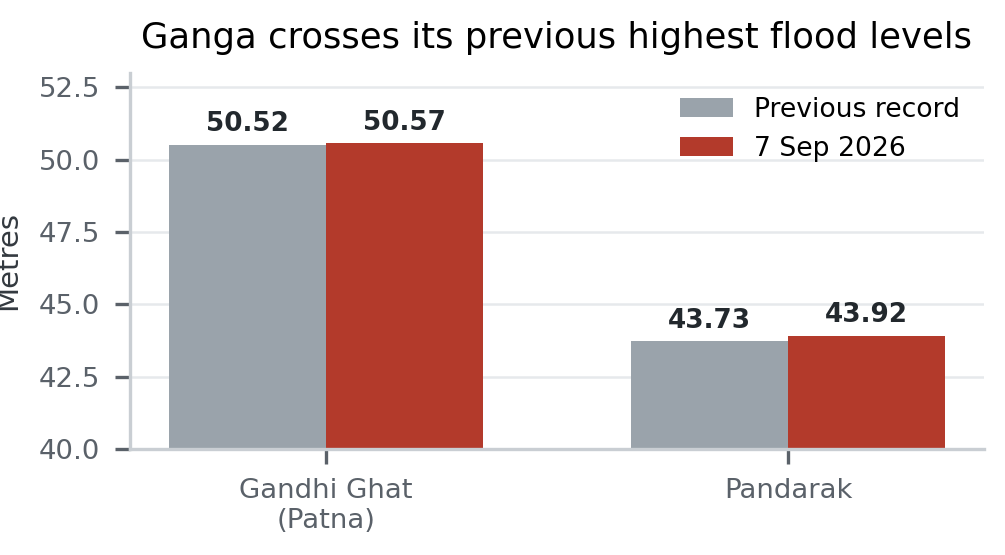
Ganga crosses its previous highest flood level at Patna; 19.57 lakh affected across 11 Bihar districts.
Home Ministry unveils a three-year roadmap for a drug-free India by 2029.
A Supreme Court judge's letters to the CJI reopen the judicial accountability debate.
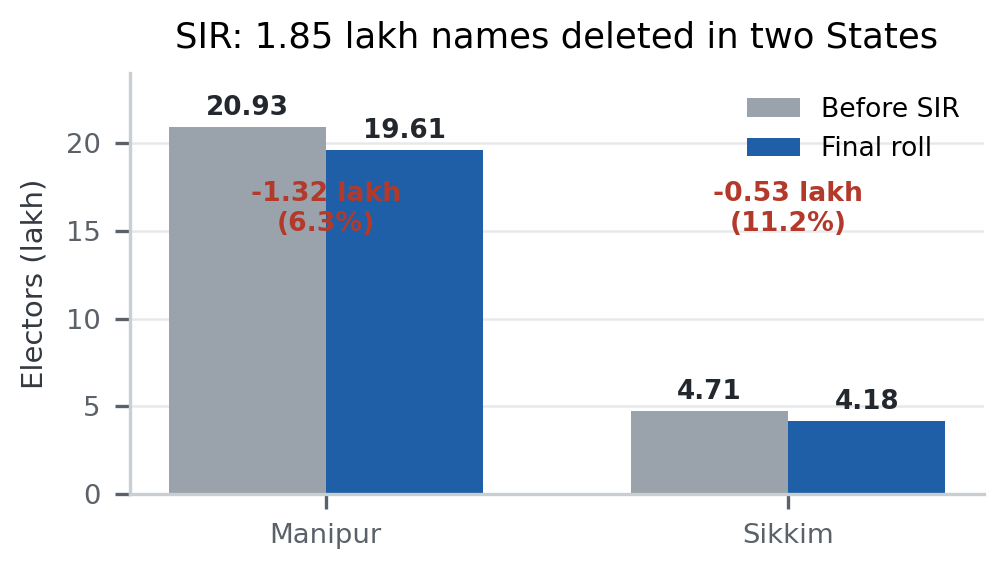
SIR final rolls delete 1.85 lakh names across Manipur and Sikkim.
Tribal Affairs Ministry says the FRA has no gram sabha consent clause for forest clearance.
DRDO and University of Hyderabad patent BAM-H24, a boron-rich solid rocket propellant.
Chhattisgarh tops Jal Sanchay Jan Bhagidari 3.0 with 77,719 structures completed.
Detailed notes
1. ISRO refutes 'privatisation'; the IN-SPACe remark explained
SCI-TECHHIGH-YIELD: Prelims + Mains GS3
Syllabus linkage
GS-III - Achievements of Indians in science and technology; indigenisation. Prelims: IN-SPACe, NSIL, Indian Space Policy 2023.
Context
Nine ISRO employee associations wrote on 4 September seeking clarity after the IN-SPACe chairman said on 21 August that ISRO would eventually not manufacture launch vehicles. ISRO called privatisation fears 'completely baseless'.
Key facts
The associations asked about Space Commission approval, sanctioned strength and recruitment over a 5-10 year horizon.
IN-SPACe clarified the direction is 'not a smaller ISRO but a larger ecosystem'.
Division of labour: industry scales mature vehicles and satellites; ISRO keeps advanced R&D, scientific and strategic missions.
Department of Space staff are outside the statutory definition of 'industry' and organise as service associations under CCS (Recognition of Service Associations) Rules, 1993.
Way forward
Publish a transparent transition roadmap with workforce guarantees, so technology transfer does not read as withdrawal from a domain.
Concept
IN-SPACe authorises and regulates non-government space activity; NSIL is the commercial arm that markets mature ISRO technology. Both were created by the 2020 space reforms.
2. Japan's JCR upgrades India to 'A-' after 35 years
ECONOMYHIGH-YIELD: Prelims + Mains GS3
Syllabus linkage
GS-III - Indian economy, growth and development; mobilisation of resources. Prelims: sovereign ratings, country ceiling, fiscal deficit.
Context
Japan Credit Rating Agency raised India's sovereign rating to 'A-' from 'BBB+' with a stable outlook - its first upgrade of India in 35 years. The country ceiling was also raised to 'A'.
Key facts
JCR cites GDP growth projected above 6% for 2026-27.
Central fiscal deficit improved from 4.7% of GDP in FY25 to 4.4% in FY26.
Banking health: gross NPA ratio fell to 1.8% by March 2026.
A higher rating lowers external borrowing costs for the sovereign and for Indian corporates raising funds abroad.
Way forward
Sustained fiscal consolidation and better capital-expenditure quality decide whether the larger agencies follow with upgrades.
Concept
A country ceiling caps the rating most domestic issuers can receive, since few borrowers are considered safer than their sovereign. Ratings assess default risk, not growth.
3. UNEP: breaching 1.5°C is now unavoidable
ENVIRONMENTHIGH-YIELD: Prelims + Mains GS3
Syllabus linkage
GS-III - Environment, conservation and climate change. Prelims: Paris Agreement, overshoot, carbon dioxide removal.
Context
A UNEP report on limiting overshoot concludes the 1.5°C threshold will be crossed, with warming peaking around 1.8°C in the best case. Current policies point to roughly 2.6°C by 2100.
Key facts
Every five years of sustained emissions at present levels could add about 0.1°C.
The report maps a narrow return pathway below 1.5°C after overshoot.
Some overshoot effects - ice-sheet loss, coral die-off - are effectively irreversible on human timescales.
Way forward
The policy question shifts from avoiding overshoot to minimising its depth and duration, raising the salience of adaptation finance for the Global South.
Concept
Overshoot means temporarily exceeding a temperature limit before returning below it. The Paris Agreement (2015) targets 'well below 2°C' while pursuing 1.5°C.
4. DRDO and UoH patent BAM-H24 rocket propellant
SCI-TECHCOMMON: Prelims + Mains GS3
Syllabus linkage
GS-III - Indigenisation of technology and developing new technology; defence R&D. Prelims: solid propellants, DRDO.
Context
DRDO with the University of Hyderabad secured Indian Patent No. 599900 on 20 August 2026 for BAM-H24, a boron-, hydrogen- and nitrogen-rich compound for solid rocket propulsion.
Key facts
Key properties: high thermal stability and reduced ignition delay.
Boron-rich formulations offer high volumetric energy density, valuable where volume is constrained.
Useful for compact tactical missiles and boosters where storage life matters.
Developed by Dr Muddamarri Hanumantha Rao and Prof. Muralidharan Krishnamurthi.
Way forward
Indigenous energetic materials cut import dependence in missile propulsion and feed the Atmanirbhar Bharat defence push.
Concept
Solid propellants cast fuel and oxidiser into a single grain - simple, storable and instantly ready, but they cannot be throttled or shut down once ignited, unlike liquid engines.
5. Bihar floods: Ganga crosses its record flood level
DISASTERHIGH-YIELD: Prelims + Mains GS3
Syllabus linkage
GS-III - Disaster management. GS-I - Geography: Ganga basin, drainage and floods.
Context
About 19.57 lakh people across 11 districts and 330 gram panchayats are affected as the Ganga crossed its previous highest flood level at Patna. Eight rivers are above danger level.
Key facts
Gandhi Ghat, Patna: 50.57 m, above the August 2016 record of 50.52 m.
Pandarak: 43.92 m, above the 2021 record of 43.73 m.
Districts hit include Patna, Bhojpur, Saran, Vaishali, Bhagalpur, Begusarai and Buxar.
Response: 110 community kitchens, 1,345 boats, 27 SDRF and 10 NDRF teams.
Way forward
Shift from embankment-only defence to basin-level management - silt policy, floodplain zoning and data sharing with Nepal on Himalayan tributaries.
Concept
About 73% of Bihar's area is flood-prone. Himalayan rivers carry heavy silt loads onto a low-gradient plain, raising riverbeds and reducing the carrying capacity behind embankments.
Bihar floods: Ganga crosses its record flood level — StudyForGS
6. Three-year roadmap for a drug-free India by 2029
SECURITYHIGH-YIELD: Prelims + Mains GS3
Syllabus linkage
GS-III - Internal security: challenges of narcotics, trafficking and money-laundering linkages. Prelims: NDPS Act, NCORD, NCB.
Context
The Union Home Minister unveiled a roadmap running July 2026 to July 2029 to make India drug-free, framing narcotics control as a national security priority comparable to counter-Naxal operations.
Key facts
Four pillars: intelligence-led enforcement, precursor and synthetic drug control, demand reduction, and institutional capacity.
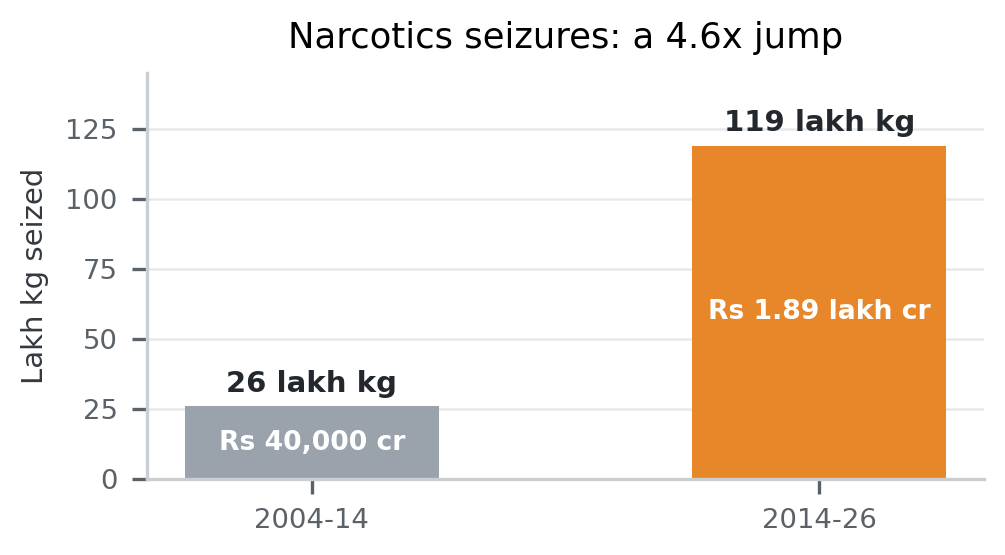
Seizures rose from 26 lakh kg (Rs 40,000 cr) in 2004-14 to over 1.19 crore kg (Rs 1.89 lakh cr) in 2014-26.
De-addiction centres to triple to 1,751; 10,000 volunteers for community outreach.
274 fugitives extradited from 36 countries (2019-July 2026); assets worth Rs 17,874 crore seized.
Way forward
Synthetic drugs and precursor diversion are the emerging front - chemical-industry regulation and port scanning matter as much as street seizures.
Concept
The NDPS Act, 1985 is the parent statute. NCORD gives four-tier Centre-State coordination and the Narcotics Control Bureau is the apex enforcement agency.
Three-year roadmap for a drug-free India by 2029 — StudyForGS
7. SEBI and ESMA renew cooperation on clearing houses
ECONOMYCOMMON: Prelims + Mains GS3
Syllabus linkage
GS-III - Capital markets and financial regulation. Prelims: SEBI, central counterparties, EMIR.
Context
SEBI and the European Securities and Markets Authority signed an updated MoU on the supervision of central counterparties, replacing a 2017 agreement. It lets Indian CCPs reapply for recognition under the EU's EMIR framework.
Key facts
Signed by SEBI chairman Tuhin Kanta Pandey and ESMA chair Verena Ross.
A central counterparty sits between buyer and seller in a trade, guaranteeing settlement if one side defaults.
EU recognition matters because European banks face higher capital charges when clearing through unrecognised CCPs.
The 2017 MoU had lapsed amid a supervisory access dispute between the two regulators.
Way forward
Restored recognition lowers the cost for European banks to clear Indian trades and supports rupee-market depth.
Concept
EMIR (European Market Infrastructure Regulation) governs derivatives clearing in the EU. Regulatory deference - recognising another jurisdiction's supervision as equivalent - is what avoids duplicate compliance.
A sitting Supreme Court judge wrote three letters (2, 10 and 17 August) to the CJI seeking the transfer of the Acting Chief Justice of the Rajasthan High Court, alleging victimisation of judges, misuse of the master-of-roster power and nepotism in appointments.
Key facts
The Rajasthan HC functioned without a regular Chief Justice for about 11 months.
The Collegium recommended a new Chief Justice on 31 August 2026.
K. Veeraswami (1991): prior permission of the CJI is needed to register an FIR against a higher judiciary judge.
The Judicial Standards and Accountability Bill passed the Lok Sabha in 2012 but lapsed in 2014.
Way forward
Strengthen the 1999 in-house procedure with time limits and a reasoned outcome, and revive a statutory accountability framework short of impeachment.
Concept
Removal is governed by Articles 124(4) (SC) and 217(1)(b) (HC) read with the Judges (Inquiry) Act, 1968. No impeachment has ever succeeded in India - making the in-house mechanism the only working check.
9. SIR: 1.85 lakh names deleted in Manipur and Sikkim
POLITYHIGH-YIELD: Prelims + Mains GS2
Syllabus linkage
GS-II - Election Commission, electoral rolls and franchise. Prelims: RP Act 1950, Articles 324 and 326.
Context
Final rolls after the Special Intensive Revision showed about 1.85 lakh deletions across Manipur and Sikkim. Karnataka's CEO separately published a notice list covering 43.81 lakh electors.
Key facts
Manipur: 20,93,076 to 19,60,620 - a deletion of 1,32,456 names (about 6.3%).
Sikkim: about 4,71,081 to 4,18,467 - a deletion of 52,614 names (about 11.2%).
Deletion heads: shifted, deceased, absent and duplicate entries.
Manipur's final roll sex ratio: 1,056 women per 1,000 men.
Way forward
Credibility rests on grievance redress - appeals run from the ERO to the District Magistrate and then the Chief Electoral Officer.
Concept
Section 21(3), RP Act 1950 lets the ECI order a special revision at any time for reasons recorded in writing. Intensive revision means fresh house-to-house enumeration; summary revision only invites claims and objections against the existing roll.
SIR: 1.85 lakh names deleted in Manipur and Sikkim — StudyForGS
10. 'FRA has no gram sabha consent clause', says Ministry
GOVERNANCEHIGH-YIELD: Prelims + Mains GS2
Syllabus linkage
GS-II - Government policies and issues arising out of their design and implementation. GS-III - Environment: forest clearance.
Context
The Ministry of Tribal Affairs told NHPC in a 31 August letter that the FRA, 2006 has no provision for gram sabha consent for forest clearance and that the matter is not under its purview - despite being the Act's nodal ministry.
Key facts
Environment Ministry circulars since 2009 make FRA compliance and a gram sabha NOC a precondition for Stage-II forest clearance.
A Standing Committee report (3 August) found forest clearance for NHPC projects averaged 106 months.
NHPC proposed a 'qualified super-majority' of 70-75% of affected gram sabhas for national-importance projects.
A jurisdictional disclaimer by the nodal ministry leaves a governance vacuum; clarity, not abdication, is what both project timelines and forest dwellers need.
Concept
Section 5, FRA empowers the gram sabha to protect forests and biodiversity. Niyamgiri (2013) held gram sabha consent decisive on community and religious forest claims. PESA, 1996 mandates consultation in Fifth Schedule areas.
11. ST classification criteria and the Lokur legacy
A national convention of the Adivasi Adhikar Rashtriya Manch in New Delhi demanded that ST classification criteria be insulated from political manipulation, opposing proposals to delist converted Adivasis on religious grounds.
Key facts
Lokur Committee (1965) criteria: primitive traits, distinctive culture, geographical isolation, shyness of contact and backwardness - widely called obsolete.
Article 342: the President specifies STs; only Parliament by law can include or exclude a community.
Unlike Scheduled Castes, ST status carries no religion condition - the delisting campaign seeks to change this.
The convention also sought Adivasi languages in the Eighth Schedule, which now has 22 languages.
Way forward
An evidence-based revision of the Lokur criteria is the long-pending reform; a 2002 task force proposed changes but none were ever adopted.
Concept
Article 366(25) defines STs with reference to Article 342. Article 338A (89th Amendment, 2003) created the National Commission for Scheduled Tribes.
12. Hasina interview strains India-Bangladesh ties
IRHIGH-YIELD: Prelims + Mains GS2
Syllabus linkage
GS-II - India and its neighbourhood; bilateral agreements. Prelims: 2013 extradition treaty, 1951 Refugee Convention.
Context
Bangladesh's former Prime Minister Sheikh Hasina, in India since 5 August 2024, defended her right to address party workers and the press. Dhaka has linked the postponement of a high-level visit to her public interactions.
Key facts
She has been convicted in Bangladesh over the 2024 crackdown on student protesters.
India has no domestic refugee or asylum law and is not party to the 1951 Refugee Convention.
The 2013 extradition treaty (amended 2016) exempts offences of a political character.
Pending files: Teesta water sharing and renewal of the Ganga Waters Treaty, 1996.
Way forward
India needs a statutory asylum framework so individual cases stop becoming bilateral irritants with every political transition next door.
Concept
The relationship rests on the 1971 Liberation War legacy, the 1972 Treaty of Friendship, the 2015 Land Boundary Agreement settling enclaves, and the 2014 UN maritime boundary award.
13. US-Iran war enters sixth month; Hormuz still unsafe
IRHIGH-YIELD: Prelims + Mains GS2
Syllabus linkage
GS-II - Effect of policies of developed countries on India's interests. GS-I - Geography: strategic chokepoints.
Context
Iranian strikes on US warships and American retaliation against Iranian tankers have kept the Strait of Hormuz unsafe. Diplomacy collapsed after the 17 June Islamabad MoU failed to produce talks.
Key facts
The strait is about 21 nautical miles at its narrowest; usable shipping lanes are only kilometres wide.
Bordered by Iran to the north and Oman's Musandam exclave and the UAE to the south.
It is the world's most critical oil chokepoint, carrying a large share of traded crude and LNG.
India has run Operation Sankalp escort deployments in the Gulf since 2019.
Way forward
Bypass pipelines - Saudi East-West to Yanbu and the UAE's Habshan-Fujairah - fall well short of Hormuz throughput, so India's import basket stays exposed.
Concept
Transit passage under UNCLOS allows continuous and expeditious passage through international straits. Iran signed but never ratified UNCLOS and is bound by the customary rule.
14. Chhattisgarh tops Jal Sanchay Jan Bhagidari 3.0
GOVERNANCECOMMON: Prelims + Mains GS2
Syllabus linkage
GS-II - Government schemes and community participation. GS-III - Water resources and conservation.
Context
Chhattisgarh ranked first nationally under Jal Sanchay Jan Bhagidari 3.0, part of the Catch the Rain campaign, completing 77,719 of 79,775 registered water conservation structures.
Key facts
Five districts feature in India's top ten - Surajpur, Mahasamund, Balod, Balodabazar-Bhatapara and Kabirdham.
Koriya district's '5 Per Cent Model' asks farmers to set aside 5% of farmland for groundwater recharge.
The scheme sits under the Jal Shakti Abhiyan: Catch the Rain campaign of the Jal Shakti Ministry.
It works through panchayat and community participation rather than pure departmental construction.
Way forward
Community-led recharge is replicable in water-stressed States, but maintenance of structures after completion remains the weak link.
Concept
Jal Shakti Abhiyan: Catch the Rain is a time-bound campaign promoting rainwater harvesting and aquifer recharge, with the tagline 'catch the rain, where it falls, when it falls'.
15. Punjab's 'Pehchaan' portal for unidentified dead
Punjab launched the 'Pehchaan' portal to help identify unclaimed deceased persons - the first such State-level system in India. It is built on the MedLEaPR medico-legal platform.
Key facts
Photographs and identification marks are uploaded within 48 hours of a body being found.
The portal integrates with CCTNS, the national police crime and criminal records network.
It lets families search across districts instead of visiting individual police stations or morgues.
MedLEaPR digitises post-mortem and medico-legal reports, linking hospitals with police.
Way forward
A searchable national registry would extend the benefit beyond State borders, where most missing-person cases actually run.
Concept
CCTNS (Crime and Criminal Tracking Network and Systems) is a Mission Mode Project under the National e-Governance Plan, linking police stations into a common database.
Data point of the day
$740.80 billion
India's forex reserves, an all-time high
Prelims rapid-fire
Forex reserves stand at a record $740.80 billion; the weekly rise was $11.47 billion.
JCR is a Japanese rating agency; it moved India from BBB+ to A- with a stable outlook.
Patent No. 599900 covers BAM-H24, a boron-rich solid rocket propellant.
Gandhi Ghat and Pandarak are the Ganga gauge sites in Patna district that crossed record levels.
Section 21(3) of the RP Act, 1950 is the legal basis for a Special Intensive Revision.
The Lokur Committee of 1965 laid down the five criteria still used to identify Scheduled Tribes.
Practice MCQs — UPSC Prelims pattern
Q1. Prelims MCQ 1. With reference to the Special Intensive Revision (SIR) of electoral rolls, consider the following statements:1. It is conducted under the Representation of the People Act, 1951.2. An intensive revision involves fresh house-to-house enumeration.3. Appeals against an Electoral Registration Officer's decision lie to the District Magistrate.Which of the statements given above are correct?
1 and 2 only
2 and 3 only
1 and 3 only
1, 2 and 3
Show answer
Answer: B Statements 2 and 3 are correct. Statement 1 is wrong - electoral roll preparation is governed by the RP Act, 1950; the RP Act, 1951 deals with the conduct of elections and disqualifications.
Q2. Prelims MCQ 2. Consider the following pairs of constitutional provisions and their subject:1. Article 342 - specification of Scheduled Tribes2. Article 338A - National Commission for Scheduled Tribes3. Article 366(25) - definition of Scheduled TribesHow many of the pairs given above are correctly matched?
Only one
Only two
All three
None
Show answer
Answer: C All three are correctly matched. Note that only Parliament by law can include or exclude a community from the ST list, even though the President issues the initial notification under Article 342.
Mains practice question
Q. "The absence of a working removal mechanism has made India's judiciary accountable largely to itself." In light of recent developments, examine the adequacy of existing judicial accountability mechanisms and suggest reforms. (250 words, 15 marks)
Hint / approach
Open with the Articles 124(4) / 217(1)(b) route and the fact that no impeachment has succeeded. Cover the 1999 in-house procedure, the K. Veeraswami (1991) bar on FIRs, and the lapsed 2012 Bill. Balance independence versus accountability - avoid executive-controlled remedies. Close with time-bound in-house inquiry, reasoned outcomes and transparency in Collegium decisions.
📌 One-line revision: Forex $740.80 bn record | JCR upgrade to A- | UNEP 1.5°C overshoot, peak 1.8°C | Ganga 50.57 m at Gandhi Ghat | Drug-free India 2029 roadmap | SIR deletes 1.85 lakh in Manipur + Sikkim | FRA consent row | BAM-H24 patent | Chhattisgarh tops Jal Sanchay 3.0