India and China open first eastern-sector Corps Commander talks at Wacha; UNGA votes 164-1 to 'correct the map' with India's backing; EOS-05 becomes India's first imaging satellite bound for geostationary orbit.
Sunday, 6 September 2026 · IST · National & International · 11 items · 2 MCQs
Military commanders of India and China met at Wacha-Damai in Arunachal Pradesh, the first Corps Commander-level engagement outside Ladakh's Chushul-Moldo point. At the UN, India voted for an equal-area world map resolution while insisting on projection neutrality and accurate depiction of its sovereign territory. On the economy, Q1 FY27 GDP grew 7.8%, the current account deficit widened to $4.2 billion, and the RBI moved to drain a record liquidity surplus ahead of the BRICS Summit that New Delhi hosts on 12-13 September.
Today at a glance — things to remember
India and China hold the first-ever eastern-sector Corps Commander talks at Wacha, Arunachal Pradesh.
UNGA adopts the 'correct the map' resolution 164-1; India votes yes but asks for projection neutrality.
EOS-05 rides GSLV-F17 — India's first imaging satellite bound for geostationary orbit.
New Delhi readies Bharat Mandapam for the 18th BRICS Summit on 12-13 September.
Vibrant Villages Programme: ₹11,639 crore committed across 2,616 border villages.
International Vulture Awareness Day marked with the national workshop 'From Crisis to Recovery'.
Q1 FY27 real GDP grows 7.8%, beating the central bank's 7% projection.
Current account deficit widens to $4.2 billion, or 0.5% of GDP, in Q1 FY27.
RBI to absorb ₹7 lakh crore through a 30-day VRRR; surplus at a record ₹10.32 lakh crore.
Special NIA court convicts all ten accused in the 2013 Jhiram Ghati Maoist ambush.
Detailed notes
1. EOS-05 lifts off on GSLV-F17: India's first imaging satellite bound for geostationary orbit
SCI-TECHCOMMON: Prelims + Mains GS3
Syllabus linkage
GS-III — Awareness in the field of space technology. Prelims:GSLV vs PSLV, cryogenic upper stage, GTO / GEO / Sun-synchronous orbit, the EOS series.
Context
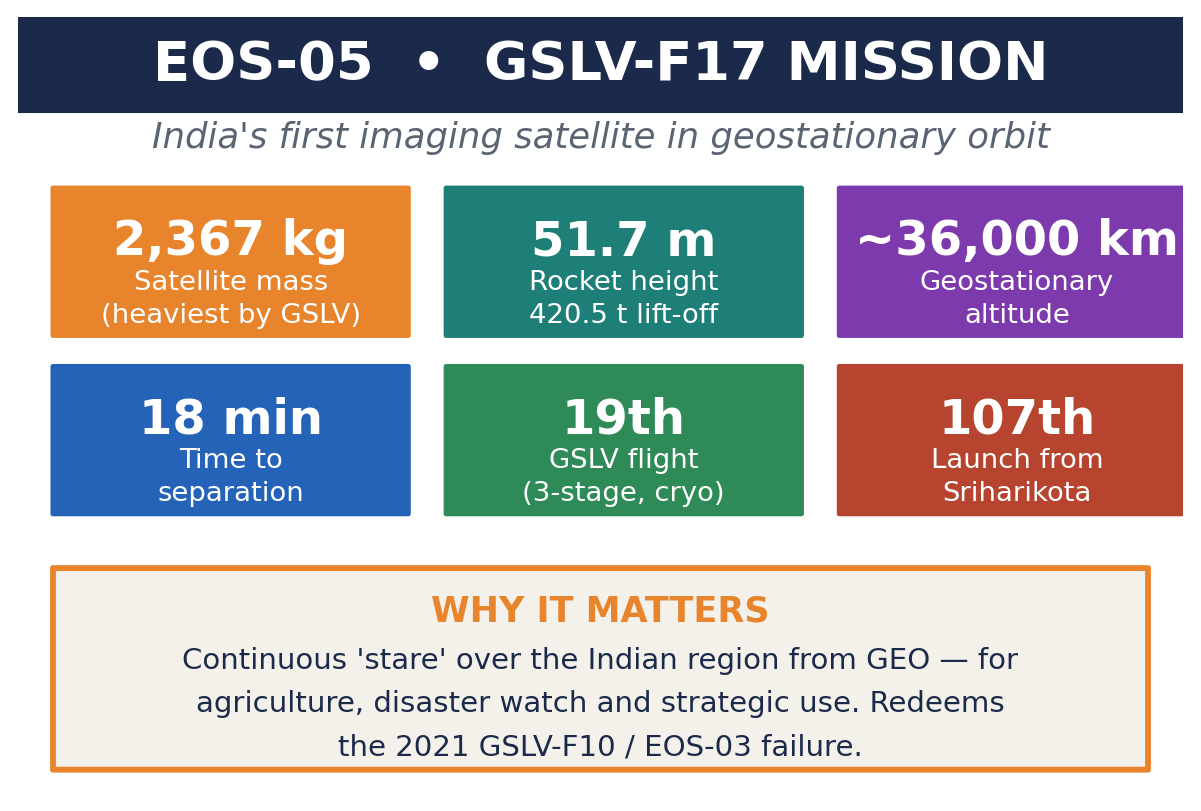
ISRO has placed EOS-05, a 2,367 kg earth-observation satellite, into a sub-geosynchronous transfer orbit aboard GSLV-F17 from Sriharikota. It is India's first dedicated imaging satellite meant to operate from geostationary orbit.
Key facts
GSLV-F17 lifted off at 2:55 am IST from the Satish Dhawan Space Centre, Sriharikota, with separation 18 minutes after launch.
The 51.7 m tall, 420.5 tonne three-stage vehicle used an indigenous cryogenic upper stage; EOS-05 is the heaviest payload ever flown on a GSLV.
The satellite will raise itself to about 36,000 km, where its orbital period matches Earth's rotation — giving a continuous 'stare' over the Indian landmass.
It was the 107th launch from Sriharikota and the 19th GSLV flight, redeeming the 2021 GSLV-F10 / EOS-03 failure.
Imagery will feed agriculture, disaster management and strategic needs; unlike low-earth-orbit satellites, the revisit is continuous rather than periodic.
Way forward
Pair GEO imaging with the low-earth-orbit EOS constellation and NavIC so that flood, cyclone and crop advisories move from daily snapshots to near-real-time watch.
Concept
A geostationary orbit is a circular equatorial orbit at about 35,786 km with a 24-hour period, so the satellite appears fixed over one spot. A Sun-synchronous polar orbit (600-800 km) gives finer resolution but only periodic revisits. GTO is the elliptical transfer orbit used to climb to GEO.
Fact-sheet of the EOS-05 mission showing satellite mass 2,367 kg, rocket height 51.7 m, geostationary altitude about 36,000 km, 18 minutes to separation, 19th GSLV flight and 107th Sriharikota launch. — StudyForGS
2. India Semiconductor Mission 2.0 shifts focus from fabs to equipment, materials and chip IP
SCI-TECHCOMMON: Prelims + Mains GS3
Syllabus linkage
GS-III — Indigenisation of technology, industrial and manufacturing policy. Prelims:ISM outlay, ATMP / OSAT, compound semiconductors, Design-Linked Incentive.
Context
With ten projects worth ₹1.60 lakh crore already cleared in the first phase, the semiconductor mission's second phase moves up the value chain — to equipment, materials and full-stack Indian chip design.
Key facts
ISM 1.0 was approved in December 2021 with a ₹76,000 crore incentive corpus; 10 projects across 6 states had been sanctioned by December 2025.
Approved units span silicon fabs, a silicon-carbide (compound semiconductor) facility, advanced packaging and ATMP/OSAT plants.
ISM 2.0 rests on three pillars: semiconductor equipment and materials made in India, full-stack Indian semiconductor IP, and supply-chain resilience.
Budget 2026-27 provides ₹1,000 crore for ISM 2.0 within an ₹8,000 crore modified programme outlay for the year.
FY27 targets include ₹4,000 crore of fab investment, ₹11,000 crore in ATMP/OSAT, support for 30 design companies and 10 semiconductor IP cores.
Way forward
Anchor demand through public procurement, deepen the VLSI design talent pipeline, and secure critical inputs — high-purity gases, photoresists and rare earths — through friend-shoring.
Concept
ATMP (Assembly, Testing, Marking and Packaging) and OSAT (Outsourced Semiconductor Assembly and Test) form the back-end of chipmaking; a fab is the front-end wafer fabrication plant. Fabless design houses are supported through the Design-Linked Incentive scheme.
3. RBI to drain ₹7 lakh crore as banking liquidity surplus hits a record
The Reserve Bank will conduct a 30-day variable rate reverse repo (VRRR) auction of ₹7 lakh crore on 7 September 2026 to mop up a surplus swollen by a special foreign-currency deposit window.
Key facts
Banking system liquidity surplus stood at about ₹10.32 lakh crore as on 3 September 2026 — a record high.
The auction reverses on 7 October 2026; banks may seek premature or partial reversal through the e-Kuber portal.
The RBI had already absorbed ₹6.02 lakh crore through two VRRR auctions, and ran 32 VRRR operations between August and early September.
Special forex measures mobilised about $136.38 billion by 31 August, of which the FCNR(B) window alone brought in $127.23 billion.
Excess liquidity drags the weighted average call rate below the repo rate, weakening monetary transmission.
Way forward
Calibrate the mix of VRRR, open market sales and CRR management so the operating target stays anchored near the repo rate without choking credit growth.
Concept
Under the Liquidity Adjustment Facility, the Standing Deposit Facility is the floor and the Marginal Standing Facility the ceiling of the corridor, with the repo rate in between. A VRRR is an auction-based absorption of surplus liquidity at market-determined rates.
4. Current account deficit widens to $4.2 billion in Q1 FY27
ECONOMYCOMMON: Prelims + Mains GS3
Syllabus linkage
GS-III — Balance of payments, external sector stability. Prelims: structure of the BoP, invisibles, NRI deposits, CAD thresholds.
Context
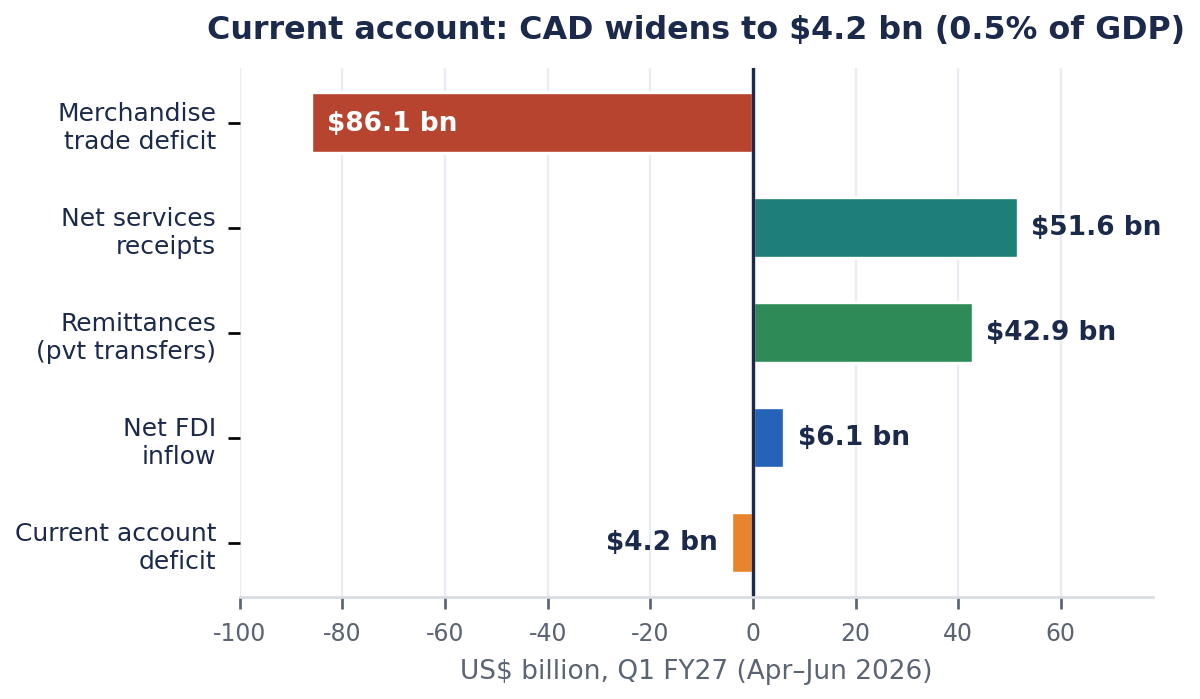
Central bank data put the current account deficit at $4.2 billion, or 0.5% of GDP, in April-June 2026, up from $3.4 billion (0.4% of GDP) a year earlier, as goods imports outran export growth.
Key facts
The merchandise trade deficit widened sharply to $86.1 billion from $68.9 billion a year ago.
Net services receipts rose to $51.6 billion from $47.9 billion, led by computer services, other business services and transport.
Private transfer receipts — largely remittances — jumped to $42.9 billion from $33.2 billion.
Net FDI inflow improved to $6.1 billion against $5.2 billion in the year-ago quarter.
A CAD near 0.5% of GDP stays comfortably below the 2.5-3% band generally treated as the stress threshold for India.
Way forward
Broaden the export basket beyond services, cut import dependence in electronics and energy, and keep the gap financed by stable FDI rather than volatile portfolio flows.
Concept
The current account covers trade in goods and services, primary income and transfers; the capital and financial account covers FDI, FPI, ECBs and NRI deposits. A deficit financed by FDI is considered higher quality than one financed by FPI, which can reverse quickly.
Horizontal bar chart of India's Q1 FY27 balance of payments: merchandise trade deficit $86.1 billion, net services receipts $51.6 billion, remittances $42.9 billion, net FDI $6.1 billion and a current account deficit of $4.2 billion. — StudyForGS
5. Special NIA court convicts all ten accused in the 2013 Jhiram Ghati ambush
POLITYCOMMON: Prelims + Mains GS3
Syllabus linkage
GS-III — Left Wing Extremism, internal security challenges. GS-II — statutory and investigative bodies. Prelims:NIA Act 2008, UAPA, special courts.
Context
A special NIA court in Bastar has held all ten accused guilty in the Jhiram Ghati (Jhiram Valley) Maoist ambush of 2013, thirteen years after the attack. Sentencing is listed for 16 September 2026.
Key facts
The ambush took place on 25 May 2013 in Jhiram Valley, Bastar district, Chhattisgarh, on a convoy returning from a political rally.
29 people were killed, among them Nand Kumar Patel, Mahendra Karma, Vidya Charan Shukla and Uday Mudliyar.
The case moved from state police to the National Investigation Agency, which filed its charge sheet in September 2014; 101 witnesses were examined.
The NIA, created under the NIA Act, 2008, is India's central counter-terror agency and can investigate scheduled offences across states without prior state consent.
LWE violence has contracted to a small cluster of districts, with the government working to a target of ending Maoist violence by 31 March 2026.
Way forward
Speed up trials in special courts, strengthen witness protection, and pair security gains with delivery of forest rights, road connectivity and skilling in the affected belt.
Concept
The Unlawful Activities (Prevention) Act, 1967 permits designation of individuals as terrorists and makes bail harder for scheduled offences. SAMADHAN is the doctrine guiding anti-LWE operations, running from smart leadership and actionable intelligence to choking terror financing.
6. India and China hold their first Corps Commander talks in the eastern sector
IRHIGH-YIELD: Prelims + Mains GS2
Syllabus linkage
GS-II — India and its neighbourhood, bilateral agreements. GS-III — border management. Prelims:LAC sectors, Border Personnel Meeting points, WMCC.
Context
Senior military commanders of India and China met at Wacha-Damai in Arunachal Pradesh — the first Corps Commander-level engagement in the eastern sector, every previous round having been held at Chushul-Moldo in eastern Ladakh.
Key facts
The Indian side was led by Lieutenant General Girish Kalia, commander of 3 Corps.
3 Corps and 4 Corps (Tezpur) together hold responsibility for the LAC in the eastern sector.
The meeting follows the National Security Adviser's visit to China and understandings on maintaining peace and tranquillity along the LAC.
The core difficulty remains differing perceptions of the alignment of the LAC, which is not a delimited boundary.
Way forward
Institutionalise eastern-sector military dialogue alongside the WMCC, resume clarification of the LAC on maps, and keep border infrastructure and the Vibrant Villages push moving in parallel.
Concept
The Line of Actual Control runs about 3,488 km across the western, middle and eastern sectors. Border Personnel Meeting points include Chushul and Daulat Beg Oldi in Ladakh, Nathu La in Sikkim, and Bum La and Kibithu in Arunachal Pradesh. The Working Mechanism for Consultation and Coordination (WMCC), set up in 2012, is the diplomatic channel.
7. UNGA votes 164-1 to 'correct the map'; India backs equal-area projections
IRHIGH-YIELD: Prelims + Mains GS2
Syllabus linkage
GS-II — important international institutions and their mandates. GS-I — geography, map projections. Prelims:Mercator, Equal Earth, Mollweide, UNGA voting.
Context
The UN General Assembly adopted a resolution urging a shift away from the sixteenth-century Mercator projection towards equal-area representations of the world. India voted in favour while pressing for technological and methodological neutrality.
Key facts
The resolution was adopted on 5 September 2026 by 164 votes to 1, with the Equal Earth projection promoted as the alternative.
India's representative argued the text should endorse the equal-area principle rather than any single projection, leaving states free to choose.
India also stressed that its sovereign territory, including Jammu and Kashmir, must be depicted accurately on UN maps.
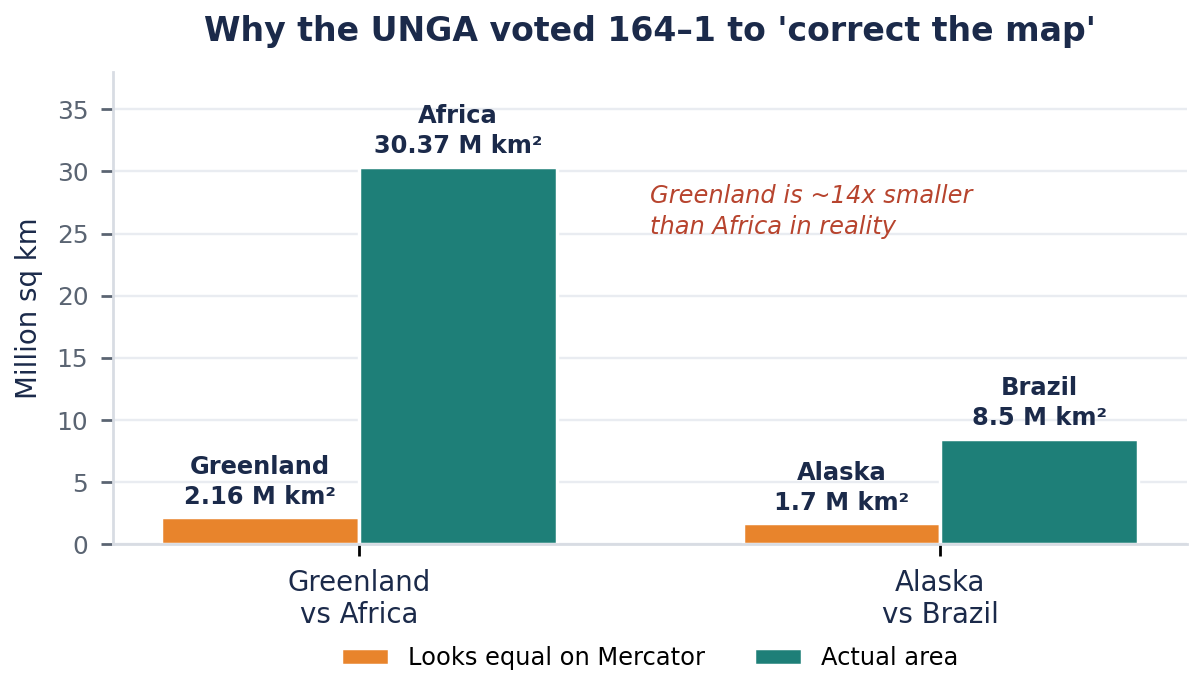
Mercator makes Greenland (2.16 million sq km) look as large as Africa (30.37 million sq km) — a roughly 14-fold error.
Way forward
Adopt equal-area projections in official atlases and school geography, while retaining Mercator for navigation, where its conformal property remains genuinely useful.
Concept
No flat map can preserve area, shape, distance and direction at once. Mercator is conformal — it preserves angles and straight rhumb lines but inflates high latitudes. Equal Earth, Gall-Peters and Mollweide are equal-area: they preserve relative size while distorting shape.
Bar chart contrasting apparent and actual land areas: Greenland 2.16 million sq km against Africa 30.37 million sq km, and Alaska 1.7 million sq km against Brazil 8.5 million sq km. — StudyForGS
8. New Delhi readies for the 18th BRICS Summit on 12-13 September
IRHIGH-YIELD: Prelims + Mains GS2
Syllabus linkage
GS-II — bilateral, regional and global groupings involving India. Prelims: BRICS members and expansion, New Development Bank, Contingent Reserve Arrangement, chairship rotation.
Context
India, which took over the BRICS chairship on 1 January 2026, hosts the eighteenth summit at Bharat Mandapam, New Delhi on 12 and 13 September, with security rehearsals and an investors' track already under way.
Key facts
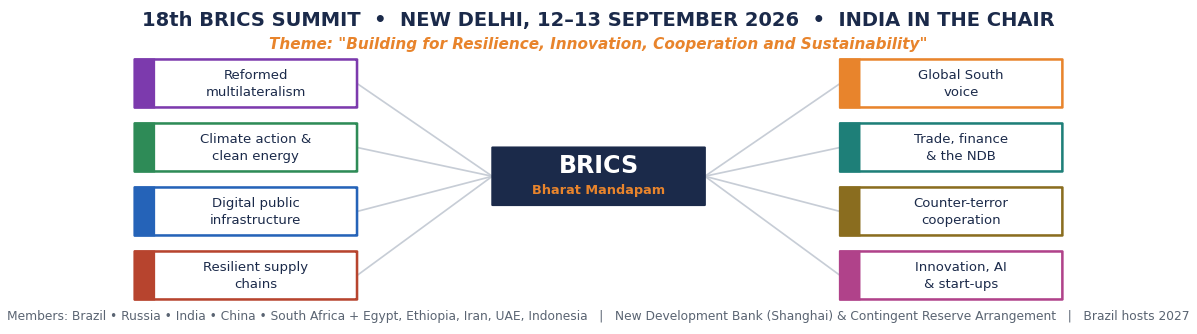
Theme of India's chairship: 'Building for Resilience, Innovation, Cooperation and Sustainability'.
Priorities include climate action, clean energy, digital public infrastructure, innovation, supply-chain resilience and reformed multilateralism.
An inaugural iBRICS investor summit runs alongside, drawing more than 500 investors and finance leaders.
The grouping now spans Brazil, Russia, India, China and South Africa along with Egypt, Ethiopia, Iran, the UAE and Indonesia, besides a set of partner countries.
Way forward
Use the chairship to push quota and voice reform at the IMF and World Bank, expand local-currency settlement, and position BRICS as a bridge for the Global South rather than a bloc against the West.
Concept
The New Development Bank, headquartered in Shanghai, and the Contingent Reserve Arrangement, a $100 billion currency-swap safety net, are the two financial pillars of BRICS. Decisions are taken by consensus and the chairship rotates annually.
Mind-map of the 18th BRICS Summit in New Delhi showing the theme and eight priority spokes: reformed multilateralism, climate action, digital public infrastructure, resilient supply chains, Global South voice, trade and the NDB, counter-terror cooperation and innovation. — StudyForGS
9. Vibrant Villages Programme reframes the border hamlet as the 'first village'
SOCIETYHIGH-YIELD: Prelims + Mains GS2
Syllabus linkage
GS-II — government policies and interventions for development. GS-III — border area management. Prelims: VVP-I vs VVP-II, funding pattern, border lengths.
Context
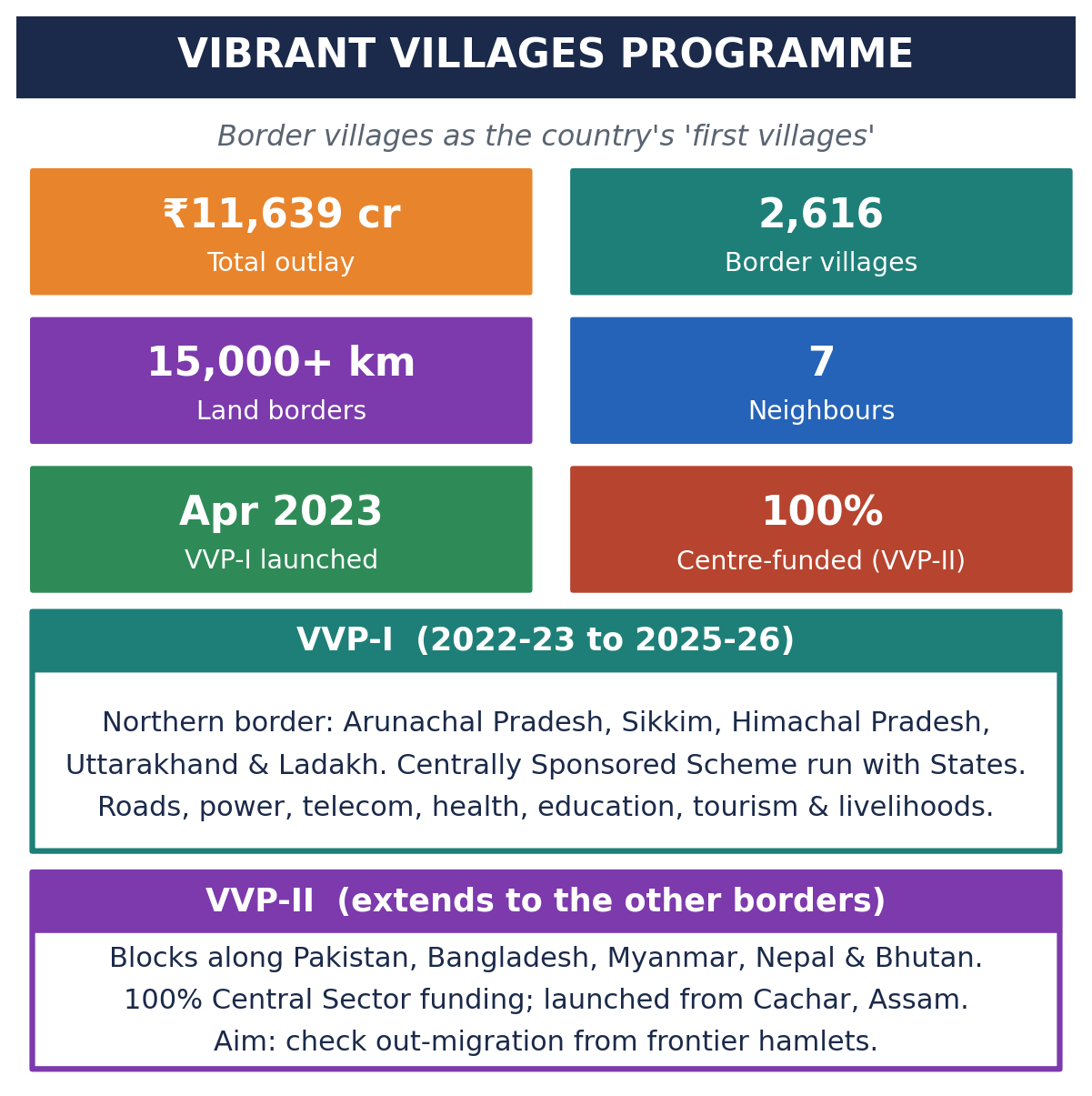
An official backgrounder places a combined ₹11,639 crore behind 2,616 border villages under the Vibrant Villages Programme, whose central idea is to treat frontier settlements as the country's first villages rather than its last outposts.
Key facts
India shares more than 15,000 km of land border with seven neighbours; the longest stretches are with Bangladesh (4,096.7 km), China (3,488 km) and Pakistan (3,323 km).
VVP-I, launched in April 2023, is a Centrally Sponsored Scheme covering northern border villages in Arunachal Pradesh, Sikkim, Himachal Pradesh, Uttarakhand and Ladakh.
VVP-II extends coverage to blocks along the other international borders and is a Central Sector Scheme funded fully by the Union; it was launched from Cachar, Assam.
Interventions cover all-weather road connectivity, electricity including renewables, telecom, housing, health, education, tourism circuits and cooperative livelihoods.
Way forward
Converge VVP with border road works, homestay tourism and mobile connectivity targets, and use village-level saturation dashboards so that delivery, not sanction, becomes the metric.
Concept
A Centrally Sponsored Scheme is cost-shared with States and implemented by them; a Central Sector Scheme is funded and implemented entirely by the Union. Depopulated border villages weaken both the local economy and the first line of surveillance — the idea behind treating residents as 'eyes and ears' of the border.
Vibrant Villages Programme fact panel: ₹11,639 crore outlay, 2,616 border villages, 15,000-plus km of land borders, seven neighbours, VVP-I launched April 2023 and VVP-II fully Centre-funded, with a comparison of the two phases. — StudyForGS
10. Vulture conservation moves 'from crisis to recovery' on Vulture Awareness Day
ENVIRONMENTCOMMON: Prelims + Mains GS3
Syllabus linkage
GS-III — conservation and biodiversity. Prelims: vulture species and IUCN status, diclofenac, Vulture Safe Zones, Schedule I of the Wild Life (Protection) Act.
Context
International Vulture Awareness Day was marked with a national workshop at Panchkula, Haryana, themed 'From Crisis to Recovery — Conserving India's Vultures', built around Vulture Safe Zones, scientific captive breeding and stronger technical capacity.
Key facts
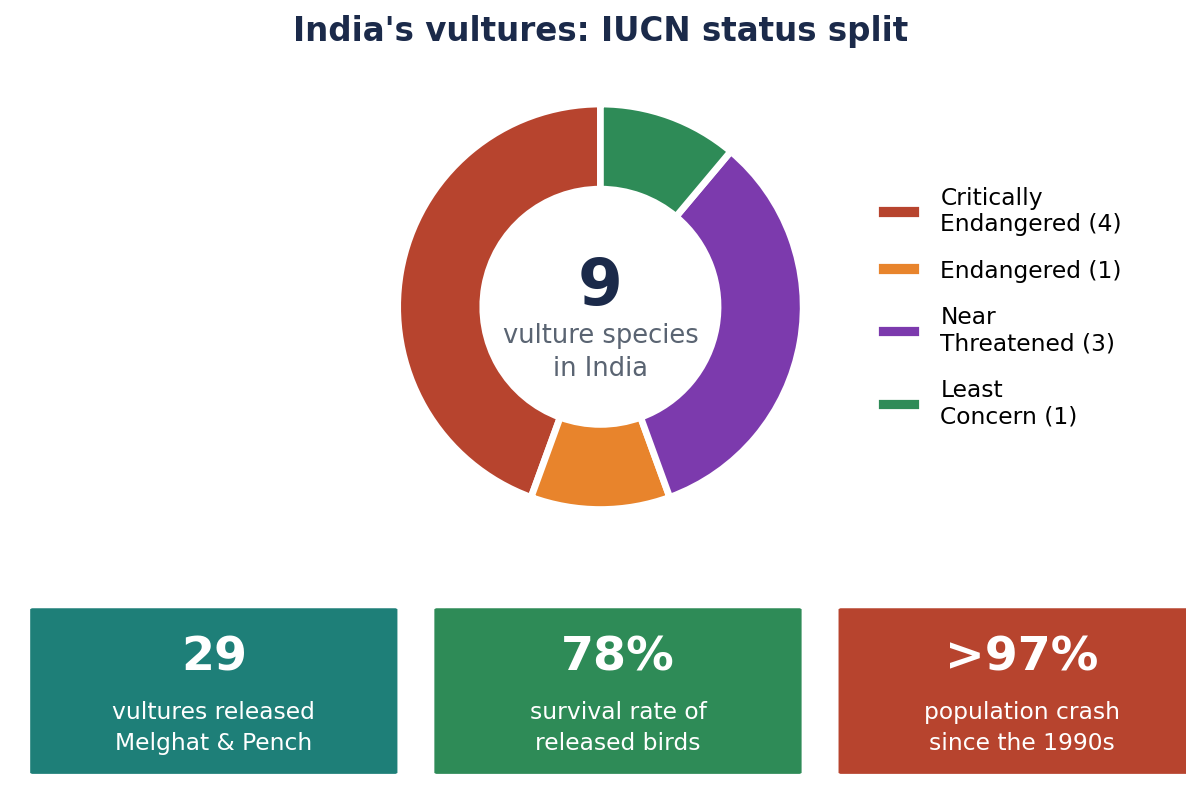
India hosts nine vulture species; four are Critically Endangered — White-rumped, Indian (Long-billed), Slender-billed and Red-headed — and the Egyptian Vulture is Endangered.
Gyps vulture populations crashed by more than 97% from the 1990s, driven by the veterinary anti-inflammatory diclofenac in cattle carcasses; its veterinary use was banned in 2006.
Melghat and Pench tiger reserves have emerged as the most successful reintroduction sites — 29 birds released between December 2025 and January 2026 with a 78% survival rate.
A Vulture Safe Zone is a landscape of roughly 100 km radius around a colony kept free of vulture-toxic drugs — diclofenac, aceclofenac, ketoprofen, nimesulide; meloxicam is the safe substitute.
Way forward
Extend the safe-zone network around conservation breeding centres, tighten enforcement against toxic NSAIDs in veterinary pharmacies, and track released birds with satellite tags.
Concept
Vultures are listed in Schedule I of the Wild Life (Protection) Act, 1972. They are obligate scavengers and a keystone species; their collapse set off a trophic cascade of feral dog population growth. Recovery rests on three legs — conservation breeding, safe zones free of toxic NSAIDs, and monitored release into prey-rich, inviolate habitat.
Donut chart of the IUCN status of India's nine vulture species — four Critically Endangered, one Endangered, three Near Threatened and one Least Concern — with tiles for 29 vultures released, 78% survival rate and a population crash of over 97%. — StudyForGS
11. India's Vinaya Prakash Singh re-elected Secretary-General of the Asian-Pacific Postal Union
REPORTMODERATE: Prelims focus
Syllabus linkage
GS-II — international organisations and India's role in them. Prelims:APPU and UPU — year, headquarters, membership, restricted unions.
Context
Dr Vinaya Prakash Singh, a 1988-batch Indian Postal Service officer, has been re-elected unopposed as Secretary-General of the Asian-Pacific Postal Union (APPU) for a second consecutive four-year term, covering 2027-2030.
Key facts
The APPU is a Restricted Union of the Universal Postal Union under Article 8 of the UPU Constitution, and the only such body in the Asia-Pacific.
It traces its origins to 1961 and took its present form on 1 July 1982; it is headquartered in Bangkok, Thailand, with 32 member countries.
The UPU, established in 1874 and headquartered in Berne, Switzerland, is the specialised agency of the United Nations for postal cooperation — the second-oldest international organisation.
India has held the APPU Secretary-General's office since 2022, the first time an Indian occupies the post.
Way forward
Use the position to export India's postal digital stack — address digitisation, parcel tracking and post office banking — across the Asia-Pacific.
Concept
Restricted unions are regional groupings permitted under the UPU Constitution to deepen cooperation among members of a region without diluting the universal service obligation. Such leadership posts count towards a country's soft power and its presence in technical multilateralism.
Data point of the day
7.8%
India's real GDP growth, Q1 FY27 (April-June 2026) Against the central bank's 7% projection. Manufacturing grew 9.2% (from 8.3%) and services 10% (from 8%), while mining contracted 2.4% and agriculture eased to 3.6%. Real gross fixed capital formation rose 11.9%, lifting the investment rate to 34.3% of GDP from 31.4%. Nominal GDP grew 10.3%. Inflation is projected at 5.9% for October-December 2026.
Prelims rapid-fire
The IAF's Sarang helicopter display team, flying the indigenous Dhruv ALH, is in Egypt for the El Alamein International Airshow (8-10 September 2026).
GSLV-F17 was the 19th GSLV flight and the 107th launch from Sriharikota.
Meloxicam is the vulture-safe alternative to diclofenac, whose veterinary use India banned in 2006.
Sentencing in the Jhiram Ghati case is fixed for 16 September 2026 by the special NIA court at Jagdalpur, Bastar.
The BRICS Contingent Reserve Arrangement is a $100 billion currency-swap net; the New Development Bank sits in Shanghai.
Equal Earth, Gall-Peters and Mollweide are equal-area projections; Mercator is conformal and used for navigation.
Practice MCQs — UPSC Prelims pattern
Q1. With reference to the recently launched EOS-05 mission, consider the following statements:
1. It was placed in orbit by the GSLV, which uses an indigenous cryogenic upper stage.
2. It is India's first imaging satellite intended for a geostationary orbit.
3. A geostationary orbit lies at an altitude of about 800 km above the equator.
Which of the statements given above are correct?
1 and 2 only
2 and 3 only
1 and 3 only
1, 2 and 3
Show answer
Answer: a Statements 1 and 2 are correct. Statement 3 is wrong — a geostationary orbit lies at roughly 35,786 km above the equator; 800 km is typical of a Sun-synchronous polar orbit.
Q2. Consider the following pairs of map projections and their properties:
1. Mercator — conformal, preserves angles
2. Equal Earth — equal-area, preserves relative size
3. Mollweide — equal-area
How many of the pairs given above are correctly matched?
Only one
Only two
All three
None
Show answer
Answer: c All three pairs are correctly matched. Mercator preserves angles and is useful for navigation but inflates high-latitude landmasses; Equal Earth and Mollweide are equal-area projections that preserve relative size while distorting shape.
Mains practice question
Q. "Border villages are not the last settlements of the country but its first." Examine how the Vibrant Villages Programme seeks to translate this idea into policy, and assess the challenges in its implementation. (250 words, 15 marks)
Hint / approach
Open with out-migration and the security-development link. Contrast VVP-I (Centrally Sponsored, northern border, April 2023) with VVP-II (Central Sector, other borders), anchoring on ₹11,639 crore and 2,616 villages. Challenges: terrain and short working seasons, land acquisition, thin absorptive capacity of small local bodies, and connectivity in the eastern sector amid LAC frictions. Close by linking to today's eastern-sector Corps Commander talks and the case for convergence with border infrastructure.
📌 One-line revision: EOS-05 in GEO on GSLV-F17 | GDP 7.8% in Q1 FY27 | CAD $4.2 bn (0.5% of GDP) | ₹11,639 cr for 2,616 border villages | UNGA 164-1 on equal-area maps | BRICS in New Delhi, 12-13 September