EOS-05 becomes India's first imaging satellite in geosynchronous orbit; August GST crosses ₹1.99 lakh crore; 31-member JPC to scrutinise the FCRA Amendment Bill
Saturday, 5 September 2026 · IST · National & International · 9 items · 3 MCQs
ISRO's GSLV-F17 placed EOS-05 in orbit, giving India round-the-clock hyperspectral eyes on its own landmass. On the economy, gross GST touched a record ₹1,99,853 crore in August with refunds up nearly 68 per cent, while the services PMI improved to 54.1. In governance, a 31-member Joint Parliamentary Committee was constituted on the FCRA (Amendment) Bill, 2026, and the President conferred the National Teachers' Awards on Teachers' Day.
Today at a glance — things to remember
EOS-05 launched on GSLV-F17 — India's first imaging satellite from geosynchronous orbit.
August 2026 gross GST at a record ₹1,99,853 crore, up 14.8% year-on-year.
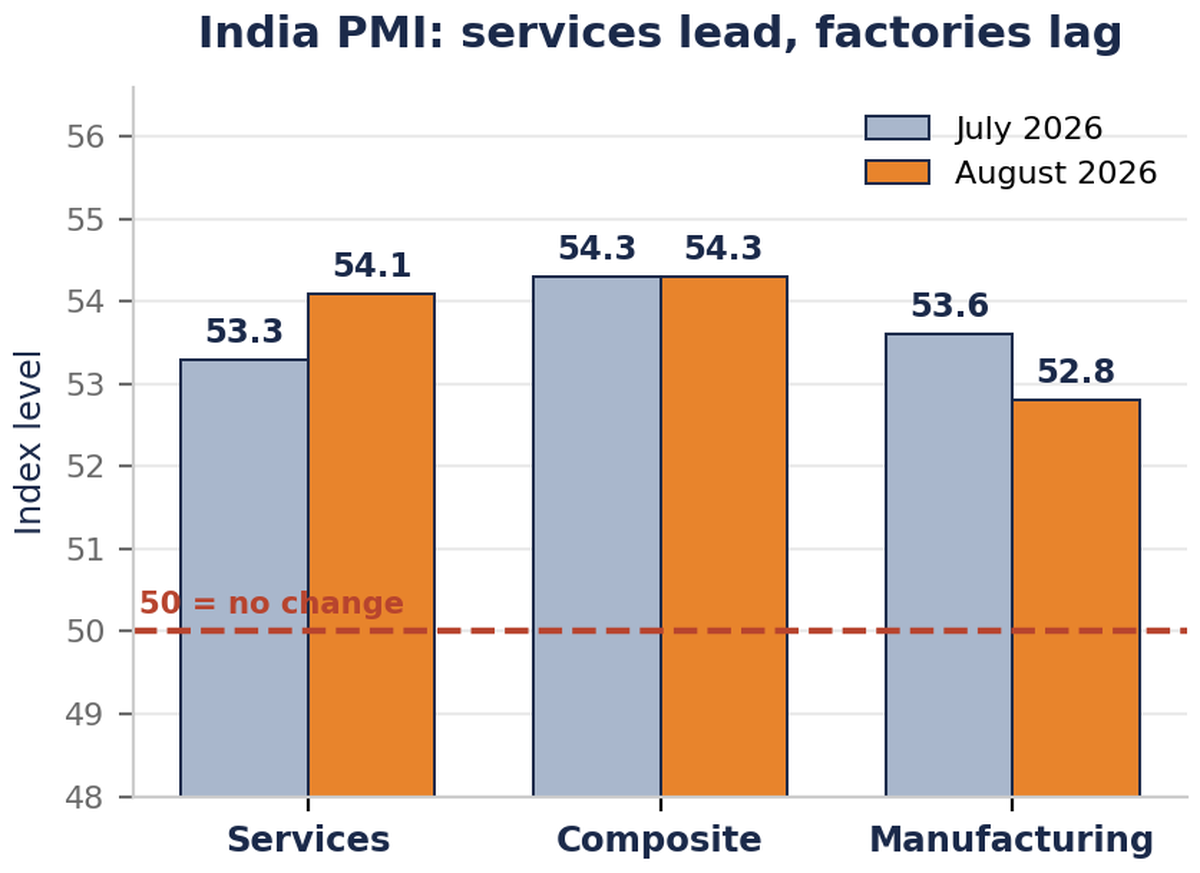
Services PMI improves to 54.1; composite output index steady at 54.3.
31-member Joint Parliamentary Committee constituted on the FCRA (Amendment) Bill, 2026.
President confers National Teachers' Awards on 69 educators on Teachers' Day.
RAKSHA — India's first 10-year defence diplomacy roadmap — released.
BIO-NIVESH launched to channel private capital into biotechnology start-ups.
IAF successfully tests the indigenous Khagantak-243 long-range glide bomb.
India and Germany sign a Joint Declaration on wetland conservation at the 4th IGEF.
Odisha signs disaster-risk pacts for hazard mapping across 30 districts.
Detailed notes
1. EOS-05 Launched: India's First Imaging Satellite in Geosynchronous Orbit
SCI-TECHCOMMON: Prelims + Mains GS3
Syllabus linkage
GS Paper III — Awareness in Space; Achievements of Indians in Sci-Tech; Disaster Management. Prelims: GSLV vs PSLV vs LVM3, GTO/Sub-GTO, hyperspectral vs multispectral imaging, geosynchronous vs geostationary orbit.
Context
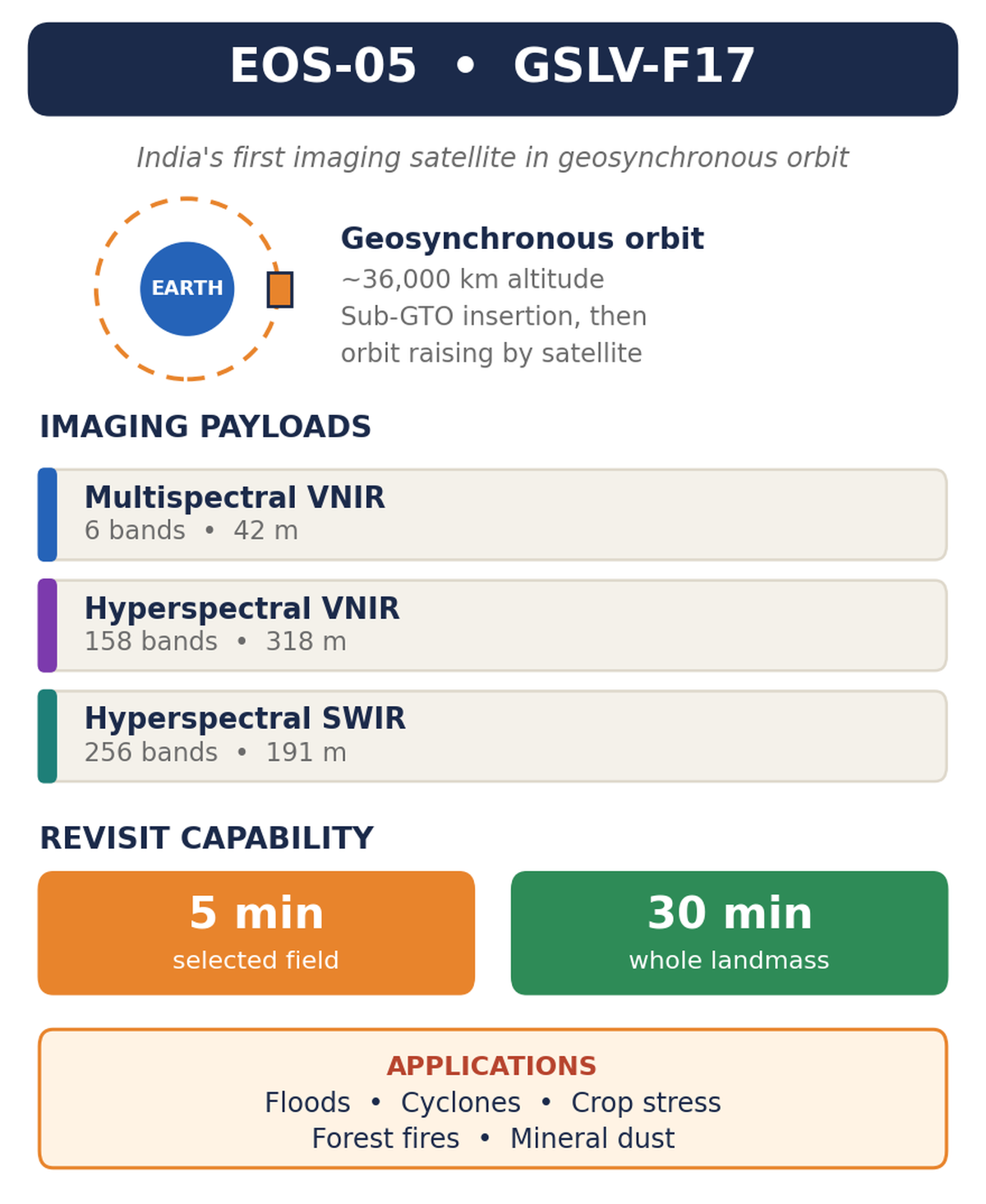
ISRO placed the Earth-observation satellite EOS-05 into a Sub-Geosynchronous Transfer Orbit (Sub-GTO) using GSLV-F17 from the Second Launch Pad, Satish Dhawan Space Centre, Sriharikota on 4 September 2026. It is billed as India's first-ever imaging satellite operating from a geosynchronous orbit.
Key facts
19th flight of the GSLV, flown with a 4-metre diameter ogive composite payload fairing; the vehicle is nicknamed the 'Naughty Boy' for its patchy early record.
EOS-05 carries a multispectral VNIR imager (6 bands, 42 m resolution), a hyperspectral VNIR sensor (158 bands, 318 m) and a hyperspectral SWIR sensor (256 bands, 191 m).
Designed to image a selected field every 5 minutes and the entire Indian landmass every 30 minutes at 42 m resolution under cloud-free conditions.
From a geosynchronous perch (~36,000 km) it gives persistent, near-real-time coverage — unlike sun-synchronous LEO satellites that revisit only once in days.
Way forward
Fold near-real-time EOS-05 feeds into NDMA/SDMA early-warning chains and the Bhuvan platform, and pair them with AI-based change detection so that disaster response moves from reactive relief to anticipatory action.
Concept
Geosynchronous orbit: period equals one sidereal day (~23h 56m); geostationary is the special case with 0° inclination so the satellite appears fixed. Hyperspectral imaging captures hundreds of narrow contiguous bands, allowing chemical/material 'fingerprinting'; multispectral uses a few broad bands. Sub-GTO is a lower-energy transfer orbit from which the satellite raises itself using onboard propulsion.
Fact-sheet schematic of EOS-05 showing launch vehicle, orbit, three imaging payloads with band counts and resolutions, and revisit times. — StudyForGS
2. Services PMI Rises to 54.1; Composite Output Index Steady at 54.3
ECONOMYCOMMON: Prelims + Mains GS3
Syllabus linkage
GS Paper III — Indian Economy: growth, employment, inflation. Prelims: meaning of a diffusion index, 50-mark threshold, difference between PMI and IIP/GVA.
Context
India's services Purchasing Managers' Index (PMI) improved to 54.1 in August 2026 from 53.3 in July, while the composite output index held at 54.3. The manufacturing PMI slipped to 52.8, a five-year low, making services the sole engine of private-sector momentum.
Key facts
A PMI reading above 50 signals expansion; below 50 signals contraction. It is a diffusion index built from a monthly survey of purchasing managers.
Services PMI at 54.1 remains below its long-run average of 54.5 — growth is positive but sub-trend.
Job creation hit a 15-month high, with about 11% of surveyed firms adding staff; aggregate employment grew at the fastest pace in 14 months.
Output prices rose at the fastest pace since March as firms passed on higher costs of digital platforms, electricity, labour and marketing.
Way forward
With manufacturing at a five-year low, sustaining growth needs demand-side support and faster input-cost relief so that services-led job creation is not eroded by cost-push price pressure.
Concept
PMI is a leading indicator (survey-based, released within days of month-end); IIP and GVA are lagging, production-based. A composite PMI weights manufacturing and services output. Cost-push inflation arises from rising input costs rather than excess demand — relevant to RBI's flexible inflation-targeting framework (CPI target 4% ± 2%).
Bar chart comparing India's services, composite and manufacturing PMI for July and August 2026 against the 50-point no-change line. — StudyForGS
3. BIO-NIVESH Launched to Channel Private Capital into Biotech Start-ups
SCI-TECHCOMMON: Prelims + Mains GS3
Syllabus linkage
GS Paper III — Science & Technology: biotechnology; Indian economy: investment models, start-up ecosystem. Prelims:BIRAC, BioE3 Policy, RDI Fund.
Context
Union Minister of State for Science & Technology Dr Jitendra Singh launched BIO-NIVESH, a structured engagement platform that connects biotechnology and deep-tech start-ups with private investors, at a joint round table in New Delhi on 3 September 2026.
Key facts
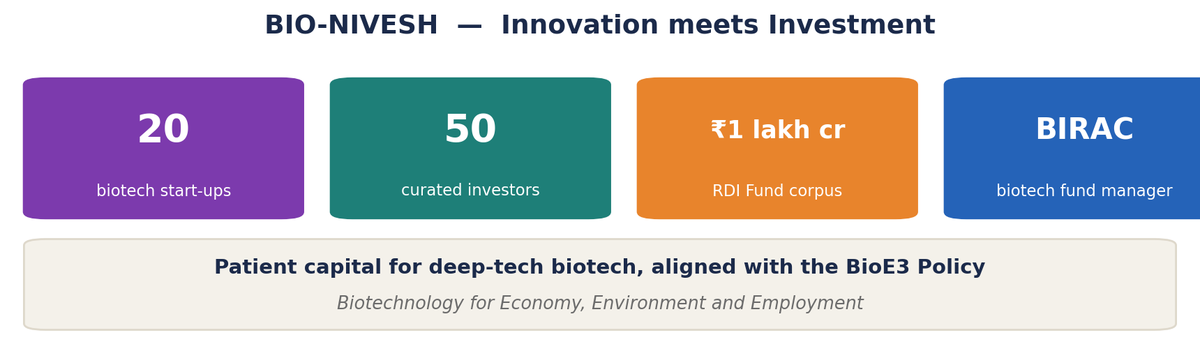
The inaugural edition brought together 20 high-potential biotech/deep-tech start-ups and about 50 curated investors.
BIRAC (Biotechnology Industry Research Assistance Council) acts as the Second-Level Fund Manager for biotechnology under the ₹1 lakh crore Research, Development and Innovation (RDI) Fund.
The RDI Fund is designed to supply long-term 'patient capital' for strategic, high-risk projects that conventional venture capital avoids.
BIO-NIVESH will be a recurring platform, with subsequent editions planned in other cities to link regional biotech clusters to capital.
Way forward
Pair BIO-NIVESH with faster regulatory clearances and public procurement guarantees so that the 'valley of death' between lab proof-of-concept and commercial scale-up is bridged, in line with the BioE3 vision of a bio-manufacturing-led economy.
Concept
BioE3 Policy — 'Biotechnology for Economy, Environment and Employment' — targets high-performance bio-manufacturing and a bio-based circular economy. Patient capital tolerates long gestation. Deep tech denotes ventures built on substantive scientific or engineering advances rather than business-model innovation.
Row of statistic tiles for BIO-NIVESH showing 20 start-ups, 50 investors, ₹1 lakh crore RDI Fund and BIRAC's fund-manager role. — StudyForGS
GS Paper III — Internal Security: defence technology, indigenisation. Prelims: stand-off weapons, glide bomb vs cruise missile, iDEX, Make-in-India in defence.
Context
The Indian Air Force completed a successful drop trial of the Khagantak-243, an indigenous long-range precision glide bomb in the 300-kg class with a reported range of 140 km and above, developed with Bharat Electronics Ltd (BEL) and JSR Dynamics.
Key facts
A glide bomb is an unpowered munition released from an aircraft that glides to the target using deployable wings and a guidance kit — no rocket motor.
Range of 140+ km places it firmly in the stand-off class, letting aircraft strike without entering enemy air-defence envelopes.
Represents private-sector + PSU + armed-forces co-development, the model pushed under Make-in-India and iDEX.
Officials cautioned that the trial is one developmental step, not induction into operational service.
Way forward
Move quickly from developmental trials to user trials and series production orders, and build a domestic supply chain for seekers, INS/GPS-aided guidance kits and airframes to cut import dependence in precision munitions.
Concept
Stand-off weapon: launched at a distance sufficient to avoid defensive fire. Glide bomb vs cruise missile: the glide bomb is unpowered and cheaper, the cruise missile is self-propelled with longer reach. India's defence indigenisation rests on the positive indigenisation lists, Defence Acquisition Procedure, and defence industrial corridors in Uttar Pradesh and Tamil Nadu.
5. GeM and Textiles Committee Sign MoU for a 'Waste-to-Value-to-Market' Ecosystem
ECONOMYCOMMON: Prelims + Mains GS3
Syllabus linkage
GS Paper III — Indian economy: MSMEs, circular economy, government procurement. GS Paper II — e-governance. Prelims:GeM, Textiles Committee, EPR.
Context
The Government e-Marketplace (GeM) and the Textiles Committee signed a Memorandum of Understanding to build a 'Waste-to-Value-to-Market' ecosystem for textile waste, using a hub-and-spoke model to plug MSMEs, artisans and recyclers into public procurement.
Key facts
Signed by Ajit B. Chavan (CEO, GeM) and Kartikay Dhanda (Secretary, Textiles Committee).
GeM is the national public procurement portal under the Ministry of Commerce and Industry, mandatory for central government buying.
The Textiles Committee is a statutory body under the Textiles Committee Act, 1963, tasked with quality assurance of textiles.
Creates guaranteed demand for recycled textile products — the key missing link in India's circular-economy value chains.
Way forward
Extend the model with Extended Producer Responsibility (EPR) for textiles, traceability standards for recycled content, and preferential procurement weightage so that circularity becomes commercially self-sustaining.
Concept
Circular economy replaces 'take-make-dispose' with reduce-reuse-recycle-recover loops. EPR places post-consumer waste responsibility on producers. Public procurement as industrial policy — government demand used to seed markets — also underlies Make in India and MSE procurement targets under the Public Procurement Policy.
6. President Confers National Teachers' Awards on 69 Educators
SOCIETYCOMMON: Prelims + Mains GS2
Syllabus linkage
GS Paper II — Issues relating to development and management of Education; government policies and interventions. Prelims:Teachers' Day, Dr S. Radhakrishnan, NEP 2020 teacher provisions.
Context
On Teachers' Day, 5 September 2026, President Droupadi Murmu conferred the National Teachers' Awards in New Delhi on 69 educators — 48 school teachers and 21 from higher education and polytechnics. The day marks the birth anniversary of Dr Sarvepalli Radhakrishnan, India's first Vice-President and second President.
Key facts
The 48 school teachers were drawn from 27 States, 7 Union Territories and 6 Central Government organisations.
The higher-education set covered 12 faculty from central institutions, 5 from State universities (3 government, 2 private) and 4 from polytechnics.
Selection follows a three-tier online, self-nomination based process — district, State/organisation and national jury — designed to remove discretion.
The President urged teachers to update knowledge continuously, embrace technology and build classrooms where students question, explore and think independently.
Way forward
Institutionalise peer learning from awardees through NISHTHA-style training and the National Professional Standards for Teachers (NPST) envisaged in NEP 2020, so recognition translates into system-wide pedagogic change.
Concept
NEP 2020 on teachers: merit-based recruitment, 4-year Integrated B.Ed. by 2030 as the minimum qualification, NPST to be developed by the National Council for Teacher Education (NCTE), and continuous professional development of 50 hours a year. Article 21A and the RTE Act, 2009 provide the constitutional and statutory backdrop.
7. 31-Member Joint Parliamentary Committee Constituted on the FCRA (Amendment) Bill, 2026
POLITYCOMMON: Prelims + Mains GS2
Syllabus linkage
GS Paper II — Parliament and State legislatures: structure, functioning, conduct of business; role of civil society and NGOs. Prelims:Joint Committee vs Select Committee vs Standing Committee, FCRA 2010.
Context
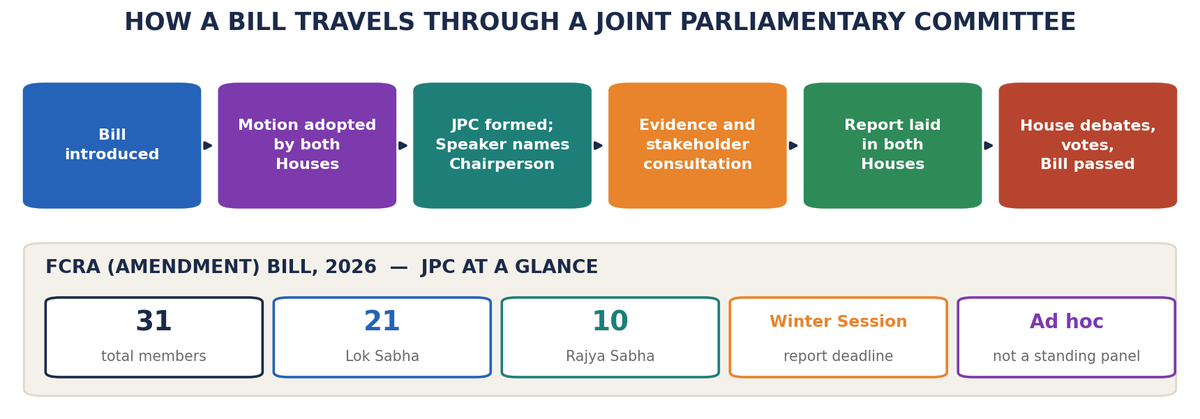
A 31-member Joint Parliamentary Committee (JPC) has been constituted to examine the Foreign Contribution (Regulation) Amendment Bill, 2026, with BJP MP Dr Sanjay Jaiswal as Chairperson. The Bill regulates foreign funding of associations and individuals in India.
Key facts
Composition: 21 members from the Lok Sabha and 10 from the Rajya Sabha, reflecting the ratio of strength between the Houses.
The Committee must submit its report by the last day of the Winter Session (November–December 2026).
The parent law is the Foreign Contribution (Regulation) Act, 2010, administered by the Ministry of Home Affairs; it was last substantially amended in 2020.
Core tension: national security and transparency in foreign funding versus the freedom of association under Article 19(1)(c) and the space for civil society.
Way forward
The Committee should seek wide stakeholder consultation, and any tightening of rules must satisfy the tests of reasonableness, proportionality and procedural fairness so that legitimate development and humanitarian work is not chilled.
Concept
Types of committees: Standing (permanent, e.g. Department-Related Standing Committees, PAC, Estimates, Public Undertakings) and Ad hoc (Select Committee — one House; Joint Committee — both Houses). Committees are the 'mini-legislatures' that compensate for limited floor time. Article 19(1)(c) guarantees freedom of association, subject to reasonable restrictions under Article 19(4) on sovereignty, integrity and public order.
Flowchart of how a Bill travels through a Joint Parliamentary Committee, from introduction to report and passage, with the FCRA Bill's composition and deadline highlighted. — StudyForGS
8. 'RAKSHA': India Unveils a 10-Year Defence Diplomacy Roadmap
IRCOMMON: Prelims + Mains GS2
Syllabus linkage
GS Paper II — India and its neighbourhood; bilateral and regional groupings; effect of policies of developed countries. GS Paper III — defence exports. Prelims: Net Security Provider, IOR initiatives.
Context
Defence Minister Rajnath Singh released RAKSHA, India's first consolidated 10-year defence diplomacy document, in New Delhi on 3 September 2026. It aligns national security objectives with proactive international cooperation.
Key facts
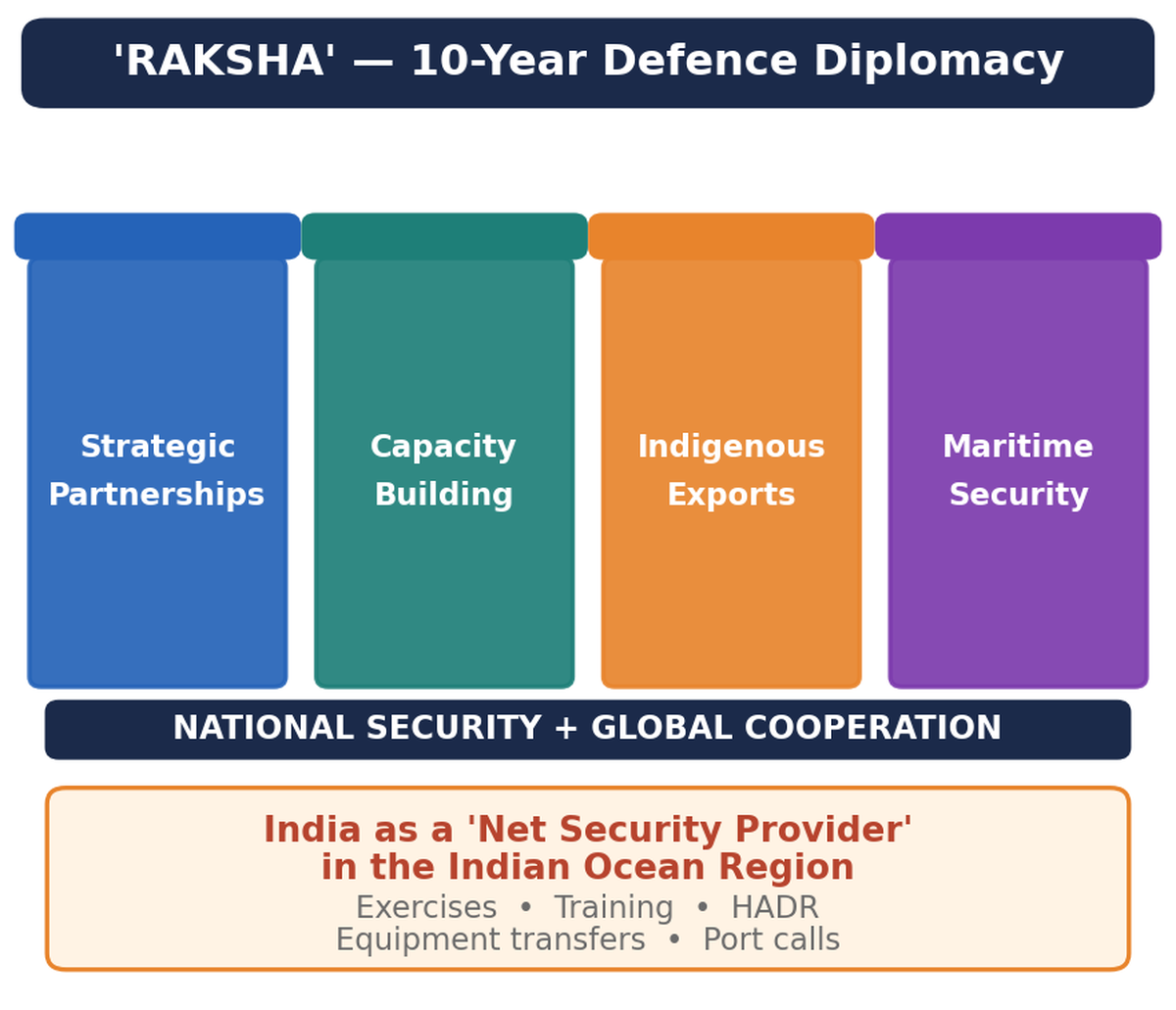
Built on four pillars: Strategic Partnerships, Capacity Building, Indigenous Defence Exports, and Maritime Security.
Capacity building covers joint exercises, training slots for friendly foreign countries and knowledge-sharing.
Positions India as a 'Net Security Provider' in the Indian Ocean Region (IOR) and as an anchor of a rules-based order.
Frames defence exports as an instrument of diplomacy, not merely commerce — exports create long-term strategic dependencies and goodwill.
Way forward
Success depends on delivery capacity — dependable export timelines, lifecycle support for partner militaries, and closer MoD–MEA coordination through defence attachés so that diplomacy and industry pull in the same direction.
Concept
Defence diplomacy is the peacetime use of armed forces and defence assets — exercises, port calls, training, HADR, equipment transfers — to build influence. Net Security Provider: a state that supplies public security goods (anti-piracy, HADR, maritime domain awareness) beyond its borders. Related IOR frameworks: SAGAR/MAHASAGAR vision, IONS, Indian Ocean Rim Association (IORA), Colombo Security Conclave.
Four-pillar diagram of the RAKSHA defence diplomacy framework showing strategic partnerships, capacity building, indigenous exports and maritime security. — StudyForGS
9. India and Germany Sign Joint Declaration on Wetland Conservation
ENVIRONMENTCOMMON: Prelims + Mains GS3
Syllabus linkage
GS Paper III — Conservation, environmental pollution and degradation. GS Paper II — bilateral agreements. Prelims:Ramsar Convention, Montreux Record, Wetlands (Conservation and Management) Rules, 2017.
Context
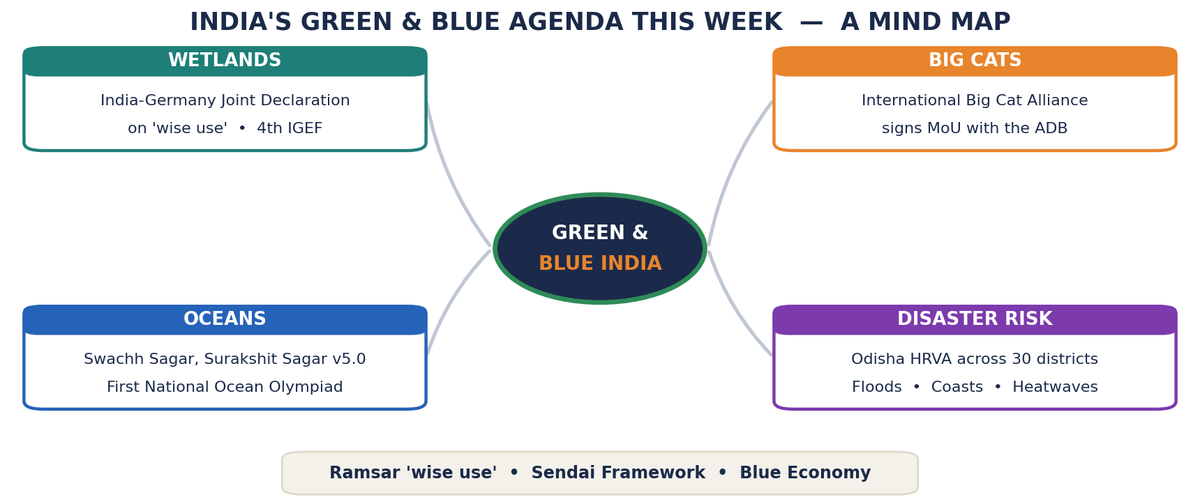
At the 4th Indo-German Environment Forum (IGEF), Union Environment Minister Bhupender Yadav and German Federal Environment Minister Carsten Schneider signed a Joint Declaration of Intent on the conservation and wise use of wetlands of international importance, alongside talks on carbon markets.
Key facts
Focus areas: scientific cooperation, knowledge-sharing on wetland management, climate adaptation, biodiversity conservation and joint projects.
The IGEF has been the bilateral environmental policy platform since 2008; this is its fourth edition.
'Wise use' is the operative principle of the Ramsar Convention on Wetlands (1971, Ramsar, Iran), which India joined in 1982.
India has the largest network of Ramsar sites in Asia; wetlands act as carbon sinks, flood buffers, groundwater rechargers and biodiversity refugia.
Way forward
Convert declarations into site-level management plans, strengthen State Wetland Authorities under the Wetlands Rules, 2017, and mobilise blended and biodiversity finance so that conservation is funded beyond project cycles.
Concept
Ramsar Convention (1971) — intergovernmental treaty for wetland conservation and wise use; the Montreux Record lists Ramsar sites facing ecological change (India: Keoladeo and Loktak). Domestic law: Wetlands (Conservation and Management) Rules, 2017, plus missions such as Amrit Dharohar. Wetlands are among the most productive ecosystems on Earth.
Mind-map of India's green and blue diplomacy of the week, linking the wetlands declaration with ocean cleanliness, tiger-landscape finance and district-level disaster risk work. — StudyForGS
Data point of the day
₹1,99,853 crore
Gross GST Collection — August 2026 Up 14.8% year-on-year from ₹1,74,116 crore — a record for the month. Net collections after refunds stood at ₹1,68,057 crore (+8.3%) because refunds surged 67.9% to ₹31,795 crore. Imports (+29.0%) far outpaced domestic revenue (+9.3%). Component-wise: CGST ₹38,413 cr, SGST ₹46,316 cr, IGST ₹1,15,124 cr. For April–August 2026, gross collections reached ₹10,42,757 crore (+11.0%). Exam angle: GST is a destination-based, multi-stage, value-added tax; the GST Council (Article 279A) is the recommendatory federal body — Centre holds one-third of the weighted votes, all States together two-thirds, and decisions need a three-fourths majority of members present and voting.
Prelims rapid-fire
EOS-05 launch vehicle — GSLV-F17, the 19th flight of the GSLV, from the Second Launch Pad, Sriharikota.
FCRA JPC head — Dr Sanjay Jaiswal; 31 members — 21 Lok Sabha + 10 Rajya Sabha.
August 2026 gross GST — ₹1,99,853 crore, up 14.8%; refunds up 67.9%.
Teachers' Day awards — 69 educators honoured — 48 school + 21 higher education/polytechnic.
Khagantak-243 — Indigenous 300-kg class glide bomb, range 140+ km, by BEL and JSR Dynamics.
68th Ramon Magsaysay Awards — Tommy Koh (Singapore), Runa Khan (Bangladesh), Bo Kyi (Myanmar).
Gollala Gudi Temple — Declared a Monument of National Importance by the ASI — Telangana's 10th protected site.
First non-medical woman two-star officer — Air Vice Marshal Shakti Sharma of the Indian Air Force.
Kalyani Strategic Systems + Thales — Pact for 70mm rocket systems in India; first unit expected early 2027; counter-drone role.
Odisha disaster-risk pacts — OSDMA with UNDP and CivicDataLab — HRVA across 30 districts, 'Zero Casualty' goal.
India-US trade deal condition — India will sign the BTA only on a preferential tariff edge over rivals; 9 FTAs already cover ~$60 trillion of GDP.
Practice MCQs — UPSC Prelims pattern
Q1. With reference to EOS-05, recently launched by ISRO, consider the following statements:
1. It was placed in orbit by the PSLV from the First Launch Pad at Sriharikota.
2. It is India's first imaging satellite to operate from a geosynchronous orbit.
3. It carries both multispectral and hyperspectral imaging payloads.
Which of the statements given above is/are correct?
1 and 2 only
2 and 3 only
1 and 3 only
1, 2 and 3
Show answer
Answer: B Statement 1 is incorrect — EOS-05 was launched by GSLV-F17 from the Second Launch Pad. Statements 2 and 3 are correct: it is described as India's first imaging satellite from a geosynchronous orbit and carries a multispectral VNIR imager plus hyperspectral VNIR and SWIR sensors.
Q2. Consider the following statements regarding a Joint Parliamentary Committee (JPC):
1. It consists of members drawn from both Houses of Parliament.
2. It is a permanent (standing) committee of Parliament.
3. Its recommendations on a Bill are binding on the Government.
Which of the statements given above is/are correct?
1 only
1 and 2 only
2 and 3 only
1, 2 and 3
Show answer
Answer: A Only statement 1 is correct. A JPC is an ad hoc committee, constituted for a specific purpose and dissolved once it reports — so statement 2 is wrong. Committee recommendations are advisory/recommendatory, not binding on the Government — so statement 3 is wrong. The FCRA (Amendment) Bill JPC has 21 Lok Sabha and 10 Rajya Sabha members.
Q3. The Purchasing Managers' Index (PMI), frequently in the news, is best described as:
A production-based index compiled from factory output returns
A survey-based diffusion index where a reading above 50 indicates expansion
A price index used by the RBI for inflation targeting
A composite index of stock-market capitalisation of listed manufacturers
Show answer
Answer: B PMI is a survey-based diffusion index derived from responses of purchasing managers; a reading above 50 signals expansion over the previous month and below 50 a contraction. It is a leading indicator, unlike the production-based IIP. India's services PMI was 54.1 in August 2026 with the composite at 54.3.
Mains practice question
Q. India's space programme is increasingly being framed as a service to governance rather than a symbol of prestige. In light of recent Earth-observation missions, examine how space-based assets can strengthen India's disaster management and agricultural resilience. (250 words, 15 marks)
Hint / approach
Open with the shift from prestige-driven to application-driven space policy. Use EOS-05's geosynchronous perch — imaging a selected field every 5 minutes and the whole landmass every 30 minutes — to argue for anticipatory action over reactive relief. Link to the Disaster Management Act, 2005 architecture and the Sendai Framework priority of 'understanding disaster risk'. For agriculture, connect hyperspectral crop-stress detection to crop insurance settlement, drought declaration and advisory services. Add limitations — cloud cover, coarse 42 m resolution, last-mile dissemination and data-literacy gaps at district level. Conclude with Indian Space Policy 2023 and private-sector participation for downstream applications.
📌 One-line revision: EOS-05 gives India a geosynchronous eye — 5-minute revisit; August GST ₹1,99,853 crore (+14.8%); services PMI 54.1; 31-member JPC on the FCRA Amendment Bill; RAKSHA sets a 10-year defence diplomacy roadmap.