Thursday, 5 November 2026 · IST · Uttarakhand + National · 10 items · 2 MCQs
Uttarakhand dominates today: rescuers recovered four bodies on the snow-bound Kedartal trek in Uttarkashi, while the Char Dham Yatra 2026 crossed 63 lakh pilgrims and CM Pushkar Singh Dhami sanctioned ₹22.15 crore for 26 works in 7 districts. Nationally, the Union Cabinet extended Agniveer service by 2 years, approved the ₹4,371.10 crore VISTAR statistics scheme and a 92 GWh energy-storage plan, and the Supreme Court referred the two-child norm to a larger bench.
Today at a glance — things to remember
Kedartal trek (Uttarkashi): 4 dead, 4 missing after avalanche; SDRF + NIM lead rescue.
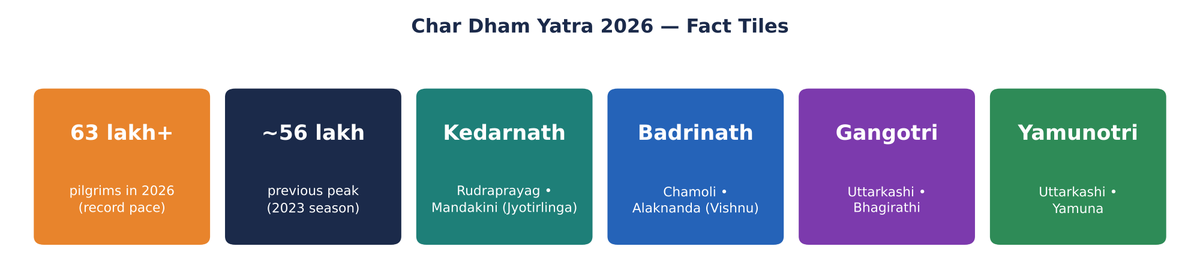
Char Dham Yatra 2026 crosses 63 lakh pilgrims — above the 2023 peak of ~56 lakh.
Kedarnath portals close for winter on Bhai Dooj (11 Nov).
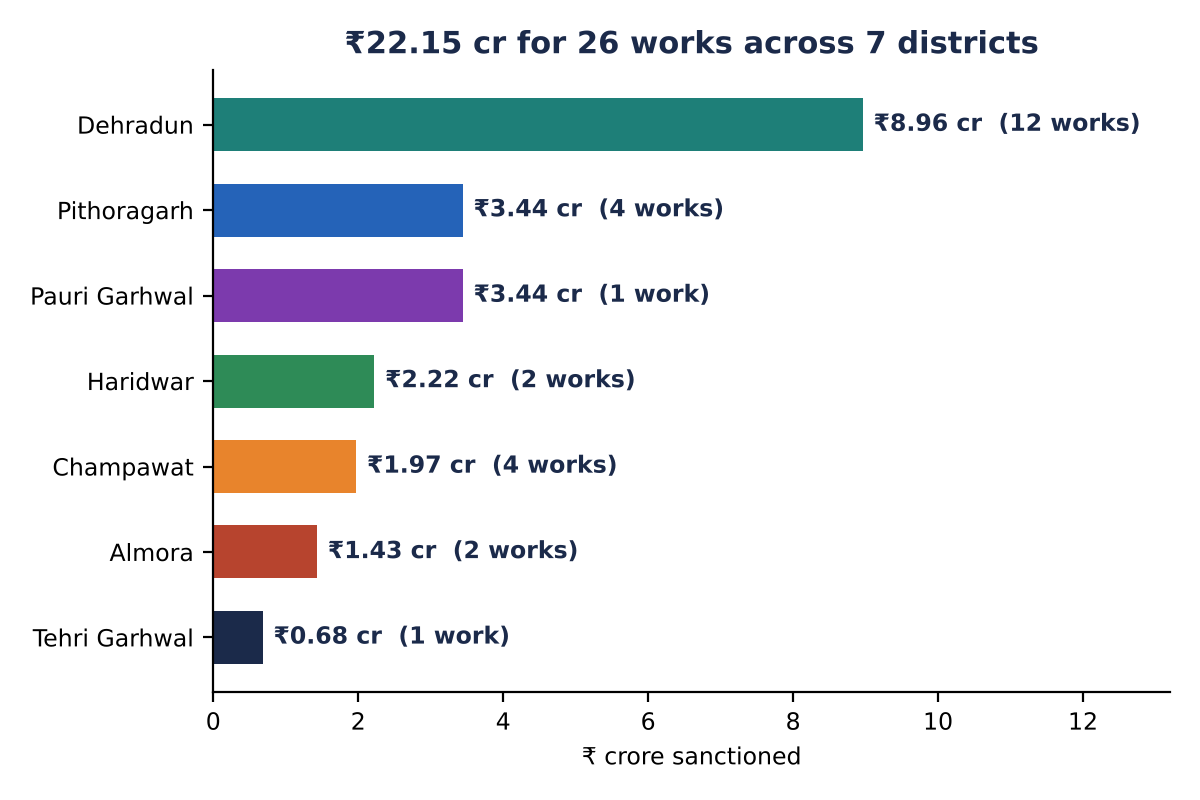
CM sanctions ₹22.15 cr for 26 works in 7 districts; Dehradun gets ₹8.96 cr.
Uttarakhand marks its 26th Foundation Day on 9 Nov (state formed 9 Nov 2000).
Agnipath: 75% Agniveers get 2-year extension ('Second Tour of Duty').
SC refers Javed v. State of Haryana (2003) on two-child norm to a larger bench; TFR now 1.9.
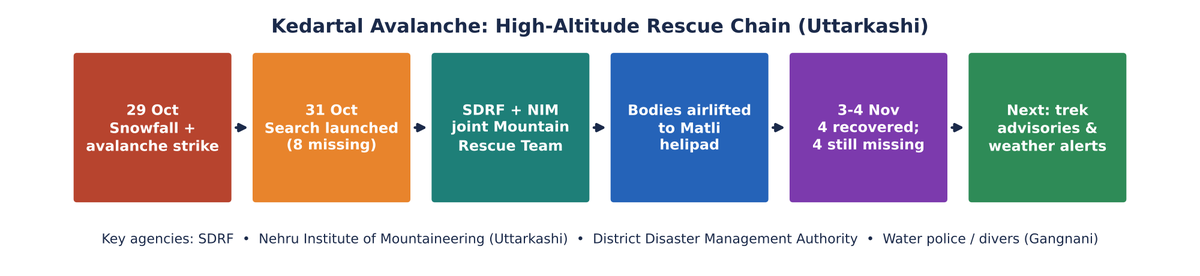
Heavy snowfall and an avalanche struck a trekking group on the Kedartal route in the Gangotri glacier region on 29 October. A joint SDRF–NIM Mountain Rescue Team has recovered 4 bodies (on 3–4 Nov); 4 remain missing. Separately, a vehicle plunged into the river near Gangnani on the Gangotri NH, killing 4.
Key facts
Group of 8: 5 trekkers from West Bengal, 2 women from Uttar Pradesh, 1 local guide; search began 31 Oct.
Bodies airlifted to Matli helipad (Uttarkashi) for post-mortem.
Kedartal (~4,750 m) is a glacial lake below Thalay Sagar peak, fed by the Kedar Ganga, a tributary of the Bhagirathi.
NIM (Nehru Institute of Mountaineering), Uttarkashi, was set up in 1965.
Gangnani accident: SDRF, water police and divers deployed; DM-led inquiry ordered.
Way forward
Mandatory weather-linked trek permits, GPS tracking of groups, early-warning for post-monsoon snow events and more high-altitude SDRF posts.
Concept
Avalanche = rapid flow of snow down a slope, triggered by fresh snow load, wind slabs or warming. Uttarakhand's SDRF was raised in 2013 after the Kedarnath disaster; the Disaster Management Act, 2005 provides the NDMA–SDMA–DDMA framework.
Flowchart of the Kedartal avalanche rescue chain: 29 Oct avalanche, 31 Oct search launched, SDRF and NIM joint rescue team, bodies airlifted to Matli helipad, 4 recovered and 4 missing by 3-4 Nov, next steps trek advisories and weather alerts. — StudyForGS
2. Char Dham Yatra 2026 Crosses Record 63 Lakh Pilgrims
Uttarakhand culture & pilgrimage; tourism economy; crowd/carrying-capacity management; Prelims: location of the four Dhams, rivers, districts.
Context
CM Pushkar Singh Dhami said on 5 Nov that over 63 lakh devotees have visited the Char Dham shrines this season, putting the yatra on course for a new record. The season now winds down as portals close for winter.
Key facts
Previous peak: ~56 lakh pilgrims in the 2023 season.
Kedarnath (Rudraprayag, Mandakini) closes on Bhai Dooj — 11 Nov 2026; winter seat Omkareshwar Temple, Ukhimath.
Gangotri (winter seat Mukhba) and Yamunotri (winter seat Kharsali) — both in Uttarkashi.
Shrines are managed by the Badrinath–Kedarnath Temple Committee (BKTC).
Way forward
Promote winter Char Dham (Sheetkaal Yatra) to spread footfall, enforce carrying-capacity limits and boost homestays to retain tourism income in hill villages.
Concept
Carrying capacity = maximum visitors a site can sustain without ecological or infrastructural damage. Pilgrimage tourism is a key pillar of Uttarakhand's tertiary-sector-led economy and a tool against palayan (out-migration).
Stat tiles: 63 lakh plus pilgrims in 2026, about 56 lakh previous peak in 2023, and the four dhams with districts and rivers — Kedarnath (Rudraprayag, Mandakini), Badrinath (Chamoli, Alaknanda), Gangotri (Uttarkashi, Bhagirathi), Yamunotri (Uttarkashi, Yamuna). — StudyForGS
3. CM Sanctions ₹22.15 Crore for 26 Works Across 7 Districts
State development administration; rural infrastructure; human-wildlife conflict; fairs & temples of Kumaon-Garhwal; Prelims: Nauling fair, Jageshwar, district facts.
Context
On 4 Nov, CM Dhami approved ₹22.15 crore for 26 works — roads, drains, drinking water, street-lights, anti-wild-boar fencing and development of temples and fair grounds — across Dehradun, Pithoragarh, Almora, Champawat, Tehri, Haridwar and Pauri.
Tie such sanctions to outcome monitoring and village-level planning (GPDP); scale crop-protection fencing that also curbs farm abandonment in hills.
Concept
Human-wildlife conflict (wild boar, monkeys, leopards) is a major cause of barren farmland and palayan in hill districts. The Jageshwar group (Almora) has 100+ stone temples of the Katyuri era.
Uttarakhand statehood movement; state polity & administration; Prelims: formation date, Act, capitals, divisions, first office-holders.
Context
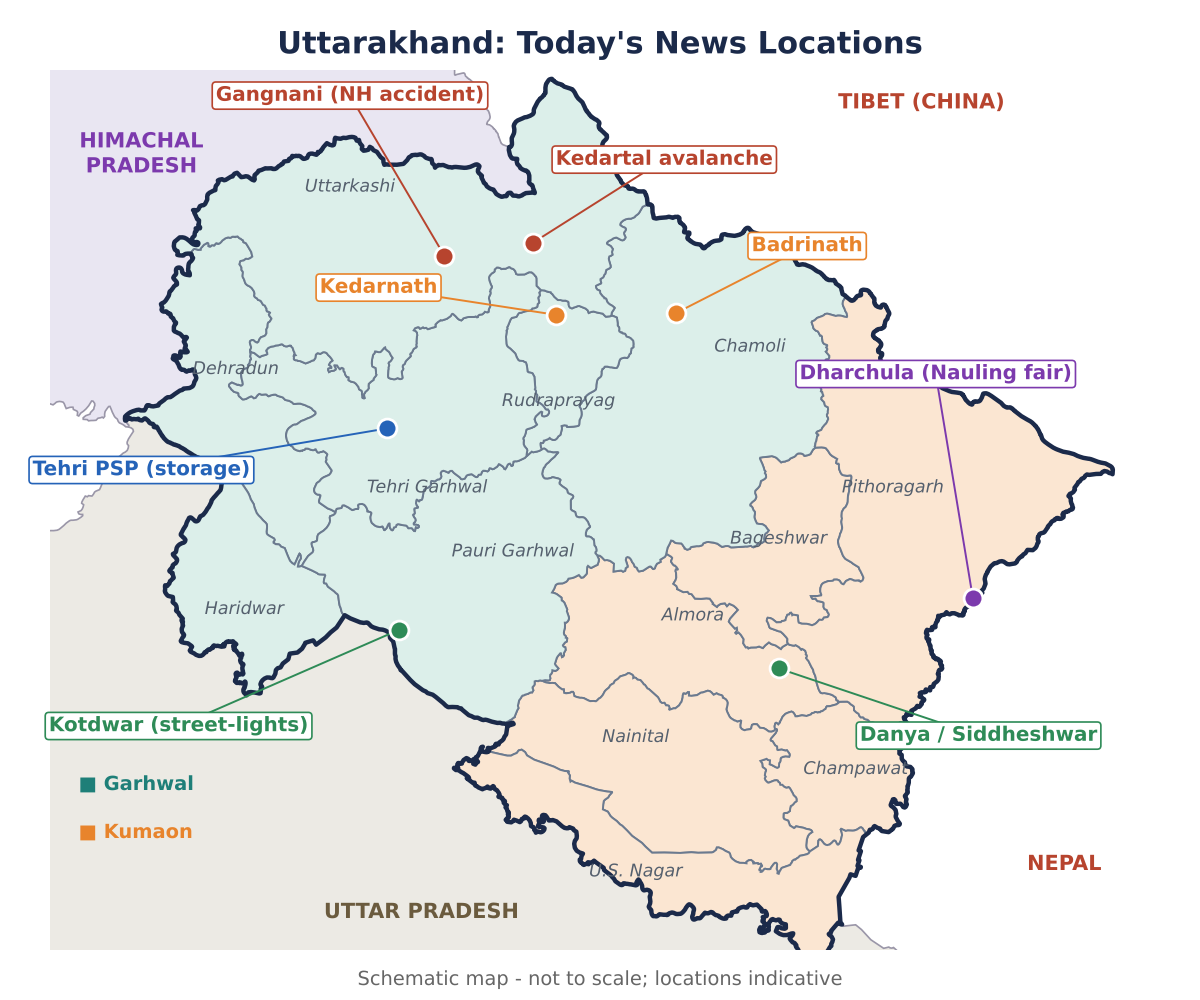
The state prepares to mark its 26th Foundation Day on 9 November 2026, a year after the Silver Jubilee (Rajat Jayanti) celebrations of 2025. Today's map plots the locations in the day's Uttarakhand stories.
Key facts
Formed on 9 Nov 2000 as the 27th state under the Uttar Pradesh Reorganisation Act, 2000; named Uttaranchal, renamed Uttarakhand on 1 Jan 2007.
13 districts in 2 divisions — Garhwal (7) and Kumaon (6).
Dehradun: winter capital; Gairsain (Bhararisain): declared summer capital in 2020.
70 Assembly seats, 5 Lok Sabha, 3 Rajya Sabha seats; High Court at Nainital.
First CM: Nityanand Swami; first Governor: Surjit Singh Barnala.
Way forward
Use the milestone to review hill-plain disparity, palayan and a Himalayan development model built on GEP and disaster resilience.
Concept
Statehood movement: key milestones — Uttarakhand Kranti Dal (1979), Khatima & Mussoorie firings (1–2 Sept 1994), Rampur Tiraha incident (2 Oct 1994). New states are created by Parliament under Article 3.
Schematic district map of Uttarakhand with Garhwal and Kumaon divisions shaded, neighbours Himachal Pradesh, Uttar Pradesh, Tibet (China) and Nepal labelled, and markers for Kedartal, Gangnani, Kedarnath, Badrinath, Tehri pumped storage, Kotdwar, Danya and Dharchula. — StudyForGS
5. Agnipath Revamp: 2-Year Extension for 75% Agniveers; Uttarakhand Quota in Focus
Defence reforms; government schemes for youth; Uttarakhand's military tradition and ex-servicemen welfare; Prelims: Agnipath features, state horizontal reservation.
Context
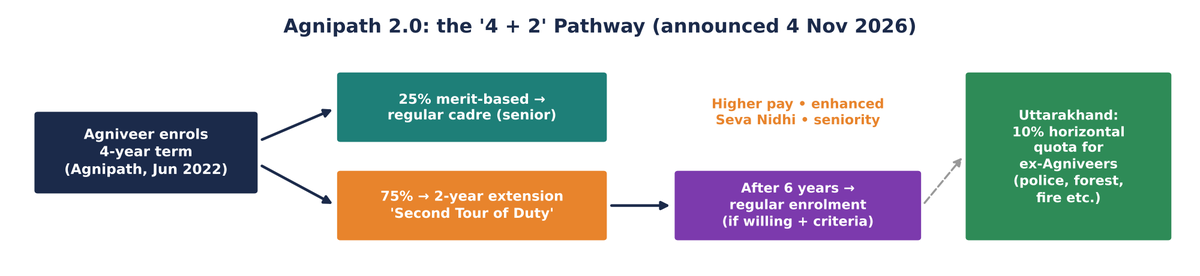
On 4 Nov, after Cabinet approval, CDS Gen N.S. Raja Subramani announced that the 75% Agniveers who earlier exited after 4 years will get a 2-year extension, after which they may be enrolled as regulars. About 18,300 Agniveers were due to exit by 31 Dec.
Key facts
Rajnath Singh termed it the 'Second Tour of Duty' — higher pay, enhanced Seva Nidhi, seniority benefits.
The 25% retained on merit at 4 years stay senior to extension-route entrants.
Agnipath launched June 2022; entry age ~17.5–21 years; 3 lakh+ currently serving.
Uttarakhand gives 10% horizontal reservation to ex-Agniveers in uniformed posts (police, forest guard, fire etc.) under the 2025 rules.
Uttarakhand is called 'Sainya Dham' — home to Garhwal Rifles (Lansdowne) and Kumaon Regiment (Ranikhet).
Way forward
Re-align state quotas and skilling cells with the new 4+2 model; ensure transparent merit criteria for absorption.
Concept
Horizontal reservation cuts across vertical (SC/ST/OBC/EWS) categories — e.g., for women, ex-servicemen, PwD (Indra Sawhney, 1992). CDS is the Principal Military Adviser to the Defence Minister and heads the Department of Military Affairs.
Flowchart of the Agnipath 4+2 pathway: 4-year Agniveer term splits into 25% merit-based regular cadre and 75% two-year extension, the latter eligible for regular enrolment after 6 years; Uttarakhand gives 10% horizontal quota to ex-Agniveers. — StudyForGS
6. India–Nepal Step Up Engagement Ahead of PM Balen Shah's Maiden Visit
IRUKPSC: Prelims + Mains (International Relations; Geography — Uttarakhand border)
Syllabus linkage
India's neighbourhood policy; Uttarakhand's international borders; Prelims: Mahakali (Kali) river, Pancheshwar, Lipulekh, border districts.
Context
India and Nepal are stepping up engagement ahead of Nepal PM Balendra (Balen) Shah's first bilateral visit to India, proposed for late November. The agenda includes rail links, hydropower and border connectivity — several touching Uttarakhand.
Key facts
Agenda items: Raxaul–Kathmandu rail, 750 MW West Seti + 450 MW Seti River-6 hydro (with NHPC), and a motorable bridge over the Mahakali.
A Kathmandu–Dehradun air link is also under discussion.
Uttarakhand–Nepal border runs along the Kali/Mahakali river through Pithoragarh, Champawat and Udham Singh Nagar.
Mahakali Treaty (1996) covers the Pancheshwar multipurpose project and the Sarda/Tanakpur barrages.
Open border under the India–Nepal Treaty of Peace and Friendship, 1950.
Way forward
Fast-track Pancheshwar DPR and cross-border bridges; deepen Dharchula–Darchula people-to-people and trade links.
Concept
Neighbourhood First policy; the Kalapani–Lipulekh–Limpiyadhura area (Pithoragarh) is part of India per its official map — Nepal's 2020 map claim is not recognised by India. Lipulekh Pass is a route for the Kailash Mansarovar Yatra.
7. SC: Two-Child Norm Laws Have Lost Relevance; Javed Ruling Sent to Larger Bench
Fundamental Rights (Art. 14, 21); Panchayati Raj (73rd Amendment); population policy; Prelims: Javed v. State of Haryana (2003), TFR.
Context
A bench of Justices P.S. Narasimha and Alok Aradhe said laws penalising people with more than two children have lost relevance as fertility falls, set aside a Maharashtra sarpanch's disqualification and referred Javed (2003) to a larger bench.
Key facts
Provision examined: Sec. 14(1)(j-1), Maharashtra Village Panchayats Act, 1959.
Javed (2003), a 3-judge bench, upheld the norm under the Haryana Panchayati Raj Act, 1994 — it remains precedent until the larger bench rules.
TFR: ~3.0 in 2003 vs 1.9 now; replacement level ≈ 2.1.
Court flagged reproductive autonomy under Article 21.
Uttarakhand also applies a two-child condition for panchayat polls via its 2019 amendment to the Uttarakhand Panchayati Raj Act, 2016.
Way forward
States should review disqualification rules in light of below-replacement fertility and shift to incentive-based population and gender policies.
Concept
Total Fertility Rate (TFR) = average children a woman would bear in her lifetime; 2.1 is the replacement level. A larger bench reference is needed because a smaller bench cannot overrule a coequal or larger bench's precedent.
8. Cabinet Approves ₹4,371 Crore VISTAR Scheme to Overhaul Statistical System
ECONOMYUKPSC: Prelims + Mains (Economy of India & Uttarakhand)
Syllabus linkage
Indian economy — data, national income, surveys; state & district GDP; Prelims: MoSPI, Economic Census, PLFS/HCES/ASUSE.
Context
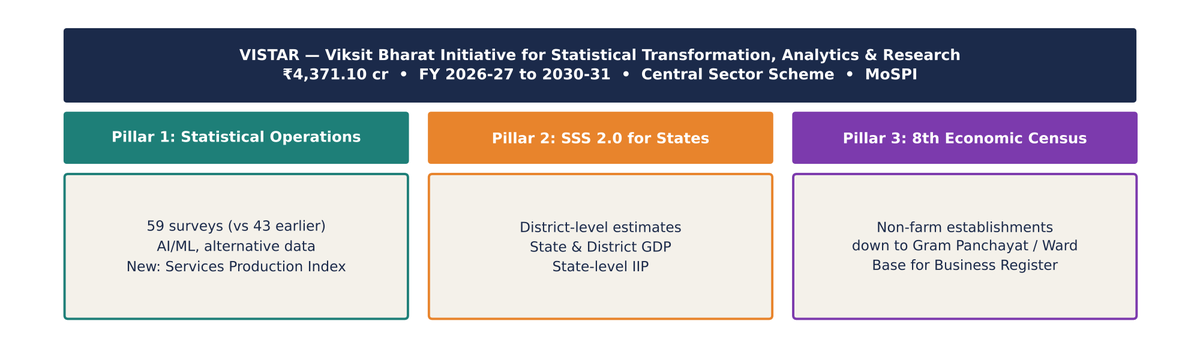
The Union Cabinet on 4 Nov approved VISTAR — Viksit Bharat Initiative for Statistical Transformation, Analytics & Research, a Central Sector Scheme of ₹4,371.10 crore for FY 2026-27 to 2030-31, to build an AI-ready, real-time statistical system.
59 surveys planned in the 16th Finance Commission cycle vs 43 earlier.
New indicators: Headline Index of Services Production and Index of Unincorporated Sector Enterprises.
SSS 2.0 helps States with district-level estimates, State/District GDP and State-level IIP.
Includes the 8th Economic Census — non-farm establishments down to Gram Panchayat / Ward.
Way forward
Uttarakhand's Directorate of Economics & Statistics can use SSS 2.0 for credible district GDP — vital for hill-plain gap analysis and GEP accounting.
Concept
Central Sector Scheme = 100% funded and implemented by the Centre (vs Centrally Sponsored Scheme, cost-shared with States). The Economic Census counts all establishments engaged in economic activity (excluding crop production & plantation).
Pillar diagram of the VISTAR scheme (₹4,371.10 crore, FY27-FY31, MoSPI): Pillar 1 statistical operations with 59 surveys and AI; Pillar 2 SSS 2.0 for states with district GDP and state IIP; Pillar 3 the 8th Economic Census down to gram panchayat level. — StudyForGS
9. 92 GWh Grid-Scale Energy Storage Plan Cleared with ₹14,500 Crore VGF
ENVIRONMENTUKPSC: Prelims + Mains (Science-Tech & Environment; Energy — Uttarakhand)
Syllabus linkage
Energy security, renewables integration; hydropower in Uttarakhand; Prelims: VGF, BESS, pumped storage, Tehri PSP.
Context
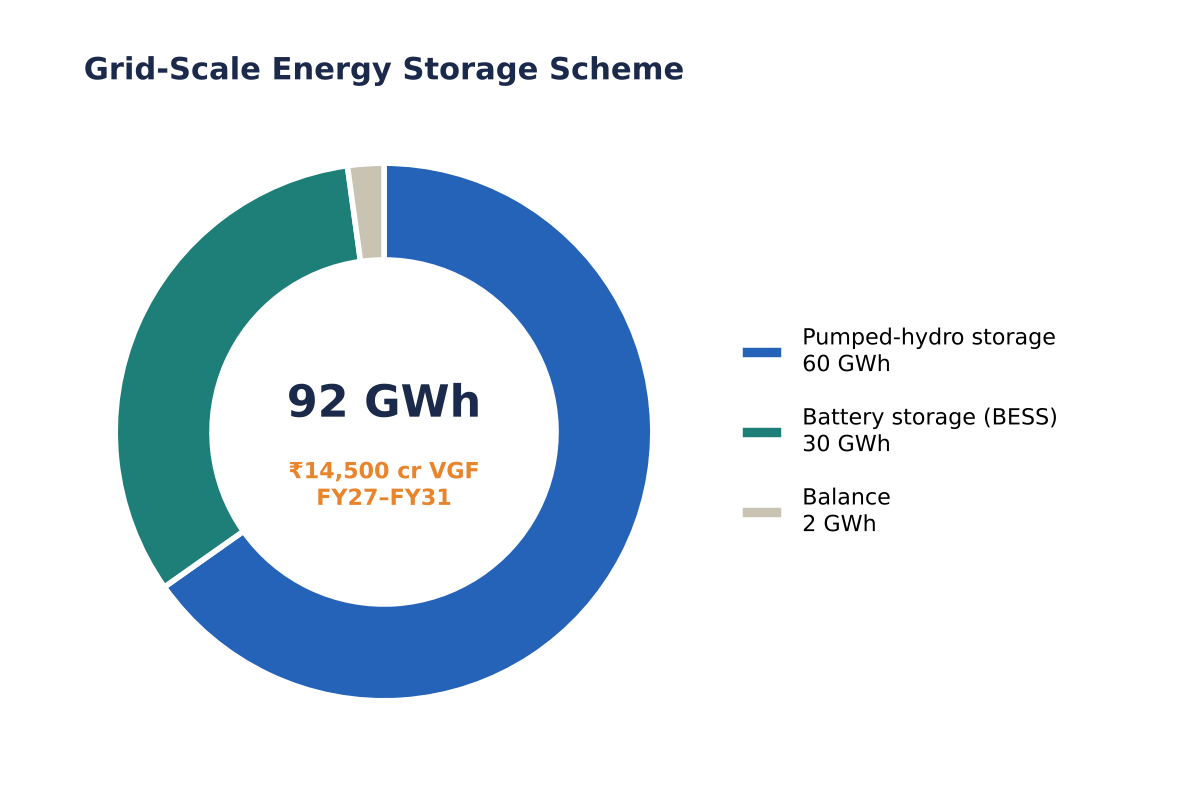
The Cabinet on 4 Nov approved ₹14,500 crore of viability gap funding (VGF) to add 92 GWh of grid-scale storage during FY27–FY31, to be implemented with States — key for absorbing variable solar and wind power.
Same day: ₹2,814 crore scheme for lithium & nickel processing (see next item).
Uttarakhand hosts the 1,000 MW Tehri Pumped Storage Plant (THDC) on the Bhagirathi.
Storage enables round-the-clock RE towards 500 GW non-fossil capacity by 2030.
Implemented as VGF — capital support that makes otherwise unviable projects bankable.
Way forward
Uttarakhand can bid for off-river (closed-loop) pumped storage with low ecological footprint, avoiding fragile valleys and eco-sensitive zones.
Concept
Pumped storage: water is pumped to an upper reservoir when power is cheap/surplus and released through turbines at peak demand — a 'water battery'. GWh measures stored energy; GW measures power capacity.
Donut chart of the 92 GWh grid-scale energy storage scheme with ₹14,500 crore VGF for FY27-FY31: pumped-hydro storage 60 GWh, battery storage 30 GWh, balance 2 GWh. — StudyForGS
10. ₹2,814 Crore Capex Support for Lithium and Nickel Processing
Industrial policy, critical minerals, supply-chain resilience; Prelims: National Critical Mineral Mission, lithium/nickel uses.
Context
The Cabinet cleared a ₹2,814-crore capital-expenditure support scheme for FY27–FY31 to set up domestic plants that refine lithium and nickel ores into high-purity compounds for batteries and electronics, cutting import dependence.
Key facts
30% capital subsidy; 2 lithium + 2 nickel plants selected on least-cost bidding.
Minimum capacity: 30,000 tpa (lithium), 50,000 tpa (nickel); cobalt as a nickel by-product.
Caps: ₹500 cr (lithium) and ₹900 cr (nickel) per beneficiary; 3 milestone tranches.
Processing parks planned in Gujarat, Maharashtra (lithium), Odisha (nickel) and Andhra Pradesh.
Builds on the National Critical Mineral Mission (₹34,300 cr, 2025).
Way forward
Secure ore through overseas assets (KABIL) and recycling; pair with strict environmental safeguards for refining effluents.
Concept
Critical minerals are those essential for the economy with supply-risk — India has identified 30 (2023). Lithium is vital for Li-ion batteries; India's first lithium inferred resource was reported at Reasi (J&K) in 2023.
Data point of the day
1.9
India's Total Fertility Rate (TFR) — cited by the Supreme Court on 4 Nov Below the replacement level of 2.1, down from ~3.0 when Javed (2003) upheld the two-child norm — the core reason the Court called such laws outdated.
Prelims rapid-fire
Fast-track special courts: Cabinet extended 850 FTSCs for rape & POCSO cases till 2031.
India–Canada held the inaugural Defence Dialogue (virtual, 3 Nov) — focus: defence industry, R&D, military-technical cooperation.
Kedarnath — one of the 12 Jyotirlingas; temple at ~3,583 m in Rudraprayag district.
Tehri Dam (Bhagirathi) — India's tallest dam (~260.5 m), operated by THDC India Ltd.
Nauling Devta fair site at Ghatghor Gadi (Dharchula, Pithoragarh) gets ₹79.49 lakh.
VISTAR's 8th Economic Census will provide the baseline for a National Statistical Business Register.
Practice MCQs — UKPSC Prelims pattern
Q1. With reference to the Char Dham shrines of Uttarakhand, consider the following pairs (Shrine — Winter seat):
1. Kedarnath — Ukhimath
2. Gangotri — Mukhba
3. Yamunotri — Pandukeshwar
How many of the above pairs are correctly matched?
Only one
Only two
All three
None
Show answer
Answer: B Kedarnath's winter seat is Omkareshwar Temple, Ukhimath and Gangotri's is Mukhba. Yamunotri's winter seat is Kharsali; Pandukeshwar is linked to Badrinath. Hence only two pairs are correct.
Q2. Consider the following statements regarding the VISTAR scheme approved on 4 November 2026:
1. It is a Centrally Sponsored Scheme implemented by NITI Aayog.
2. It includes the 8th Economic Census covering non-farm establishments.
3. It supports States in preparing district-level GDP estimates.
Which of the statements given above are correct?
1 and 2 only
2 and 3 only
1 and 3 only
1, 2 and 3
Show answer
Answer: B VISTAR is a Central Sector Scheme of MoSPI (₹4,371.10 cr), not a CSS of NITI Aayog — statement 1 is wrong. It includes the 8th Economic Census and SSS 2.0 for district GDP — statements 2 and 3 are correct.
Mains practice question
Q. Post-monsoon avalanches and record pilgrim footfall in 2026 highlight the twin challenge of risk and carrying capacity in the Uttarakhand Himalaya. Discuss the measures needed to make high-altitude tourism and trekking safe and sustainable. (200 words)
Hint / approach
Intro: Kedartal tragedy + 63 lakh Char Dham footfall. Body: weather-linked permits & GPS tracking, SDRF/NIM high-altitude capacity, avalanche early warning, carrying-capacity caps, winter yatra & homestays to spread load, local guide certification. Conclude with a Himalayan resilience model linked to GEP.
📌 One-line revision: Kedartal avalanche (Uttarkashi) • Char Dham 63 lakh+ • ₹22.15 cr for 26 works • UK Day 9 Nov 2000 • Agniveer 4+2 • TFR 1.9 vs 2.1 • VISTAR ₹4,371 cr • 92 GWh storage • ₹2,814 cr Li-Ni.