Uttarakhand clears 76 MW battery storage; High Court orders Mussoorie carrying-capacity plan; Centre approves ₹1.86 lakh crore Green Energy Corridor-III
Friday, 2 October 2026 · IST · Uttarakhand + National · 12 items · 2 MCQs
Uttarakhand's power regulator cleared four battery storage projects of 76 MW/190 MWh, the High Court gave the State 9 months to frame a carrying-capacity plan for Mussoorie, and 260 trekkers were brought back safely as snowfall shut Gangotri National Park routes. Nationally, the Union Cabinet approved Green Energy Corridor Phase-III (₹1,86,405 crore) and higher rabi MSPs (wheat ₹2,610), while September GST rose 14.7% to ₹2.04 lakh crore ahead of the RBI MPC meeting on 5–7 October.
Today at a glance — things to remember
UERC clears 4 BESS projects — 76 MW/190 MWh; largest at Dhakrani (30 MW).
High Court: Mussoorie carrying-capacity plan within 9 months.
Gangotri NP treks shut after snowfall; 260 rescued (67 airlifted).
Rampur Tiraha firing — 2 Oct 1994; state formed 9 Nov 2000.
Wildlife Week: ₹51,000 each to 18 brave citizens; Haldwani zoo announced.
9,93,886 pensioners got ₹147.34 crore in Sept; free coaching for divyang youth.
GEC-III: ₹1,86,405 crore, 135 GW RE evacuation, 50 GWh BESS.
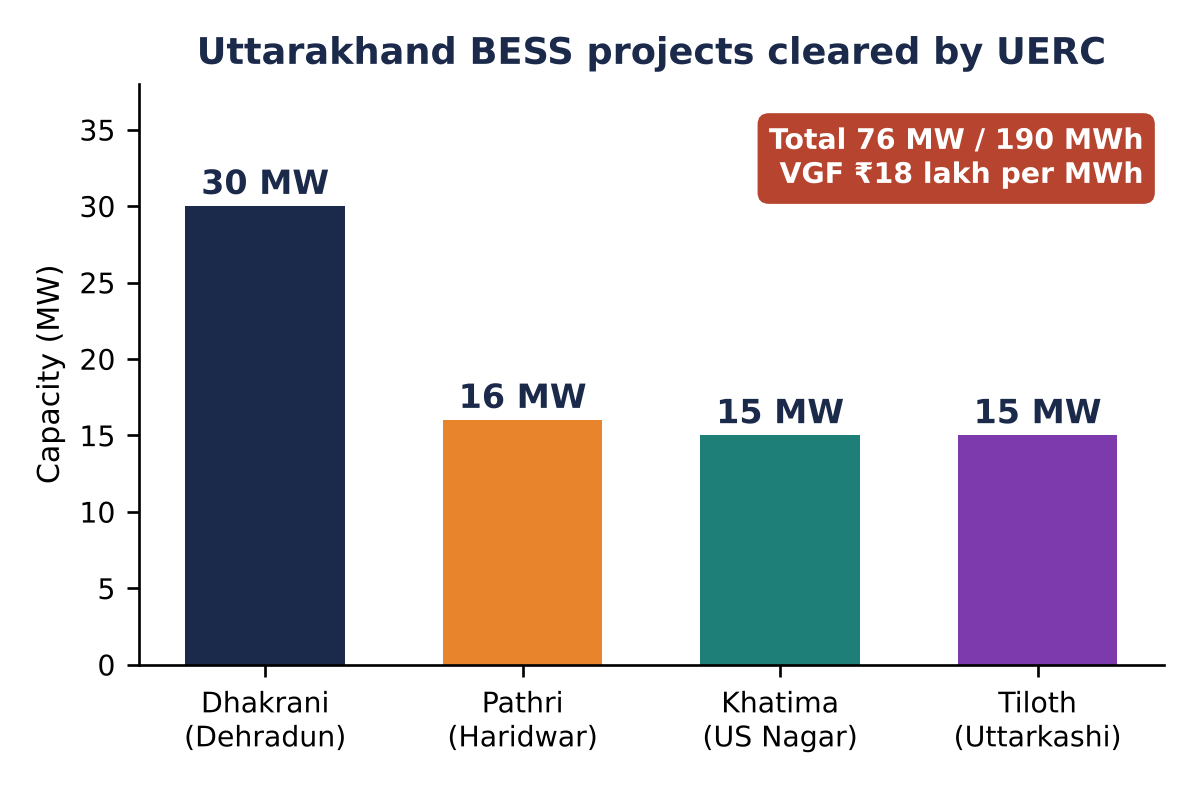
On 2 October 2026 it was reported that the Uttarakhand Electricity Regulatory Commission (UERC) has conditionally approved tariffs and power-purchase agreements for four Battery Energy Storage System (BESS) projects of 76 MW/190 MWh, to be implemented through UJVN Ltd.
Approved tariffs of about ₹2.70–2.80 lakh per MW per month — reported lower than similar projects in Delhi and Punjab.
Central Viability Gap Funding (VGF) of ₹18 lakh per MWh, paid in 3 instalments from the Power System Development Fund (PSDF).
Batteries will feed the grid in the evening peak (6–9 PM), cutting costly power-exchange purchases and grid-failure risk.
Developers: Patanjali Renewable Energy Pvt Ltd (3 projects) and Army Infotek Ltd (Tiloth).
Way forward
Pair BESS with solar + hydro to firm up winter supply when river flows dip; frame safety norms for battery sites in seismic hill zones.
Concept
BESS stores surplus power (mostly lithium-ion) and releases it at peak; here storage is 2.5 hours (190 MWh ÷ 76 MW). VGF = one-time capital grant bridging cost and viability. Uttarakhand's grid is hydro-dominated; UJVN Ltd is the state hydro generator.
Bar chart of the four approved BESS projects in Uttarakhand: Dhakrani 30 MW, Pathri 16 MW, Khatima 15 MW, Tiloth 15 MW, total 76 MW/190 MWh. — StudyForGS
2. High Court gives State 9 months to frame Mussoorie carrying-capacity plan
Uttarakhand High Court (Nainital) — PILs & environmental governance; Himalayan ecology & sustainable tourism. Prelims: carrying capacity, NGT.
Context
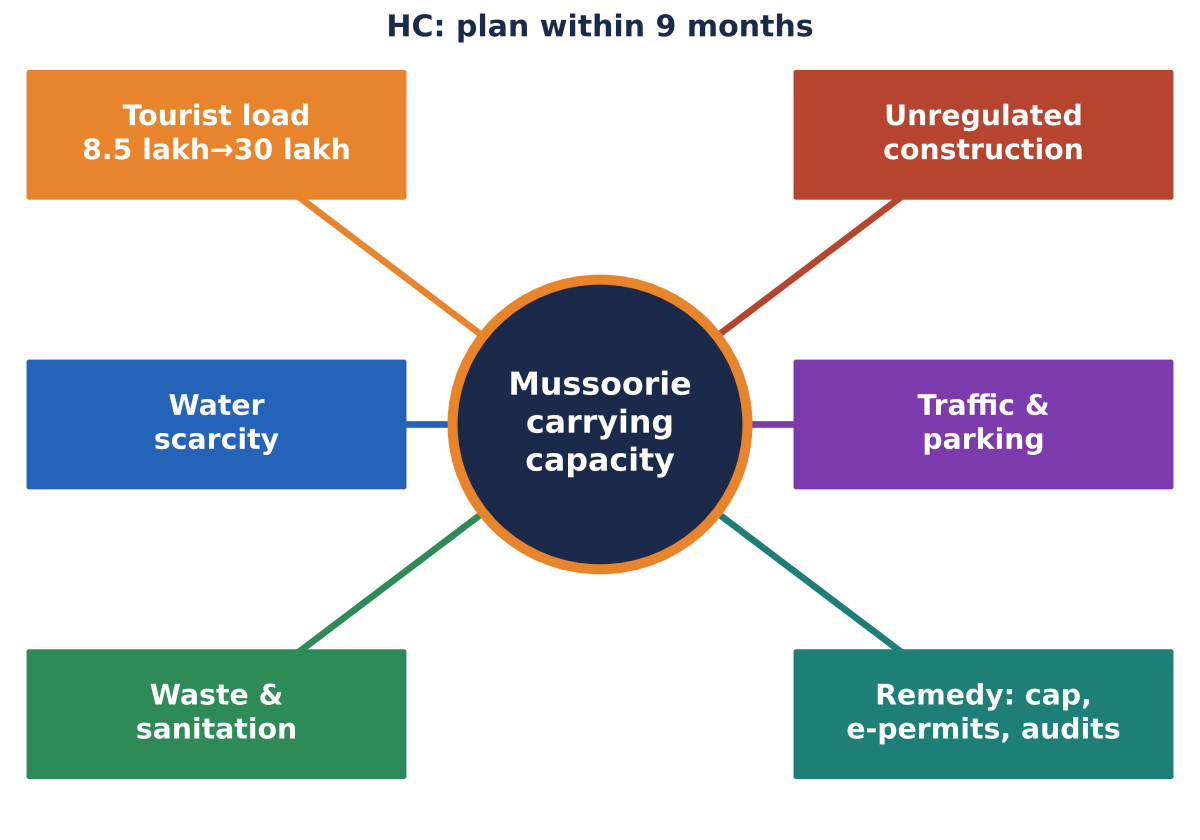
On 1 October 2026, a Division Bench of Justice Manoj Kumar Tiwari and Justice Pankaj Purohit directed the Chief Secretary to prepare a policy and action plan based on Mussoorie's carrying capacity within 9 months.
Key facts
PIL flagged unregulated construction, tree felling, traffic jams, water scarcity and sanitation stress.
Tourist arrivals rose from about 8.5 lakh (2000) to about 30 lakh (2019) while parking and civic capacity lagged.
Plan must factor in earlier National Green Tribunal (NGT) directions; petitioners may submit data to the Chief Secretary.
Bench also asked the Tehri DM to act on safety at Tapovan Ganga ghats — orders within 8 weeks.
Way forward
Notify a visitor cap with online permits and parking-linked entry; mandate a geotechnical audit before new construction, as after Joshimath.
Concept
Carrying capacity = the maximum use an area can sustain without degrading its environment (physical, real and effective). NGT was set up under the NGT Act, 2010; in 2023 it sought a holistic study of Mussoorie after Joshimath subsidence. Uttarakhand High Court est. 9 Nov 2000, seat Nainital.
Mind-map of Mussoorie carrying-capacity issues: tourist load, construction, water, traffic, waste, and remedies like permits and audits. — StudyForGS
3. Snowfall shuts Gangotri National Park treks; 260 brought back safely from Bhagirathi-II and Gaumukh routes
Disaster management in Uttarakhand — early warning, NDRF/ITBP roles; protected areas of Uttarkashi. Prelims: Gangotri NP, Gaumukh, Bhagirathi peaks.
Context
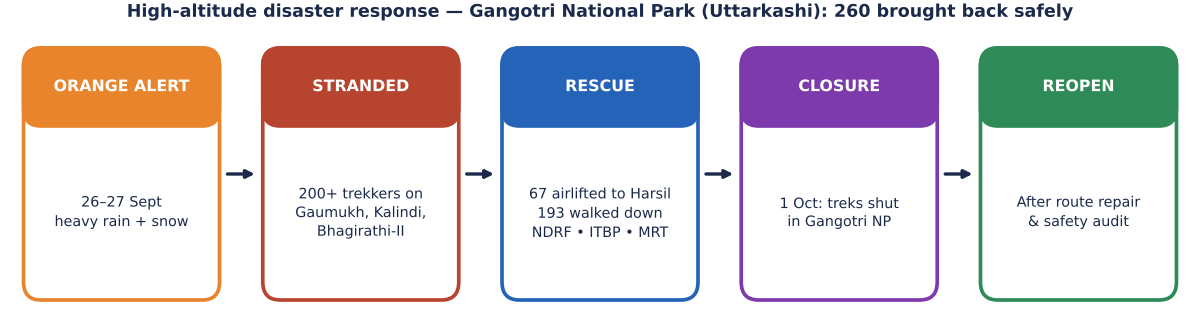
On 1 October 2026, the Gangotri National Park administration banned trekking after heavy rain and snowfall on 26–27 September damaged routes, while a joint operation brought 260 trekkers, porters and climbers safely to Gangotri.
Key facts
Routes hit: Gangotri–Gaumukh–Tapovan, Kedartal, Kalindi trek; reopening only after safety checks.
67 airlifted (28–29 Sept) to Harsil helipad; 193 walked down with rescuers; incl. 9 climbers of the Bhagirathi-II expedition.
Agencies: district administration, NDRF, ITBP (35th Bn), Mountain Rescue Team, Forest Dept — acting on an IMD orange alert.
Monsoon withdrawing from most of Uttarakhand by 3 October, as per the state Met Centre.
Way forward
Make online registration + GPS tracking mandatory for high-altitude treks; pre-position supplies at Bhojbasa/Tapovan for early-winter storms.
Concept
Gangotri NP (est. 1989, ~2,390 km²) — snow leopard & bharal habitat. Gaumukh, snout of the Gangotri glacier, is the source of the Bhagirathi, which meets the Alaknanda at Devprayag to form the Ganga. IMD alerts: green–yellow–orange (be prepared)–red (take action).
Flowchart of the Gangotri high-altitude rescue: IMD orange alert, snowfall on 26-27 September, airlift of 67 and foot evacuation of 193, trek closure on 1 October and reopening after safety audit. — StudyForGS
4. Rampur Tiraha firing anniversary: State pays homage to statehood martyrs
History of Uttarakhand — statehood movement (1994–2000). Prelims: dates of Khatima, Mussoorie and Rampur Tiraha incidents; Article 3.
Context
On 2 October 2026, CM Pushkar Singh Dhami laid a wreath at the Shaheed Sthal in the Kachahari premises, Dehradun, on the anniversary of the Rampur Tiraha firing (2 October 1994), saying the agitators' sacrifice made statehood a reality.
Key facts
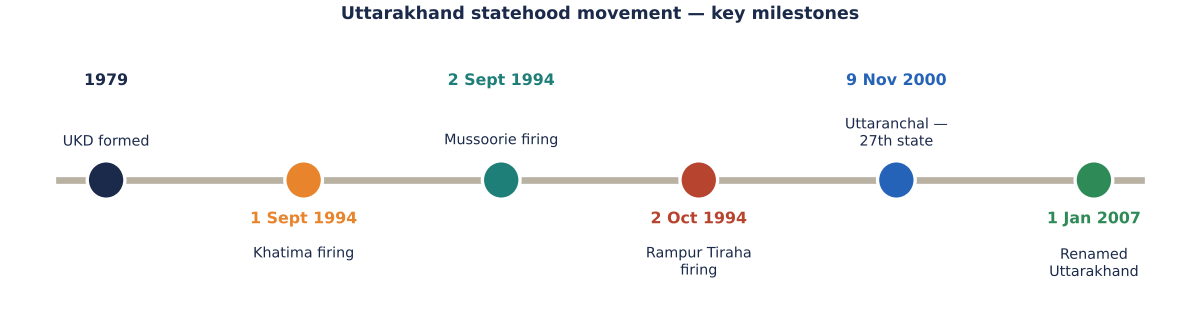
Night of 1–2 Oct 1994: police fired on agitators heading to a Delhi rally at Rampur Tiraha, Muzaffarnagar (UP); several were killed.
Preceded by the Khatima firing (1 Sept 1994) and Mussoorie firing (2 Sept 1994).
Uttaranchal formed on 9 Nov 2000 as India's 27th state (UP Reorganisation Act, 2000); renamed Uttarakhand from 1 Jan 2007.
Uttarakhand Kranti Dal (UKD), formed in 1979, led the political demand.
Way forward
Record oral histories of agitators, add the movement to school syllabi and keep welfare benefits for state agitators (Rajya Andolankari) time-bound.
Concept
New states are created under Article 3 by a law of Parliament passed by simple majority, after the President refers the Bill to the state legislature for views (not binding). In 2000 also: Chhattisgarh (1 Nov) and Jharkhand (15 Nov).
Timeline of the Uttarakhand statehood movement: UKD 1979, Khatima firing 1 Sept 1994, Mussoorie firing 2 Sept 1994, Rampur Tiraha 2 Oct 1994, state formed 9 Nov 2000, renamed Uttarakhand 1 Jan 2007. — StudyForGS
5. Wildlife Week 2026 opens at FRI: ₹51,000 each for 18 citizens who braved wild-animal attacks
Biodiversity & protected areas of Uttarakhand; human–wildlife conflict. Prelims: Wildlife Week (1–7 Oct), FRI Dehradun, Corbett & Rajaji.
Context
Inaugurating Wildlife Week 2026 at the Forest Research Institute (FRI), Dehradun on 1 October, CM Dhami honoured 18 persons for courage during wildlife conflict with ₹51,000 each — an amount to be given to all such future awardees.
Key facts
A zoo at Haldwani (Nainital district) announced as a manifesto commitment.
Officials told to develop at least one new tourism site per district without harming natural beauty.
Ex-gratia for death in wildlife attacks was raised from ₹6 lakh to ₹10 lakh (Cabinet, Nov 2025) with free treatment for the injured.
Scale up solar fencing, SMS early warning, quick-response teams and village waste management that draws bears and leopards.
Concept
Wildlife Week is observed 1–7 October every year. Jim Corbett NP (1936, as Hailey NP) is India's first national park; Rajaji became a tiger reserve in 2015. FRI Dehradun dates to 1906.
6. ₹147 crore in monthly pensions to 9.93 lakh beneficiaries; free civil services coaching for divyang youth
Welfare of vulnerable sections — elderly & persons with disabilities; Uttarakhand schemes. Prelims: scheme names, Day of Older Persons, RPwD Act.
Context
On the International Day of Older Persons (1 October), CM Dhami announced free civil services coaching for differently-abled (divyang) youth and said 9,93,886 pensioners received ₹147.34 crore in September.
Key facts
Schemes cited: Atal Vayo Abhyudaya Yojana (elderly welfare) and Deendayal Matri-Pitri Tirthatan Yojana (free pilgrimage).
Parents & Senior Citizens Maintenance Act, 2007 to be enforced; old-age homes strengthened in all districts.
Next: State Cabinet meets at Banbasa (Champawat) on 4 Oct; tablets for Class 10 & 12 students of govt inter colleges likely on the agenda.
Way forward
Use DBT + Aadhaar-seeded pension rolls to stop leakages; build accessible coaching (screen readers, sign-language) under the divyang initiative.
Concept
International Day of Older Persons — 1 October (UNGA, observed since 1991). Article 41 (DPSP): public assistance in old age and disablement. RPwD Act, 2016 lists 21 disabilities and 4% reservation in government jobs.
7. Cabinet clears ₹1.86 lakh crore Green Energy Corridor Phase-III to integrate 135 GW renewables
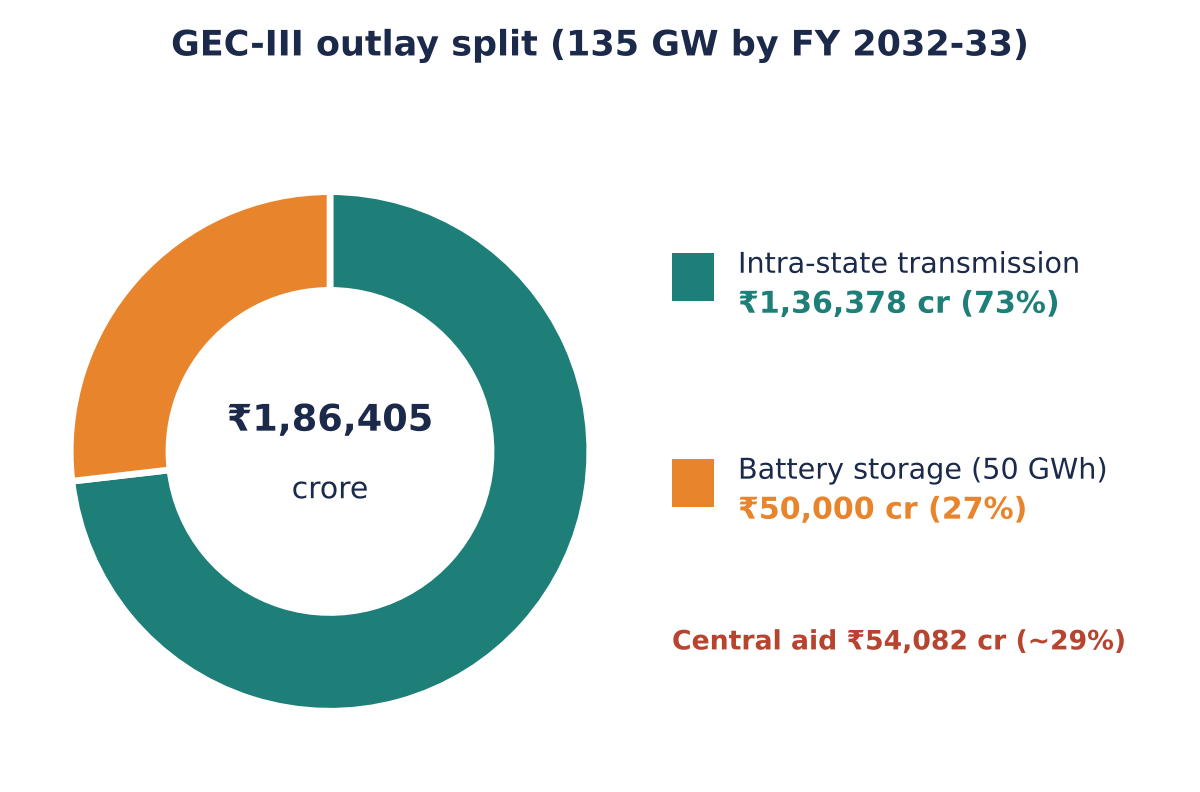
On 30 September 2026, the Union Cabinet approved Green Energy Corridor Phase-III (GEC-III) with an outlay of ₹1,86,405 crore to evacuate and integrate up to 135 GW of renewable power into state grids by FY 2032-33.
Key facts
Split: ₹1,36,378 crore for intra-state transmission (InSTS) + ₹50,000 crore for 50 GWh of battery storage.
Central support of ₹54,082 crore (~29%) to ease intra-state transmission charges.
State Transmission Utilities (STUs) lead; new projects via competitive bidding, upgrades on cost-plus.
Targets intermittency, grid congestion and curtailment of solar/wind at peak hours.
Way forward
Hill states such as Uttarakhand should bid early for transmission + BESS to evacuate small hydro and solar; fast-track right-of-way clearances.
Concept
GEC-I (from 2015) was backed by Germany's KfW; GEC-II (2022) targeted ~20 GW in 7 states. India met its NDC goal of 50% installed capacity from non-fossil sources in 2025, ahead of 2030.
Donut chart of GEC-III outlay: ₹1,36,378 crore intra-state transmission (73%) and ₹50,000 crore battery storage (27%), total ₹1,86,405 crore. — StudyForGS
8. Rabi MSP 2027-28: oilseeds and pulses get the biggest hikes; wheat up just ₹25 to ₹2,610
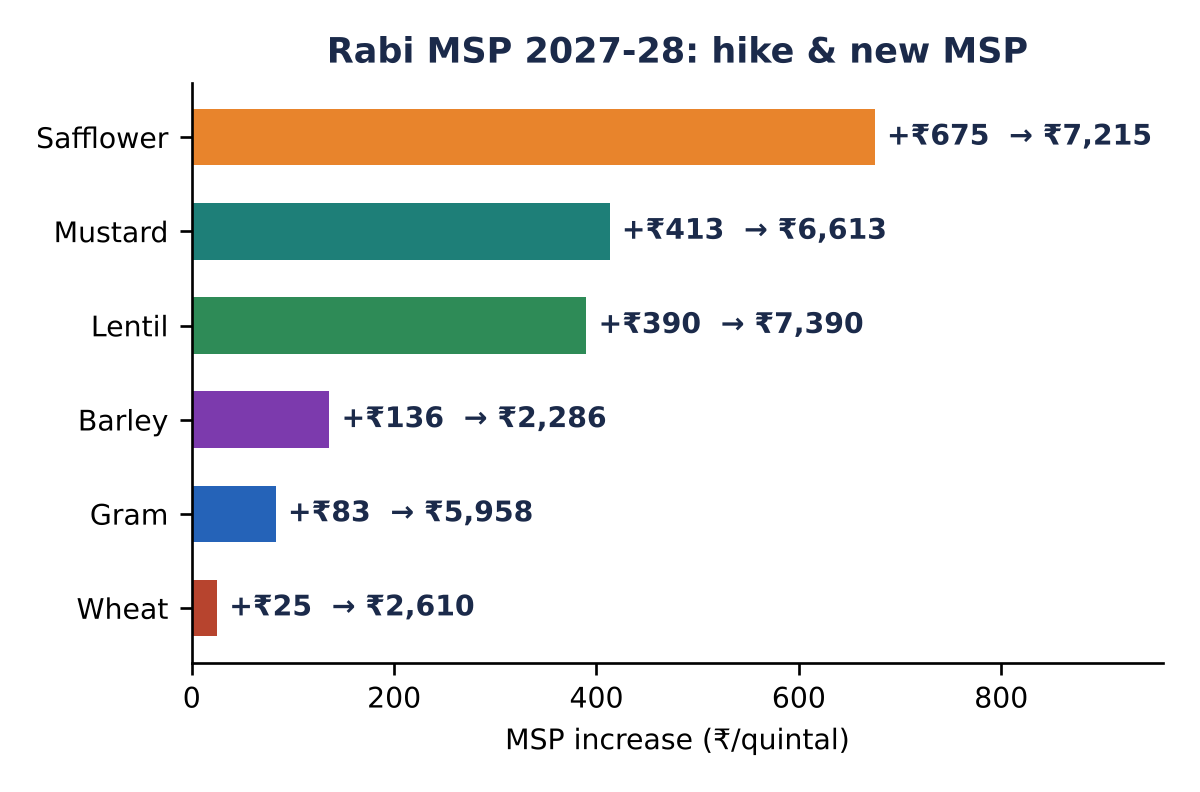
On 30 September 2026, the Centre raised MSPs for six rabi crops for Rabi Marketing Season 2027-28, giving the largest increases to oilseeds and pulses to cut import dependence.
Wheat +₹25 only → ₹2,610/qtl, yet the highest margin over cost at 106%.
Other margins over cost: mustard 96%, lentil 92%, gram 59%, barley 58%, safflower 50%.
Way forward
Back price signals with assured procurement of pulses and oilseeds; in Uttarakhand's hills, extend procurement and branding to millets (mandua, jhangora).
Concept
MSP is fixed for 22 mandated crops (plus FRP for sugarcane) on the advice of the CACP (est. 1965, attached office of the Agriculture Ministry, not statutory); the CCEA approves. Since 2018-19, MSP is at least 1.5× the all-India weighted average cost (A2+FL).
Horizontal bar chart of MSP increases for RMS 2027-28: safflower ₹675, mustard ₹413, lentil ₹390, barley ₹136, gram ₹83, wheat ₹25 per quintal. — StudyForGS
9. RBI MPC meets 5–7 October; first rate hike since 2023 on the table as CPI hits 4.82%
The RBI's Monetary Policy Committee, chaired by Governor Sanjay Malhotra, meets on 5–7 October 2026; most economists polled expect a 25 bps hike in the repo rate from 5.25% to 5.50%.
Key facts
CPI inflation 4.82% (August) — above the 4% target for the third straight month; WPI 9.92%.
Pressures: high crude prices, geopolitical tension, rupee down about 6% vs the dollar in 2026, tightening by the US Fed and Bank of Japan.
Repo unchanged at 5.25% for four reviews after 125 bps of cuts in 2025.
A hike would be the first since February 2023.
Way forward
Complement monetary tightening with supply-side steps — edible-oil and pulse imports, fuel-tax calibration — to protect growth.
Concept
Six-member MPC under Section 45ZB, RBI Act 1934 (amended 2016): 3 RBI + 3 Centre-nominated members; Governor has a casting vote. Target: CPI 4% ± 2%. Repo = rate at which RBI lends short-term funds to banks.
10. Nation marks Gandhi's 157th and Shastri's 122nd birth anniversary
SOCIETYUKPSC: Prelims + Mains (History & Culture — Modern India)
Syllabus linkage
Modern Indian history — Gandhian phase; Gandhi's links with Uttarakhand. Prelims: dates, slogans, international days.
Context
On 2 October 2026, President Droupadi Murmu, Vice-President C.P. Radhakrishnan and PM Narendra Modi paid tribute at Rajghat and Vijay Ghat; the PM urged citizens to buy at least one Khadi product.
Key facts
2 October is also the UN International Day of Non-Violence (UNGA resolution, 2007).
Swachh Bharat Mission was launched on 2 Oct 2014; swachhata drives and shramdaan held across states.
Gandhi born 1869, Porbandar; Shastri born 1904, Mughalsarai — gave the slogan 'Jai Jawan Jai Kisan' (1965).
In 1929 Gandhi stayed at Kausani (Bageshwar), wrote his introduction to Anasakti Yoga and called it the 'Switzerland of India'.
Way forward
Apply Gandhian ideas — Khadi, Gram Swaraj, local self-reliance — to revive hill economies and curb palayan (out-migration).
Concept
Gandhian principles in the DPSP: Art. 40 (village panchayats), 43 (cottage industries), 46 (weaker sections), 47 (prohibition), 48 (cattle). Anasakti Ashram, Kausani, marks his stay.
11. India–Canada eye ~$70 billion trade in five years; Putin praises Modi's Ukraine peace ideas
IRUKPSC: Prelims + Mains (International Relations)
On 2 October 2026, Canada's International Trade Minister Maninder Sidhu, at the G20 Trade Ministers' Meeting in Milwaukee (USA), said both sides aim to lift bilateral trade from about $30 billion to nearly $70 billion in five years. Separately, President Vladimir Putin told the Valdai forum that PM Modi has 'very good ideas' for a mutually acceptable Ukraine settlement.
Key facts
5th round of CEPA talks opens in Ottawa; 4 rounds done; both sides target a deal by end-2026.
India's stand on Ukraine: 'on the side of peace' — dialogue and diplomacy, no bloc alignment.
The USA holds the G20 presidency in 2026.
Way forward
Conclude CEPA with safeguards for dairy and agriculture; tap Canadian minerals for the National Critical Mineral Mission.
Concept
CEPA is broader than an FTA — covers goods, services, investment and IPR. The Valdai Discussion Club is a Moscow-based forum (est. 2004). India–Canada ties were reset in 2025 with High Commissioners restored.
12. Asian Games 2026: India's women's recurve archers win maiden team gold, beat South Korea 5-3
SPORTSUKPSC: Prelims (Sports & Current Events)
Syllabus linkage
Current events of national importance — sports. Prelims: host cities, OCA, first-time achievements.
Context
On 2 October 2026, the trio of Ankita Bhakat, Kirti Sharma and Kumkum Mohod won India's first-ever Asian Games gold in the women's recurve team event, edging 10-time Olympic champions South Korea 5-3 at Aichi-Nagoya.
Key facts
India beat China 5-1 in the semi-final to reach its first women's recurve team final.
Decisive moment: a score correction in set four (an 8 upgraded to a 9) sealed 54 points for India.
20th Asian Games: 19 Sept–4 Oct 2026, Aichi & Nagoya, Japan; India sent 496 athletes in 36 sports.
India's flag-bearers: Manu Bhaker and Pawan Sehrawat.
Way forward
Build on the result through Khelo India and TOPS support for archery, and grassroots talent hunts in hill states such as Uttarakhand.
Concept
Asian Games are run by the Olympic Council of Asia (OCA), HQ Kuwait City. The first Asian Games were held in New Delhi (1951). Recurve is the only bow used at the Olympics; compound archery is not an Olympic event.
Data point of the day
₹2.04 lakh crore (+14.7% YoY)
Gross GST collection — September 2026 Gross ₹2,04,050 crore vs ₹1,77,279 crore in Sept 2025. Domestic ₹1.38 lakh crore (+10.1%), imports ₹65,525 crore (+25.9%); refunds ₹27,001 crore; net ₹1.77 lakh crore (+18.1%). H1 FY27 gross ₹12.46 lakh crore (+11.6%). GST came into force on 1 July 2017 (101st Amendment); GST Council under Article 279A.
Prelims rapid-fire
Uttarakhand State Election Commissioner Sushil Kumar called on the Governor at Lok Bhavan, Dehradun (1 Oct).
Dehradun Warriors won Uttarakhand Premier League Season 3, beating Haridwar in the final (1 Oct).
Haridwar Kumbh 2027: Mela Officer Sonika and IG Yogendra Rawat briefed the Governor on preparations incl. AI-based crowd management (30 Sept).
Monsoon withdrawal line: Gurdaspur–Chandigarh–Muzaffarnagar–Aligarh; Uttarakhand largely monsoon-free by 3 Oct.
Seva Sankalp Abhiyan in Uttarakhand runs 17 Sept–17 Oct 2026 with 11 programmes linked to Viksit Bharat 2047.
5th Kautilya Economic Conclave opens in New Delhi on 3 Oct.
Practice MCQs — UKPSC Prelims pattern
Q1. Arrange the following events of the Uttarakhand statehood movement in chronological order: 1. Mussoorie firing 2. Formation of Uttarakhand Kranti Dal 3. Rampur Tiraha firing 4. Khatima firing
2-4-1-3
4-1-2-3
2-1-4-3
4-2-1-3
Show answer
Answer: A UKD (1979) → Khatima (1 Sept 1994) → Mussoorie (2 Sept 1994) → Rampur Tiraha (2 Oct 1994).
Q2. Consider the following statements about Minimum Support Price (MSP): 1. The Commission for Agricultural Costs and Prices (CACP) is a statutory body. 2. MSP is announced for 22 mandated crops. 3. For RMS 2027-28, wheat received the highest absolute MSP increase. Which of the statements given above is/are correct?
1 and 2 only
2 only
2 and 3 only
1, 2 and 3
Show answer
Answer: B CACP is an attached office (not statutory). Wheat got the smallest hike (₹25); safflower got the highest (₹675).
Mains practice question
Q. Over-tourism is straining Uttarakhand's hill towns. Discuss the need for carrying-capacity-based tourism regulation, citing recent judicial interventions, and suggest a framework for Mussoorie. (125 words, 8 marks)
Hint / approach
Intro: tourist growth 8.5 lakh → 30 lakh. Body: HC's 9-month deadline, NGT's post-Joshimath study; issues (water, traffic, construction, waste). Framework: visitor cap + e-permits, parking-linked entry, building bye-laws, geotechnical audits, green fee. Conclude with sustainable hill tourism.