Thursday, 24 September 2026 · IST · Uttarakhand + National · 11 items · 2 MCQs
Uttarakhand leads today's digest: Badrinath Dham has crossed a record 17.79 lakh pilgrims as the Char Dham Yatra's second phase runs, even as the Kedarnath route recovers from a landslide and the state tightens its homestay policy and UCC rules. Nationally, the Supreme Court protected freedom of conscience on the National Song, SEMICON India 2026 drew about Rs 1 lakh crore in commitments, and India's non-fossil power capacity crossed 54%.
Badrinath Dham has crossed 17.79 lakh pilgrims in 2026 — its highest-ever footfall — as the Char Dham Yatra's second phase gathers pace after the monsoon.
Key facts
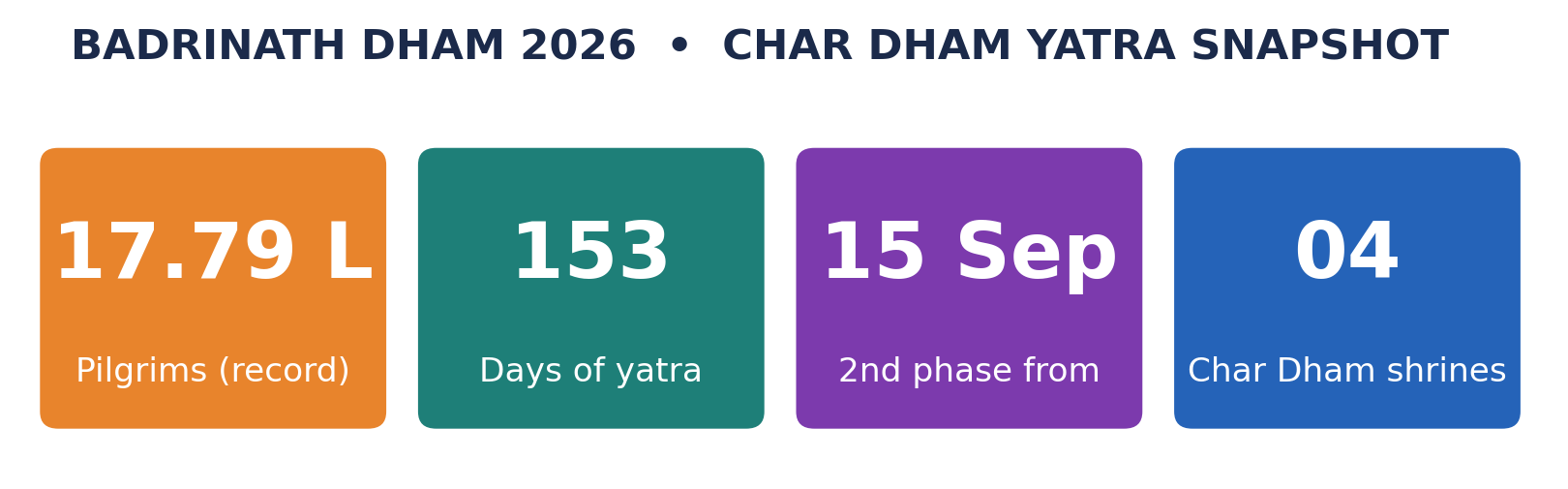
Badrinath footfall: 17,79,805 pilgrims as of 22 September 2026, first time above 17 lakh.
Season opened 23 April 2026; figure reached over 153 days; ~1.5–2 months of yatra remain.
Second phase of the yatra resumed from 15 September 2026 after monsoon disruptions.
Char Dham = Yamunotri, Gangotri, Kedarnath, Badrinath — all in the Garhwal Himalayas.
Thrust on pilgrim facilities, health services and security; Badrinath being redeveloped as a planned shrine.
Way forward
Real-time crowd-cap registration, weather-linked slot management and all-weather road resilience are key to safe, sustainable high-volume pilgrimage.
Concept
Char Dham lies in the Higher Himalayas; Badrinath is on the Alaknanda (Chamoli) and Kedarnath on the Mandakini (Rudraprayag); linked by the Char Dham All-Weather Road.
Stat-tile row showing Badrinath 2026 pilgrim figures: 17.79 lakh total, 153 days, second phase from 15 Sept, four Char Dham shrines. — StudyForGS
2. Kedarnath Trek Reopens After Chirbasa Landslide; Monsoon Risk Persists
Disaster management in the Himalayas; landslides, cloudbursts, GLOF; Uttarakhand physical geography.
Context
The Kedarnath trekking route reopened in mid-September 2026 after a fatal landslide at Chirbasa, underscoring the fragility of Himalayan pilgrim routes during an extended monsoon.
Key facts
Landslide struck near Chirbasa on the Kedarnath foot route; trek later restored after clearance.
The 2026 monsoon repeatedly blocked Badrinath & Kedarnath highways; rivers ran in spate.
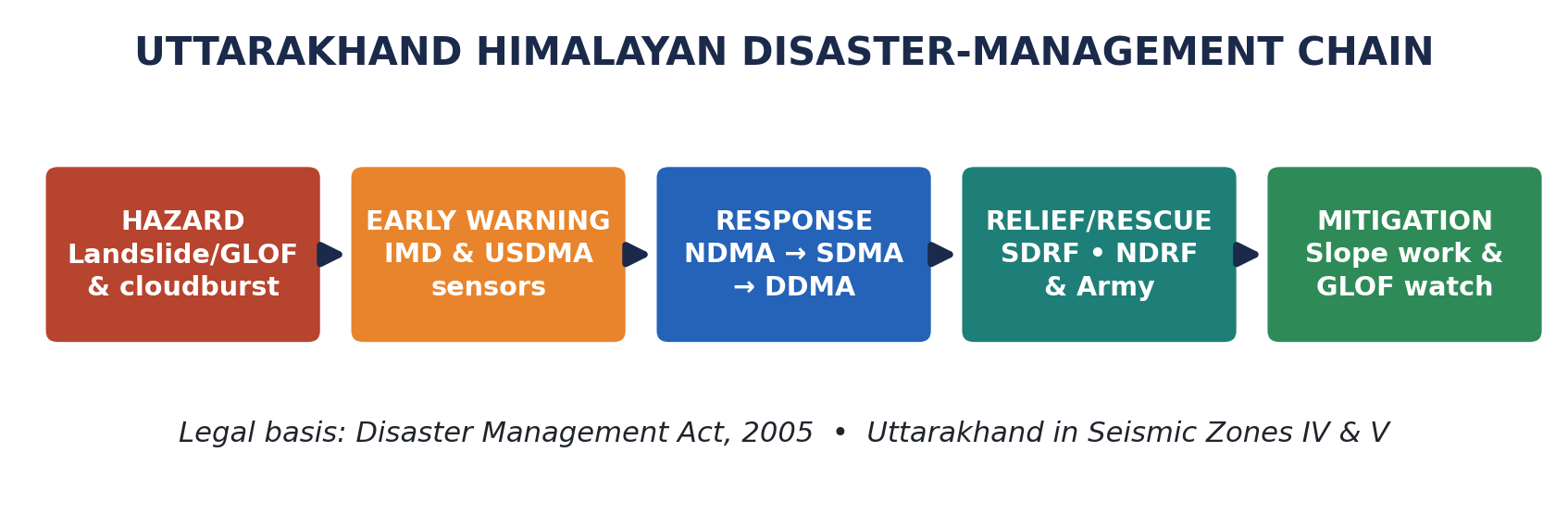
Uttarakhand lies in Seismic Zones IV & V and is highly landslide-prone.
Nodal body: Uttarakhand SDMA (USDMA); district response via DDMAs.
GLOF (glacial lake outburst flood) risk rising with warming; early-warning being expanded.
Way forward
Slope stabilisation, GLOF early-warning, weather-gated yatra slots and relocation of vulnerable settlements can cut disaster losses.
Concept
GLOF: sudden release of water from a glacial lake; landslides depend on slope, rainfall & lithology; the DM Act, 2005 sets the NDMA–SDMA–DDMA structure.
Flowchart of Uttarakhand's disaster-management chain: hazard (landslide/GLOF/cloudburst) to early warning to NDMA-SDMA-DDMA response to relief and mitigation. — StudyForGS
3. Uttarakhand Revamps Homestay Policy to Push Rural, Resident-Led Tourism
Uttarakhand has tightened homestay rules to favour permanent residents running units from their own homes, redirecting commercial operators to the Bed & Breakfast track and promoting community tourism.
Key facts
~6,000 homestays registered; Nainital leads, then Dehradun & Pithoragarh.
Homestays now restricted to permanent residents operating from their own homes.
Registration renewal every 5 years (earlier one-time).
Non-residents / caretaker-run units shifted to the Bed & Breakfast scheme.
Aims to curb palayan (out-migration) and spread tourism to villages.
Way forward
Linking homestays to GI products, treks and 'Vibrant Villages' can build hill livelihoods and reverse migration.
Concept
Palayan = out-migration from hill villages; the Rural Development & Migration Prevention (Palayan) Commission tracks it; homestays are a livelihood-diversification tool.
4. India–Mongolia Drill 'Nomadic Elephant 2026' Begins in Pithoragarh
DEFENCEUKPSC: Prelims + Mains (Defence & IR — Uttarakhand venue)
Syllabus linkage
India's defence exercises; IR (Mongolia, 'third neighbour'); Uttarakhand as a strategic border state.
Context
The 18th edition of the India–Mongolia joint military exercise Nomadic Elephant began on 21 September 2026 at Pithoragarh, Uttarakhand, focusing on mountain warfare, drones and cyber security.
Key facts
18th edition; held 21 Sept – 3 Oct 2026 at Pithoragarh, Uttarakhand.
45 personnel each side; the Indian contingent is from the Arunachal Scouts.
Focus: counter-insurgency in mountainous terrain, drones & cyber security under a UN mandate.
Reflects Mongolia's 'Third Neighbour' policy toward India.
Pithoragarh borders Tibet (China) & Nepal — strategically sensitive.
Article 44 (DPSP); UCC; personal laws; live-in registration; state legislation.
Context
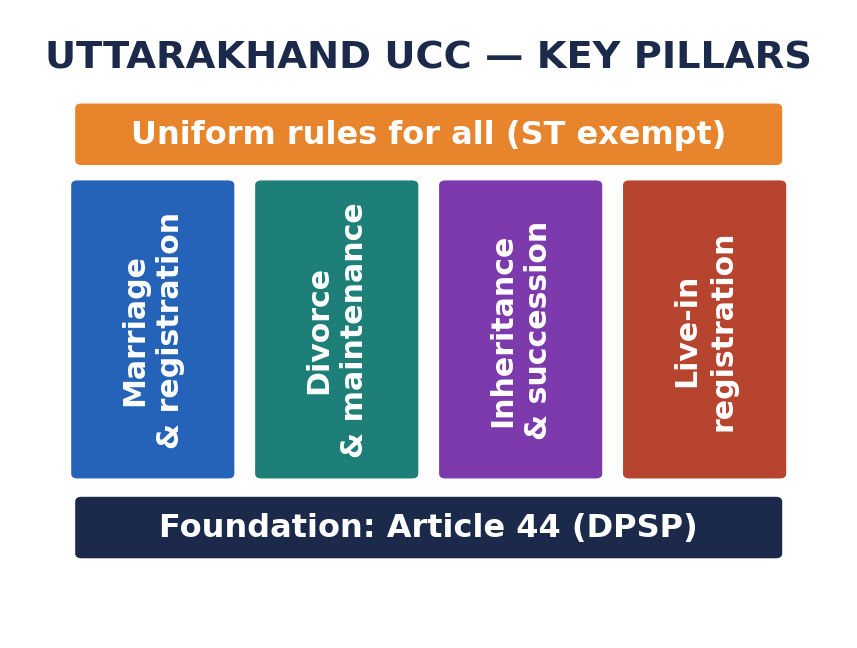
Uttarakhand — the first state to implement a UCC — has brought 2026 amendments refining rules on marriage, divorce, inheritance and live-in registration, and expanded its UCC portal.
Key facts
Uttarakhand became the first state to implement a UCC (rules notified 27 January 2025).
Smooth grievance redress, privacy safeguards for live-in data and public awareness will shape UCC's credibility and replication.
Concept
Article 44: State shall endeavour to secure a UCC. Rooted in Constituent Assembly debate (23 Nov 1948, draft Art. 35); Goa already had a common civil code.
Pillar diagram of Uttarakhand UCC covering marriage, divorce, inheritance and live-in registration, on an Article 44 base. — StudyForGS
6. India: Non-Fossil Sources Cross 54% of Installed Power Capacity
At an environment-and-climate conference, India highlighted that non-fossil sources now exceed 54% of installed electricity capacity — meeting COP-21 commitments ahead of schedule.
Key facts
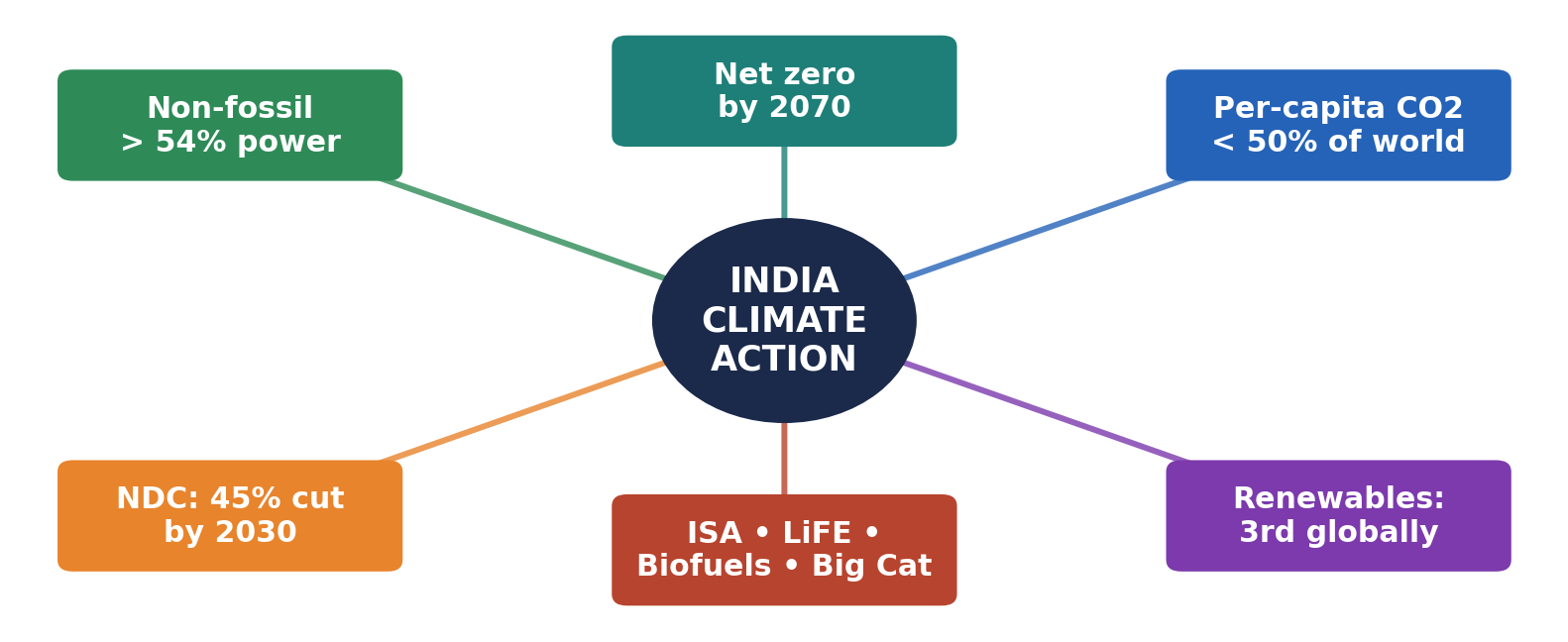
Non-fossil > 54% of installed power capacity.
Per-capita emissions < 50% of the global average.
Wind capacity tripled in ~12 years; India 3rd in renewables globally.
Updated NDC (2022): 45% emissions-intensity cut by 2030; net zero by 2070.
Leads ISA, Global Biofuels Alliance, Big Cat Alliance & Mission LiFE.
Way forward
Grid storage, green hydrogen and a just transition will sustain the clean-energy shift.
Concept
NDC = Nationally Determined Contribution under the Paris Agreement; emissions intensity = CO2 per unit GDP; ISA HQ is at Gurugram.
Mind-map of India's climate action: non-fossil 54%, NDC 45% by 2030, net zero 2070, and alliances ISA, Mission LiFE, Global Biofuels Alliance, Big Cat Alliance. — StudyForGS
7. SC: State May Prescribe National Song but Can't Force Anyone to Sing It
Fundamental Rights (Art 19, 25); freedom of speech & conscience; national symbols.
Context
The Supreme Court held that while the State may define or promote the National Song, it cannot penalise those who respectfully decline to sing it, reaffirming freedom of conscience.
Key facts
A three-judge Bench (CJI-led) ruled on the National Song question.
Reaffirmed Bijoe Emmanuel v. State of Kerala (1986) — silent, respectful objection is protected.
Grounded in Articles 19(1)(a) & 25 (speech & conscience).
Heard a challenge to the Prevention of Insults to National Honour (Amendment) Act, 2026.
Distinguished State promotion from compelled speech.
Way forward
Balancing national symbols with individual liberty needs clear, non-coercive guidelines.
Concept
Vande Mataram (Bankim Chandra) is the National Song; Jana Gana Mana is the National Anthem. Fundamental Duty 51A(a) is to respect national symbols.
8. SEMICON India 2026: ~Rs 1 Lakh Crore Pledged; Market Eyeing $200 Billion by 2035
Urbanisation; indices & reports; economic geography; liveability.
Context
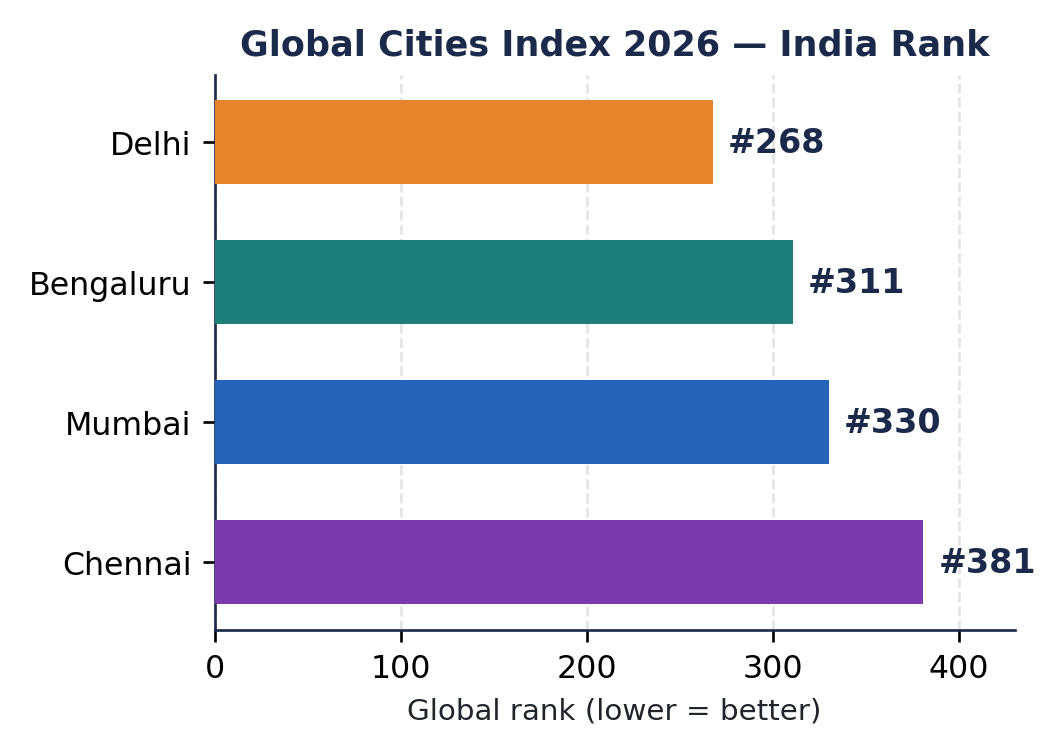
A Global Cities Index ranking shows India dominating the world's fastest-growing cities, even as Indian metros rank low on liveability and environment.
Key facts
55 of the top 100 fastest-growing cities are Indian.
Highest-ranked Indian city: Delhi, 268th (score 57.6/100).
Bengaluru 311th, Mumbai 330th, Chennai 381st.
Delhi: Human Capital 13th, but Environment 915th.
Gap = strong growth/talent vs weak liveability & air quality.
Way forward
Investing in air quality, governance and urban services can convert growth into liveability.
Concept
Such indices typically score cities on Economics, Human Capital, Quality of Life, Governance and Environment.
Horizontal bar chart of global rank of top Indian cities: Delhi 268, Bengaluru 311, Mumbai 330, Chennai 381. — StudyForGS
10. UN Gender Snapshot 2026: Funding for Equality at Lowest Since 2021
REPORTUKPSC: Prelims + Mains (Society & IR)
Syllabus linkage
Gender & development; SDGs (SDG-5); international reports.
Context
The Gender Snapshot 2026 warns that budgets for gender-equality institutions are shrinking even as women's political representation slowly rises.
Key facts
1 in 4 gender-equality mechanisms saw budget cuts.
Global equality funding at its lowest since 2021.
Women in parliaments: 27.4% (up from 22.3% in 2015).
Six in seven countries are led by men.
Tied to the SDG-5 (Gender Equality) review.
Way forward
Gender-responsive budgeting and protected funding are needed to keep SDG-5 on track.
Concept
SDG-5 targets gender equality by 2030; gender-responsive budgeting allocates funds to close gender gaps.
11. Canal-Top Solar: Land-Neutral Power With 131 GW National Potential
Renewable energy tech; land & water conservation; PM Surya Sarovar.
Context
Canal-top photovoltaics — solar panels over irrigation canals — are back in focus as a land-neutral, water-saving option with large untapped potential.
Key facts
First 1 MW canal-top plant: Narmada canal, Mehsana, Gujarat (2012).
Saves ~9 million litres water/year per stretch; generates ~1.6 million units/year.
National potential ~131 GW across canal-top/bank sites.
Top states: UP, Bihar, Karnataka, Andhra Pradesh, Punjab.
Standard designs and viability-gap funding can scale canal-top and floating solar.
Concept
CTPV cuts evaporation and saves land; floating solar sits on reservoirs — both raise the land-use efficiency of renewables.
Data point of the day
Rs 1.11 lakh crore
Uttarakhand Budget 2026-27 The FY 2026-27 state budget is about Rs 1,11,000 crore, with thrust on villages, women, education, justice (UCC & fast-track courts) and hill infrastructure.
Q1. Consider the following about Exercise Nomadic Elephant 2026: 1) It is a joint military exercise between India and Mongolia. 2) The 2026 edition is being held in Pithoragarh, Uttarakhand. 3) The Indian contingent is drawn from the Arunachal Scouts. Which of the statements are correct?
1 and 2 only
2 and 3 only
1 and 3 only
1, 2 and 3
Show answer
Answer: D All three are correct — it is the 18th India–Mongolia drill at Pithoragarh (21 Sept–3 Oct 2026), with the Indian side drawn from the Arunachal Scouts.
Q2. With reference to the Uniform Civil Code (UCC), consider the following: 1) Article 44 is a part of the Fundamental Rights. 2) Uttarakhand was the first Indian state to implement a UCC. 3) The directive on UCC is non-justiciable. Which of the statements are correct?
1 and 2 only
2 and 3 only
1 and 3 only
1, 2 and 3
Show answer
Answer: B Article 44 is a Directive Principle (Part IV), so statement 1 is wrong. Uttarakhand implemented the first state UCC (2025) and DPSPs are non-justiciable, so statements 2 and 3 are correct.
Mains practice question
Q. Uttarakhand's Himalayan geography makes it both a spiritual magnet and a disaster hotspot. Discuss the challenges of managing high-volume pilgrimage such as the Char Dham Yatra in an ecologically fragile, disaster-prone state, and suggest a sustainable model. (250 words)
Hint / approach
Cover footfall data & carrying capacity, landslide/GLOF risk, the all-weather road debate, the SDMA framework, tech-based slot & early-warning systems, and an eco-sensitive / GEP approach.
📌 One-line revision: Today: Badrinath hits record 17.79 lakh pilgrims • Nomadic Elephant 2026 at Pithoragarh • UCC 2026 amendments • SEMICON India eyes $200 bn • India non-fossil power > 54%.