Char Dham 2026 nears a record 5-crore darshan, Uttarakhand deepens its Gross Environment Product and UCC rollout, and the India-New Zealand FTA gets a 20 October start.
Wednesday, 23 September 2026 · IST · Uttarakhand + National · 12 items · 2 MCQs
Uttarakhand dominates today's brief: a near-record Char Dham Yatra with a state-wide safety review, the High Court's rebuke over Nainital's contaminated-water deaths, and continued momentum on the Gross Environment Product and Uniform Civil Code. Nationally, the India-New Zealand FTA gets an entry-into-force date, the RBI fine-tunes liquidity through VRRR, and GDP accounting shifts to a 2022-23 base with double deflation.
The state government reviewed Char Dham Yatra 2026 arrangements, with the pilgrimage nearing a record turnout and safety on Himalayan routes made the top priority.
Key facts
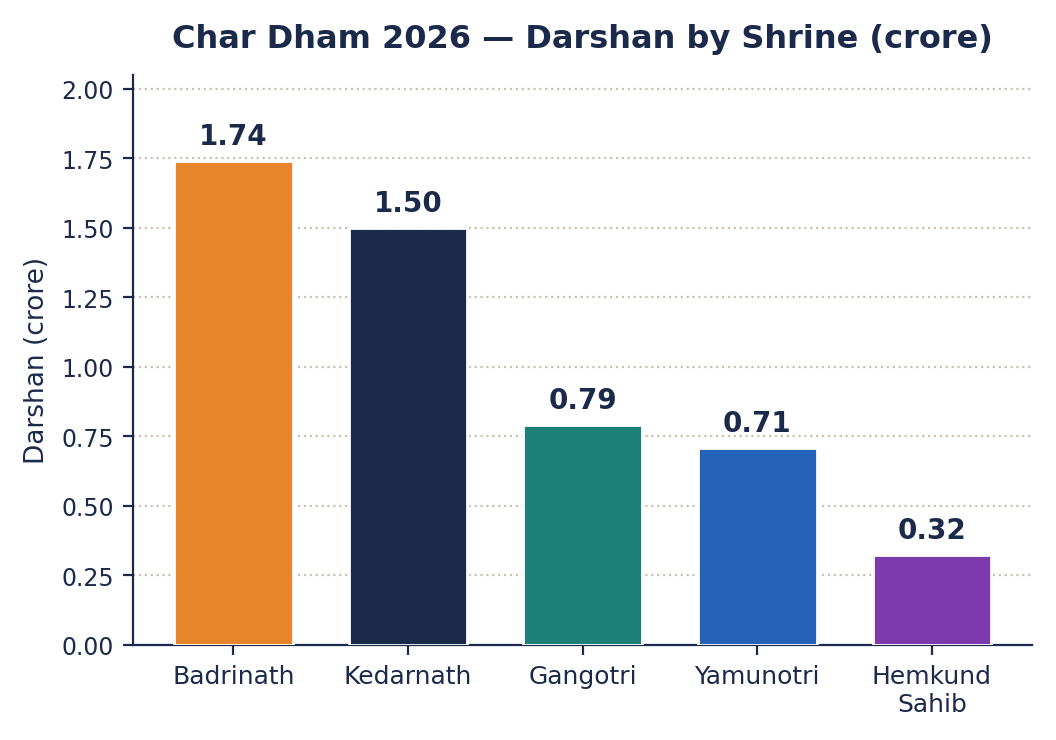
6.607 crore (66.07 million) pilgrims registered by 14 September 2026; 5.056 crore darshan completed.
High-risk stretches flagged: Chirbasa, Bhairav Glacier, Syanachatti; movement of pilgrims, horses and mules regulated.
Second horse-parking at Yamunotri, route widening for Yamunotri & Gangotri, and better mobile coverage ordered.
Way forward
Real-time, weather-linked crowd caps and carrying-capacity limits can balance faith tourism with fragile-Himalaya safety.
Concept
Char Dham = Yamunotri, Gangotri, Kedarnath, Badrinath (plus Hemkund Sahib); spread across Uttarkashi, Rudraprayag & Chamoli districts in the Garhwal Himalayas.
Bar chart of Char Dham 2026 darshan by shrine: Badrinath 1.74 cr, Kedarnath 1.50 cr, Gangotri 0.79 cr, Yamunotri 0.71 cr, Hemkund Sahib 0.32 cr. — StudyForGS
2. CM Orders Time-Bound Justice in SC/ST Atrocity Cases
SOCIETYUKPSC: Prelims + Mains (Polity, Governance & Social Justice)
Syllabus linkage
Social justice & vulnerable sections; state governance & law and order; constitutional safeguards (UKPSC GS — Polity/Society).
Context
At a state-level vigilance committee meeting on 22 September 2026, the CM directed speedy, victim-centric disposal of cases under the SC/ST (Prevention of Atrocities) Act.
Key facts
Cases pending since 2024 to be reviewed and disposed on priority with fixed timelines.
Police, administration and prosecution told to coordinate on serious and longstanding cases.
Adequate special public prosecutors and continuous monitoring of special courts ordered.
Focus on victims getting justice, security and dignity in a time-bound manner.
Way forward
District-level monitoring dashboards and victim-witness protection can cut delays and improve conviction rates.
Concept
SC/ST (Prevention of Atrocities) Act, 1989 — a special law providing Special/Exclusive Special Courts; complements Art. 17 (abolition of untouchability) and Art. 15(4).
3. High Court Slams Nainital Over 'Epidemic-Like' Water Contamination
Judiciary & PIL; Right to Life; public health governance in hill towns (UKPSC GS — Polity + Uttarakhand administration).
Context
The Uttarakhand High Court (Nainital) came down on the district administration after contaminated drinking water caused deaths and mass illness across several Nainital villages.
Key facts
2 deaths and 250+ people sickened across Jeolikote, Ganja, Virbhatti, Chhina, Beluakhan, Sariyatal (8 Sept 2026).
The bench called it 'epidemic-like', blaming unrepaired sewer and drinking-water pipelines.
DM to personally monitor relief and clean-water tankers; a sewer-leak helpline ordered.
Water-testing lab for Kumaon to be fast-tracked; 20-25 sources sampled in 6 days; ₹4 lakh released for medical testing.
Way forward
Piped-water source protection, routine potability testing and quick-response cells can prevent water-borne outbreaks in hill towns.
Concept
The Right to clean water flows from Art. 21 (Right to Life); PIL and judicial activism let High Courts (Art. 226) enforce civic duties.
Environmental economics & green accounting; Himalayan ecology; state innovations (UKPSC GS — Environment + Uttarakhand economy).
Context
Uttarakhand is India's first state to value its natural capital through a Gross Environment Product (GEP) index, complementing GDP with ecological worth.
Key facts
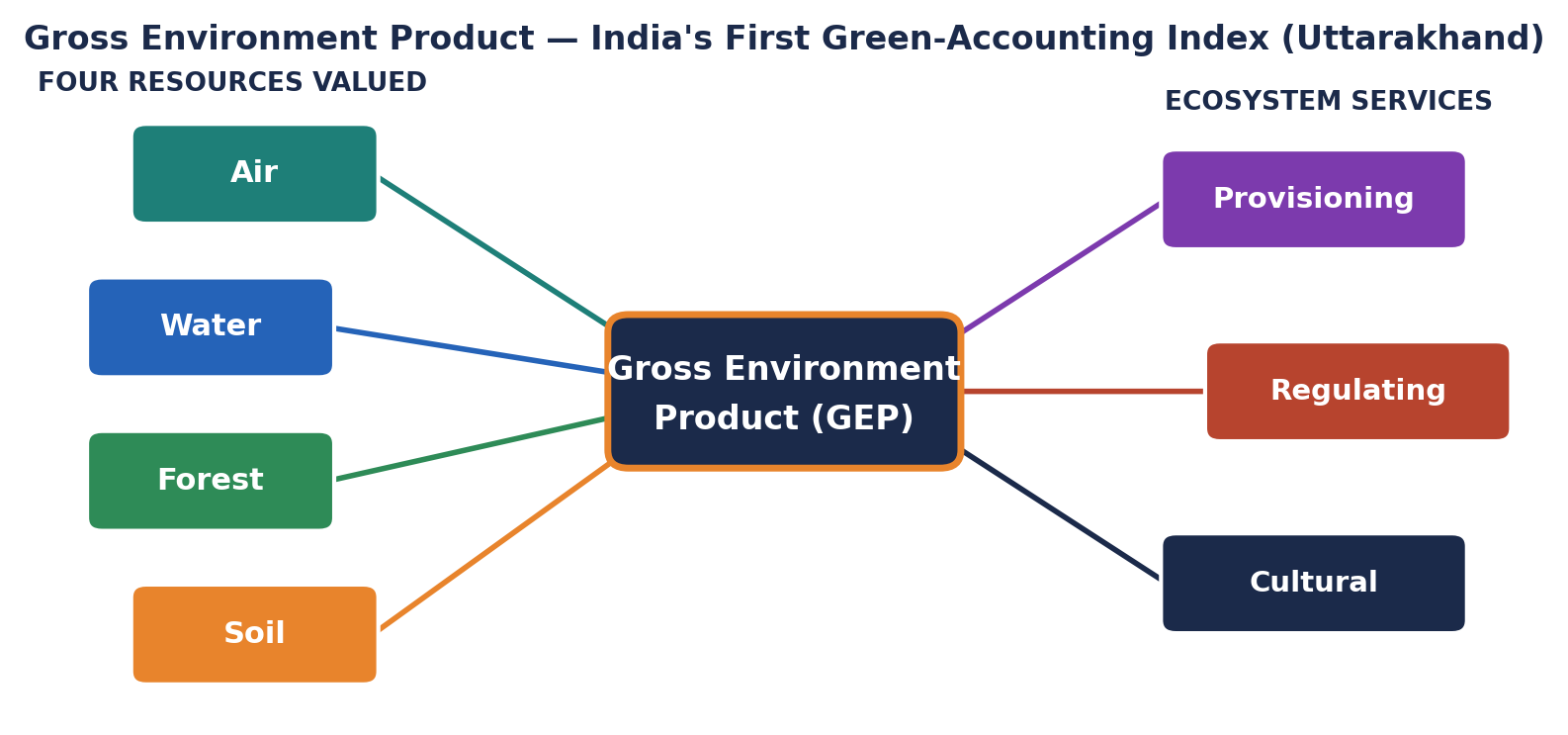
GEP assigns monetary value to four resources: air, water, forest and soil.
It covers provisioning, regulating and cultural ecosystem services.
First-of-its-kind in India (launched 2024); the index used 2020-22 data showing a 0.9% rise in environmental output.
It distinguishes man-made assets (amrit sarovars) from natural processes such as rainfall.
Way forward
Linking GEP to ecosystem-service payments and Green Bonus demands can reward Himalayan states for conservation.
Concept
GEP ≈ Green GDP — it internalises environmental degradation and biodiversity loss; about 66% of Uttarakhand's area is under forest.
Mind-map of Gross Environment Product showing four pillars (air, water, forest, soil) and three ecosystem-service types (provisioning, regulating, cultural). — StudyForGS
DPSP & Article 44; personal-law reform vs. religious freedom; state legislation (UKPSC GS — Polity, Uttarakhand-specific).
Context
Uttarakhand remains the first state to enforce a Uniform Civil Code, with the UCC Amendment Ordinance, 2026 refining rules on registration and compliance.
Key facts
UCC enforced from 27 January 2025; Amendment Ordinance, 2026 notified to ease implementation.
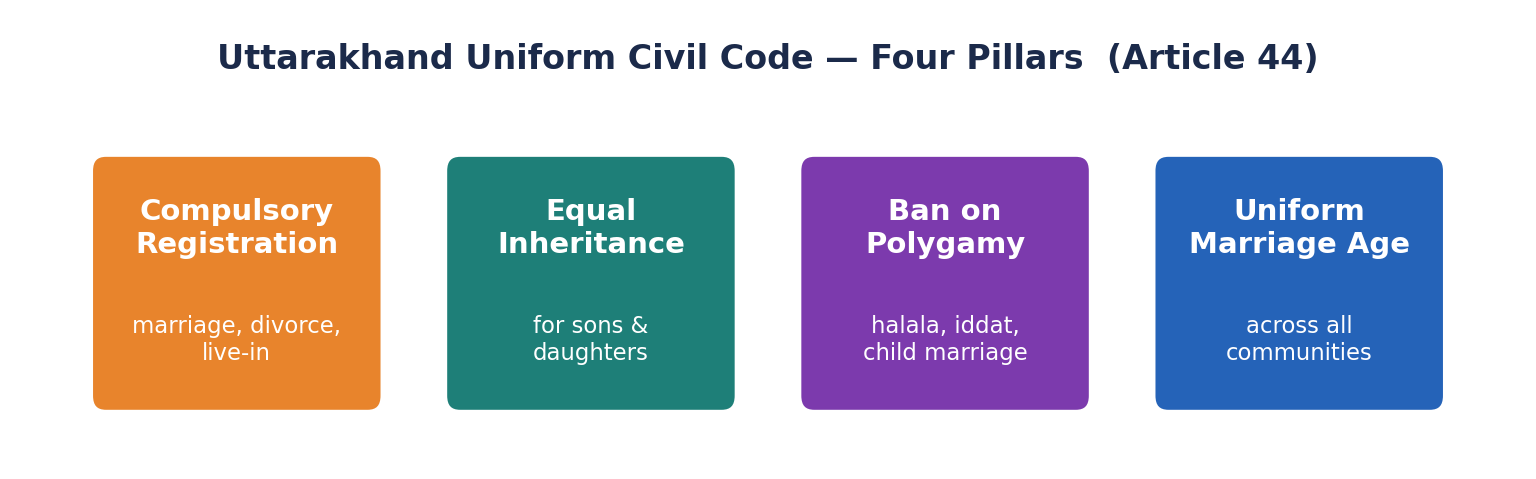
Mandatory registration of marriage, divorce and live-in relationships; equal inheritance rights.
Polygamy, halala, iddat and child marriage prohibited; a uniform marriageable age set.
Backed by Article 44 (DPSP) — the goal of a Uniform Civil Code across India.
Way forward
Clear grievance-redress and privacy safeguards for live-in registration will shape UCC's acceptance and its replication elsewhere.
Concept
Art. 44 is a Directive Principle (non-justiciable); the tension between personal-law reform and religious freedom (Art. 25) is the core debate.
Pillar diagram of Uttarakhand UCC: compulsory registration of marriage, divorce and live-in; equal inheritance; ban on polygamy/halala; uniform marriage age. — StudyForGS
A punishing 2026 monsoon — landslides blocking 100+ roads and washed-out highways — has kept Uttarakhand's disaster-response system on alert as the season winds down.
Key facts
At peak, 100+ roads were blocked; a 30-metre stretch of the Karnaprayag-Nainisain road washed away in Chamoli.
Alerts spanned Dehradun & Bageshwar (orange) and 8+ hill districts (yellow).
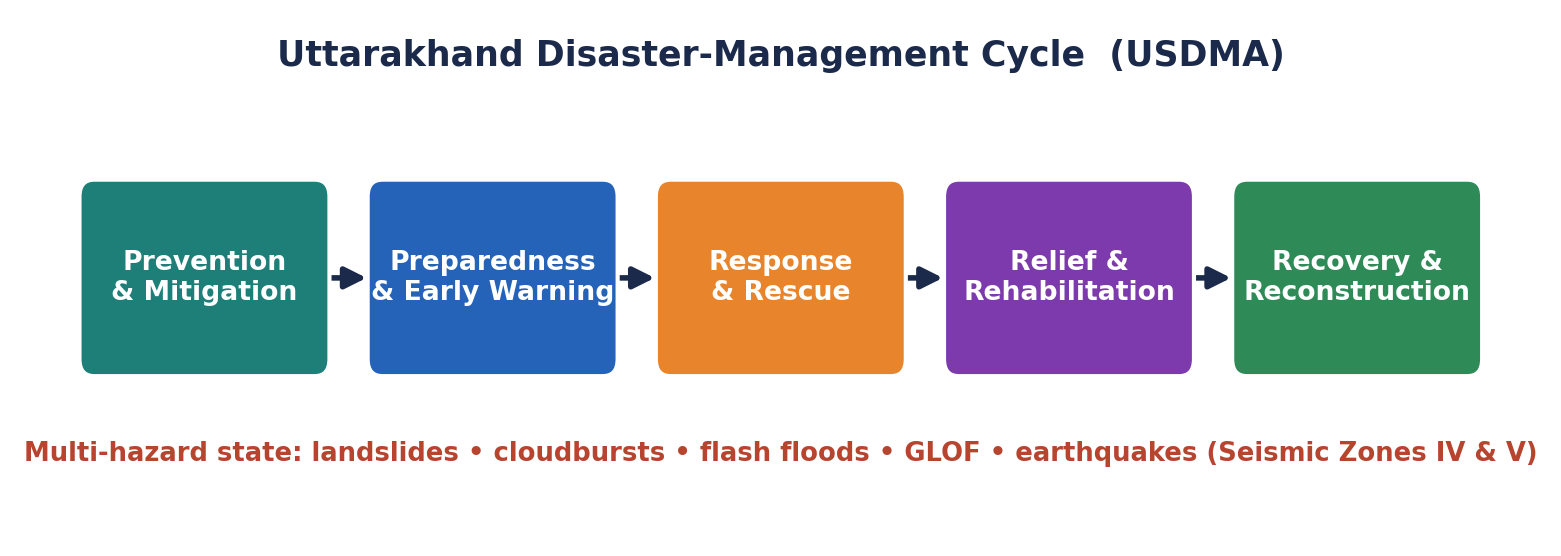
The state is prone to landslides, cloudbursts, flash floods, GLOF and earthquakes (Seismic Zones IV & V).
USDMA coordinates response; SDRF and early-warning systems are deployed.
Way forward
Glacial-lake monitoring, slope stabilisation on Char Dham routes and strict eco-sensitive-zone norms can lower disaster risk.
Concept
GLOF = Glacial Lake Outburst Flood; Uttarakhand's fragile geology plus high seismicity make it a multi-hazard Himalayan state.
7. India-New Zealand FTA to Take Effect from 20 October 2026
IRUKPSC: Prelims + Mains (International Relations & Economy)
Syllabus linkage
India & the world; trade agreements (FTA/BIT); economic diplomacy (UKPSC GS — Polity/IR & Economy).
Context
India and New Zealand's Free Trade Agreement will enter into force on 20 October 2026, opening markets and easing mobility for Indian professionals.
Key facts
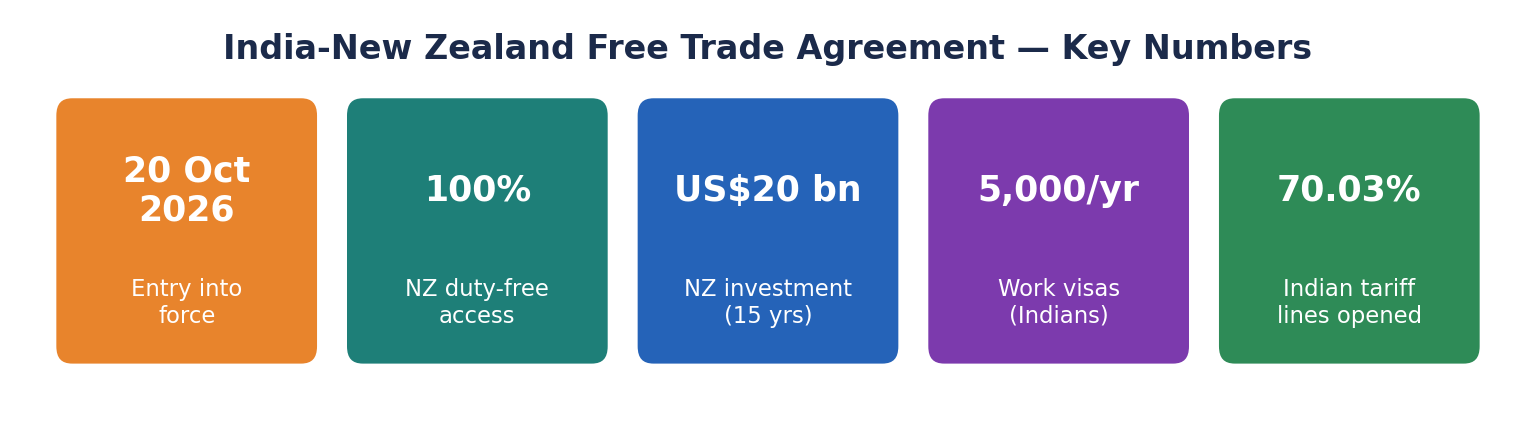
NZ offers 100% duty-free access to Indian exports from day one; India opens 70.03% of tariff lines (~95% of bilateral trade).
A US$20 billion New Zealand investment commitment over 15 years.
5,000 temporary work visas and 1,000 working-holiday visas a year for Indians; 3-year post-study work for STEM graduates.
India's arbitration base: Arbitration & Conciliation Act, 1996; recent BITs signed with UAE & Uzbekistan.
Way forward
Services mobility and mutual recognition of qualifications can make this FTA a template for India's deals with developed economies.
Concept
An FTA cuts tariffs and non-tariff barriers between partners; a BIT protects cross-border investment via ISDS dispute settlement.
Stat-tile row for India-New Zealand FTA: entry into force 20 Oct 2026, 100% NZ duty-free, US$20 bn investment, 5,000 work visas/year, 70.03% Indian tariff lines. — StudyForGS
8. RBI Drains ₹71,971 cr via VRRR to Manage Liquidity
Monetary policy & RBI tools; liquidity management; inflation control (UKPSC GS — Indian Economy).
Context
The RBI conducted a Variable Rate Reverse Repo (VRRR) auction to absorb surplus banking-system liquidity and anchor short-term rates.
Key facts
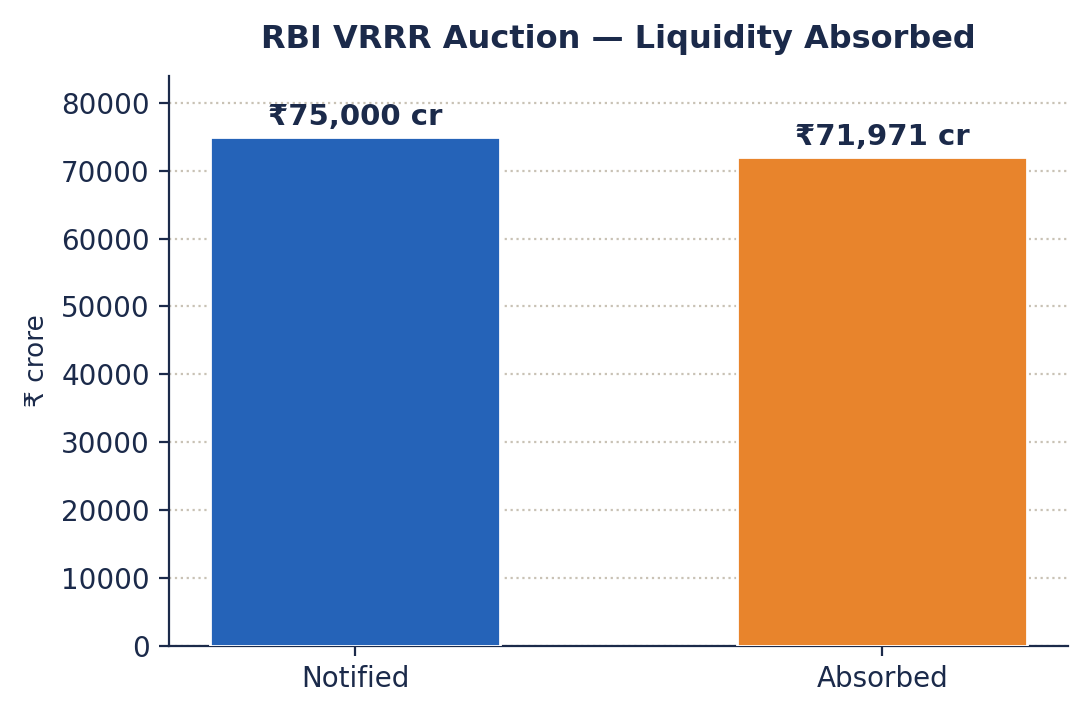
₹71,971 crore absorbed against a notified ₹75,000 crore.
VRRR mops up liquidity, while VRR injects it — both are LAF tools.
Aim: control inflation, steady overnight/call rates, and curb excess credit growth.
The policy repo rate stays the RBI's key signalling rate.
Way forward
Fine-tuning VRRR tenors helps the RBI keep the operative rate aligned with the repo rate amid volatile liquidity.
Concept
LAF (Liquidity Adjustment Facility): Repo injects, Reverse Repo/VRRR absorbs — part of the RBI's monetary-policy toolkit.
Bar chart comparing RBI VRRR notified amount ₹75,000 crore with the amount absorbed ₹71,971 crore. — StudyForGS
9. GDP Data Revamp: New Base Year 2022-23, 'Double Deflation'
ECONOMYUKPSC: Prelims + Mains (Economy — National Income Accounting)
Syllabus linkage
National income; GDP/GVA concepts; statistical systems (UKPSC GS — Indian Economy).
Context
India is overhauling its national accounts with a new base year and international best practices to improve the accuracy of GDP estimates.
Key facts
The base year shifts to 2022-23 (from 2011-12).
Double deflation adopted for manufacturing — output and input prices adjusted separately.
Greater use of GST and administrative data for real-time coverage.
It aligns India's GVA/GDP estimates with global standards.
Way forward
Timely, granular data can sharpen fiscal and monetary decisions and reduce the size of later GDP revisions.
Concept
GDP = value of final goods/services; GVA = GDP + subsidies − product taxes; the base year fixes constant (real) prices.
10. SC: No Penalty for Declining to Sing the National Song
POLITYUKPSC: Prelims + Mains (Polity — Fundamental Rights)
Syllabus linkage
Fundamental Rights; freedom of conscience; National symbols & duties (UKPSC GS — Polity).
Context
The Supreme Court is examining whether compulsory singing of Vande Mataram at public functions can attract penal consequences, testing freedom of conscience.
Key facts
The Court's view: individuals cannot be penalised for declining to recite the National Song.
It is rooted in Art. 25 (freedom of conscience) and Art. 26.
Key precedent: Bijoe Emmanuel v. State of Kerala (1986) — the National Anthem case.
Art. 51A(a) — the fundamental duty to respect the Constitution, National Flag and Anthem.
Way forward
Balancing constitutional patriotism with individual liberty keeps compulsory-expression rules within Art. 19 and 25 limits.
Concept
Vande Mataram is the National Song (Bankim Chandra Chatterjee), adopted 24 Jan 1950 — equal in status to Jana Gana Mana but with no codified singing rules.
11. India-Mongolia 'Nomadic Elephant' Military Drill Begins
DEFENCEUKPSC: Prelims + Mains (Security & International Relations)
The 18th edition of the India-Mongolia joint military exercise Nomadic Elephant has commenced, deepening counter-insurgency and mountain-warfare cooperation.
Key facts
This is the 18th edition, which began 21 September 2026.
Focus: counter-terror and counter-insurgency operations in semi-mountainous, rural terrain.
Other India drills: Khaan Quest (Mongolia, multinational), Mitra Shakti (Sri Lanka), Garuda Shakti (Indonesia).
It boosts interoperability and strategic ties in the region.
Way forward
Regular high-altitude drills strengthen India's mountain-warfare readiness, relevant to its northern borders.
Concept
Bilateral exercises build interoperability; Mongolia is a key 'third neighbour' in India's Act-East and Central-Asia outreach.
12. 55 Indian Cities Among the World's 100 Fastest-Growing
The Global Cities Index 2026 places a majority of the world's fastest-growing cities in India, underscoring its urban-economic momentum.
Key facts
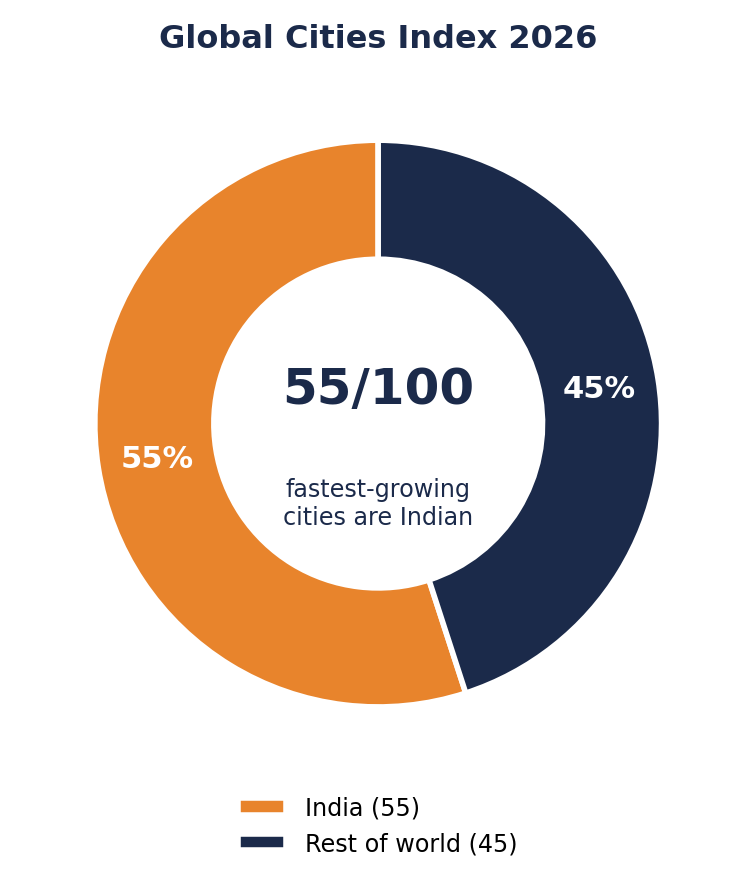
55 of 100 fastest-growing cities (by GDP growth) are Indian.
Delhi ranked 268 overall on the broader global list.
The index weighs economics, human capital, quality of life, environment and governance.
It signals India's rising urban share of GDP and consumption.
Way forward
Investment in urban infrastructure, jobs and climate resilience can convert fast growth into higher liveability ranks.
Concept
A Global Cities Index benchmarks cities on multi-dimensional strength; rapid growth need not mean a high absolute rank (base effect).
Donut chart showing 55 of the 100 fastest-growing global cities are Indian and 45 are from the rest of the world. — StudyForGS
Data point of the day
~₹1.11 lakh crore
Uttarakhand State Budget, FY 2026-27 The state cabinet cleared a record budget of about ₹1.11 lakh crore for 2026-27, prioritising infrastructure, hill-area development and disaster resilience (official state release).
Prelims rapid-fire
NSWS (National Single Window System) uses PAN as a Single Business ID; run by DPIIT; launched 22 Sept 2021.
National Ayush Mission received ₹6,406.99 crore (2014-15 to 2025-26); it is a Centrally Sponsored Scheme.
Punjab groundwater extraction is at 156.87%; 115 of 153 units over-exploited — scheme 'Paani Bachao, Paisa Kamao'.
Bab el-Mandeb Strait links the Red Sea to the Gulf of Aden; Perim Island lies within it.
Agasthyamalai Biosphere Reserve lies in the Southern Western Ghats, spanning Kerala & Tamil Nadu.
Uttarakhand holds a record of 18 GI tags in a single day; e.g., Uttarakhand Pahari Toor Dal.
Practice MCQs — UKPSC Prelims pattern
Q1. With reference to Uttarakhand's Gross Environment Product (GEP), consider: 1) It assigns a monetary value to air, water, forest and soil. 2) Uttarakhand was the first Indian state to launch it. 3) It is designed to replace GDP as the sole growth measure. Which are correct?
1 and 2 only
2 and 3 only
1 and 3 only
1, 2 and 3
Show answer
Answer: A GEP values four resources and Uttarakhand launched it first (2024); it complements — not replaces — GDP. Hence 1 and 2 only.
Q2. The Variable Rate Reverse Repo (VRRR), often in the news, is used by the RBI primarily to:
Inject liquidity into the banking system
Absorb surplus liquidity from the banking system
Set the government's fiscal deficit target
Regulate foreign exchange reserves
Show answer
Answer: B VRRR is an LAF tool to absorb/mop up surplus liquidity; repo injects liquidity. The RBI notified ₹75,000 cr and absorbed ₹71,971 cr.
Mains practice question
Q. Uttarakhand's fragile Himalayan geography makes disaster management central to its governance. Discuss the state's key hazards and suggest a road map for building disaster resilience. (250 words)
Hint / approach
Cover landslides, cloudbursts, flash floods, GLOF and seismic Zones IV/V; the role of USDMA/SDRF, early-warning systems, eco-sensitive-zone regulation, carrying-capacity limits on pilgrim routes, and slope stabilisation.
📌 One-line revision: Revise: Char Dham 5.05 cr darshan • GEP values air-water-forest-soil • UCC = Art. 44 • VRRR absorbs liquidity • India-NZ FTA from 20 Oct 2026 • GDP base year 2022-23.