Monday, 21 September 2026 · IST · Uttarakhand + National · 11 items · 2 MCQs
Uttarakhand dominates today's board: the Char Dham Yatra's first phase closed as the most-attended ever (50.56 lakh) with phase 2 now open, the High Court cleared the way to relocate from Nainital toward Haldwani, and the homestay scheme's ₹79.28 crore push is driving reverse migration. Nationally, retail inflation rose to 4.82% with the repo held at 5.25%, the Semiconductor Mission's ₹1.27-lakh-crore Phase 2 targets full-stack chipmaking, and a new US law threatens 100% tariffs on buyers of Russian oil.
Today at a glance — things to remember
Char Dham phase-1: record 50.56 lakh pilgrims; phase-2 on from 15 Sept.
Uttarakhand HC cleared to move Nainital -> Haldwani region.
Homestay scheme: ₹79.28 cr to 537 beneficiaries; ~6,500 reverse migrants.
UCC live-in registration & equal inheritance rolling out (since 27 Jan 2026).
GEP — Uttarakhand's India-first green accounting model.
Retail inflation 4.82%; RBI repo steady at 5.25%.
US law allows 100% tariff on Russian-oil buyers — India watch.
Semiconductor Mission-2: ₹1.27 lakh cr for full-stack chips.
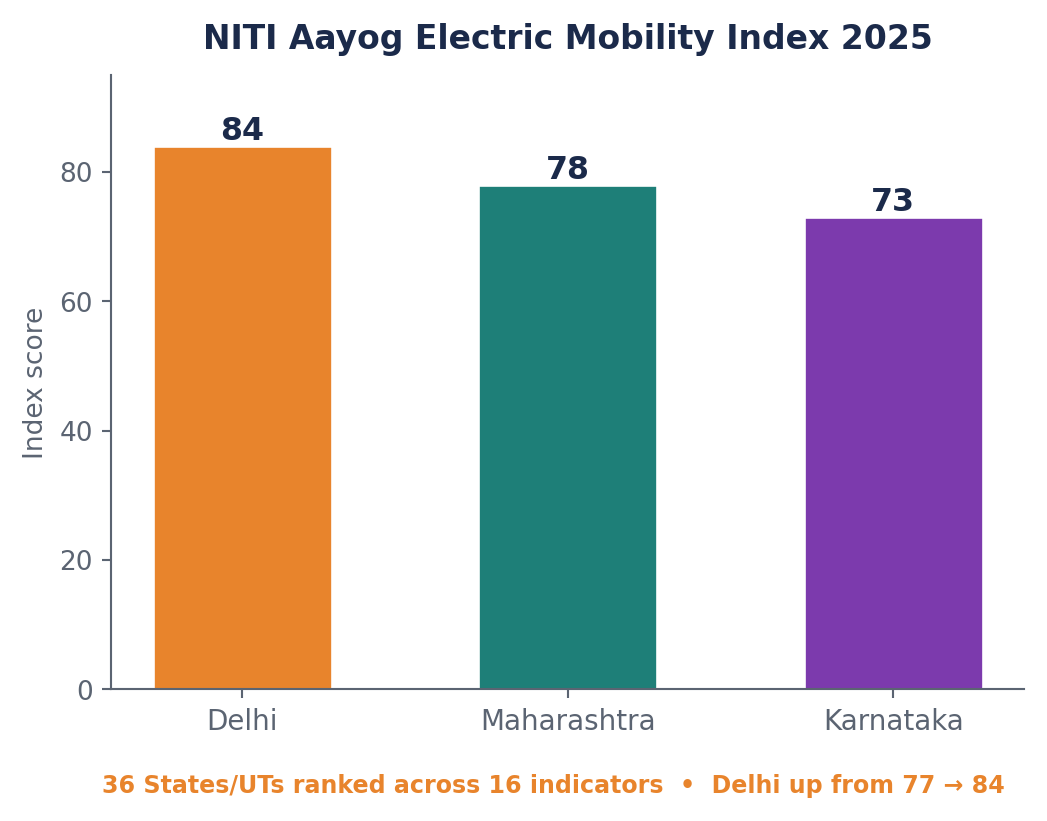
NITI EV Mobility Index: Delhi tops (84).
GIFT City rises to 37th in GFCI; EPFO ceiling up to ₹25,000.
The 2026 Char Dham Yatra's first phase closed as the most-attended ever; the post-monsoon second phase began on 15 September, with the CM reviewing arrangements at Badrinath.
Key facts
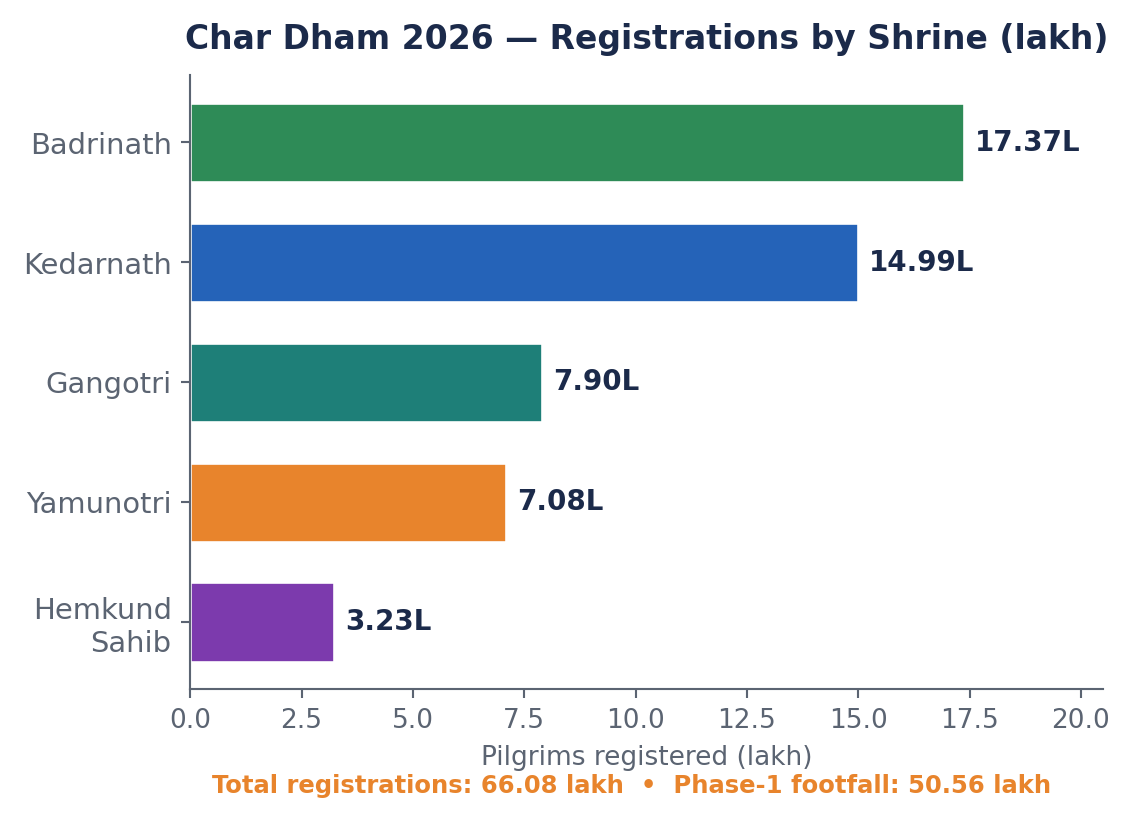
Phase-1 footfall: 50.56 lakh pilgrims (as of 14 Sept); total registrations: 66.08 lakh.
Shrine-wise: Badrinath 17.37 L, Kedarnath 14.99 L, Gangotri 7.90 L, Yamunotri 7.08 L, Hemkund Sahib 3.23 L.
The four dhams: Yamunotri (Yamuna, Uttarkashi), Gangotri (Bhagirathi, Uttarkashi), Kedarnath (Mandakini, Rudraprayag), Badrinath (Alaknanda, Chamoli).
Second phase began 15 September 2026; mandatory online registration continues for crowd control.
Way forward
Real-time crowd-cap dashboards, health screening on hill stretches and a permanent carrying-capacity study can make the yatra safer and greener.
Concept
Char Dham = Himalayan circuit in Garhwal; Panch Prayag confluences feed the Alaknanda; Hemkund Sahib is a Sikh shrine near the Valley of Flowers.
Horizontal bar chart of Char Dham 2026 registrations by shrine in lakh: Badrinath 17.37, Kedarnath 14.99, Gangotri 7.90, Yamunotri 7.08, Hemkund Sahib 3.23. — StudyForGS
2. Uttarakhand HC clears path to shift from Nainital to Haldwani
State judiciary; High Court seat; Prelims: Uttarakhand HC (Nainital, est. 2000).
Context
A division bench dismissed as premature a plea challenging the proposed relocation of the Uttarakhand High Court from Nainital to the Haldwani region, citing space and access constraints.
Key facts
Bench of Justice Manoj Kumar Tiwari and Justice Pankaj Purohit dismissed the challenge (early Sept 2026).
Nainital cited for 'acute lack of space and inadequate infrastructure', high living costs and poor connectivity for litigants.
Full court (19 June) approved shifting to ~73 hectares of forest land in the Tarai-Central Forest Division near Rudrapur.
Site is ~10 km from the elephant corridor; forest de-reservation and statutory clearances still pending.
Way forward
Balancing judicial access with elephant-corridor and forest safeguards, through due Forest (Conservation) Act clearances, will decide the move's legality.
Concept
The Uttarakhand High Court was established in 2000 at Nainital; relocating a HC seat involves executive notification and forest-law clearances.
3. Homestay policy powers 'reverse palayan' in the hills
UTTARAKHANDUKPSC: Prelims + Mains (Economy & Society - Uttarakhand)
Syllabus linkage
Hill economy, tourism, migration (palayan); Prelims: Deen Dayal Upadhyay Homestay Scheme.
Context
State data show the Deen Dayal Upadhyay Homestay Development Scheme is anchoring rural tourism and pulling migrants back to their villages.
Key facts
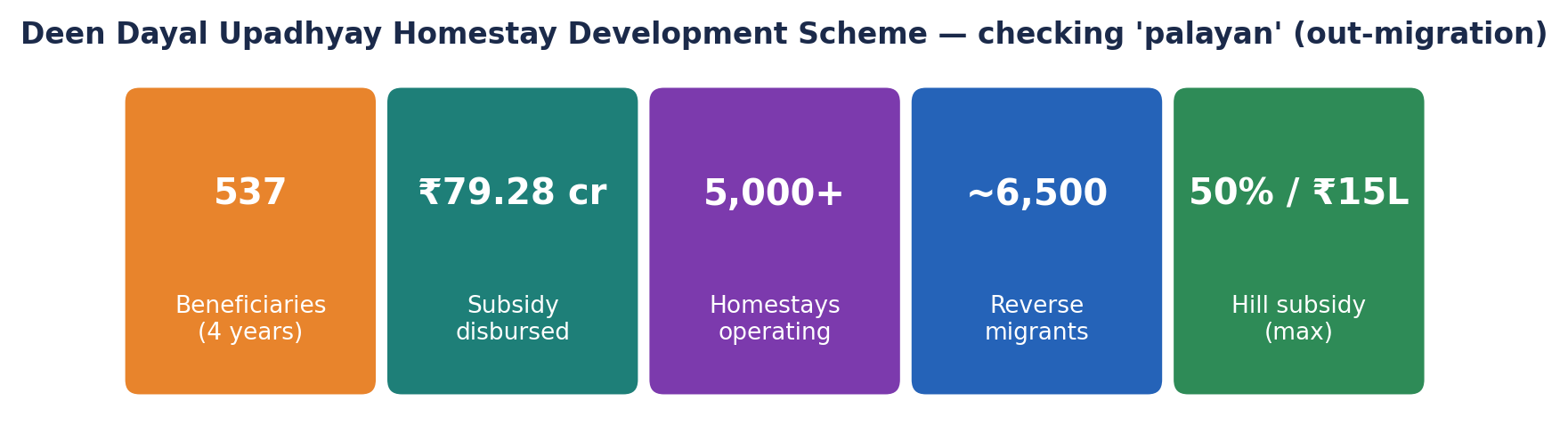
537 beneficiaries received ₹79.28 crore subsidy over four years.
Over 5,000 homestays now operate statewide; ~6,500 migrants returned, ~22% taking up homestays.
Subsidy: 50% (max ₹15 lakh) in hills, 25% (max ₹7.5 lakh) in plains; only Uttarakhand natives eligible.
A Trekking Traction Centre Homestay sub-scheme aided 258 applicants under 'My Plan, My Government'.
Way forward
Linking homestays with GI produce, trek routes and skill training can make reverse-migration durable and spread tourism beyond the Char Dham belt.
Concept
Palayan = out-migration from hill villages; reverse migration restores demographic balance and revives 'ghost villages' (bhutiya gaon).
Stat-tile row for the Deen Dayal Upadhyay Homestay Development Scheme: 537 beneficiaries, ₹79.28 crore subsidy, 5,000+ homestays, ~6,500 reverse migrants, 50% / ₹15 lakh maximum hill subsidy. — StudyForGS
Uttarakhand remains the first state to enforce a Uniform Civil Code; its portal-based marriage, divorce and live-in registration system keeps expanding under the 2026 amendment.
Key facts
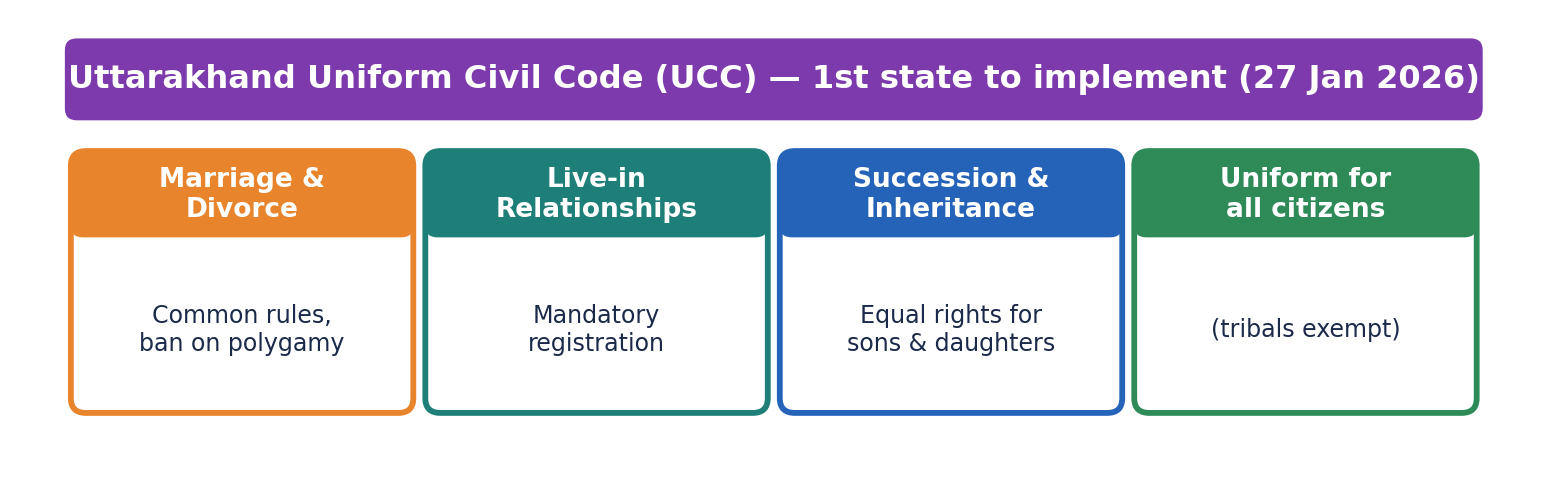
UCC came into force 27 January 2026; Uttarakhand is the first state to implement one post-Independence.
Common rules on marriage, divorce, succession and inheritance; polygamy and halala barred; equal inheritance for daughters.
Scheduled Tribes are exempted; rooted in Article 44 (DPSP) directive for a uniform civil code.
Way forward
Awareness drives, privacy safeguards for live-in data and smooth grievance redress will shape how the model is judged by other states.
Concept
Article 44 (DPSP) urges the State to secure a UCC; DPSPs are non-justiciable (Art. 37) yet fundamental to governance.
Four-card flow of the Uttarakhand Uniform Civil Code: marriage & divorce common rules, mandatory live-in registration, equal succession & inheritance, uniform for all citizens with tribals exempt. — StudyForGS
5. Gross Environment Product: Uttarakhand values its nature
Green accounting; Himalayan ecology; Prelims: GEP (India's first, Uttarakhand).
Context
Uttarakhand's Gross Environment Product framework - the first of its kind in India - continues to be projected as a green-growth model alongside GDP.
Key facts
Uttarakhand launched India's first GEP to value ecological wealth alongside economic output.
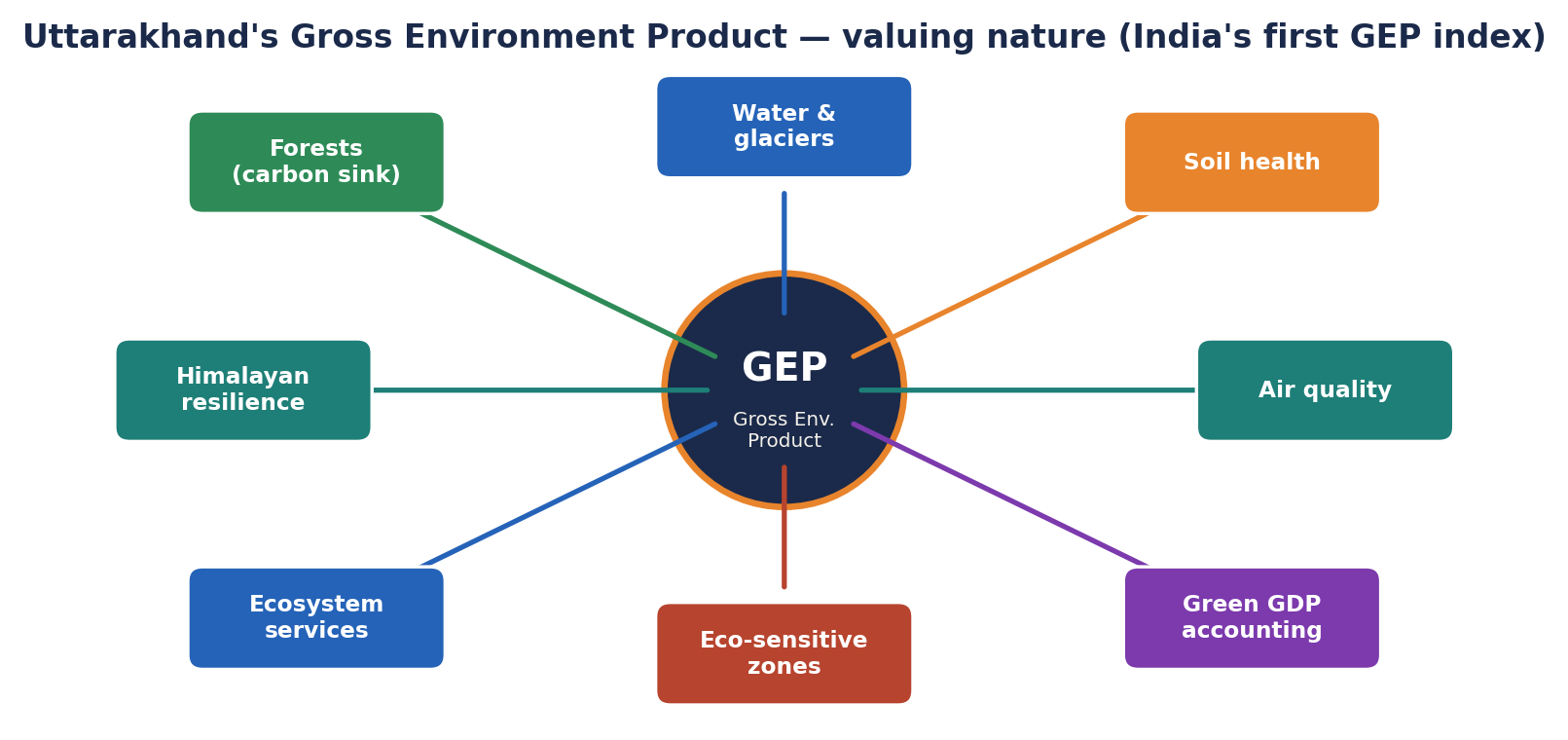
GEP measures four services: air, water, soil and forest.
Aligns with the state's push on eco-sensitive zones, green bonuses and Himalayan resilience.
Complements Green GDP accounting and the demand for a Green Bonus for Himalayan states.
Way forward
Statutory GEP audits and payments-for-ecosystem-services could turn conservation into a revenue stream for hill communities.
Concept
GEP = monetary value of ecosystem services; kin to Green GDP, which nets natural-resource depletion from output.
Mind-map of Uttarakhand's Gross Environment Product with GEP at the centre linked to forests, water & glaciers, soil health, air quality, green GDP accounting, eco-sensitive zones, ecosystem services and Himalayan resilience. — StudyForGS
6. Retail inflation climbs to 4.82%, repo held at 5.25%
August CPI data show retail inflation edging up, keeping the RBI's neutral stance and repo rate steady with a positive real policy rate.
Key facts
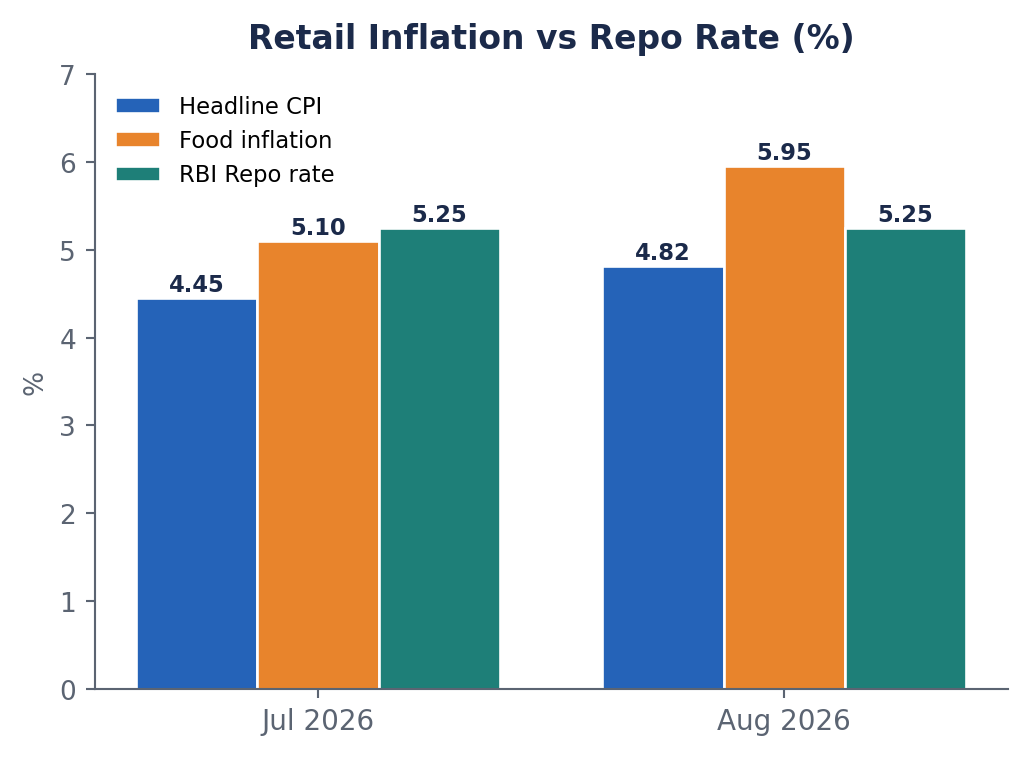
CPI August 2026: 4.82%, up from 4.45% in July; food inflation 5.95%.
Repo rate: 5.25% (neutral stance); positive real policy rate.
Credit growth 19.1% vs deposit growth 17.8%; credit-deposit ratio 80.3%.
GDP growth 7.8%; inflation stays within the RBI 4% (+/-2%) band.
Way forward
The MPC is likely to stay data-dependent, watching food prices and global oil before any rate move.
Concept
Repo rate = rate at which RBI lends to banks; the CPI target is 4% (+/-2%) under flexible inflation targeting.
Grouped bar chart of headline CPI, food inflation and RBI repo rate for July and August 2026: CPI 4.45% to 4.82%, food 5.10% to 5.95%, repo steady at 5.25%. — StudyForGS
7. US law authorises 100% tariff on buyers of Russian oil
IRUKPSC: Prelims + Mains (International Relations & Economy)
Syllabus linkage
India-US-Russia ties; energy security; Prelims: sanctions, trade.
Context
A new US sanctions law empowers 100% tariffs on countries importing Russian oil, with direct implications for India's crude sourcing and exports.
Key facts
Law authorises 100% tariffs on importers of Russian oil, atop existing duties.
US takes ~20% of India's goods exports; Russia supplied 51%+ of India's oil imports (July 2026).
Requires a written waiver justification to the US Congress.
Sharpens India's energy-security vs market-access trade-off.
Way forward
India will likely diversify crude sources and press for exemptions while safeguarding its strategic autonomy.
Concept
Strategic autonomy = India's policy of independent choices; secondary sanctions penalise third countries dealing with a sanctioned state.
Electronics manufacturing, self-reliance; Prelims: India Semiconductor Mission.
Context
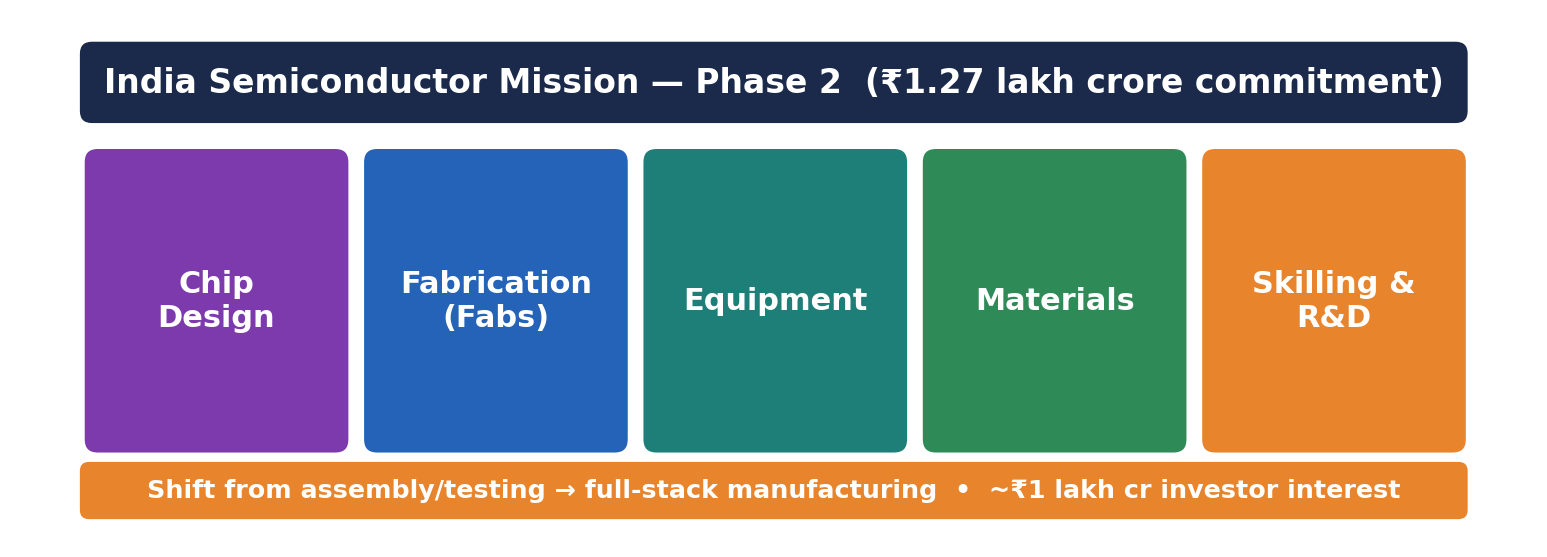
The second phase of the India Semiconductor Mission shifts focus from packaging toward full-stack chipmaking, backed by a large government commitment.
Key facts
Government commitment: ₹1.27 lakh crore under Phase 2; ~₹1 lakh crore investor interest received.
Widens scope to design, fabrication, equipment and materials (from assembly/testing).
Five-year goal: chips for automobiles, power systems and appliances.
Advances Atmanirbhar Bharat and cuts import dependence in electronics.
Way forward
Skilling, water-and-power-ready fab clusters and a resilient materials supply chain will decide execution.
Concept
Semiconductor = material for chips; India's mission targets the full value chain - design -> fab -> ATMP (assembly, test, marking, packaging).
Pillar diagram of India Semiconductor Mission Phase 2 (₹1.27 lakh crore) with five pillars: chip design, fabrication, equipment, materials, and skilling & R&D, shifting from assembly/testing to full-stack manufacturing. — StudyForGS
9. NITI Aayog Electric Mobility Index 2025: Delhi tops
Expands retirement-savings coverage for more formal workers.
Administered by EPFO under the Ministry of Labour & Employment.
Way forward
Higher ceilings must be paired with easy portability (UAN) and pension-adequacy reforms.
Concept
EPFO manages the EPF/EPS; employer and employee each contribute 12% of basic wages to provident fund.
11. GIFT City jumps to 37th in Global Financial Centres Index
ECONOMYUKPSC: Prelims (Economy & Institutions)
Syllabus linkage
Financial hubs, IFSC; Prelims: GIFT City, GFCI.
Context
India's GIFT City climbed nine places in the latest Global Financial Centres Index, reinforcing its role as an international finance hub.
Key facts
GIFT City rose to 37th (from 46th) in GFCI 40.
New York topped, followed by London and Hong Kong.
GIFT City hosts India's first IFSC, regulated by IFSCA.
Boosts India's ambition as a global fintech and bullion gateway.
Way forward
Deeper product lines and tax certainty can help GIFT City rival established Asian centres.
Concept
GIFT City = Gujarat International Finance Tec-City; its IFSC is regulated by a unified regulator, IFSCA.
Data point of the day
50.56 lakh pilgrims
Char Dham Yatra 2026 - Phase 1 Highest-ever first-phase footfall; total registrations touched 66.08 lakh, with the yatra reopening for its second phase on 15 September 2026.
Prelims rapid-fire
GOBARdhan: Compressed Biogas (CBG) priced at ₹2,110/MMBTU (₹98/kg), with ₹10/kg support for 10 years.
Karnataka gave Tulu additional official-language status in Dakshina Kannada & Udupi; ₹82 lakh/yr for translation.
NPCI: UPI transactions above ₹2,000 to attract 0.4% MDR from 15 Oct 2026; below ₹2,000 stay free.
Arthur M. Bueche Award 2026 went to Indian-American Sethuraman Panchanathan - a first for an Indian-origin scientist.
Registration of Births & Deaths (Amendment) Act 2026 effective 1 Oct 2026; digital birth certificate as single document.
Swachhata Hi Seva 2026: 17 Sept-2 Oct, theme 'Swachhata Mein Sahbhag; Swachh Bharat, Viksit Bharat'.
Practice MCQs — UKPSC Prelims pattern
Q1. With reference to the Char Dham Yatra, consider the following shrine-river pairs: 1. Kedarnath - Mandakini 2. Badrinath - Alaknanda 3. Yamunotri - Bhagirathi. Which of the pairs is/are correctly matched?
1 and 2 only
2 and 3 only
1 and 3 only
1, 2 and 3
Show answer
Answer: A Kedarnath lies on the Mandakini and Badrinath on the Alaknanda. Yamunotri is the source area of the Yamuna, not the Bhagirathi (which is linked to Gangotri). Hence 1 and 2 only.
Q2. The 'Gross Environment Product (GEP)', recently in news, was launched first by which Indian state, and it primarily values which of the following?
Sikkim; only forest cover
Uttarakhand; air, water, soil and forest services
Himachal Pradesh; hydropower output
Kerala; coastal ecosystems only
Show answer
Answer: B Uttarakhand launched India's first GEP, valuing four ecosystem services - air, water, soil and forest - as a green counterpart to GDP.
Mains practice question
Q. Uttarakhand's homestay policy is being projected as a tool against 'palayan' (out-migration). Examine how tourism-led livelihood models can address hill-region migration, and the risks they must guard against.
Hint / approach
Cover reverse-migration data (537 beneficiaries, ~6,500 returnees), employment and GI/trek linkages; risks - carrying capacity, ecological stress, uneven benefits; suggest carrying-capacity limits and skill support.
📌 One-line revision: Char Dham phase-1 record 50.56 lakh | UK HC to Haldwani | Homestay ₹79.28 cr reverse-palayan | UCC live-in registration | GEP green accounting | CPI 4.82% / repo 5.25% | Semiconductor Mission-2 ₹1.27 lakh cr | GIFT City 37th.