Thursday, 17 September 2026 · IST · Uttarakhand + National · 10 items · 2 MCQs
Uttarakhand CM Pushkar Singh Dhami launched the month-long Seva Sankalp Abhiyan (17 Sep–17 Oct) to take welfare schemes to the grassroots under the Viksit Bharat 2047 vision. The 2026 Char Dham Yatra crossed 50 lakh pilgrims as its second phase began, keeping crowd and disaster management in focus. Nationally, the Union Cabinet raised the mandatory EPFO wage ceiling from ₹15,000 to ₹25,000, and India's Q1 FY27 GDP grew a strong 7.8%.
Today at a glance — things to remember
Seva Sankalp Abhiyan runs 17 Sep–17 Oct across all 13 districts
State governance & schemes; welfare delivery; Uttarakhand-specific GS component.
Context
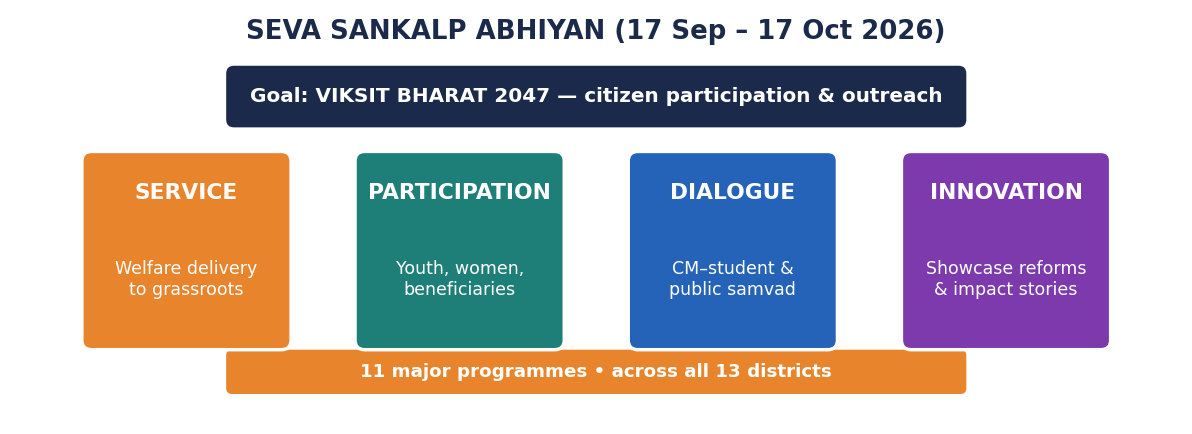
Marking PM Modi's birthday, the Chief Minister flagged off the Seva Sankalp Abhiyan, a month-long (17 Sep–17 Oct 2026) citizen-outreach drive linked to the Viksit Bharat 2047 goal.
Key facts
Runs 17 September to 17 October 2026 across all 13 districts.
11 major programmes planned around service, participation, dialogue and innovation.
Targets students, youth, women, beneficiaries and public representatives.
Aim: showcase scheme benefits and real-life beneficiary impact stories.
Way forward
Effective last-mile delivery and grievance redress will decide the drive's real impact.
Concept
Viksit Bharat 2047: vision to make India a developed nation by the centenary of independence; 'saturation' approach seeks 100% scheme coverage of eligible beneficiaries.
Pillar diagram of the Seva Sankalp Abhiyan showing service, participation, dialogue and innovation pillars supporting the Viksit Bharat 2047 goal. — StudyForGS
2. Nainital High Court raps state on encroachment, teacher transfers
Judiciary & High Courts; PIL; urban drainage/encroachment; administrative accountability.
Context
The High Court of Uttarakhand (Nainital) took a strict view on storm-water drain encroachments and on the difficult-to-easy transfer policy for teachers, seeking the government's stand.
Key facts
Court sought a clear status report on drain encroachment removal.
Directed the Education Director to respond on teacher transfer grievances.
Nainital is the seat of the Uttarakhand High Court (est. 2000).
Reflects growing use of judicial oversight over hill-town civic issues.
Way forward
Time-bound compliance and transparent transfer norms can reduce repeat litigation.
Concept
High Court powers flow from Articles 226/227 (writs & superintendence); a PIL lets courts act on public-interest grievances.
Pilgrimage tourism; crowd & disaster management; Himalayan geography of Uttarakhand.
Context
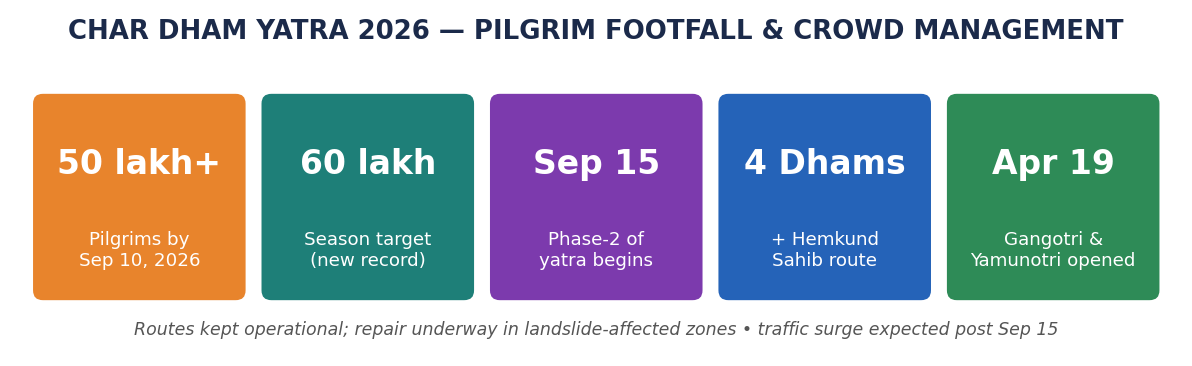
The second phase of the 2026 Char Dham Yatra began on 15 September, with pilgrim footfall crossing 50 lakh by 10 September and a season target of ~60 lakh.
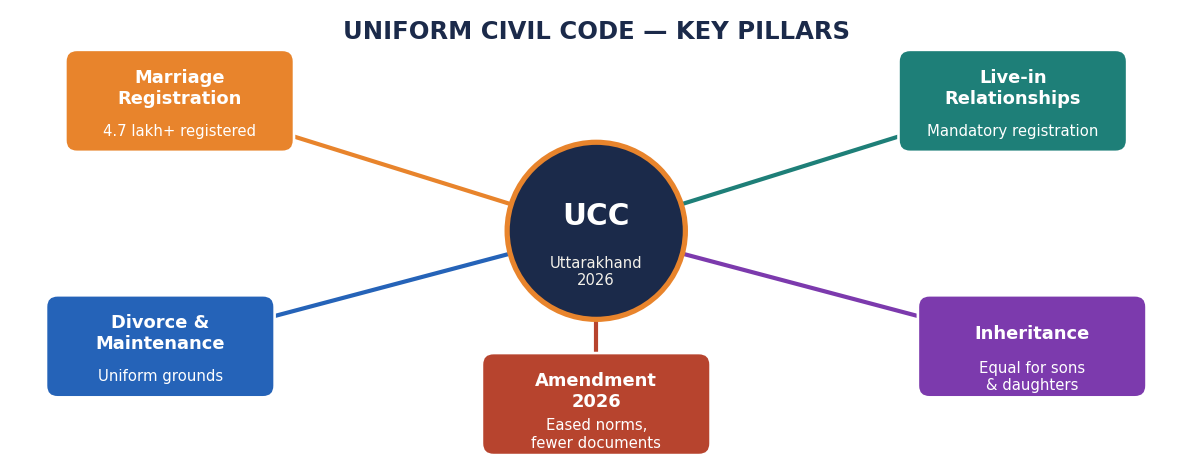
Uttarakhand — the first state to implement a UCC (from 27 Jan 2025) — has registered over 4.7 lakh marriages online; UCC Amendment 2026 further eased marriage and live-in norms.
Key facts
First state in independent India to enforce a Uniform Civil Code.
Online portal enables marriage, divorce, live-in & will registration.
UCC Amendment 2026 eased documentation and live-in registration rules.
UCC flows from Article 44 — a Directive Principle of State Policy.
Way forward
Privacy safeguards for live-in data and awareness in rural areas remain the key challenges.
Concept
Article 44 (DPSP): State shall endeavour to secure a Uniform Civil Code; DPSPs are non-justiciable but fundamental to governance.
Mind-map of Uttarakhand's Uniform Civil Code covering marriage registration, live-in, divorce, inheritance and the 2026 amendment. — StudyForGS
5. Homestay scheme offers up to ₹15 lakh to curb hill 'palayan'
Rural tourism; out-migration (palayan); livelihoods; hill-area development economics.
Context
To fight out-migration ('palayan'), the state's homestay scheme offers subsidy/incentives up to ₹15 lakh to help residents run rural tourism ventures in their villages.
Key facts
Incentives support construction & upgrade of village homestays.
Aim: jobs, rural revival and reverse migration in hill districts.
Complements Uttarakhand's push for year-round, off-season tourism.
Migration ('palayan') has emptied many 'ghost villages' in the hills.
Way forward
Skill training, marketing linkages and easy credit will decide the scheme's uptake.
Concept
Palayan (out-migration): large-scale movement from hill villages to plains/cities for jobs; the Rural Development & Migration Commission tracks it in Uttarakhand.
6. Uttarakhand runs India's first Gross Environment Product (GEP)
Green accounting; ecosystem services valuation; Himalayan ecology; sustainable development.
Context
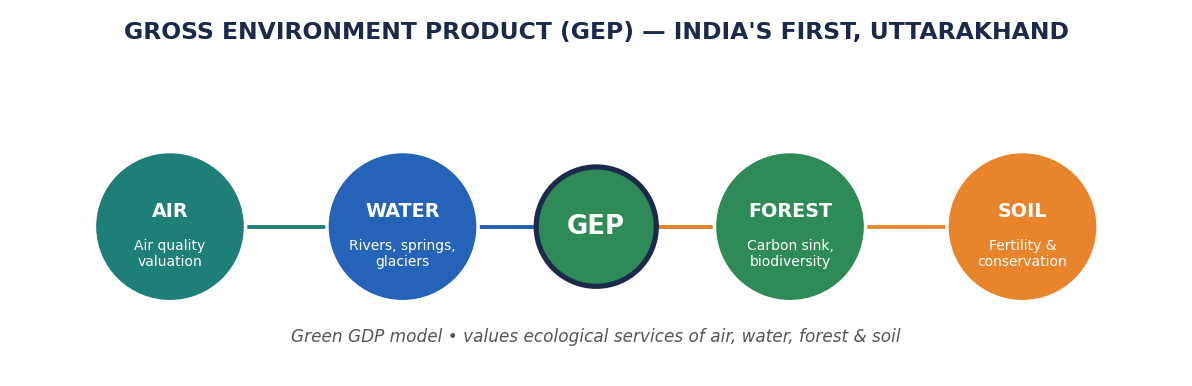
Uttarakhand pioneered India's first Gross Environment Product (GEP) — a 'green GDP' that assigns economic value to the state's air, water, forest and soil services.
Key facts
GEP values four components: air, water, forest and soil.
First-of-its-kind environmental valuation by any Indian state.
Links ecology with economy for evidence-based green policy.
Reinforces Uttarakhand's identity as a Himalayan ecological state.
Way forward
Periodic GEP updates can guide payments for ecosystem services and green budgeting.
Concept
Ecosystem services: benefits nature provides (provisioning, regulating, cultural, supporting); GEP is a tool of green/natural-capital accounting.
Mind-map of Gross Environment Product with four components: air, water, forest and soil. — StudyForGS
Social security; EPFO/EPF; labour welfare; fiscal cost of welfare schemes.
Context
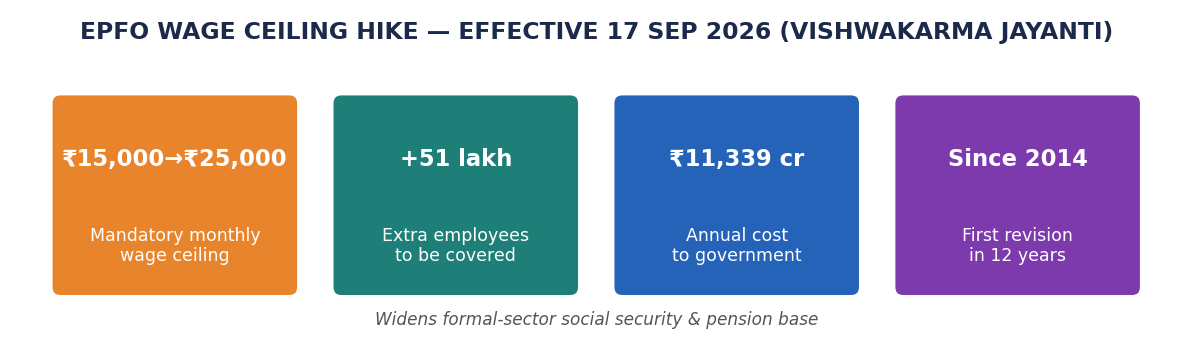
The Union Cabinet raised the mandatory EPFO wage ceiling from ₹15,000 to ₹25,000 per month — effective 17 September 2026 (Vishwakarma Jayanti) — the first revision since 2014.
Key facts
Ceiling hiked ₹15,000 → ₹25,000; last revised in 2014.
Set to cover an extra ~51 lakh employees under EPF/EPS.
Estimated annual cost to government: about ₹11,339 crore.
Widens formal-sector social security and pension base.
Way forward
Higher take-home vs. higher retirement corpus is the trade-off employees must weigh.
Concept
EPFO administers EPF, EPS-1995 & EDLI; the wage ceiling is the salary limit up to which EPF membership is mandatory.
Stat tiles for the EPFO wage-ceiling hike from Rs 15,000 to Rs 25,000, covering 51 lakh more employees at Rs 11,339 crore annual cost. — StudyForGS
8. State of India's Environment 2026 report released
The annual State of India's Environment 2026 report was released, compiling data on climate, pollution, forests, water and biodiversity — a key source for environment questions.
Key facts
Tracks air & water pollution, forest cover and climate trends.
Flags rising extreme weather and Himalayan disaster risk.
A widely-cited data compendium for policy and exams.
Complements the Environmental Performance Index (EPI) debate.
Way forward
Better data granularity and enforcement, not just reporting, will drive outcomes.
Concept
Such State of Environment reports track SDGs (esp. 13-Climate, 14-Life below water, 15-Life on land) and inform India's climate policy.
Fiscal federalism; Union-State powers; Seventh Schedule; taxation of mineral rights.
Context
A proposed mining law amendment (Section 9D) would restrict state levies on mineral rights, reviving tension after the 2024 Supreme Court ruling upholding states' power to tax mineral lands.
Key facts
2024 SC verdict affirmed states can tax mineral-bearing land.
Amendment may cap levies via Entry 50, List II limits.
Mineral-rich states like Odisha, Chhattisgarh, Jharkhand most affected.
Touches core of Union vs. State financial autonomy.
Way forward
A consultative Centre-State framework via the GST Council model could balance interests.
Concept
Seventh Schedule: divides powers into Union, State & Concurrent Lists; fiscal federalism governs revenue-sharing between Centre and states.
10. India lodges protest after Pakistan warship collision at sea
IRUKPSC: Prelims + Mains (International Relations & Defence)
Syllabus linkage
India's maritime security; India-Pakistan CBMs; naval diplomacy; Arabian Sea.
Context
An Indian Navy warship and Pakistan's PNS Hunain had a collision in the North Arabian Sea; India lodged a diplomatic protest citing violation of a 1991 India-Pakistan military agreement.
Key facts
Incident occurred in the North Arabian Sea; only minor damage, no casualties.
India cited breach of a 1991 bilateral military agreement clause.
Both sides lodged counter-protests through diplomatic channels.
Highlights need for stronger maritime confidence-building measures.
Way forward
Reviving hotlines and incident-at-sea protocols can prevent escalation.
Concept
CBMs (Confidence-Building Measures): steps between rivals to reduce risk of accidental conflict, e.g. hotlines and prior notification of exercises.
Data point of the day
7.8%
India GDP Growth — Q1 FY27 (Apr–Jun 2026) India's real GDP grew 7.8% in Q1 FY27, beating the RBI's 7% forecast. Growth was led by manufacturing (+9.2%) and services (+10%), while mining contracted 2.4% — signalling resilient momentum despite global headwinds.
Prelims rapid-fire
Seva Sankalp Abhiyan: runs 17 Sep–17 Oct 2026 in Uttarakhand.
UCC Uttarakhand: first state to implement; 4.7 lakh+ marriages registered.
GEP: Uttarakhand launched India's first Gross Environment Product.
Practice MCQs — UKPSC Prelims pattern
Q1. Consider the following about the Uniform Civil Code (UCC) in India:
1. Uttarakhand was the first state in independent India to implement a UCC.
2. The UCC is explicitly mentioned as a Fundamental Right in Part III of the Constitution.
3. Article 44 relates to the Uniform Civil Code.
Which of the statements given above are correct?
1 and 2 only
1 and 3 only
2 and 3 only
1, 2 and 3
Show answer
Answer: B Uttarakhand was the first state to implement a UCC (2025). Article 44 (a DPSP, not a Fundamental Right) deals with the UCC, so statement 2 is wrong.
Q2. With reference to the Gross Environment Product (GEP), which was in the news, consider the following:
1. It is India's first initiative of its kind, launched by Uttarakhand.
2. It assigns economic value to ecological services such as air, water, forest and soil.
Which of the statements is/are correct?
1 only
2 only
Both 1 and 2
Neither 1 nor 2
Show answer
Answer: C GEP, launched by Uttarakhand, is India's first 'green GDP' that values ecosystem services of air, water, forest and soil. Both statements are correct.
Mains practice question
Q. Pilgrimage tourism is both an economic opportunity and an ecological challenge for Uttarakhand. In the light of the Char Dham Yatra, discuss the measures needed to balance faith, livelihoods and Himalayan sustainability. (150 words)
Hint / approach
Cover: record footfall & revenue/jobs; fragile Higher-Himalaya ecology (GLOF, landslides, carrying capacity); crowd-management tech; infrastructure vs. eco-sensitive zones; homestay-led local livelihoods; disaster preparedness (USDMA/SDRF).
📌 One-line revision: Remember today: Seva Sankalp Abhiyan (17 Sep–17 Oct) • Char Dham 50 lakh+ • EPFO ceiling ₹25,000 • India GDP 7.8% • UCC 4.7 lakh marriages • GEP = India's first green GDP.