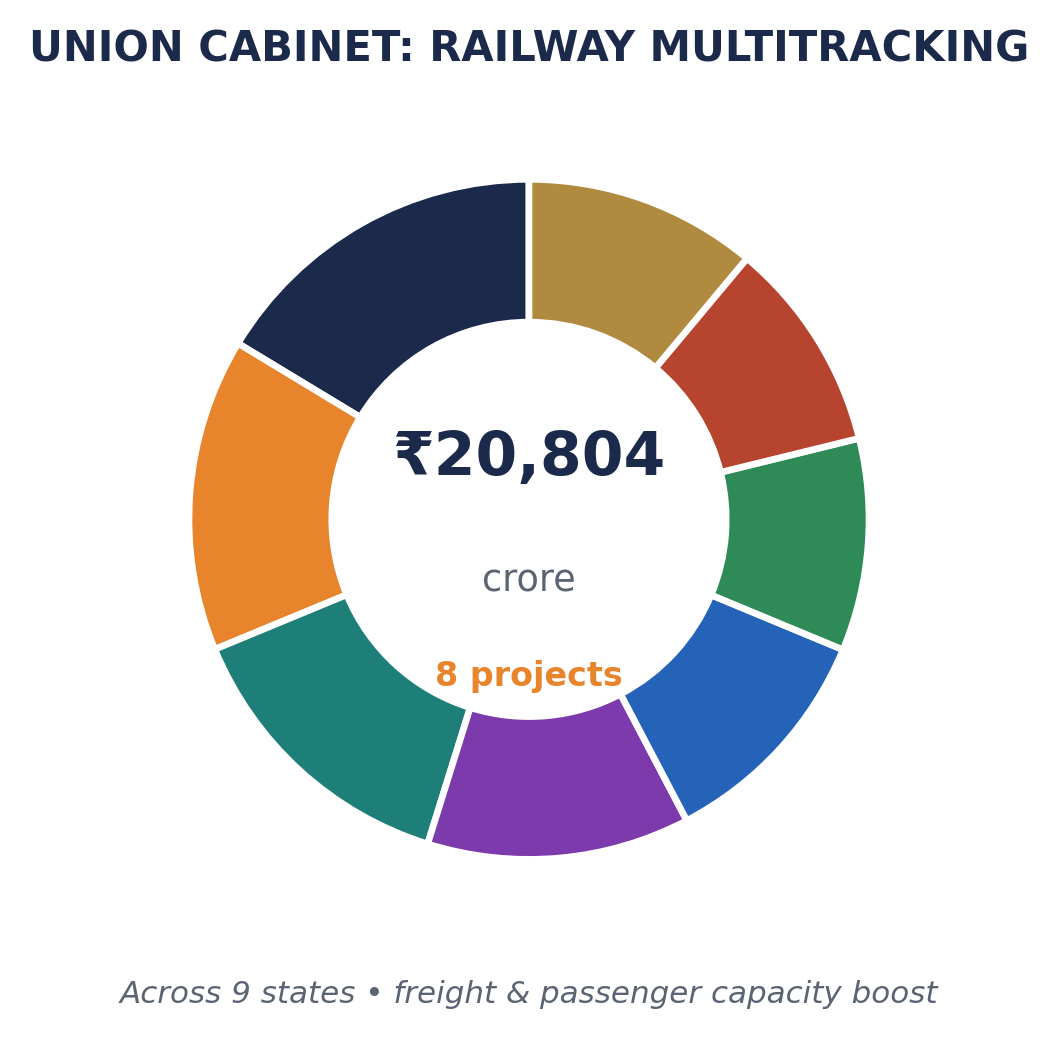
Uttarakhand's ₹1.11 lakh crore youth-focused Budget, a record 37-lakh Char Dham rush and a fresh UCC test in the Nainital High Court lead today; nationally, a proposed Article 371(K) for Ladakh and ₹20,804 crore of rail multitracking stand out.
Thursday, 10 September 2026 · IST · Uttarakhand + National · 9 items · 2 MCQs
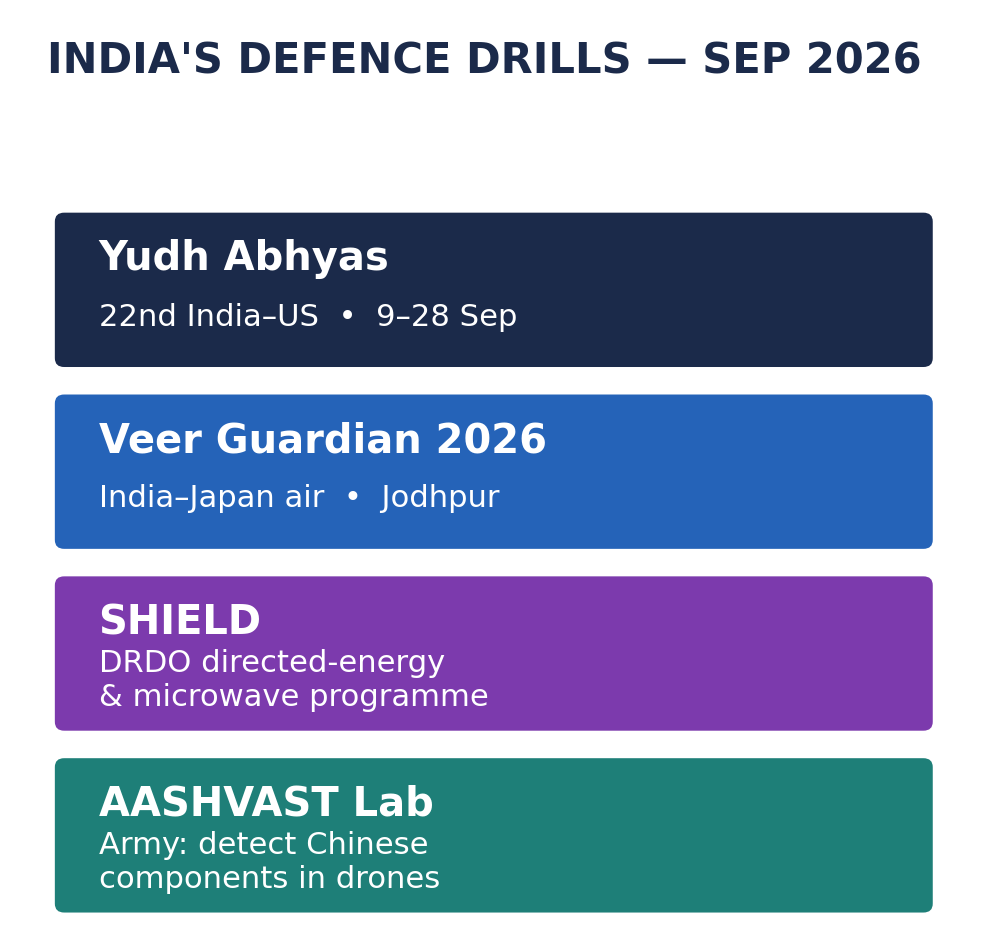
Uttarakhand pushed youth welfare with the new free-coaching Yuva Bhavishya Nirman Yojana, while a five-district heavy-rain alert kept the disaster machinery on watch and the Char Dham Yatra logged a record 37 lakh-plus pilgrims. The Uniform Civil Code returned to the Nainital High Court, and the ₹1,11,703 crore state Budget stayed anchored to the GYAN model. Nationally, the Centre proposed Article 371(K) safeguards for Ladakh, the Cabinet cleared ₹20,804 crore of rail multitracking, and DRDO launched the SHIELD directed-energy programme.
UTTARAKHANDUKPSC: Prelims + Mains (Polity, Governance & Social Justice)
Syllabus linkage
UKPSC GS — Governance & social justice; state welfare schemes (a strong Uttarakhand-specific Prelims area).
Context
CM Pushkar Singh Dhami approved the Mukhyamantri Yuva Bhavishya Nirman Yojana, giving free online coaching to state youth for competitive exams; a formal launch is imminent.
Key facts
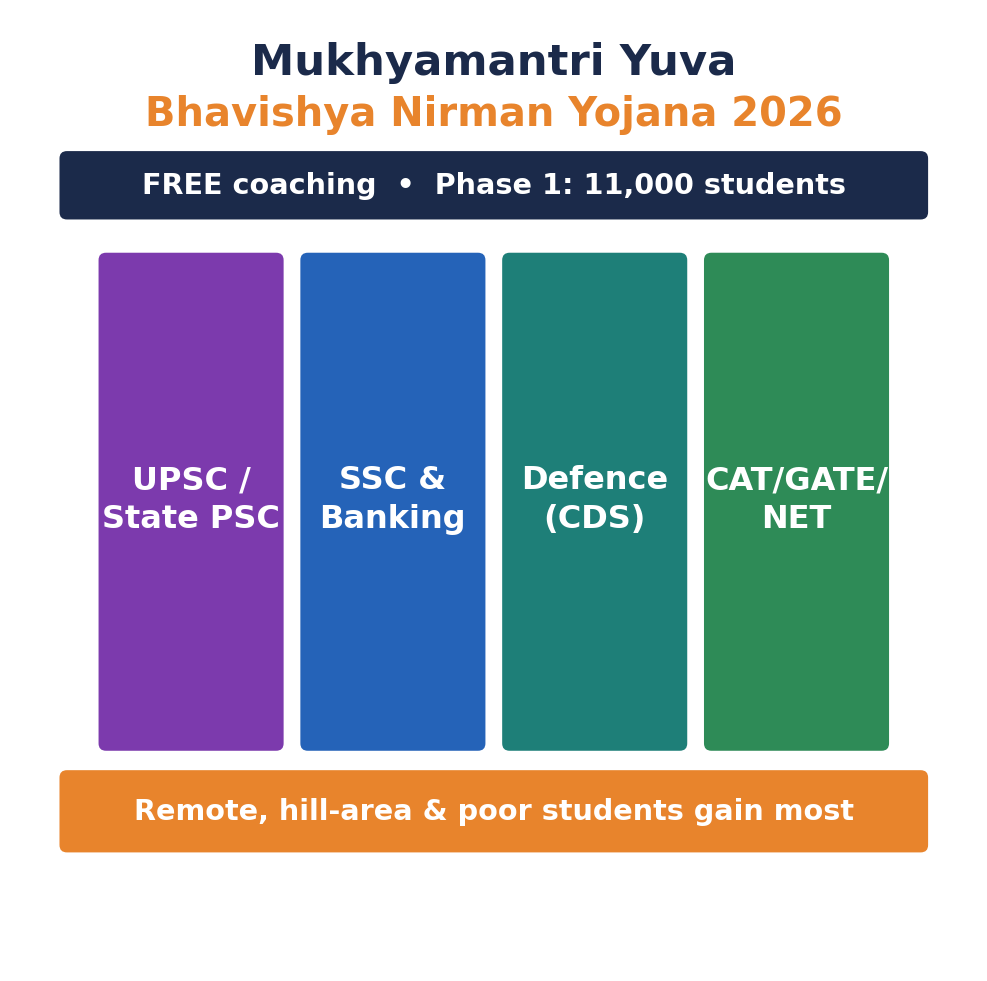
Free online coaching from home for UPSC/PSC, SSC, banking, railways, CDS defence and CAT/GATE/NET aspirants.
Phase 1 covers 11,000 students in state universities and govt/aided colleges.
Targets remote, hilly and financially weaker students to bridge the coaching-access gap.
Fits the Budget's Yuva (youth) focus under the GYAN model.
Way forward
Digital delivery can democratise exam prep, but needs quality mentors, hill-area connectivity and regular content updates.
Concept
GYAN model = Gareeb, Yuva, Annadata, Nari — the four focus groups of Uttarakhand Budget 2026-27.
Pillar diagram of the Yuva Bhavishya Nirman Yojana showing free coaching for UPSC/PSC, SSC & banking, defence and CAT/GATE/NET, with 11,000 Phase-1 students. — StudyForGS
2. Heavy-rain alert for five hill districts; disaster machinery on watch
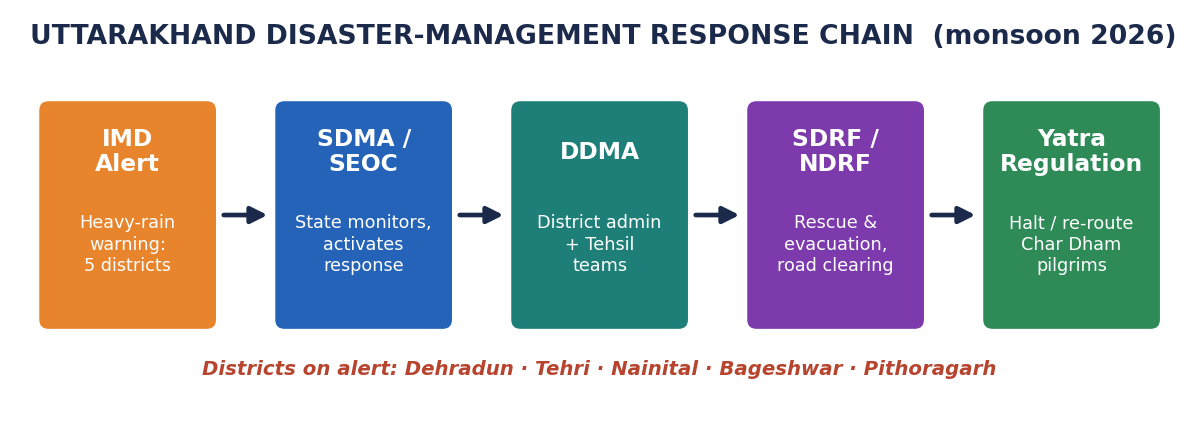
The met department warned of heavy to very heavy rain at isolated places over Sep 10–14, keeping the disaster-response chain active in the tail of the monsoon.
Key facts
Districts on alert: Dehradun, Tehri, Nainital, Bageshwar and Pithoragarh.
Thunderstorm and strong-wind warning for all districts through Sep 14.
Monsoon hazards: landslides, flash floods, cloudbursts and road blockages on hill routes.
The Char Dham Yatra can be halted or re-routed during severe spells.
Way forward
Early-warning dissemination, slope stabilisation and strict building norms in eco-fragile zones cut recurring monsoon losses.
Concept
Uttarakhand lies in Seismic Zones IV & V and is highly landslide-prone; USDMA coordinates state response; GLOF = Glacial Lake Outburst Flood.
Flowchart of Uttarakhand's disaster-management response chain: IMD alert to SDMA/SEOC to DDMA to SDRF/NDRF to Char Dham Yatra regulation. — StudyForGS
3. Char Dham Yatra 2026 sees record rush — 37 lakh+ pilgrims in 61 days
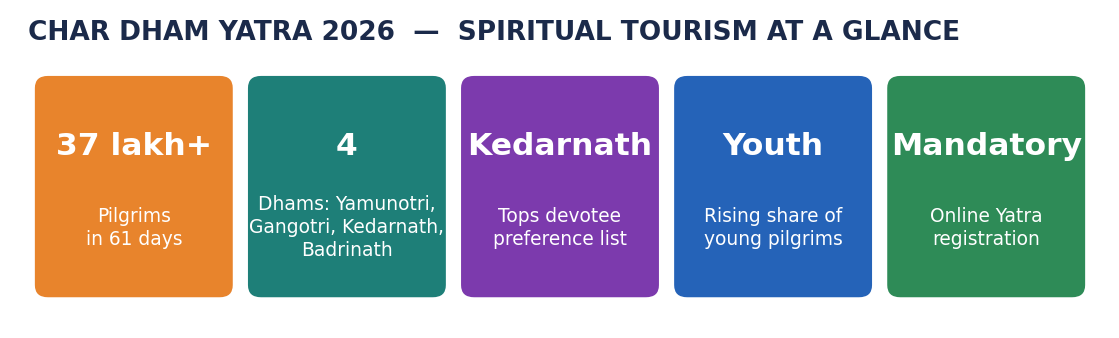
The Char Dham pilgrimage logged a record turnout, with over 37 lakh devotees in the first 61 days and a rising share of young pilgrims driving spiritual tourism.
Petitions in the Uttarakhand High Court continue to challenge the Uniform Civil Code — India's first state UCC — with hearings this month on its constitutional validity.
Key facts
Uttarakhand is the first state to implement a UCC (in force from 27 Jan 2025; an Amendment Ordinance 2026 added rules).
PILs argue the law violates Articles 14, 15, 19 and 21 and privacy.
UCC covers marriage, divorce, succession and live-in registration; Scheduled Tribes are excluded.
Article 44 (DPSP) urges a Uniform Civil Code for citizens.
Way forward
Courts will weigh gender-justice gains against liberty and privacy, shaping how other states model their own codes.
Concept
Article 44 is a Directive Principle (non-justiciable): the State shall endeavour to secure a UCC.
5. Green accounting: Uttarakhand's Gross Environment Product back in focus
UKPSC GS — Environment & ecology; Himalayan conservation; green GDP.
Context
As monsoon hazards underline the value of intact ecosystems, Uttarakhand's pioneering Gross Environment Product (GEP) framework returns to attention as a model for valuing nature.
Key facts
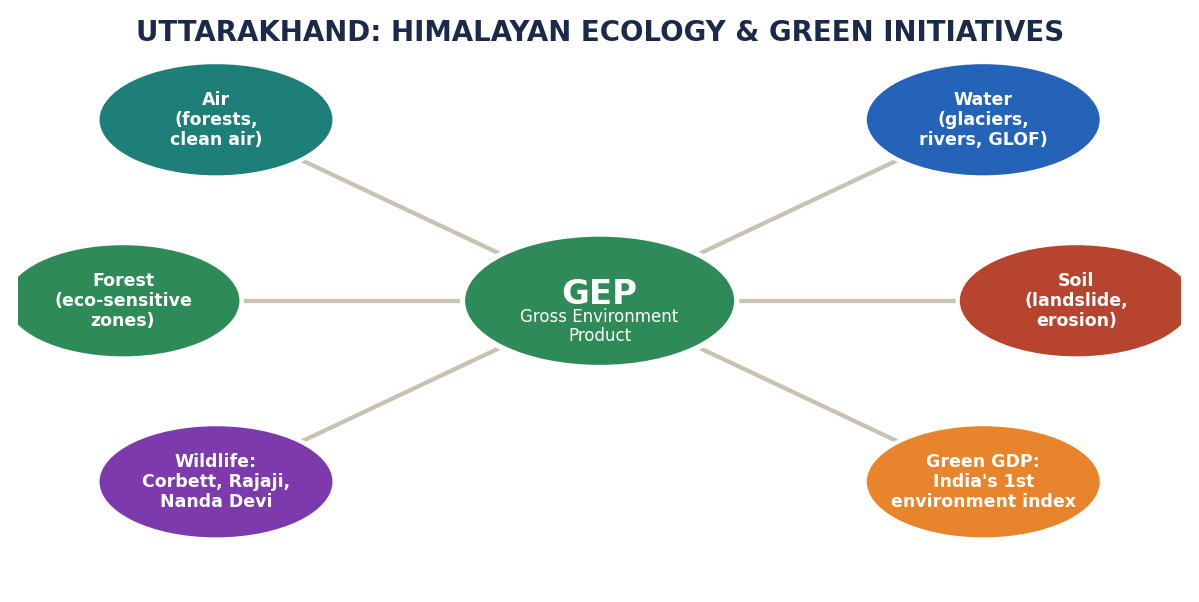
Uttarakhand is the first Indian state to launch a GEP (Green GDP) index.
GEP values four ecological services: air, water, soil and forest.
It aims to quantify nature's contribution alongside GSDP growth.
It complements protected areas: Corbett, Rajaji, Nanda Devi, Valley of Flowers, Gangotri.
Way forward
Linking GEP to budgeting and green-bonus transfers can reward hill states for conservation and curb migration ('palayan').
Concept
GEP / Green GDP internalises ecological value and complements GSDP — an 'ecosystem services' valuation.
Mind-map of Uttarakhand's Himalayan ecology and green initiatives centred on GEP, with nodes for air, water, forest, soil, wildlife and green GDP. — StudyForGS
6. Centre proposes special 'Article 371(K)' safeguards for Ladakh
GS — Constitution; special provisions; centre–UT relations.
Context
The Union Home Ministry floated a customised Article 371-type framework to give Ladakh constitutional safeguards over land, jobs and culture amid statehood/Sixth Schedule demands.
Key facts
A proposed 'Article 371(K)' would offer special protections and a possible legislative body for Ladakh.
Ladakh became a UT without legislature after Article 370 was read down in 2019.
Demands include Sixth Schedule status, statehood and job/land safeguards.
Article 371 already gives special provisions to states like Nagaland, Mizoram and Sikkim.
Way forward
A negotiated constitutional guarantee could balance ecological fragility, tribal identity and local aspirations in the cold desert.
Concept
Sixth Schedule (Art 244) — autonomous district councils for tribal areas in Assam, Meghalaya, Tripura and Mizoram.
GS — Renewable energy; agriculture; central schemes.
Context
The government signalled a second phase of PM-KUSUM with a dedicated agrivoltaics component that combines farming with solar generation on the same land.
Key facts
PM-KUSUM (2019) promotes solar pumps and grid-connected solar for farmers.
Phase 2 to add agrivoltaics — crops + solar panels together.
Boosts farmer income, energy security and clean-energy targets.
Supports India's 500 GW non-fossil capacity goal by 2030.
Way forward
Agrivoltaics can ease land-versus-energy trade-offs but needs crop-suitability studies and viable tariffs.
Concept
Agrivoltaics = simultaneous use of land for solar PV and agriculture, improving land-use efficiency.
Dr Vinaya Prakash Singh re-elected APPU Secretary-General (2027–30).
GalaxEye (India) won a US patent for OptoSAR — fusing optical + SAR for all-weather imaging.
Practice MCQs — UKPSC Prelims pattern
Q1. Consider the following about Uttarakhand's Uniform Civil Code (UCC): (1) Uttarakhand was the first state to implement a UCC. (2) It provides for registration of live-in relationships. (3) Scheduled Tribes are excluded from its ambit. Which of the above are correct?
1 and 2 only
2 and 3 only
1 and 3 only
1, 2 and 3
Show answer
Answer: D All three are correct. The UCC (in force 27 Jan 2025) is India's first state UCC; it mandates live-in registration and exempts Scheduled Tribes.
Q2. The Gross Environment Product (GEP) index, first launched by an Indian state, values which of the following ecological services?
Air and water only
Air, water, soil and forest
Only forest cover
Carbon credits alone
Show answer
Answer: B Uttarakhand's GEP values four services — air, water, soil and forest — as a green-GDP style measure.
Mains practice question
Q. Rising pilgrim footfall on the Char Dham route highlights the tension between religious tourism and Himalayan ecological fragility. Discuss with reference to carrying capacity and disaster management. (250 words)
Hint / approach
Cover the record footfall, carrying capacity, monsoon hazards (landslides/GLOF), SDMA measures, and sustainable-tourism steps like staggered registration and waste management.