Daily Current Affairs for Madhya Pradesh PSC (MPPSC)
MPPSC Current Affairs — 22 October 2026
Soybean Bhavantar sale window opens in Madhya Pradesh today; Jabalpur–Indore Economic Corridor SPV cleared and Indore to host MP Semiconductor Summit; nationally, core-sector growth hits a record 7.9%.
Thursday, 22 October 2026 · IST · Madhya Pradesh + National · 11 items · 2 MCQs
Madhya Pradesh leads the day: the 2026 Kharif Soybean Bhavantar (price-deficiency) scheme sale period begins today (22 Oct), the Cabinet's ₹27,050 crore package includes a government SPV for the Jabalpur–Indore Economic Corridor, and Indore gears up for the MP Semiconductor Summit (23–24 Oct). Nationally, the eight core industries grew 7.9% in September 2026 (a series high) while the RBI raised the repo rate to 5.5%, and a state cheetah milestone and an SBI data breach also drew notice.
Today at a glance — things to remember
Soybean Bhavantar sale period in MP opens today, 22 Oct 2026
MP Cabinet cleared a ₹27,050 cr package incl. a Jabalpur–Indore Corridor SPV
MP Semiconductor Summit 2026 at Indore on 23–24 Oct; 50+ firms
Cheetahs Vyom & Neera released at Veerangana Durgavati Tiger Reserve
India's cheetah tally reaches 60; MP now has its 3rd cheetah home
MP Urban Conclave (28 Oct) to push Simhastha 2028 at Ujjain
Eight core industries grew 7.9% in Sept 2026 — a series high
RBI hiked the repo rate to 5.5% (+25 bps), first hike in 3+ years
India to mandate 1% SAF blending on international flights from January
Rajnath Singh flagged cross-border terror at the SCO meet in Tajikistan
Detailed notes
1. Soybean Bhavantar sale window opens today across MP mandis
MP economy & agriculture; MSP, price-support mechanisms, PM-AASHA. Prelims: Bhavantar vs PDPS vs PSS; e-Uparjan; soybean as kharif oilseed.
Context
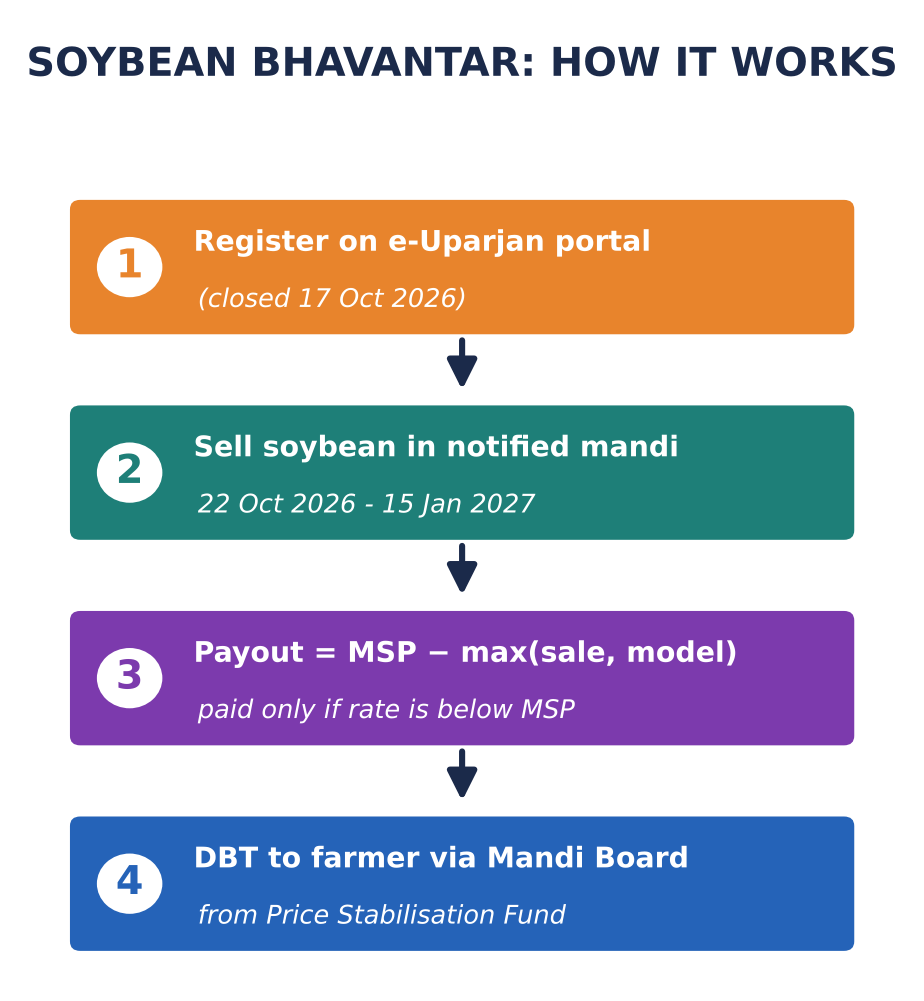
The 2026 Kharif Soybean Bhavantar (Price Deficiency Payment) scheme sale period begins today, 22 October 2026 and runs up to 15 January 2027, letting registered soybean farmers claim the gap when market prices stay below the MSP.
Key facts
Operates under PDPS guidelines of the central PM-AASHA umbrella; payout via DBT by the Mandi Board.
Registration on the Food Department e-Uparjan portal closed 17 Oct 2026; sales from 1–21 Oct are deducted from eligible quantity.
Compensation = MSP minus the higher of sale price or the model rate (14-day weighted mandi average, updated daily on e-Mandi).
Payment basis = registered area × previous-year state average productivity; seed funding from the Price Stabilisation Fund.
Oversight by a state committee under the Chief Secretary and district committees under Collectors.
Way forward
Transparent model-rate publication and timely DBT can shield MP's soybean growers from distress sales and stabilise the oilseed economy.
Concept
Bhavantar pays the price difference (farmer keeps the crop sold in the mandi), unlike PSS where the agency physically procures at MSP. MP's Malwa black-soil (Vertisol) belt is India's soybean heartland.
Flowchart of the Soybean Bhavantar payment mechanism from registration to DBT payout. — StudyForGS
MP infrastructure, industrial corridors, SPV/PPP models, ease of doing business. Prelims: MP Investment Region Act 2013; NPV on forest land.
Context
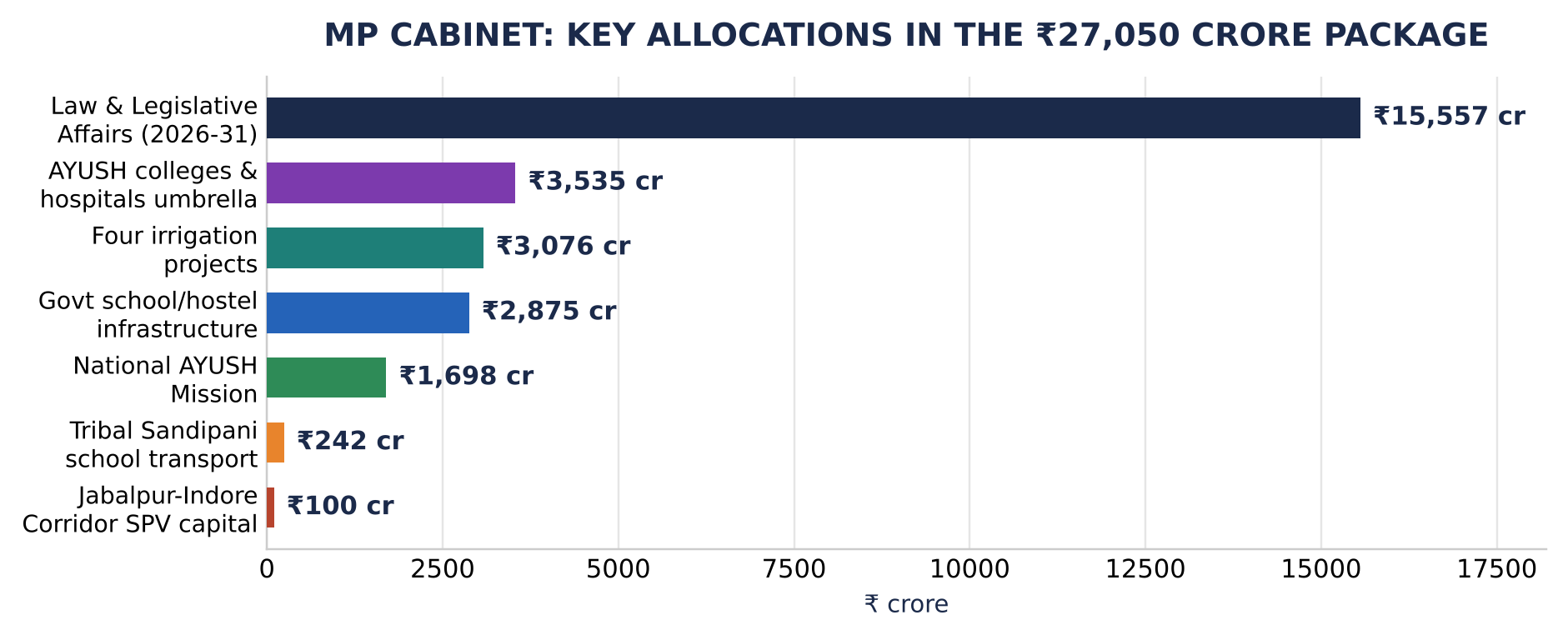
The MP Cabinet approved proposals worth about ₹27,050 crore, headlined by a fully government-owned Special Purpose Vehicle (SPV) to develop the Jabalpur–Indore Economic Corridor with an initial paid-up capital of ₹100 crore.
Key facts
SPV: Jabalpur-Indore Economic Corridor Development Company Ltd — land pooling, zoning, leasing, monetisation and infra within hubs.
Designated an Investment Region Agency under the MP Investment Region Development & Management Act, 2013.
Package also funds ₹3,076 cr for four irrigation projects and ₹15,557 cr for law & legislative affairs (2026–31).
Hubs to host industrial, agro-processing, logistics, IT parks and Global Capability Centres (GCCs).
Forest land use needs compensatory afforestation and Net Present Value (NPV) payment.
Way forward
A professional SPV can speed up land assembly and investor servicing, but transparent land pricing and environmental compliance will decide its credibility.
Concept
An SPV ring-fences a project's assets/finances in a separate company. Industrial corridors aim to cut logistics costs and cluster manufacturing along a defined spine.
Horizontal bar chart of the major MP Cabinet allocations within the 27,050 crore package. — StudyForGS
3. Indore to host MP Semiconductor Summit 2026 on 23–24 October
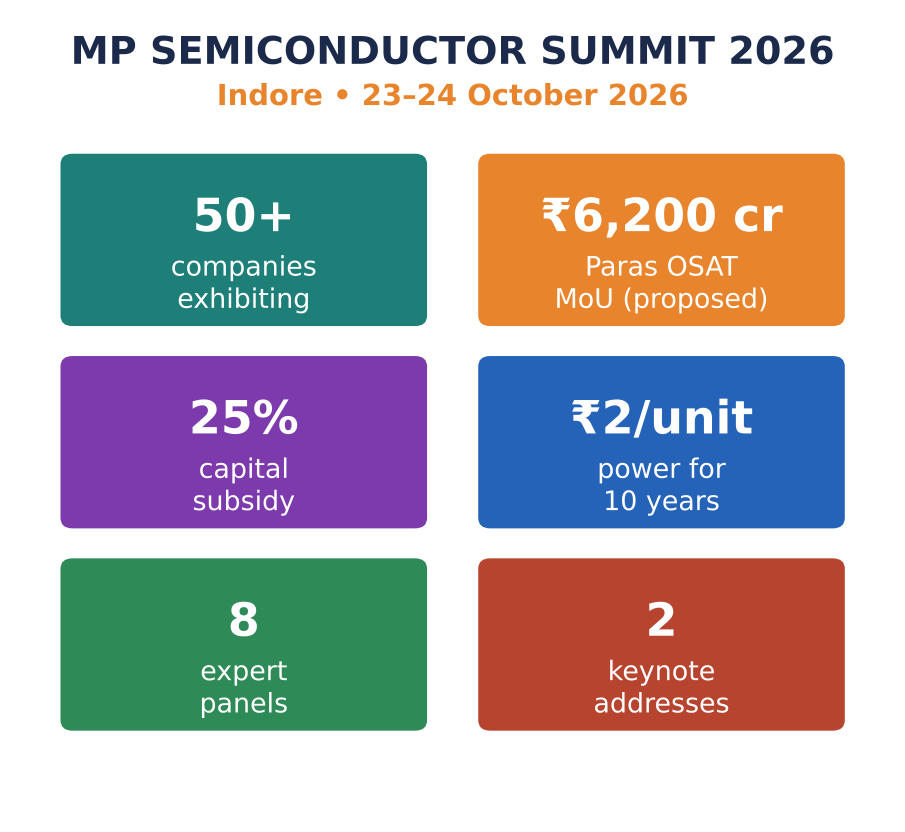
On the eve of the event, MP is set to host the Semiconductor Summit 2026 at the Brilliant Convention Centre, Indore on 23–24 October 2026, to position the state as a chip-ecosystem hub under CM Dr Mohan Yadav.
Key facts
More than 50 companies to exhibit; format spans 8 panels, 5 roundtables, 2 keynotes, an exhibition and a startup contest.
Paras Semiconductors signed an MoU for a proposed ₹6,200 crore OSAT (assembly & testing) facility.
Backed by the MP Semiconductor Policy 2025: a 25% subsidy and power at ₹2/unit for 10 years.
Themes: chip design, advanced packaging & testing, photonics, quantum tech, AI infrastructure and MSMEs.
CM to deliver the inaugural address on 'MP's Vision as a Semiconductor Hub'.
Way forward
Skilling, assured power and water, and anchor fabless/OSAT investors will determine whether MP can move up the electronics value chain.
Concept
OSAT = Outsourced Semiconductor Assembly and Test (back-end). Fabless firms design chips without owning a fab. India's drive sits under the national Semicon India programme.
Species reintroduction, protected areas of MP, conservation. Prelims: Project Cheetah sites, Kuno, Gandhi Sagar, IUCN status.
Context
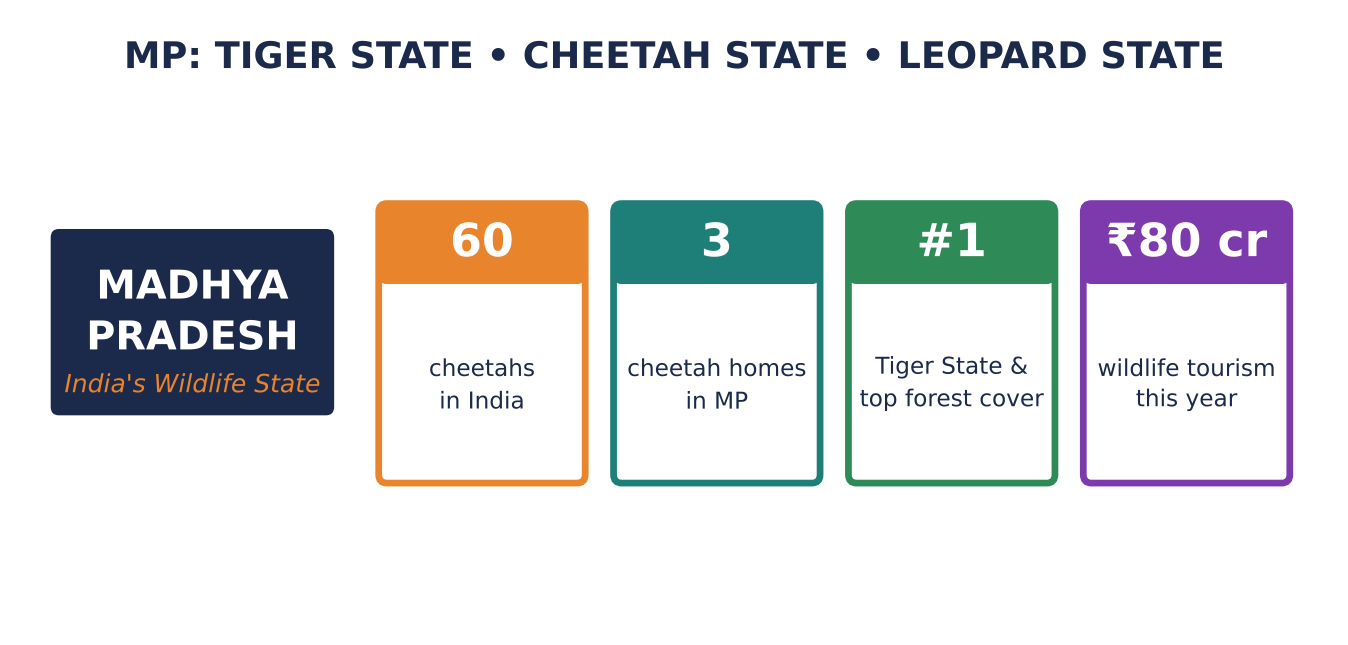
CM Dr Mohan Yadav released two cheetahs, Vyom and Neera, at the Veerangana Durgavati Tiger Reserve (Sagar district) — Madhya Pradesh's third cheetah habitat — as Wildlife Conservation Week concluded.
Key facts
Both animals were translocated from Kuno National Park; India's cheetah population has reached 60 after five cubs were born at Kuno.
MP's other cheetah sites: Kuno National Park and Gandhi Sagar Wildlife Sanctuary.
Project Cheetah began in 2022 as the world's first intercontinental large-carnivore translocation.
The reserve extends cheetahs into the Bundelkhand region; it already hosts tigers.
Also released: the Vulture Population Estimation Report 2026; wildlife tourism earned about ₹80 crore this year.
Way forward
Spreading cheetahs across multiple sites reduces single-site risk, but prey density, water and community buffers remain key to a self-sustaining metapopulation.
Concept
MP is India's 'Tiger State' with the largest forest cover by area. Cheetah is the world's fastest land animal; all big cats here are Schedule I of the Wildlife (Protection) Act, 1972.
Fact schematic of Madhya Pradesh as India's wildlife state with cheetah and tiger statistics. — StudyForGS
5. MP Urban Conclave (28 Oct) to drive Simhastha 2028 and city investment
Urban governance, municipal finance, heritage/pilgrimage economy. Prelims: AMRUT 2.0, Simhastha at Ujjain, urban financing tools.
Context
Madhya Pradesh will hold the Urban Conclave 2026 at Indore on 28 October, with a dedicated session on developing Ujjain into a world-class pilgrimage city ahead of Simhastha 2028.
Key facts
Financing tools on show: PPPs, Urban Challenge Fund, green & municipal bonds, temple bonds and viability gap funding.
Simhastha prep: digital-twin modelling, technology-based crowd and traffic management for Ujjain.
Themes include AMRUT 2.0, Namo Green City, EVs, waste-to-energy and compressed biogas (CBG).
Urban planning focus: Transit-Oriented Development, TDR, FAR reform and ABPAS building-permit automation.
CM Mohan Yadav to hold investor meetings and inaugurate urban projects.
Way forward
Linking Simhastha spending to lasting civic assets — water, transit, sanitation — can turn a one-time mega-event into durable urban capacity.
Concept
Simhastha is the Kumbh held at Ujjain on the Kshipra river, one of four Kumbh sites. Municipal/green bonds let cities raise market finance for infrastructure.
6. Cabinet boosts tribal school transport to ₹241.88 cr under Sandipani push
SOCIETYMPPSC: Prelims + Mains GS-II (Governance & Social Justice)
Within the same Cabinet package, MP sanctioned ₹241.88 crore for student transport at 94 Sandipani schools under the Tribal Affairs Department, deepening education access for India's largest tribal population state.
Key facts
Per-student annual transport allocation rises from ₹10,000 to ₹21,000, with a 5% yearly increase.
Transport to be outsourced and IT-monitored for accountability.
MP has the country's largest Scheduled Tribe population; PESA, 1996 governs Fifth Schedule areas.
Also cleared: 24 new posts for Women & Child Development in new districts (Niwari, Mauganj, Pandhurna, Maihar).
Linked schemes: Saksham Anganwadi, POSHAN 2.0 and Integrated Child Protection.
Way forward
Reliable transport tackles a key dropout driver in tribal belts; pairing it with hostels and nutrition can lift retention and learning outcomes.
Concept
PESA, 1996 extends panchayat self-rule to Fifth Schedule tribal areas, empowering the Gram Sabha. Sandipani Vidyalayas are MP's upgraded government schools.
7. Core industries grow a record 7.9% in September 2026
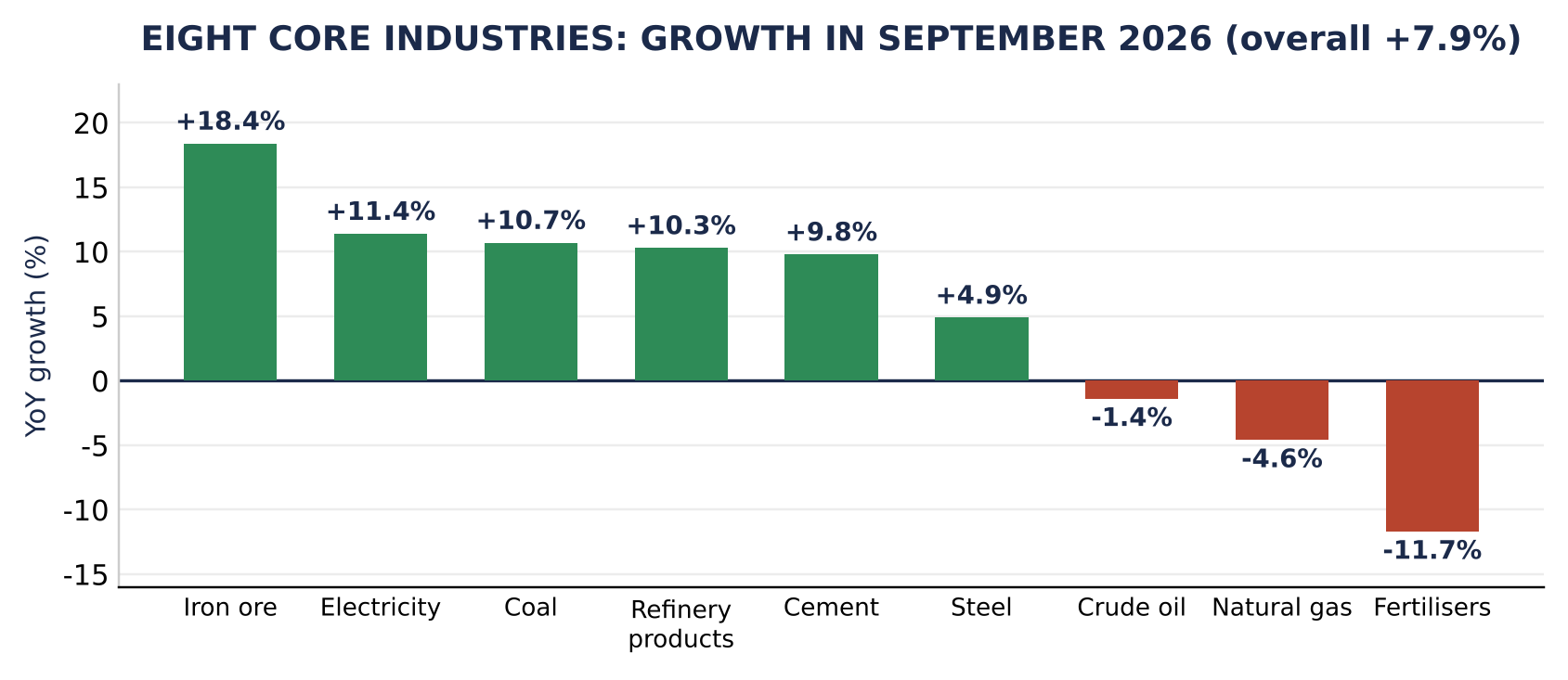
The Index of Eight Core Industries grew 7.9% in September 2026, the highest since the new series began in April 2024, signalling broad-based industrial momentum.
Key facts
Growth led by iron ore (18.4%), electricity (11.4%), coal (10.7%) and refinery products (10.3%).
Cement rose 9.8% and steel 4.9%; crude oil (-1.4%), natural gas (-4.6%) and fertilisers (-11.7%) contracted.
Fertiliser output has now fallen for seven straight months.
Compiled by the Office of the Economic Adviser, DPIIT; new series base year is 2022-23.
Wholesale (WPI) inflation stood at 11.4% in September 2026.
Way forward
Sustained core-sector strength supports GDP and jobs, but weak fertiliser and gas output warrant policy attention ahead of the rabi season.
Concept
The 8 core industries (coal, crude oil, natural gas, refinery products, fertilisers, steel, cement, electricity) have about a 40% weight in the Index of Industrial Production (IIP).
Horizontal bar chart of eight core industries growth rates for September 2026. — StudyForGS
8. RBI raises repo rate to 5.5% as inflation pressures widen
The RBI Monetary Policy Committee raised the repo rate by 25 bps to 5.5% — its first hike in over three years — citing widening inflationary pressures.
Key facts
The hike was unanimous; two external members dissented only on shifting the stance to 'calibrated tightening'.
Governor Sanjay Malhotra projected headline CPI near 6% in Q3, staying above 5% for two quarters.
Share of CPI items with inflation above 4% rose to 37% in August (from 20% in March).
Core inflation was 4.2% in August; risks include West Asia conflict and high oil prices.
India's flexible inflation-targeting band is 4% (+/- 2%).
Way forward
The RBI must balance anchoring inflation expectations against protecting the growth recovery, keeping a close watch on food and fuel prices.
Concept
The repo rate is the rate at which the RBI lends to banks against securities. The 6-member MPC sets policy to keep CPI inflation at 4% within a 2–6% band.
9. Data of ~3,900 SBI customers surfaces on the dark web
Cyber security, data protection law. Prelims: DPDP Act 2023, CERT-In, SEBI disclosure norms.
Context
Personal data of 3,897 SBI customers was found among about 3.75 lakh records on the dark web, spotlighting India's cyber-resilience gaps and data-protection timelines.
Key facts
SBI learned of the leak from its threat-intelligence provider, the Defence Cyber Agency and CERT-In — not its own systems.
Disclosure to stock exchanges came five days after alerts, under SEBI listing norms; bank cites no material impact.
The DPDP Act, 2023 duty to notify affected individuals takes effect only in 2027.
Separately, eight web-security keys of a firm used by government/PSUs were reported leaked.
CERT-In is India's national nodal cyber-incident response agency.
Way forward
Faster breach notification, third-party audits and zero-trust architecture are needed as DPDP obligations phase in.
Concept
The DPDP Act, 2023 governs processing of digital personal data, creating a Data Protection Board and duties for 'data fiduciaries'. CERT-In mandates incident reporting.
10. India to mandate 1% SAF blending on international flights from January
Energy transition, decarbonisation, aviation. Prelims: SAF, biofuels, net-zero targets.
Context
India plans to mandate 1% Sustainable Aviation Fuel (SAF) blending for all international flights from January, its first concrete step to decarbonise aviation.
Key facts
SAF is made from feedstocks like used cooking oil, agri-residue and municipal waste; it cuts lifecycle CO2.
Aviation is a hard-to-abate sector; SAF blending supports India's net-zero-by-2070 goal.
Separately, NHPC sought approval to fell over 23 lakh trees for the Kamala hydel project in Arunachal Pradesh.
Links to the national biofuel/ethanol push and circular-economy feedstocks.
India targeted 20% ethanol blending in petrol under its biofuel roadmap.
Way forward
Scaling SAF needs feedstock supply chains and price support so blending mandates do not sharply raise airfares.
Concept
SAF is a drop-in jet fuel that can cut emissions by up to ~80% over its lifecycle versus fossil jet fuel, without new aircraft engines.
11. Rajnath Singh flags cross-border terror at SCO meet in Tajikistan
IRMPPSC: Prelims + Mains GS-II (International Relations)
At the SCO Council of Heads of Government in Tajikistan, Defence Minister Rajnath Singh argued that regional cooperation cannot succeed if terrorism is treated selectively.
Key facts
India stressed that connectivity and trade depend on a stable security environment.
Pakistan's Deputy PM Ishaq Dar was present at the meet.
Follows India's 2025 refusal to endorse the SCO statement at Qingdao that omitted the Pahalgam attack.
The SCO is a Eurasian security-economic bloc; India became a full member in 2017.
SCO's counter-terror arm is RATS (Regional Anti-Terrorist Structure), based in Tashkent.
Way forward
India seeks to keep terrorism central to SCO discourse while safeguarding its connectivity and energy interests in Central Asia.
Concept
The SCO has two councils: Heads of State (CHS) for strategy and Heads of Government (CHG) for economic/trade agenda. Its HQ is in Beijing.
Data point of the day
₹4.38 lakh crore
MP Budget FY2026-27 Madhya Pradesh's FY2026-27 Budget was presented at about ₹4.38 lakh crore with no new taxes; ₹23,800 crore was earmarked for the flagship Ladli Behna Yojana (₹1,500/month per beneficiary).
Prelims rapid-fire
India–New Zealand signed a Memorandum of Cooperation on Electronic Origin Data Exchange to ease FTA trade.
The Supreme Court is examining the religion-neutrality of OBC classification.
India's cheetah population has reached 60 after five cub births at Kuno.
The new core-sector index series uses base year 2022-23 and is compiled by DPIIT.
Madhya Pradesh is India's largest soybean producer (~45% of output), centred on the Malwa plateau.
All cetaceans (whales, dolphins) are listed in Schedule I of the Wildlife (Protection) Act, 1972.
Practice MCQs — MPPSC Prelims pattern
Q1. With reference to the Bhavantar Bhugtan Yojana, consider the following statements:
1. It compensates farmers for the difference between the MSP and the market/model rate.
2. Under it, the government agency physically procures the crop at MSP.
3. It is implemented under the Price Deficiency Payment Scheme of PM-AASHA.
Which of the statements given above is/are correct?
1 and 2 only
1 and 3 only
2 and 3 only
1, 2 and 3
Show answer
Answer: B Bhavantar pays the price difference and the farmer keeps selling in the mandi, so statement 2 (physical procurement) is wrong — that describes the Price Support Scheme (PSS). It runs under PDPS of PM-AASHA, so 1 and 3 are correct.
Q2. Consider the following national parks/reserves currently associated with Project Cheetah in Madhya Pradesh:
1. Kuno National Park
2. Gandhi Sagar Wildlife Sanctuary
3. Veerangana Durgavati Tiger Reserve
How many of the above host cheetahs?
Only one
Only two
All three
None
Show answer
Answer: C As of the latest release, all three — Kuno, Gandhi Sagar and Veerangana Durgavati — host cheetahs, making MP's third cheetah habitat. India's cheetah tally has reached 60.
Mains practice question
Q. “Price-deficiency payment schemes such as Bhavantar can protect farmers without the fiscal and storage burden of physical procurement.” In light of Madhya Pradesh's Soybean Bhavantar scheme, critically examine the strengths and limitations of this approach. (250 words)
Hint / approach
Define Bhavantar vs PSS; strengths — no storage cost, market-linked, DBT transparency; limits — trader collusion suppressing mandi rates, model-rate design, budget caps, exclusion of unregistered farmers. Conclude with reforms (price monitoring, wider coverage).
📌 One-line revision: Today's must-revise: Bhavantar = MSP minus (higher of sale/model rate), under PDPS of PM-AASHA; Jabalpur–Indore Corridor SPV; MP cheetahs = Kuno + Gandhi Sagar + Veerangana Durgavati (India tally 60); core industries +7.9% (record); RBI repo 5.5%.