Friday, 6 November 2026 · IST · National & International · 11 items · 2 MCQs
The Union Cabinet approved a ₹14,500 crore VGF scheme for 92 GWh of grid-scale energy storage, a ₹2,814 crore lithium-nickel processing scheme, the ₹4,371.10 crore VISTAR statistics overhaul, Fast Track Special Courts till 2031, and a two-year extension for Agniveers. The Supreme Court ruled that arrest begins the moment liberty is physically restrained, while services PMI rose to a four-month high of 55.8 in October.
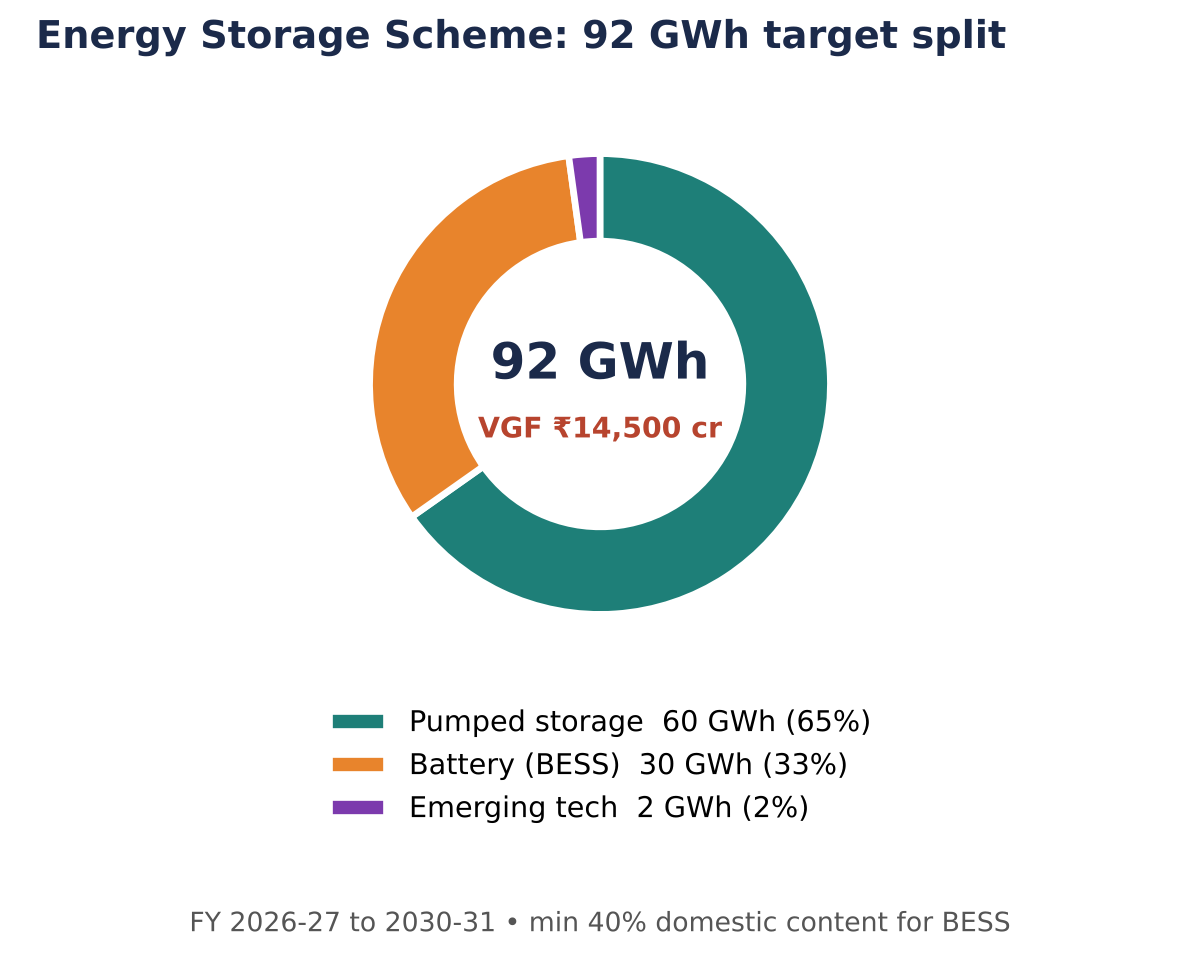
On 4 Nov 2026 the Union Cabinet approved a Viability Gap Funding scheme to build 92 GWh of grid-scale storage, so that solar and wind power generated by day can be supplied when demand peaks.
VGF outlay ₹14,500 crore; period FY 2026-27 to FY 2030-31; expected investment about ₹97,600 crore.
Projects allotted through competitive bidding; battery projects need at least 40% domestic content.
Implemented with State governments for equitable spread of storage capacity.
Way forward
Fast-track PSP site clearances, build a domestic cell-manufacturing chain and design storage tariffs so that discoms actually use the capacity.
Concept
VGF: a one-time capital grant that bridges the gap between a project's cost and its commercial viability. Pumped storage: water is pumped uphill when power is surplus and released through turbines at peak demand.
Donut chart of the 92 GWh energy storage target: 60 GWh pumped storage, 30 GWh battery storage and 2 GWh emerging technologies, with VGF of ₹14,500 crore — StudyForGS
2. ₹2,814 crore capex scheme for domestic lithium and nickel processing
ECONOMYCOMMON: Prelims + Mains GS3
Syllabus linkage
GS-III: Industrial policy, Mineral resources, Energy security. Prelims: critical minerals, cobalt by-product.
Context
The Cabinet (4 Nov) approved capital support for refining lithium and nickel at home — the mid-stream step where India depends almost fully on imports for EV batteries and storage.
Key facts
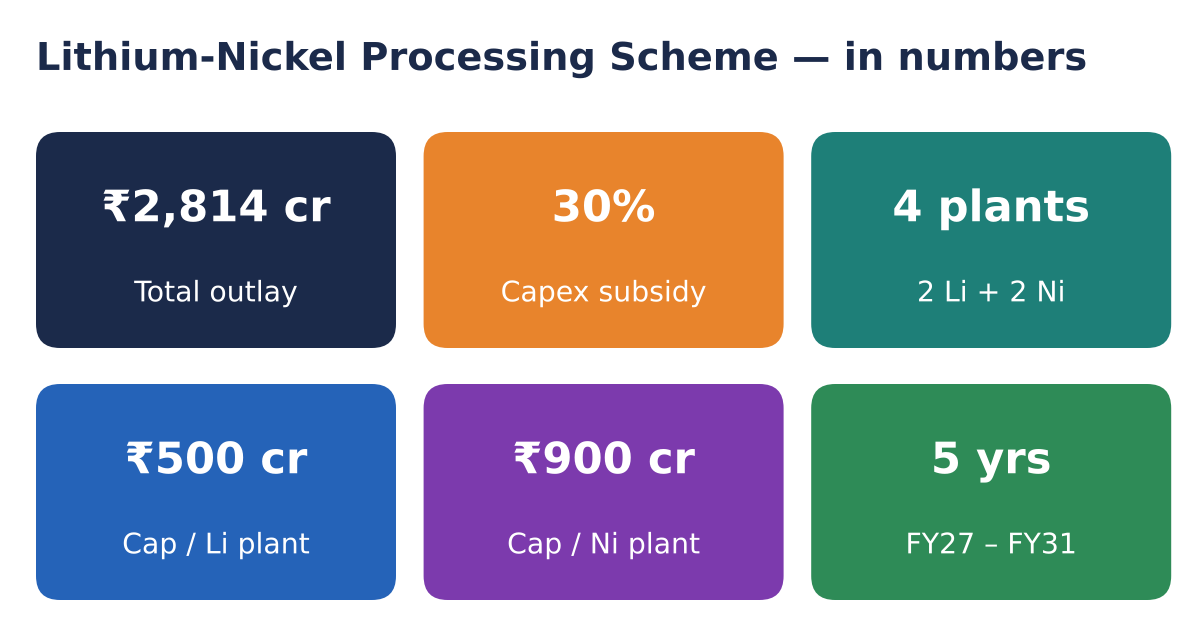
Outlay ₹2,814 crore over FY 2026-27 to FY 2030-31; 30% capital subsidy on eligible investment.
4 plants: 2 lithium (min 30,000 t/yr each) + 2 nickel (min 50,000 t/yr each); nickel units also recover cobalt.
Cap per beneficiary: ₹500 crore (lithium), ₹900 crore (nickel).
Two-stage selection: technical qualification, then bidding for least capex support; paid in 3 tranches.
Way forward
Secure ore supply through overseas assets and recycling, and link the plants to battery PLI units to create a full value chain.
Concept
National Critical Mineral Mission (2025) covers exploration to recycling. Critical minerals are those vital to the economy with supply-concentration risk; India has notified 30.
Stat tiles for the lithium-nickel processing scheme: ₹2,814 crore outlay, 30% capex subsidy, 4 plants, caps of ₹500 crore for lithium and ₹900 crore for nickel — StudyForGS
3. Agnipath revamped: Agniveers can now serve up to six years
DEFENCECOMMON: Prelims + Mains GS3
Syllabus linkage
GS-III: Security forces and their mandate; GS-II: Government policies. Prelims: Agnipath, Seva Nidhi.
Context
With the first batch of about 18,000 Agniveers nearing the end of their four-year term, the Cabinet approved a two-year extension for those not absorbed into the regular cadre.
Key facts
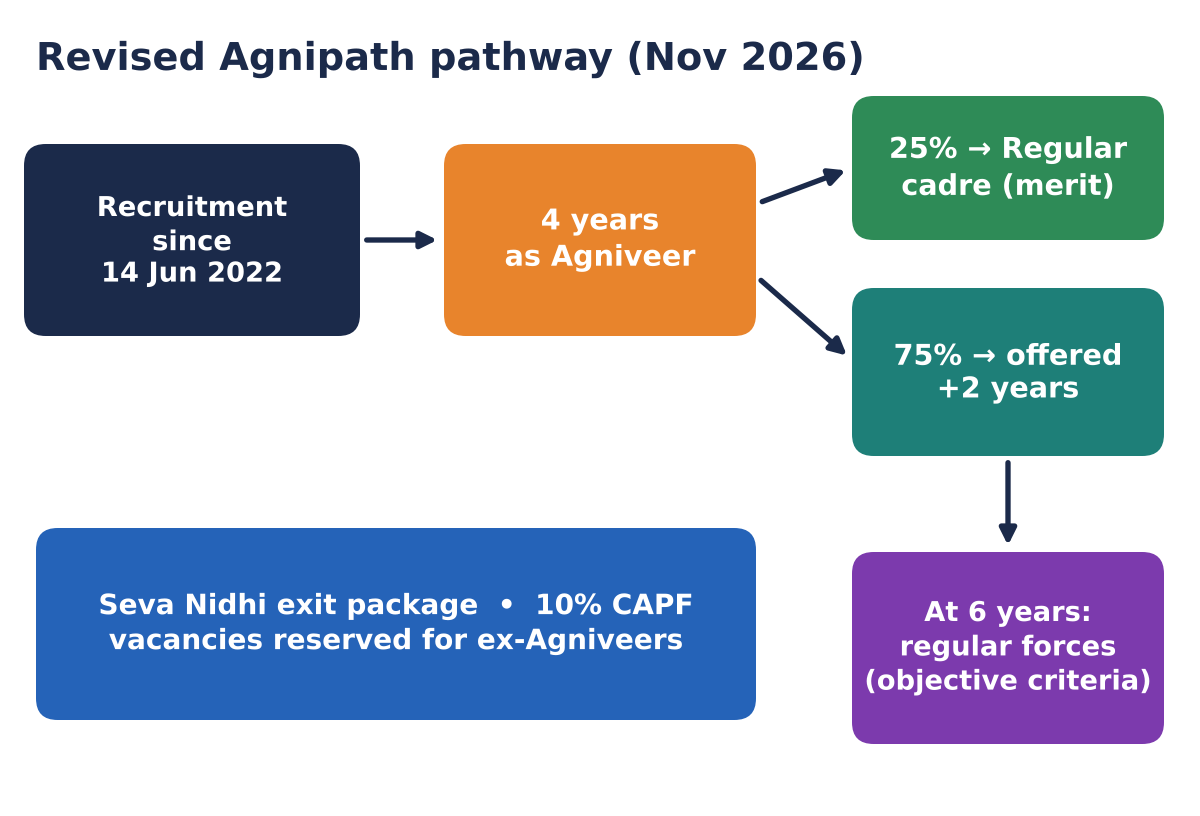
Scheme launched 14 June 2022; engagement of 4 years remains unchanged.
Up to 25% are still selected for the regular cadre after 4 years on merit.
Remaining 75% are offered an extra 2 years → maximum tenure 6 years.
After 6 years, willing Agniveers can enter the regular forces subject to objective selection criteria.
Way forward
Publish clear selection rules, keep training standards high and widen lateral job quotas (CAPFs, States) for those who exit.
Concept
Agnipath aims at a younger profile of the forces. Seva Nidhi: a tax-free exit package built from equal contributions by the Agniveer and the government. MHA reserves 10% CAPF vacancies for ex-Agniveers.
Flowchart of the revised Agnipath scheme: recruitment, four years of service, 25 percent absorbed into the regular cadre, 75 percent offered two more years, then entry to regular forces at six years subject to selection — StudyForGS
4. VISTAR: ₹4,371 crore plan to modernise India's statistical system
ECONOMYCOMMON: Prelims + Mains GS3
Syllabus linkage
GS-III: Growth and its measurement; GS-II: Governance. Prelims: MoSPI, Economic Census, Central Sector Scheme.
Context
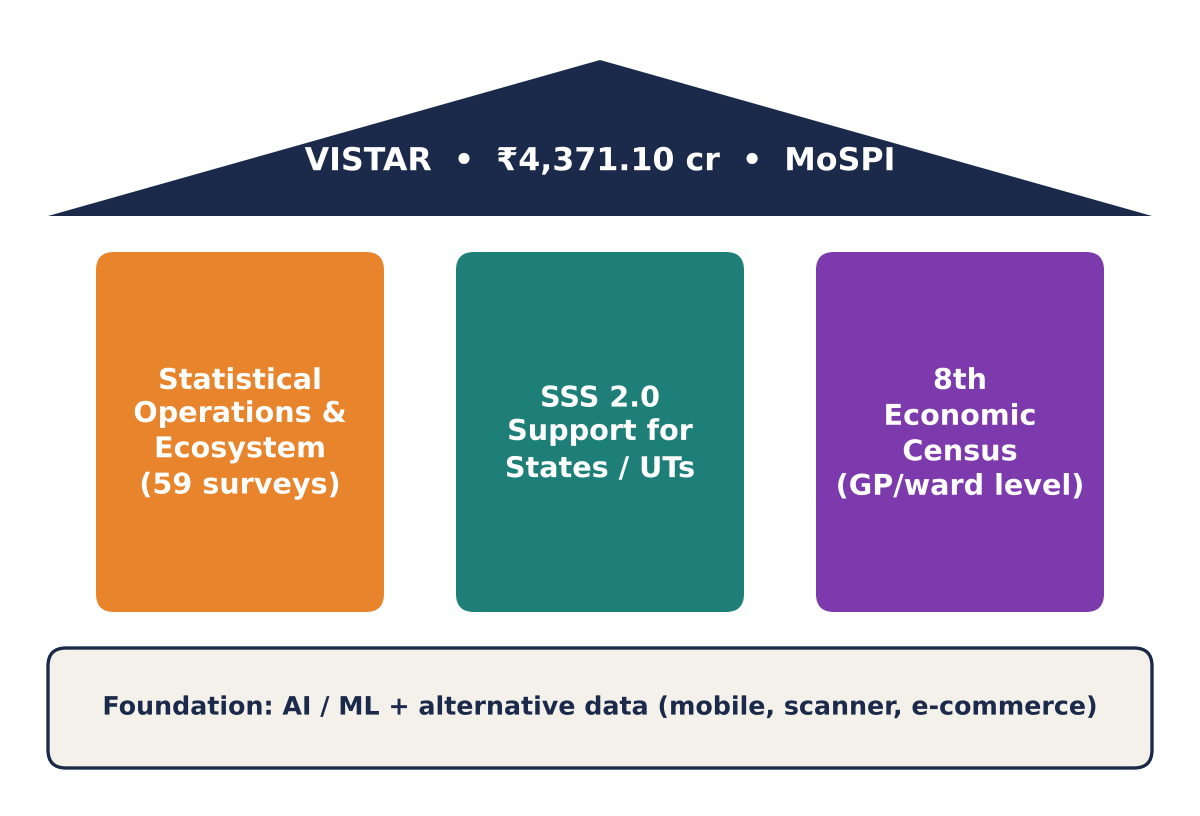
The Cabinet approved VISTAR (Viksit Bharat Initiative for Statistical Transformation, Analytics & Research), a Central Sector Scheme of MoSPI with ₹4,371.10 crore for FY 2026-27 to 2030-31.
Key facts
Three components: statistical operations & ecosystem, SSS 2.0 support for States/UTs, and the 8th Economic Census.
MoSPI plans 59 surveys in the 16th Finance Commission cycle (earlier 43).
Proposed new indices: Headline Index of Services Production and Index of Unincorporated Sector Enterprises.
Uses AI/ML and alternative data — mobile, retail-scanner and e-commerce data; census down to Gram Panchayat/ward level.
Way forward
Protect the independence of the statistical system, release data on a fixed calendar and build State-level capacity.
Concept
Central Sector Scheme: 100% Centre-funded and Centre-implemented. Economic Census counts all non-farm establishments; the 7th was held in 2019-21.
Pillar diagram of the VISTAR scheme with three pillars: statistical operations and ecosystem, SSS 2.0 support for States and UTs, and the 8th Economic Census, on a base of AI, ML and alternative data — StudyForGS
5. CERT-In issues security-audit guidelines for agentic AI
SCI-TECHCOMMON: Prelims + Mains GS3
Syllabus linkage
GS-III: Cyber security, IT & AI. Prelims: CERT-In, Section 70B IT Act.
Context
CERT-In released AI Security Auditing Guidelines for agentic AI — systems that plan and act on their own, keep memory and hand tasks to other tools or agents.
Key facts
Flags risks from autonomy, persistent memory and delegation.
Auditors must test excess permissions, unapproved tool use and credential misuse.
Recommends least privilege, audit trails, human oversight and an emergency-stop (kill-switch).
Way forward
Make audits mandatory for AI agents in finance and critical infrastructure and align them with the DPDP Act duties.
Concept
CERT-In: national nodal agency for cyber incidents under Section 70B, IT Act 2000, working under MeitY. Separate body NCIIPC (Sec 70A) protects critical information infrastructure.
6. NPCI tells Supreme Court zero-MDR on UPI is unsustainable
Defending the new merchant fee before the Supreme Court, NPCI said free UPI cannot fund the system's growth; the Court had earlier asked whether the charge is a tax or a fee.
Key facts
MDR of up to 0.4% applies only to P2M payments above ₹2,000; P2P stays free.
UPI in Aug 2026: 24.51 billion transactions worth about ₹29.82 lakh crore.
About 70% of value is P2P; only about 4% of merchant transactions are affected.
Zero MDR began January 2020 under Section 10A, PSS Act 2007.
Way forward
Keep small merchants exempt, cap fees transparently and pair them with a funded subsidy for low-value payments.
Concept
MDR (Merchant Discount Rate): the fee a merchant pays its bank for accepting digital payments. NPCI is a not-for-profit umbrella body set up under the PSS Act with RBI and IBA guidance.
7. Trade-margin cap on cancer drugs: big cuts, but uneven relief
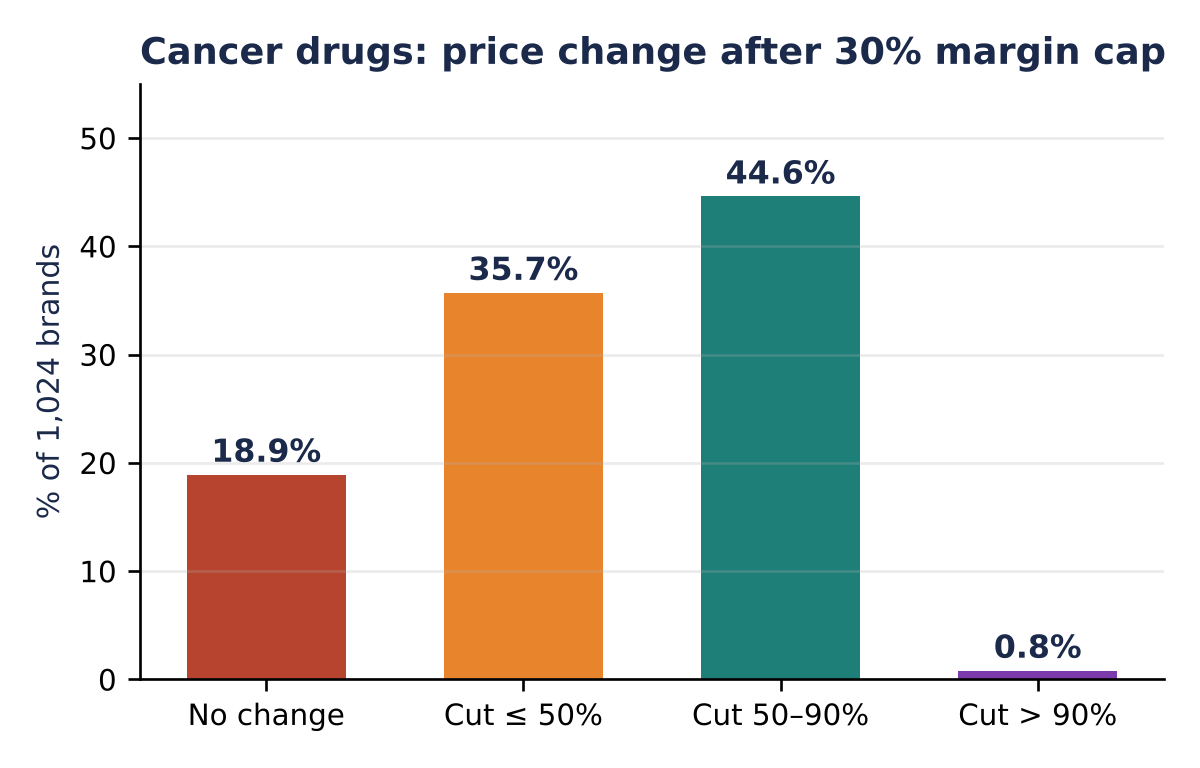
A new analysis of 1,024 brands shows how the 30% trade-margin cap set by NPPA on 137 non-scheduled anti-cancer drugs has changed prices.
Key facts
45.4% of brands fell by over 50%; 0.8% by over 90%; about 194 brands saw no change.
Nearly 900 brands became cheaper, some by 70-93%.
Median treatment cost about ₹4.1 lakh, roughly 80% out-of-pocket.
5-year breast-cancer survival: 65.5% in India vs about 90% in high-income countries.
Way forward
Extend the cap to costly biologics, use pooled procurement and widen PM-JAY cover for cancer care.
Concept
NPPA (1997) fixes and monitors drug prices under DPCO 2013; scheduled drugs come from the NLEM. Trade margin = gap between the price to stockist and the MRP.
Bar chart of price change across 1,024 anti-cancer drug brands: about 18.9 percent no change, 35.7 percent cut up to 50 percent, 44.6 percent cut 50 to 90 percent, 0.8 percent cut over 90 percent — StudyForGS
8. SC: arrest begins at physical restraint; 24-hour clock starts then
POLITYCOMMON: Prelims + Mains GS2
Syllabus linkage
GS-II: Fundamental Rights, Judiciary, criminal justice. Prelims: Art 22, BNSS 2023, D.K. Basu.
Context
A bench led by Justice Ujjal Bhuyan held that a person is arrested the moment police physically restrain their liberty — not when the arrest is formally recorded.
Key facts
The 24-hour limit for producing the person before a Magistrate (Art 22(2), BNSS Sec 58) runs from that moment.
Only journey time to the Magistrate's court can be excluded.
Informal custody without recording arrest is unconstitutional.
No penal statute, including the BNSS, defines the word "arrest".
Way forward
Use CCTV in police stations, digital arrest memos with timestamps and strict action against illegal detention.
Concept
Art 22(1)-(2): right to know grounds, to a lawyer, and production within 24 hours. Art 22(3) excludes enemy aliens and preventive detention. D.K. Basu (1997) laid down arrest guidelines.
9. ECI announces Special Summary Revision of rolls in six States/UTs
POLITYCOMMON: Prelims + Mains GS2
Syllabus linkage
GS-II: Elections, constitutional bodies. Prelims: Art 324-326, Forms 6/7/8, RPA 1950.
Context
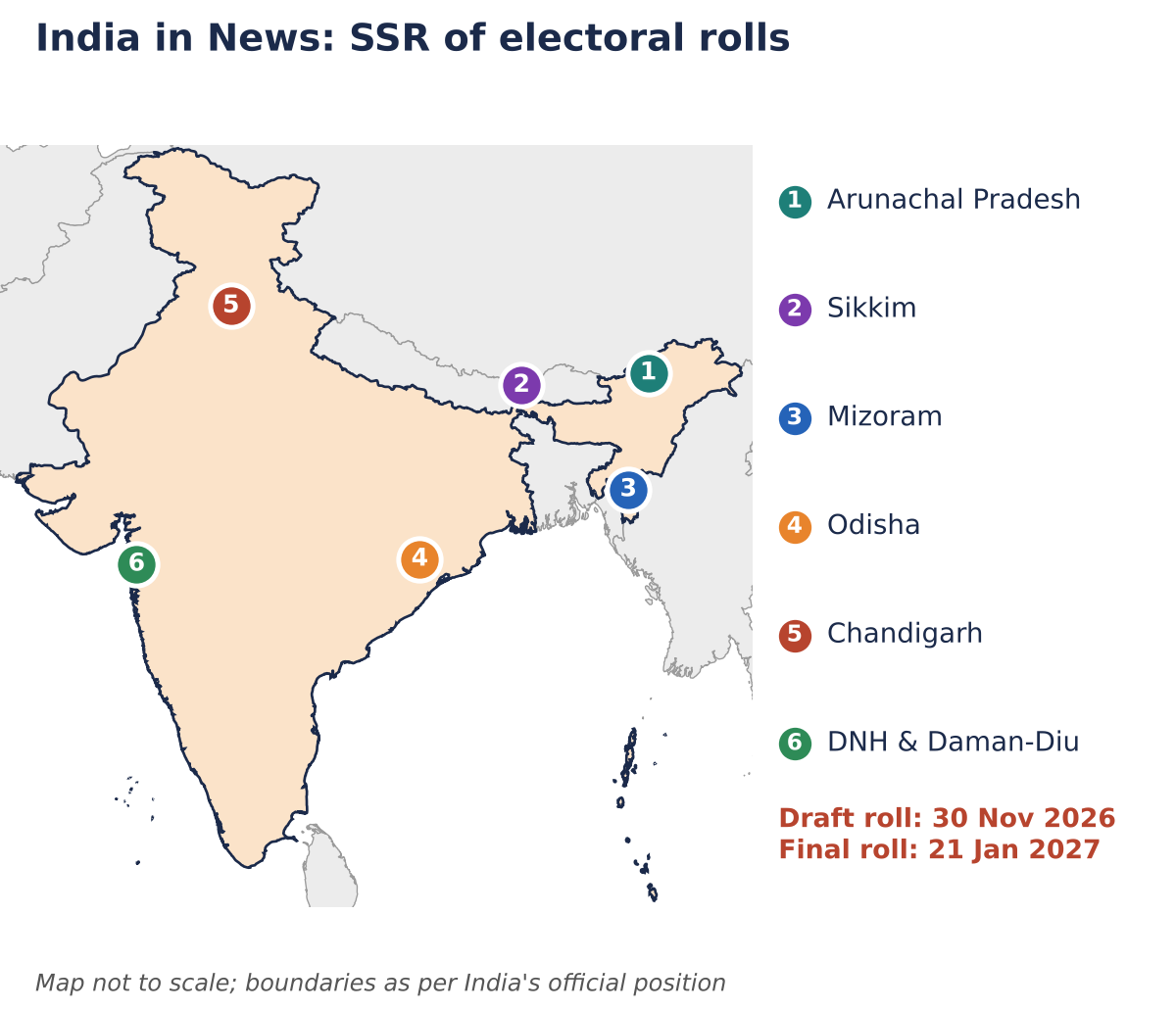
The Election Commission scheduled a Special Summary Revision (SSR) for Arunachal Pradesh, Mizoram, Odisha, Sikkim, Chandigarh and Dadra & Nagar Haveli and Daman & Diu, even as SIR disputes continue elsewhere.
Key facts
Draft rolls: 30 Nov 2026; final rolls: 21 Jan 2027.
Aadhaar linking in Forms 6 and 8 is voluntary.
Forms: 6 = inclusion, 7 = objection/deletion, 8 = correction or shift of address.
SSR is a routine update; SIR is a fresh door-to-door verification.
Way forward
Publish deletion lists with reasons, give notice before removal and audit bulk Form-7 filings to protect voters.
Concept
Art 324: superintendence of elections by ECI; Art 326: adult suffrage. 61st Amendment (1988) cut voting age from 21 to 18. Rolls are prepared under the RPA 1950.
India locator map with numbered pins for the six States and UTs under Special Summary Revision: Arunachal Pradesh, Sikkim, Mizoram, Odisha, Chandigarh and Dadra and Nagar Haveli and Daman and Diu; boundaries as per India's official position — StudyForGS
10. Fast Track Special Courts scheme extended till 2031
The Cabinet approved continuing the Centrally Sponsored FTSC scheme, including exclusive POCSO courts, from 1 Apr 2026 to 31 Mar 2031 to speed up rape and child-abuse trials.
Courts to rise from 779 to 850; 399 are exclusive POCSO courts.
Over 4,02,457 cases disposed of since launch on 2 Oct 2019.
Each court: 1 judicial officer, 1 Special Public Prosecutor, 6 support staff.
Way forward
Fill forensic-lab vacancies, set up vulnerable witness deposition centres and ensure child-friendly courtrooms in every district.
Concept
Scheme followed the Criminal Law (Amendment) Act 2018 and SC directions of 25 Jul 2019. Nodal body: Department of Justice (Ministry of Law). Nirbhaya Fund set up in 2013.
11. US midterms: Democrats win both Houses — what it means for India
IRCOMMON: Prelims + Mains GS2
Syllabus linkage
GS-II: Effect of policies of developed countries on India; bilateral relations. Prelims: US Congress, veto override.
Context
In the 3 Nov 2026 midterms, Democrats won majorities in both the House and the Senate, creating divided government for the rest of President Trump's term.
Key facts
New Congress takes office in January 2027.
Congress can override a presidential veto by two-thirds in both Houses.
Key India issues: tariffs (incl. the 50% duties of 2025), H-1B visas, technology and defence deals.
Trade Promotion Authority (fast-track trade deals) has been lapsed since 2021.
Way forward
India should engage both parties and Congressional committees to push the trade deal, iCET/TRUST tech ties and Quad cooperation.
Concept
Midterms: held midway through a 4-year presidential term; all 435 House seats and about one-third of the 100 Senate seats are contested. Treaties need two-thirds Senate consent.
Data point of the day
55.8
India Services PMI — October 2026 Up from 55.2 in September — a four-month high; Composite PMI 56.2 (from 55.9), Manufacturing 54.7. New business grew fastest since June, but export orders rose at the weakest pace since Feb 2023; input-cost inflation was the slowest in over six years. A reading above 50 means expansion.
Prelims rapid-fire
Visa rule (MHA, 4 Nov): minorities from Afghanistan, Bangladesh, Pakistan who entered by 31 Dec 2024 must now obtain an appropriate visa; CAA cut-off remains 31 Dec 2014.
6 November: UN International Day for Preventing the Exploitation of the Environment in War and Armed Conflict (UNGA, 2001).
5 November: World Tsunami Awareness Day, designated by UNGA in 2015 (Res. 70/203).
Annual Survey of Industries 2024-25: manufacturing GVA up 9.28%; top State by GVA: Maharashtra.
QS Asia Rankings 2027: IIT Delhi is India's best at 66th; India has 325 ranked universities.
Census 2027: India's first digital Census; reference date 1 March 2027 (snow-bound areas 1 Oct 2026).
Practice MCQs — UPSC Prelims pattern
Q1. With reference to the energy storage scheme approved by the Union Cabinet in November 2026, consider the following statements: 1. It targets 92 GWh of storage, of which the largest share is battery energy storage. 2. Support is given as Viability Gap Funding. 3. Battery projects must meet a minimum domestic-content requirement. Which of the statements given above are correct?
1 and 2 only
2 and 3 only
1 and 3 only
1, 2 and 3
Show answer
Answer: B The largest share is pumped storage (60 GWh), not batteries (30 GWh), so statement 1 is wrong. Support is VGF (₹14,500 crore) and battery projects need 40% domestic content.
Q2. Under Article 22 of the Constitution, the safeguard of production before the nearest Magistrate within 24 hours of arrest does NOT apply to which of the following? 1. An enemy alien 2. A person arrested under a preventive detention law 3. A person arrested without a warrant under the BNSS. Select the correct answer using the code given below:
1 only
1 and 2 only
2 and 3 only
1, 2 and 3
Show answer
Answer: B Art 22(3) excludes enemy aliens and persons held under preventive detention. A person arrested without warrant under the BNSS must be produced within 24 hours (Sec 58).
Mains practice question
Q. Grid-scale energy storage is the missing link in India's renewable-energy transition. Discuss in the light of the recently approved 92 GWh storage scheme. (150 words, 10 marks)
Hint / approach
Intro: 500 GW non-fossil target and the day-night mismatch. Body: scheme design (VGF, 60/30/2 GWh split, 40% local content), benefits (curtailment, peak supply, grid stability), challenges (PSP clearances, battery imports, discom finances). Conclude with domestic manufacturing and market reforms.