India invites Pakistan to SCO Civilisational Dialogue; Supreme Court issues notice on DNPA's DPDP challenge and flags medicine mark-ups; ICRA sees fresh bad loans rising in FY27
Wednesday, 28 October 2026 · IST · National & International · 11 items · 2 MCQs
In its first such invitation since Operation Sindoor, India has invited Pakistan's culture minister to the SCO Civilisational Dialogue Forum in New Delhi (20–22 Nov). The Supreme Court issued notice on the news publishers' challenge to the DPDP Act, 2023, questioned why most medicines sit outside price control, and agreed to examine the SIR records plea. On the economy, ICRA expects private banks' fresh NPA generation at 2.5% in FY27, while a Japanese industry delegation pitched ₹8–10 lakh crore of investment.
Today at a glance — things to remember
India invites Pakistan's culture minister Aurangzeb Khan Khichi to the SCO Civilisational Dialogue Forum, New Delhi, 20–22 Nov 2026.
SC (CJI Surya Kant) issues notice on DNPA plea against DPDP Act, 2023; next hearing 17 Nov.
SC on drug pricing: non-scheduled medicines are about 83% of the market by value; order reserved.
Japanese delegation pitches ₹8–10 lakh crore investment; Japan was top FDI source in Q1 FY27 ($5.71 bn).
SIMBEX-2026 (33rd edition) concluded off Visakhapatnam; running since 1994.
Army special forces head to Banyuwangi (Indonesia) for Exercise Garuda Shakti.
GIB rewilding: 1 of 4 released birds killed by a desert fox in Desert National Park.
Study: just 3.2% of glaciers (lake/ocean-ending) cause over half of global glacier ice loss.
ESTIC-2026 (27–29 Oct, Bharat Mandapam) spotlights CCUS and gene-edited crops.
Detailed notes
1. ICRA: Fresh Bad Loans to Rise in FY27, Private Banks Under Pressure
ECONOMYCOMMON: Prelims + Mains GS3
Syllabus linkage
GS3 – Indian Economy, banking & mobilisation of resources; Prelims: NPA, slippage ratio, GNPA, credit growth.
Context
Rating agency ICRA expects fresh NPA generation to inch up in FY27, led by stress in unsecured retail and MSME loans of private banks, even as overall credit costs stay below historical levels.
Key facts
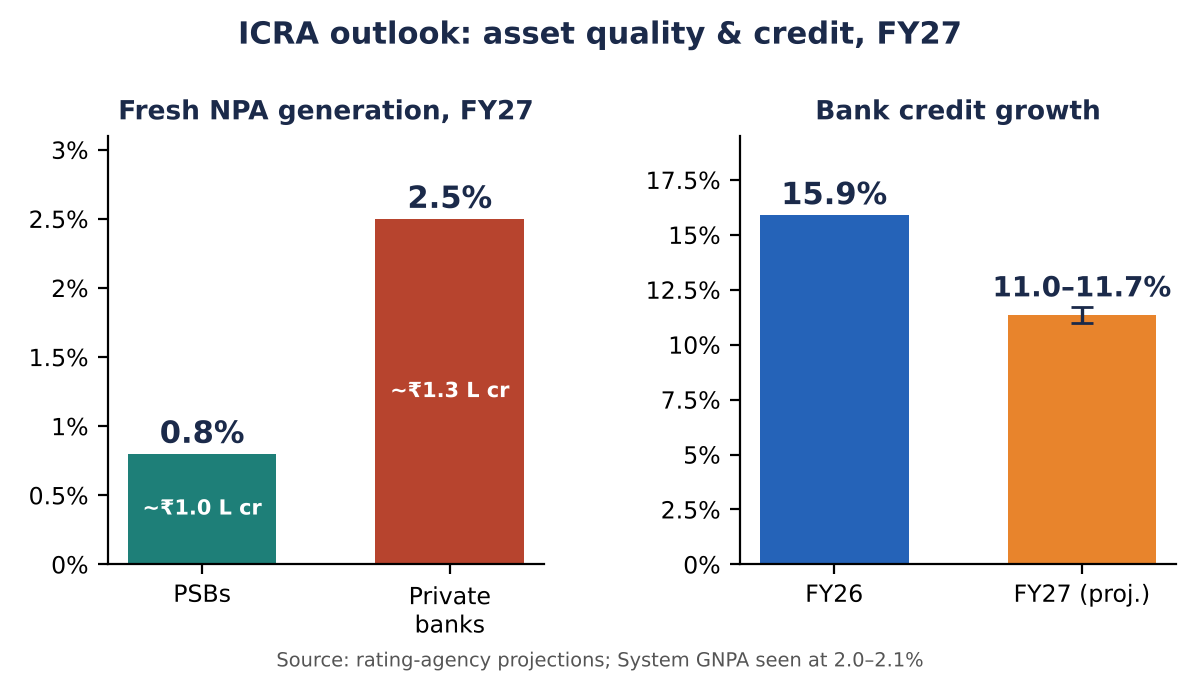
Fresh NPA generation in FY27: 0.8% for PSBs vs 2.5% for private banks.
In absolute terms: about ₹1 lakh crore (PSBs) and ₹1.3 lakh crore (private banks).
Bank credit growth seen at 11.0–11.7% in FY27, down from 15.9% in FY26.
System GNPA projected at 2.0–2.1%; slippages likely higher in H2 FY27.
Way forward
Tighter underwriting of unsecured loans, early-warning systems and timely use of IBC resolution to keep asset quality stable.
Concept
NPA: a loan whose interest/principal is overdue for more than 90 days. Slippage ratio = fresh NPAs ÷ standard advances at the start of the year. GNPA includes all NPAs; NNPA = GNPA minus provisions.
Two-panel bar chart: FY27 fresh NPA generation of 0.8% for public sector banks versus 2.5% for private banks, and bank credit growth falling from 15.9% in FY26 to 11.0–11.7% projected for FY27. — StudyForGS
2. CCUS Pitched as Key to Net Zero for Hard-to-Abate Sectors at ESTIC-2026
ENVIRONMENTCOMMON: Prelims + Mains GS3
Syllabus linkage
GS3 – Environment, conservation, climate change; Prelims: CCUS, Net Zero 2070, ESTIC.
Context
An official statement on the sidelines of the second Emerging Science, Technology and Innovation Conclave (ESTIC-2026), 27–29 Oct at Bharat Mandapam, positioned Carbon Capture, Utilisation and Storage as central to India's Net Zero by 2070 vision.
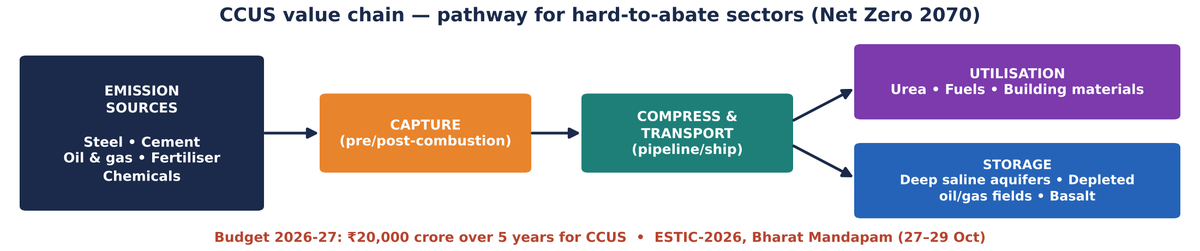
Union Budget 2026-27 proposed ₹20,000 crore over 5 years for CCUS, aligned with the Dec 2025 roadmap.
Captured CO2 is either utilised (urea, fuels, building materials) or stored in deep geological formations.
ESTIC-2026 is organised by CSIR; theme: 'Creative Minds, Catalyzing Science, Empowering Technologies'.
Way forward
Build CO2 transport hubs/clusters, a carbon-market linkage via CCTS, and storage-site mapping to cut costs and scale pilots.
Concept
Hard-to-abate sectors need high heat or carbon as a feedstock, so renewables alone cannot decarbonise them. India's updated NDC: 45% cut in emissions intensity (2005 base) by 2030, 50% non-fossil power capacity, Net Zero by 2070.
Flowchart of the CCUS value chain: emission sources such as steel, cement and fertiliser plants feed CO2 capture, then compression and transport, which splits into utilisation (urea, fuels, building materials) and permanent geological storage, all supporting Net Zero 2070. — StudyForGS
3. Great Indian Bustard Rewilding: One Bird Lost to Desert Fox, Next Batch Under Review
ENVIRONMENTCOMMON: Prelims + Mains GS3
Syllabus linkage
GS3 – Biodiversity conservation; Prelims: GIB, Desert National Park, IUCN status, WPA Schedule I.
Context
In the first phase of India's experimental GIB rewilding, a six-month-old captive-bred male was killed by a desert fox at a watering hole in Desert National Park, Jaisalmer; officials say the programme will continue after a review of safeguards.
2 satellite-tagged males released on 4 Oct at Sudasari (Sam); 2 more later — 4 in all.
3 surviving birds are safe and tracked by satellite; release of the remaining 7 paused for review.
Birds bred at the WII-run conservation breeding centre at Sam, Jaisalmer.
Way forward
Predator-proof soft-release enclosures, staggered releases and continued power-line undergrounding/bird diverters in GIB habitats.
Concept
GIB (Ardeotis nigriceps): Critically Endangered (IUCN), Schedule I of WPA 1972, CMS Appendix I; state bird of Rajasthan. Main threat: collision with overhead power lines. Rewilding = restoring captive-bred animals to the wild.
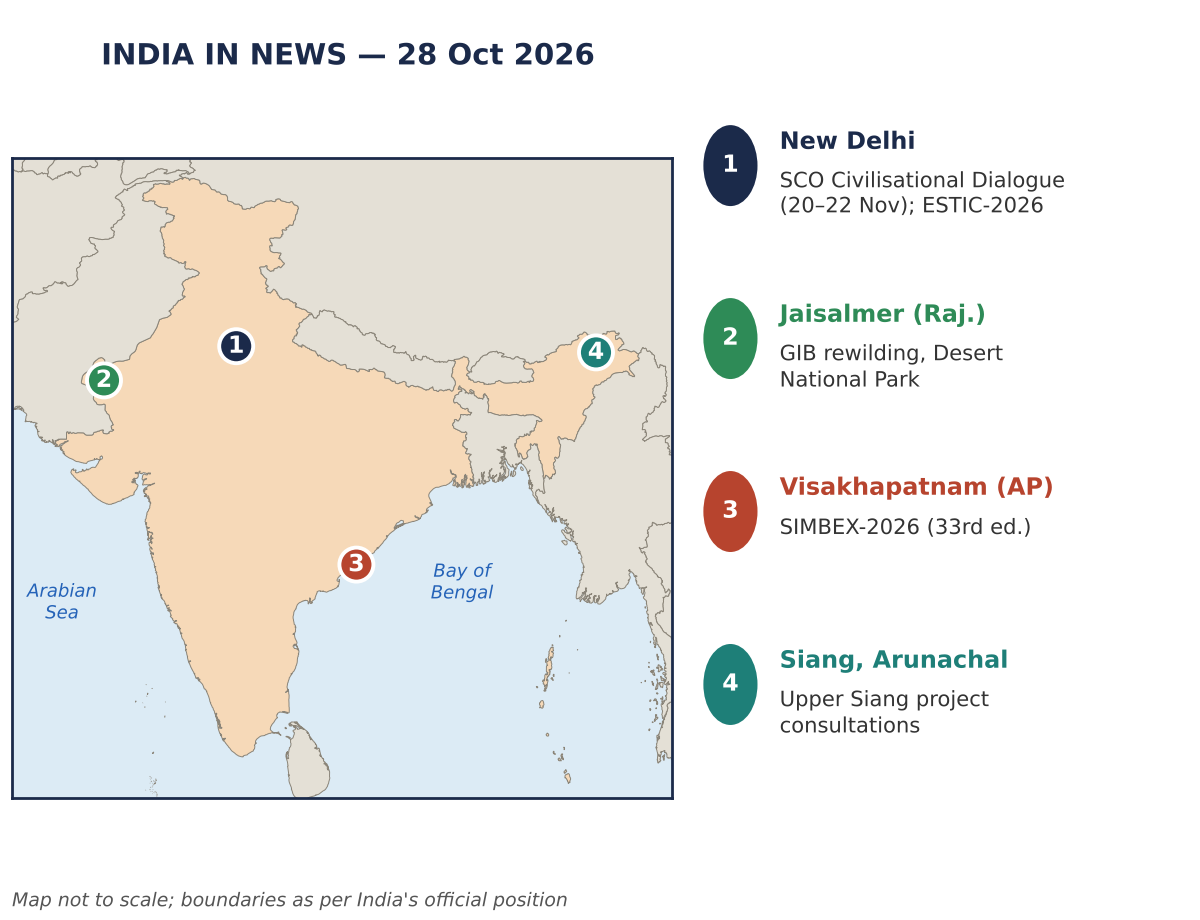
Locator map of India titled India in News showing numbered pins: 1 New Delhi (SCO Civilisational Dialogue Forum and ESTIC-2026), 2 Jaisalmer (Great Indian Bustard rewilding in Desert National Park), 3 Visakhapatnam (SIMBEX-2026), 4 Siang river, Arunachal Pradesh (Upper Siang project consultations), with India's boundaries as per India's official position. — StudyForGS
4. Nobel Laureate Backs Gene-Edited Crop Research in Indian Labs
At ESTIC-2026, Nobel laureate Richard J. Roberts (Medicine, 1993) said fears of dependence on foreign seed firms are unfounded, since CRISPR-based plant work needs only a lab and a few weeks of training.
Key facts
Bt cotton (2002) remains India's only commercially approved GM crop.
Bt brinjal moratorium since 2010; SC gave a split verdict on GM mustard in July 2024.
SDN-1 and SDN-2 genome-edited plants (no foreign DNA) exempted from GM rules in March 2022.
ICAR released India's first two genome-edited rice varieties in 2025.
Way forward
A clear national GM/gene-editing policy (as the SC asked), science-based biosafety review and public outreach to build trust.
Concept
GM crop: carries a foreign gene (transgenic). Gene editing (CRISPR-Cas9): precise changes to a plant's own genes. GEAC under MoEFCC (Rules, 1989 under EPA, 1986) approves GM organisms.
5. Just 3.2% of Glaciers Cause Over Half of Global Glacier Ice Loss
A new peer-reviewed global study found that water-terminating glaciers (ending in lakes, oceans or ice shelves) are only 3.2% of the world's glaciers but drove more than half of glacier ice loss during 2000–2019.
Key facts
These glaciers lost about 134 billion tonnes of ice a year.
Study covered 216,502 glaciers (excluding Greenland and Antarctic ice sheets).
Relative to size, lake-ending glaciers lost ice about 57% faster; current models under-count them.
Way forward
Include lake-terminating glaciers in projection models and expand GLOF early-warning systems for Himalayan glacial lakes.
Concept
Calving: breaking of ice chunks at a glacier's edge into water. GLOF (Glacial Lake Outburst Flood): sudden release of water from a moraine-dammed lake, e.g. South Lhonak (Sikkim), Oct 2023.
6. SIMBEX-2026 Concludes; Army Special Forces Head to Indonesia for Garuda Shakti
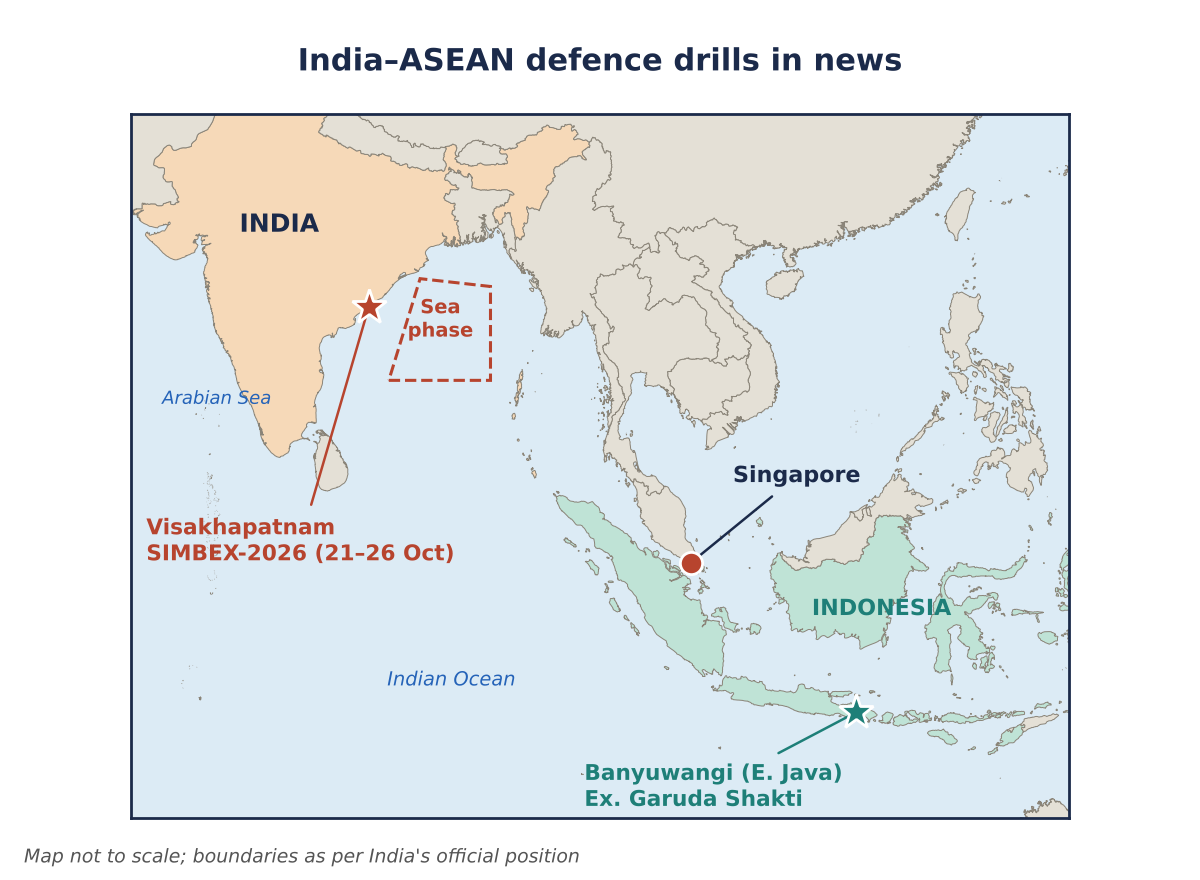
The 33rd Singapore–India Maritime Bilateral Exercise (SIMBEX-2026) concluded after harbour and sea phases off Visakhapatnam, while an Indian Army special forces contingent left for Banyuwangi (East Java) for the India–Indonesia exercise Garuda Shakti.
Key facts
SIMBEX began in 1994 as 'Exercise Lion King' — the Indian Navy's longest continuous bilateral exercise.
2026 edition: 21–26 Oct; RSN ship RSS Supreme; opening aboard INS Nilgiri and INS Kamorta.
Sea phase in the Bay of Bengal: anti-submarine, anti-surface and anti-air warfare drills.
Garuda Shakti: special forces drill on counter-terrorism and jungle operations.
Way forward
Deepen interoperability and maritime domain awareness with ASEAN partners under MAHASAGAR and the Indo-Pacific Oceans Initiative.
Concept
India–Singapore: Comprehensive Strategic Partnership (2024); India–Indonesia: CSP (2018). Other India–Indonesia drills: Samudra Shakti (navy), IND-INDO CORPAT (coordinated patrol).
Regional map of South and Southeast Asia highlighting India, Singapore and Indonesia, with markers for Visakhapatnam and the Bay of Bengal sea phase of SIMBEX-2026 and for Banyuwangi in East Java, venue of Exercise Garuda Shakti; India's boundaries as per India's official position. — StudyForGS
7. First Since Op Sindoor: India Invites Pakistan to SCO Civilisational Dialogue Forum
IRCOMMON: Prelims + Mains GS2
Syllabus linkage
GS2 – India and its neighbourhood; regional groupings; Prelims: SCO members, RATS, chairmanship.
Context
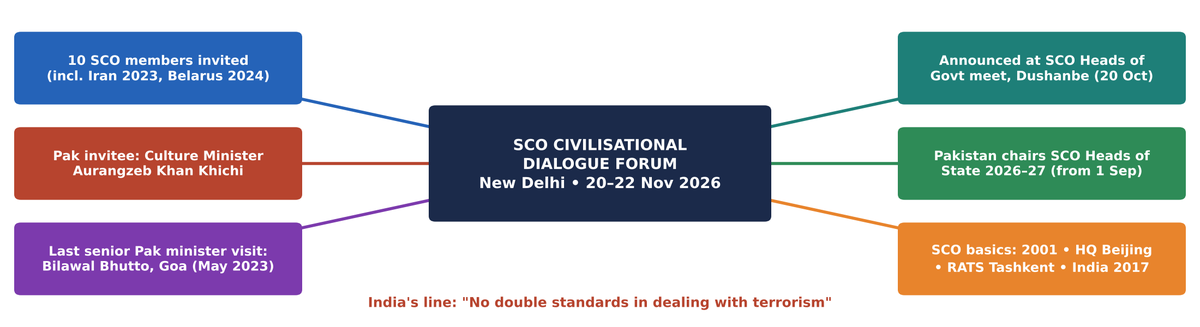
India has invited all 10 SCO members, including Pakistan's Minister for National Heritage and Culture Aurangzeb Khan Khichi, to the first SCO Civilisational Dialogue Forum in New Delhi on 20–22 November 2026.
Key facts
Forum announced at the SCO Council of Heads of Government in Dushanbe on 20 Oct.
If he attends, it would be the first senior Pakistani ministerial visit since Bilawal Bhutto (Goa, May 2023).
Pakistan chairs the SCO Council of Heads of State for 2026–27 (from 1 Sep).
India's line at SCO: 'no double standards' in dealing with terrorism.
Way forward
Use multilateral cultural platforms for people-centric engagement while keeping bilateral dialogue tied to an end to cross-border terrorism.
Concept
SCO: founded 15 June 2001, Shanghai; HQ Beijing; RATS in Tashkent. Members: China, Russia, Kazakhstan, Kyrgyzstan, Tajikistan, Uzbekistan, India & Pakistan (2017), Iran (2023), Belarus (2024).
Mind-map centred on the SCO Civilisational Dialogue Forum, New Delhi, 20–22 November 2026, with branches for the 10 member states invited, Pakistan's culture minister invitation, the announcement at Dushanbe on 20 October, Pakistan's 2026–27 chairmanship, SCO basics (2001, Beijing HQ, RATS Tashkent) and India's no-double-standards position on terrorism. — StudyForGS
8. Japanese Industry Delegation Pitches ₹8–10 Lakh Crore Investment in India
A 32-member delegation led by the Japan Chamber of Commerce and Industry met PMO and NITI Aayog officials in New Delhi, proposing ₹8–10 lakh crore of investment in infrastructure and manufacturing over the next few years.
Key facts
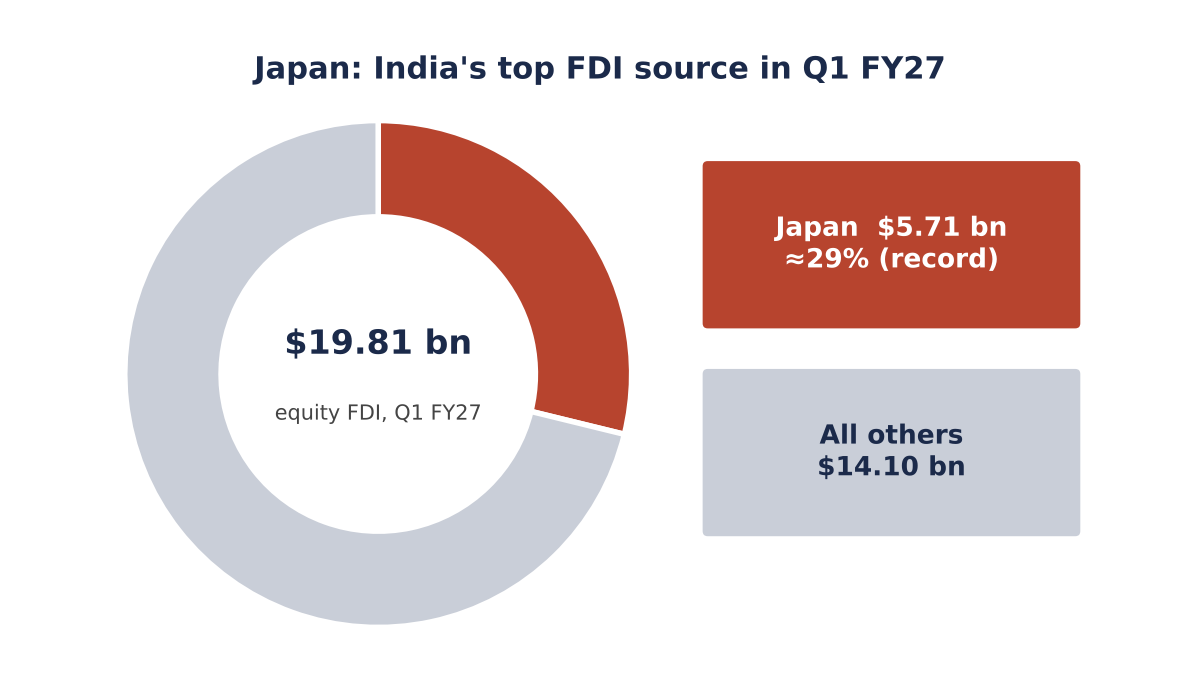
Japan was India's top FDI source in Q1 FY27: record $5.71 bn, about 29% of $19.81 bn equity inflows.
Interest in Delhi–Varanasi and Varanasi–Siliguri high-speed rail corridors; autos and manufacturing.
India–Japan HR Exchange Action Plan: movement of over 5 lakh people in 5 years.
Way forward
Fast-track single-window clearances and stable tax rules to convert pledges into projects, leveraging China+1 supply-chain shifts.
Concept
India–Japan Special Strategic and Global Partnership (2014). Aug 2025 summit set a target of ¥10 trillion private investment over 10 years. Mumbai–Ahmedabad HSR (~₹2 lakh crore) uses Shinkansen technology.
Donut chart of India's equity FDI inflows in Q1 FY27 totalling 19.81 billion dollars, showing Japan's record share of 5.71 billion dollars (about 29 percent) against 14.10 billion dollars from all other countries. — StudyForGS
9. SC Issues Notice on News Publishers' Challenge to DPDP Act, 2023
POLITYCOMMON: Prelims + Mains GS2
Syllabus linkage
GS2 – Fundamental rights, judiciary, statutory bodies; Prelims: Art. 19(1)(a), Art. 21, Puttaswamy, Data Protection Board.
Context
A bench of CJI Surya Kant and Justices Joymalya Bagchi and V. Mohana issued notice to the Centre on the Digital News Publishers Association (DNPA) plea arguing the data law has no journalistic exemption and could stifle newsrooms.
Key facts
Challenged: Sections 7, 17(2), 18, 19, 27, 29, 36, 37, 44(3) of the Act and Rules 16, 17, 23 of DPDP Rules, 2025.
Sec 44(3) amends RTI Act Sec 8(1)(j) to exempt all personal information from disclosure.
Petitioners: consent rules could act as prior restraint on investigative reporting.
CJI sought safeguards against misuse of any media exemption; next hearing 17 Nov.
Way forward
A narrowly-tailored journalistic exemption (as in GDPR Art. 85) with a public-interest test can balance privacy and press freedom.
Concept
K.S. Puttaswamy (2017): 9-judge bench held privacy a fundamental right under Art. 21; test of legality, necessity, proportionality. Press freedom is implicit in Art. 19(1)(a), subject to Art. 19(2).
10. 'Patients' Lives, Not Commerce': SC Questions Why Most Medicines Escape Price Control
HEALTHCOMMON: Prelims + Mains GS2
Syllabus linkage
GS2 – Health, government policies; Prelims: DPCO 2013, NPPA, NLEM, Para 19.
Context
Hearing Kishan Chand Jain v. EMRB, a bench of Justices Vikram Nath and Sandeep Mehta questioned steep hospital mark-ups and the narrow coverage of price control, and reserved its order with two weeks for written submissions.
Key facts
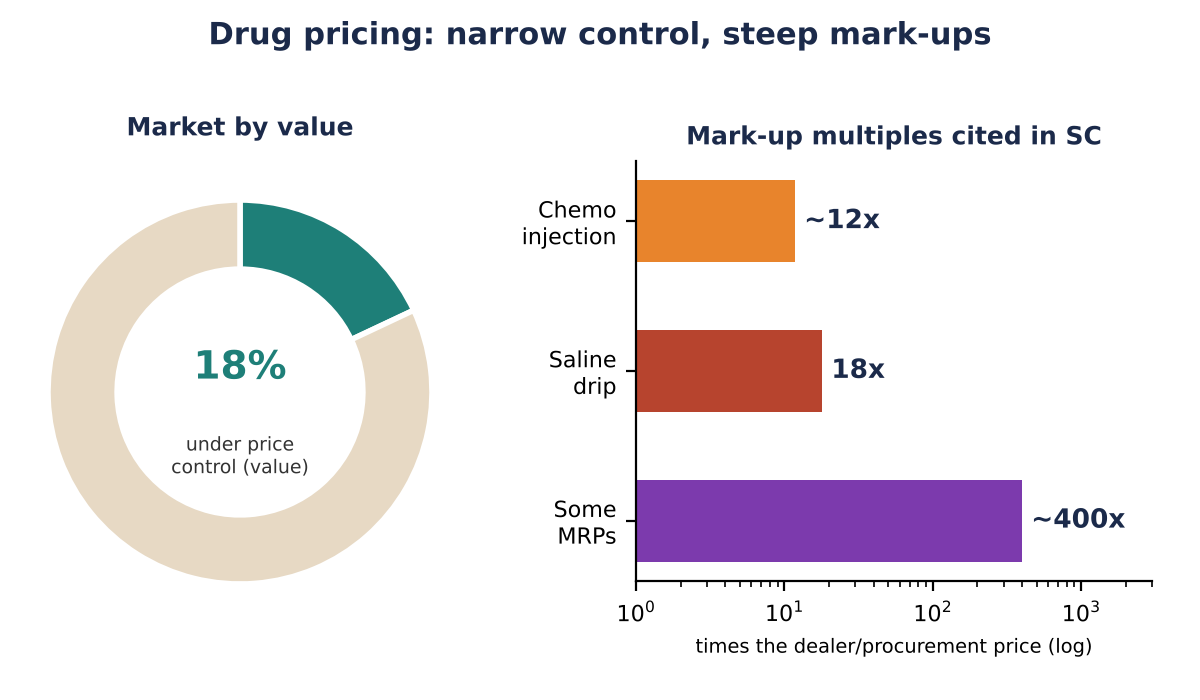
Non-scheduled medicines ≈ 83% of market by value (petitioner); scheduled drugs = 18% by price (Centre).
Examples: chemo injection ₹11,000 dealer price billed at ₹1.3 lakh; ₹15 saline sold for ₹270.
Bench noted MRPs up to ~400 times procurement price; called the regulator's functioning 'defunct'.
Centre: no legal bar to wider control, but follows a 'calibrated' policy (NPPP, 2012).
Way forward
Extend trade-margin rationalisation beyond cancer drugs, cap hospital mark-ups on consumables and strengthen NPPA monitoring.
Concept
DPCO 2013 issued under the Essential Commodities Act, 1955; caps prices of NLEM (scheduled) drugs. NPPA (1997) enforces it. Para 19 allows price fixing in extraordinary cases (e.g. stents, 2017). Right to health flows from Art. 21; Art. 47 (DPSP).
Two-part chart: a donut showing scheduled (price-controlled) medicines at about 18 percent of the market by value versus about 82 percent outside control, and a log-scale bar chart of mark-up multiples cited in court — chemotherapy injection about 12 times, saline drip 18 times, and some MRPs up to about 400 times procurement price. — StudyForGS
11. SIR Row: SC Says It Will 'Examine Everything' as Petitioners Seek Preservation of ECI Records
POLITYCOMMON: Prelims + Mains GS2
Syllabus linkage
GS2 – Constitutional bodies, elections; Prelims: Art. 324/326, RP Act 1950, Form 6.
Context
Hearing pleas on the Special Intensive Revision (SIR) of electoral rolls, the CJI-led bench was urged to order preservation of the Election Commission's files, notings and internal communications; the CJI said, 'We are aware of everything… we will examine.'
Key facts
Petitioners questioned changes to the online Form 6 (new-voter enrolment) made during the Bihar SIR.
Petitioners got 10 days to file a rejoinder to the ECI's counter-affidavit.
Matter listed next on 17 Nov, with fresh notice on the Form 6 dispute.
Way forward
Transparent SOPs, publication of deletion lists with reasons and a time-bound appeal route protect the universal adult franchise.
Concept
Art. 324: ECI superintends preparation of electoral rolls. Art. 326: adult suffrage (18+). Sec 21, RP Act 1950: revision of rolls by the ERO. Form 6: inclusion of name; Form 7: objection/deletion; Form 8: correction/shifting.
Data point of the day
2.5%
Fresh NPA generation, private banks (FY27, ICRA projection) Over 3x the 0.8% projected for public sector banks; about ₹1.3 lakh crore of fresh bad loans, driven by unsecured retail and MSME stress, while credit growth slows to 11.0–11.7%.
Prelims rapid-fire
12th BRICS Parliamentary Forum (New Delhi) adopted the New Delhi Joint Declaration: condemned the Pahalgam attack, sought UNSC and global financial reforms.
Vigilance Awareness Week 2026 (CVC): 27 Oct–2 Nov, the week of Sardar Patel's birth anniversary (31 Oct); CVC set up in 1964 (Santhanam Committee).
MoRTH amended the CMV Rules, 1989 to add E100 alongside E85 for emission certification of flex-fuel vehicles.
61st CIML (International Organization of Legal Metrology) meeting: 26–28 Oct, New Delhi — first time in India.
SC issued notice to the Centre on petitions against the law mandating six stanzas of Vande Mataram.
Arunachal government held talks with dam-affected people over the Siang Upper Multipurpose Project on the Siang (Brahmaputra).
Practice MCQs — UPSC Prelims pattern
Q1. With reference to SIMBEX, consider the following statements: 1. It began in 1994 as 'Exercise Lion King'. 2. Its 2026 edition was hosted at Visakhapatnam. 3. It is a trilateral exercise involving India, Singapore and Thailand. Which of the statements given above is/are correct?
1 only
1 and 2 only
2 and 3 only
1, 2 and 3
Show answer
Answer: B SIMBEX is a bilateral India–Singapore exercise (not trilateral; SITMEX is the trilateral with Thailand). It began in 1994 as Lion King; the 33rd edition was held off Visakhapatnam.
Q2. Consider the following statements about the Great Indian Bustard: 1. It is listed as Critically Endangered on the IUCN Red List. 2. It is listed in Schedule I of the Wild Life (Protection) Act, 1972. 3. It is the state bird of Gujarat. Which of the statements given above are correct?
1 only
2 and 3 only
1 and 2 only
1, 2 and 3
Show answer
Answer: C The GIB is Critically Endangered and in Schedule I; it is the state bird of Rajasthan, not Gujarat. Its last stronghold is Desert National Park, Jaisalmer.
Mains practice question
Q. Price regulation covers only a small share of India's pharmaceutical market by value. Examine the gaps in the current drug-pricing framework and suggest measures to make medicines affordable without hurting innovation. (GS2, 15 marks, 250 words)
Hint / approach
Intro: DPCO 2013/NLEM coverage (~18% by value). Body: gaps — non-scheduled drugs, hospital mark-ups (₹15 saline at ₹270), weak NPPA enforcement, trade margins; Centre's 'calibrated' view (innovation, industry). Way forward: trade-margin caps, Jan Aushadhi, generic prescription, hospital consumable pricing, Art. 21 right to health. Conclude with balance.
📌 One-line revision: Revise: SCO Civilisational Dialogue (Delhi, 20–22 Nov) | DPDP–DNPA (Puttaswamy, Art 19(1)(a)) | DPCO 2013 & NPPA | ICRA FY27 NPA 0.8% vs 2.5% | GIB rewilding (Sam, Jaisalmer) | SIMBEX since 1994.