RBI hikes repo rate to 5.50% in first hike since 2023; Cabinet clears ₹10,000 crore SME Growth Fund and Integrated Transport & Logistics Authority; Navy's first indigenous Fleet Support Ship 'Surya' launched
Wednesday, 7 October 2026 · IST · National & International · 11 items · 2 MCQs
The RBI's Monetary Policy Committee unanimously raised the repo rate by 25 bps to 5.50% and moved to a 'calibrated tightening' stance as West Asia tensions push up crude prices and the rupee weakens, while raising its FY27 GDP forecast to 7.1% and CPI forecast to 5.2%. The Union Cabinet approved a ₹10,000 crore SME Growth Fund and an apex Integrated Transport & Logistics Authority, and the Defence Minister launched FSS-1 'Surya' at Visakhapatnam.
Today at a glance — things to remember
RBI hikes repo rate 25 bps to 5.50%; stance now 'calibrated tightening' — first hike since Feb 2023.
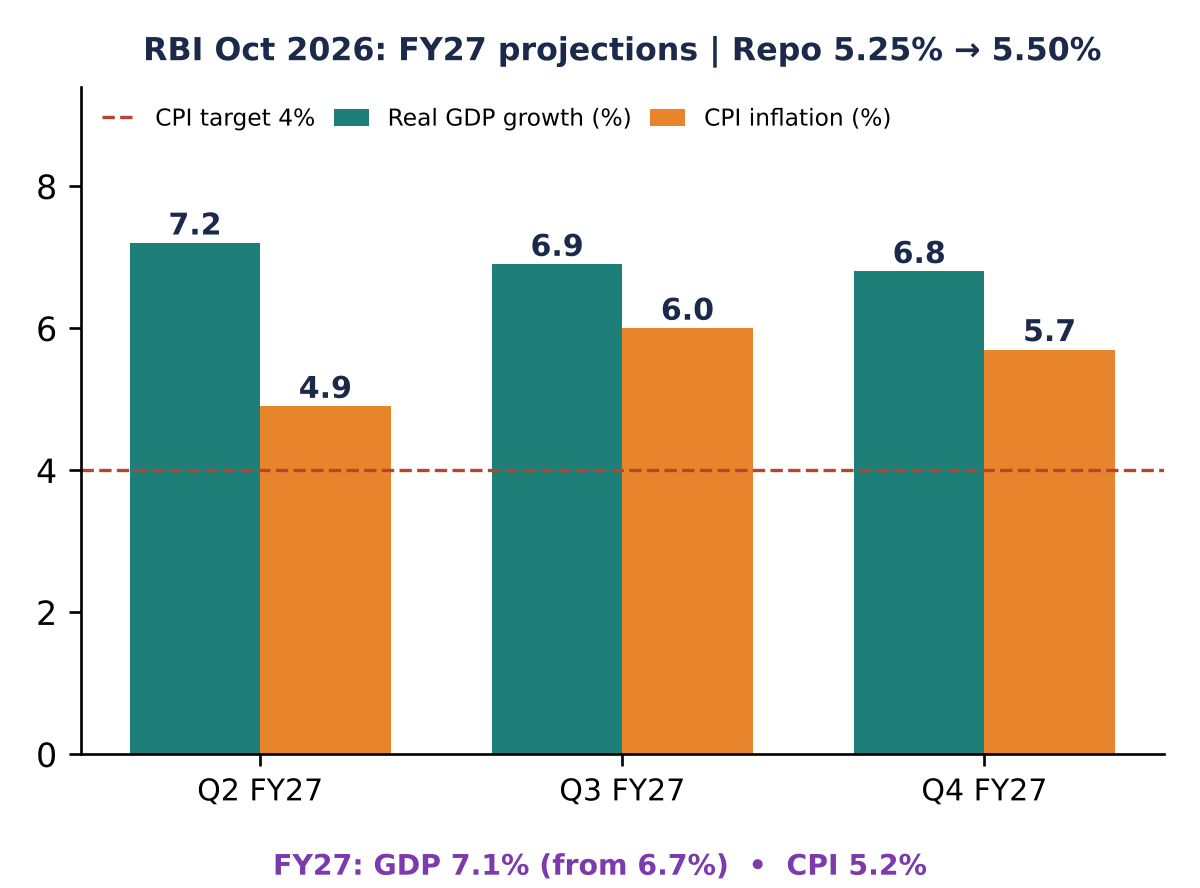
RBI raises FY27 GDP forecast to 7.1% and CPI inflation forecast to 5.2%.
Cabinet approves ₹10,000 crore SME Growth Fund — an AIF for direct equity in SMEs.
Cabinet sets up Integrated Transport & Logistics Authority (ITLA) — appraises projects ≥ ₹500 crore.
FSS-1 'Surya' — Navy's first indigenous Fleet Support Ship, launched at HSL Visakhapatnam.
On 7 Oct 2026, Governor Sanjay Malhotra announced the MPC's unanimous decision (meeting 5–7 Oct) to raise the repo rate from 5.25% to 5.50% — the first hike since Feb 2023 — citing West Asia tensions, costlier crude and a weaker rupee.
Key facts
Stance changed from 'neutral' to 'calibrated tightening'; near-term rate cuts effectively off the table.
Grouped bar chart comparing RBI's quarterly FY27 projections for real GDP growth and CPI inflation: Q2 7.2% and 4.9%, Q3 6.9% and 6.0%, Q4 6.8% and 5.7%, with the repo rate rising from 5.25% to 5.50%. — StudyForGS
2. Cabinet approves ₹10,000 crore SME Growth Fund for direct equity
ECONOMYCOMMON: Prelims + Mains GS3
Syllabus linkage
GS3 – Growth & development, industrial policy, mobilisation of resources. Prelims: AIF, MSME classification, SEBI (AIF) Regulations 2012.
Context
The Union Cabinet on 6 Oct 2026 approved a ₹10,000 crore government commitment to an SME Growth Fund to provide growth-oriented equity capital and create 'champion' Indian enterprises, in line with Viksit Bharat 2047.
Key facts
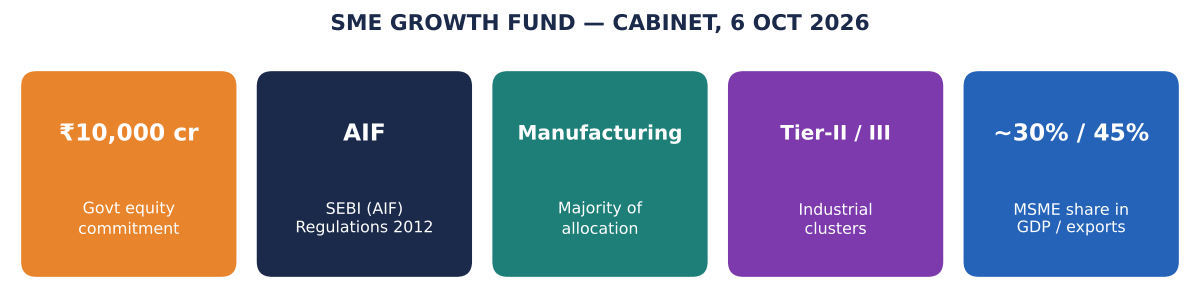
Structured as an Alternative Investment Fund (AIF) under SEBI (AIF) Regulations, 2012.
Targets SMEs with proven viability and scalability; majority allocation to manufacturing SMEs.
Focus on industrial clusters in Tier-II and Tier-III cities.
Capital for capacity expansion, technology adoption, exports, GVC integration and acquisitions.
MSMEs contribute about 30% of GDP and 45% of merchandise exports.
Way forward
Pair equity with TReDS-led working capital, credit guarantees and easier SME-exchange listing so firms graduate from micro to medium scale.
Concept
MSME (MSMED Act 2006; revised criteria): based on investment + turnover. Fund of Funds for Startups (2016) and Self-Reliant India Fund (₹50,000 crore) are earlier equity routes; AIF Category I/II/III regulated by SEBI.
Row of stat tiles summarising the SME Growth Fund: ₹10,000 crore government commitment, AIF structure under SEBI 2012 rules, majority allocation to manufacturing, Tier-II and Tier-III clusters, MSMEs at about 30% of GDP and 45% of exports. — StudyForGS
3. Integrated Transport & Logistics Authority (ITLA) set up as apex planning body
ECONOMYCOMMON: Prelims + Mains GS3
Syllabus linkage
GS3 – Infrastructure: roads, ports, railways, airports; investment models. Prelims: PM Gati Shakti, National Logistics Policy 2022.
Context
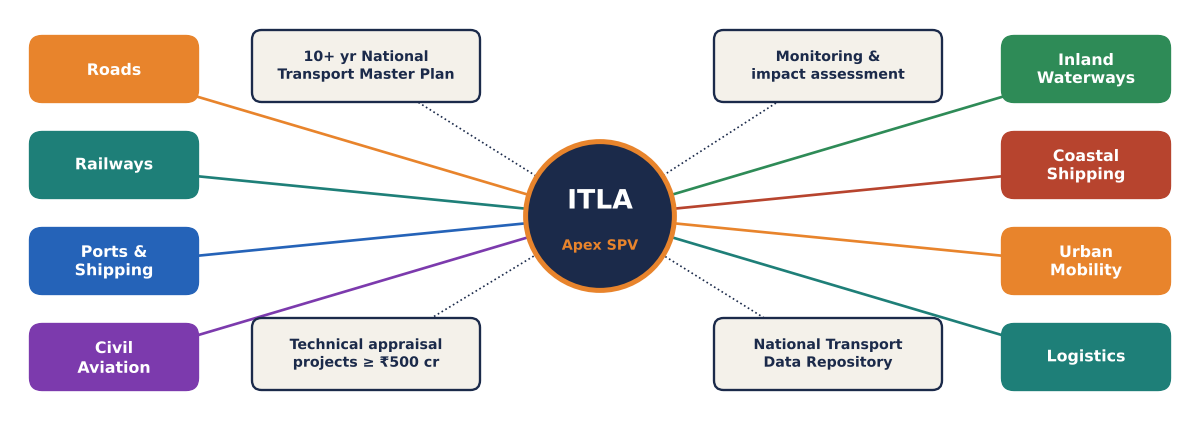
The Cabinet on 6 Oct 2026 approved the ITLA, an SPV that will act as the apex body for transport research, planning, appraisal, monitoring and impact assessment, ending the ministry-by-ministry fragmentation across five Union ministries.
Key facts
Will prepare a 10+ year National Transport Master Plan covering 8 domains — roads, railways, ports & shipping, civil aviation, inland waterways, coastal shipping, urban mobility, logistics.
Technical appraisal of central projects costing ₹500 crore or more; financial appraisal stays with existing mechanisms.
National Transport Data Repository to pool e-way bill, FASTag, Vahan, GPS and urban traffic data.
Cabinet also cleared four rail multitracking projects in WB, Odisha, TN and AP.
Way forward
Give ITLA statutory backing over time, integrate it with Gati Shakti NMP layers and use post-project audits to cut logistics cost below 8–9% of GDP.
Concept
PM Gati Shakti NMP (Oct 2021): GIS-based integrated planning on 7 engines. National Logistics Policy (Sep 2022). LEADS index ranks States on logistics. SPV: ring-fenced legal entity for a specific mandate.
Mind-map with ITLA at the centre linked to its eight modal domains — roads, railways, ports and shipping, civil aviation, inland waterways, coastal shipping, urban mobility and logistics — and to its functions: master plan, project appraisal above ₹500 crore, monitoring and data repository. — StudyForGS
4. Nobel Prize in Physics 2026 for discovery of high-energy cosmic neutrinos
SCI-TECHPRELIMS: Sci-Tech + GS3
Syllabus linkage
GS3 – Awareness in space & particle physics. Prelims: neutrinos, IceCube, INO (India-based Neutrino Observatory).
Context
The Royal Swedish Academy of Sciences on 6 Oct 2026 awarded the Physics Nobel to Francis Halzen (University of Wisconsin–Madison) for the discovery of high-energy astrophysical neutrinos using the IceCube Neutrino Observatory at the South Pole.
Key facts
IceCube uses about one cubic kilometre of Antarctic ice fitted with optical sensors to catch faint Cherenkov light.
Neutrinos are nearly massless, chargeless 'ghost particles' that pass through matter almost untouched.
High-energy neutrinos act as messengers from blazars, active galactic nuclei and other cosmic accelerators.
The 2026 Medicine Nobel (announced 5 Oct) went to pioneers of optogenetics.
Way forward
Revive and fast-track India's INO project at Bodi West Hills (Theni, TN) and deepen participation in global neutrino and multi-messenger astronomy collaborations.
Concept
Neutrino — lepton with 3 flavours (electron, muon, tau); neutrino oscillation proves non-zero mass (Nobel 2015). Cherenkov radiation: light emitted when a charged particle moves faster than light's speed in that medium.
5. FSS-1 'Surya': Navy's first indigenous Fleet Support Ship launched
DEFENCECOMMON: Prelims + Mains GS3
Syllabus linkage
GS3 – Security; indigenisation of technology; Blue Economy. Prelims: Hindustan Shipyard Ltd, fleet tankers, shipbuilding policy.
Context
Defence Minister Rajnath Singh launched 'Surya' (FSS-1) at Hindustan Shipyard Ltd (HSL), Visakhapatnam on 6 Oct 2026 — the first of five Fleet Support Ships that replenish warships at sea, extending the Navy's blue-water reach.
Key facts
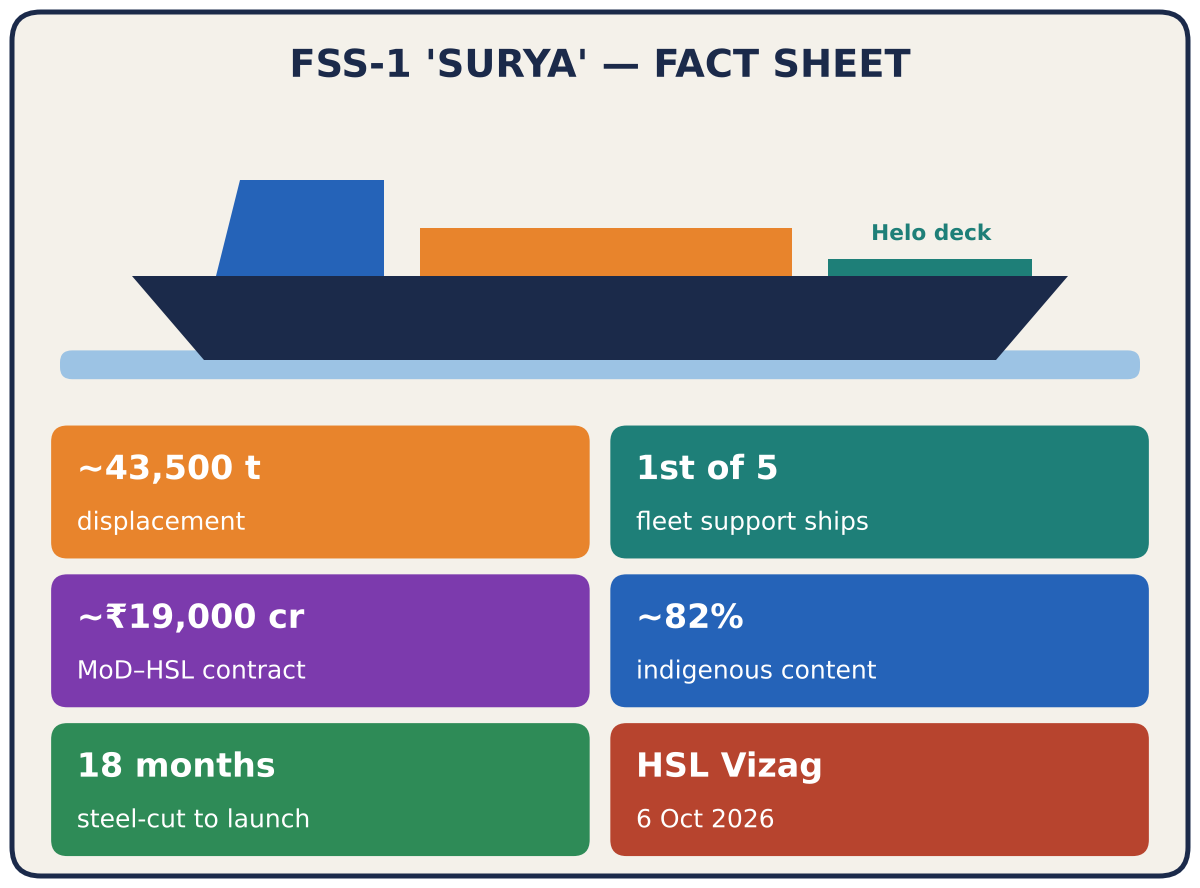
About 43,500 tonnes displacement; helicopter deck, onboard workshops and self-defence systems.
Entered the Bay of Bengal ~18 months after steel cutting; keel of FSS-5 laid the same day.
MoD–HSL contract of about ₹19,000 crore for 5 ships; around 82% indigenous content.
HSL inaugurated upgraded Slipway-4 and a 300-tonne Goliath crane.
Will supplement existing tankers INS Deepak, INS Shakti and INS Aditya.
Way forward
Scale yards to global standards on cost, quality, delivery; leverage the Maritime Amrit Kaal Vision 2047 and shipbuilding package to lift India's under-1% global share.
Concept
Fleet Support Ship / replenishment tanker: carries fuel, water, ammunition and stores for Replenishment At Sea (RAS), enabling sustained deployment. HSL — Defence PSU under MoD since 2010. Positive Indigenisation Lists curb imports.
Fact-sheet schematic of FSS-1 Surya showing a ship silhouette with labels for 43,500 tonnes displacement, helicopter deck, first of five ships, about ₹19,000 crore contract, about 82% indigenous content and launch 18 months after steel cutting at HSL Visakhapatnam. — StudyForGS
6. National Supercomputing Mission crosses 40 systems and 68 petaflops
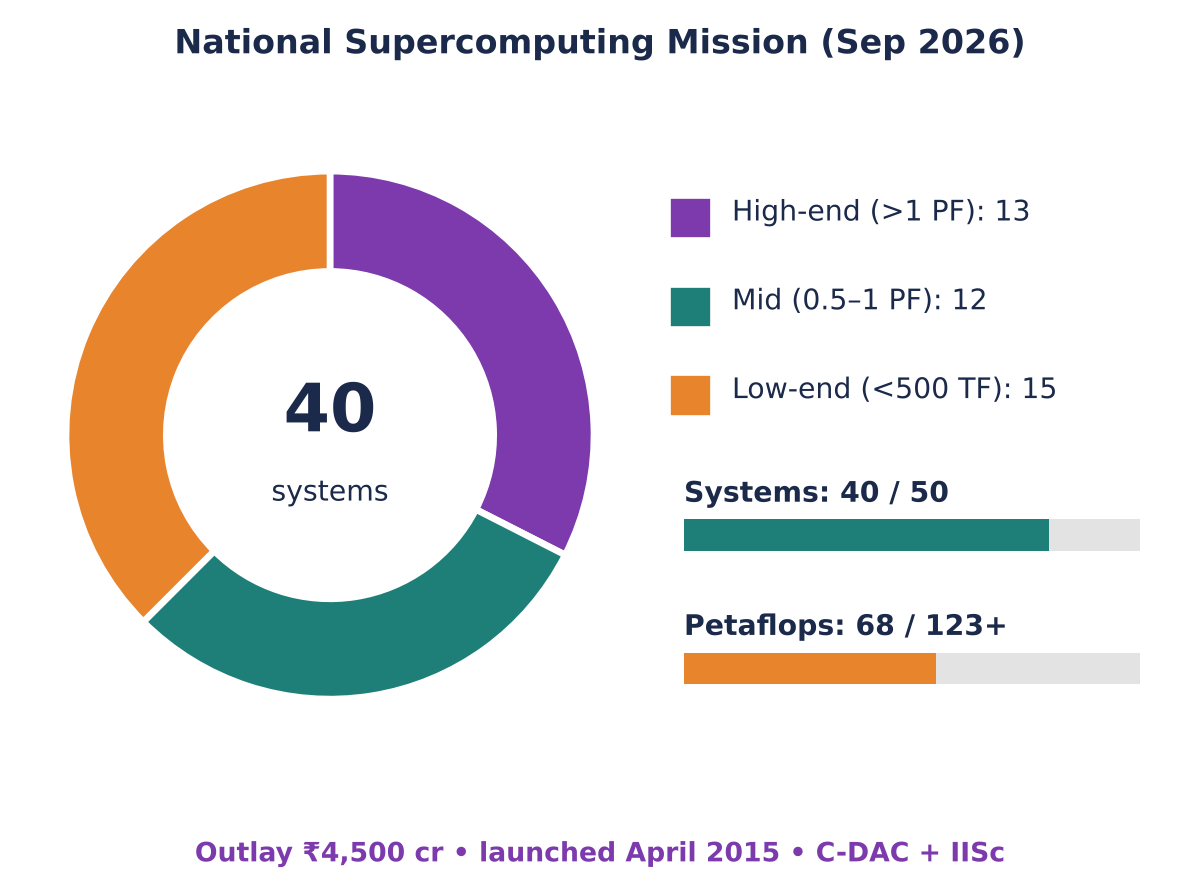
Official data show that as of Sep 2026, the NSM has commissioned 40 supercomputers with a combined 68 petaflops, against a target of 50 systems and 123+ petaflops — about 80% of systems but ~55% of planned compute.
16,000+ researchers, 1.5 crore+ jobs run, ~2,000 publications.
AIRAWAT AI supercomputer entered TOP500 at rank 75 (2023).
Way forward
Close the compute gap with IndiaAI Mission GPU capacity, indigenous processors and energy-efficient data centres; widen access for start-ups and States.
Concept
Petaflop = 10¹⁵ floating-point operations per second; exascale = 10¹⁸. PARAM 8000 (1991) was India's first supercomputer by C-DAC. TOP500 list ranks systems twice a year.
Donut chart of the 40 NSM supercomputers by class — 13 high-end above 1 petaflop, 12 mid-range between 0.5 and 1 petaflop, 15 low-end below 500 teraflops — with progress bars showing 40 of 50 systems and 68 of 123 petaflops achieved. — StudyForGS
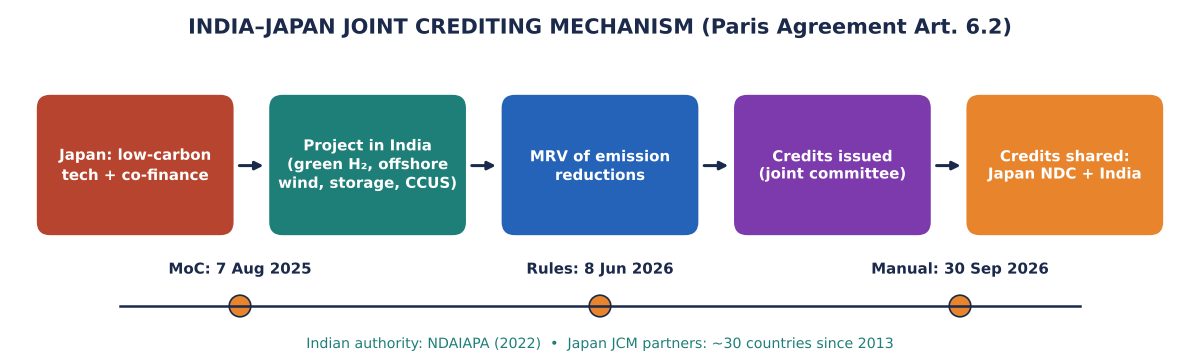
India and Japan released the JCM Operational Manual in New Delhi (dated 30 Sep 2026), making the bilateral carbon-credit mechanism project-ready after the MoC (7 Aug 2025) and Rules of Implementation (8 Jun 2026).
Key facts
Operates under Article 6.2 of the Paris Agreement (cooperative approaches, ITMOs).
Japanese technology and co-finance flow into Indian low-carbon projects; verified reductions are shared as credits.
India's eligible list: green hydrogen, offshore wind, storage-backed renewables, CCUS.
Japan has JCM partnerships with about 30 countries since 2013.
Indian authority: NDAIAPA (constituted 2022).
Way forward
Guard against over-selling credits India needs for its own NDC; link JCM registries transparently with the domestic Carbon Credit Trading Scheme.
Concept
India's updated NDC (2022): cut emissions intensity of GDP by 45% by 2030 (vs 2005); 50% power capacity from non-fossil sources; Net Zero by 2070. Article 6.4 = UN-supervised crediting mechanism.
Flowchart of the India–Japan Joint Crediting Mechanism: Japanese technology and co-finance flow to low-carbon projects in India, emission reductions are measured, reported and verified, credits are issued and shared between the two countries under Article 6.2, with a timeline of MoC 2025, rules June 2026 and manual September 2026. — StudyForGS
8. 3D concrete printing piloted for rural houses under PMAY-G
SOCIETYCOMMON: Prelims + Mains GS2/GS3
Syllabus linkage
GS2 – Welfare schemes for vulnerable sections. GS3 – infrastructure, technology in construction. Prelims: PMAY-G features, cost-sharing.
Context
A national-level pilot launched on 4 Oct 2026 in Guntur district, Andhra Pradesh is building 177 PMAY-G houses using 3D concrete printing, testing whether automated construction can deliver rural homes faster and cheaper.
Key facts
100 houses at Burripalem (near Tenali) and 77 at Pothuru; completion targeted in about six months.
Outlay ₹13.93 crore — Centre ₹9.44 crore, State ₹4.49 crore.
Cabinet approved 2 crore more houses up to 2028-29 after the 2.95 crore first-phase target.
Way forward
Benchmark cost, durability and climate suitability against conventional houses; train local masons so technology creates rather than displaces rural jobs.
Concept
PMAY-G (launched 20 Nov 2016, restructured from Indira Awaas Yojana): beneficiaries from SECC 2011 / Awaas+; cost-sharing 60:40, 90:10 for NE & Himalayan States, 100% for UTs. India's first 3D-printed house: IIT Madras start-up (2021).
9. India–Switzerland sign 5 pacts as India–EFTA TEPA completes one year
Swiss President Guy Parmelin's visit to New Delhi (talks on 5 Oct 2026) produced five agreements and opened new tracks in defence production and civil nuclear energy, marking one year of the India–EFTA TEPA (in force 1 Oct 2025).
Key facts
Migration & Mobility Partnership — multiple-entry visas up to 5 years, legal pathways for students and researchers.
Young Professionals scheme: 300 per year each way (expandable to 500) for temporary work-exchange.
Other pacts: transport technologies & infrastructure, science cooperation.
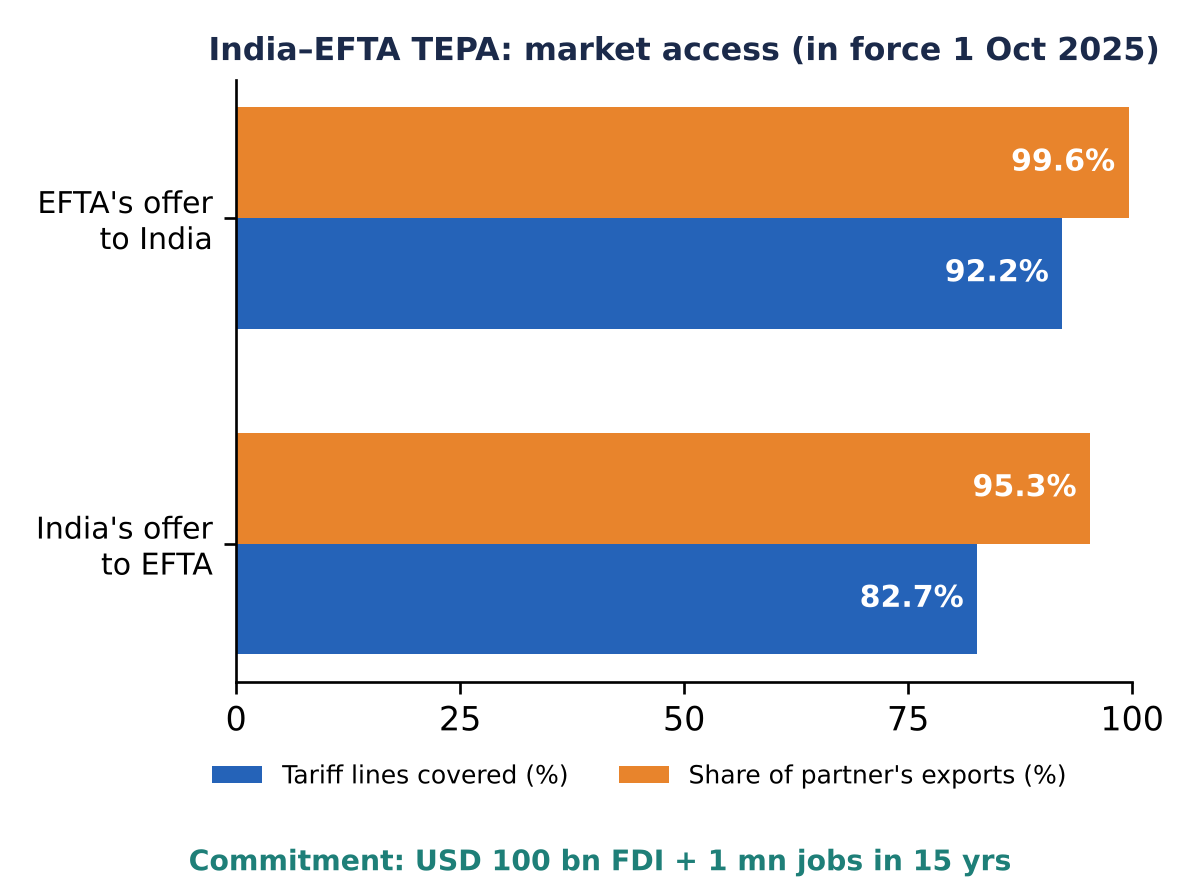
TEPA: USD 100 billion investment and 1 million direct jobs in India over 15 years — first FTA with a binding investment commitment.
EFTA offers 92.2% tariff lines (99.6% of India's exports); India offers 82.7% (95.3% of EFTA exports).
Way forward
Operationalise the investment chapter via a TEPA Desk, push services and pharma access, and use Swiss expertise in precision engineering and vocational training.
Concept
EFTA (est. 1960, Stockholm Convention): Switzerland, Norway, Iceland, Liechtenstein — not in the EU customs union. TEPA signed 10 Mar 2024. Switzerland also hosts the WTO, WHO, ILO headquarters in Geneva.
Bar chart of India–EFTA TEPA market access: EFTA offers 92.2% of tariff lines covering 99.6% of India's exports, while India offers 82.7% of tariff lines covering 95.3% of EFTA exports, with the USD 100 billion and one million jobs commitment noted. — StudyForGS
10. PM calls for global rules on AI and deepfake origin-tracing
Meeting the GSMA Board in New Delhi (6 Oct 2026), PM Narendra Modi called for global standards and common rules for emerging technologies and mechanisms that let users identify the origin of deepfakes and AI-generated content.
Key facts
PM: 'our digital future must expand opportunity while strengthening trust'.
India's Feb 2026 IT Rules amendments require platforms to embed permanent metadata / unique identifiers in synthetic content.
EU AI Act labelling duties apply from 2 Aug 2026; China mandates AI labels since Sep 2025.
India has no standalone AI law; regulation runs through the IT Act 2000 and IT Rules.
Way forward
Push interoperable watermarking/provenance standards at G20, ITU and the UN; balance safety with free speech (Art 19) and innovation via a risk-based framework.
Concept
Deepfake — AI-generated synthetic media mimicking real people. Sec 79, IT Act: safe harbour for intermediaries conditional on due diligence. Shreya Singhal (2015) struck down Sec 66A. GSMA — global body of mobile operators.
GS3 – Internal security: cyber crime, role of media & social networking. GS2 – police reforms. Prelims: I4C, 1930 helpline, NCRB.
Context
The Status of Policing in India Report (SPIR) 2026, based on a survey of 8,306 respondents across 16 States/UTs, examines how cybercrime victims seek police and bank redress amid India's UPI boom.
Key facts
13% respondents faced cybercrime in the last 2–3 years; 54% of these were digital financial frauds.
52% of financial-fraud victims complained to banks, 63% of them within 24 hours; 40% suspected bank insider involvement.
Women, the poor and rural victims lean more on informal routes (bribes, contacts) to get police help.
Ready-made fraud 'kits' (pre-activated SIMs, mule accounts) cost just ₹10,000–20,000.
UPI handled over 24,000 crore transactions worth ₹314 lakh crore in FY26.
Way forward
Mandatory FIR/e-Zero FIR registration, faster bank–police coordination via I4C, strict action on mule accounts and time-bound refunds under RBI's zero-liability norms.
Concept
RBI circular (6 Jul 2017): zero customer liability if fraud reported within 3 working days. Police & public order — State List (Entry 1, 2). I4C under MHA; National Cybercrime Reporting Portal + 1930 helpline.
Data point of the day
5.50% (+25 bps)
Repo rate after RBI's October 2026 policy First hike since Feb 2023; stance 'calibrated tightening'; FY27 GDP 7.1%, CPI 5.2%; SDF 5.25%, MSF 5.75%.
Prelims rapid-fire
Exercise Mountain Guardian 2026 — inaugural India–UAE army exercise in high-altitude Uttarakhand.
Bogibeel (Assam) — first international cargo from Upper Assam: 540 MT methanol to Dhaka via NW-2 (Brahmaputra).
EAM visit (6–10 Oct) — Ghana, Côte d'Ivoire, Ethiopia; Regional Heads of Mission conference in Addis Ababa.
Asian Games 2026 (Aichi-Nagoya, Japan) — India 4th with 85 medals (21 gold, 27 silver, 37 bronze).
NABKISAN — India's first WASH-focused social bond listed on NSE: ₹180 crore, 8.10% coupon, 5-year tenure.
National Household Travel Survey — first all-India survey of 4.92 lakh households; 61.9% male vs 41.9% female workers commute daily.
Practice MCQs — UPSC Prelims pattern
Q1. With reference to the Monetary Policy Committee (MPC) of the RBI, consider the following statements: 1. It is a statutory body under the RBI Act, 1934. 2. It has six members, of whom three are nominated by the Central Government. 3. In case of a tie, the Union Finance Minister has the casting vote. Which of the statements given above are correct?
1 and 2 only
2 and 3 only
1 and 3 only
1, 2 and 3
Show answer
Answer: A The MPC is constituted under Section 45ZB of the RBI Act, 1934, with 6 members (3 from RBI, 3 nominated by the Government). The RBI Governor, not the Finance Minister, has the casting vote — so statement 3 is wrong.
Q2. The Joint Crediting Mechanism (JCM), recently operationalised between India and Japan, is a cooperative approach under which provision of the Paris Agreement?
Article 2.1
Article 4.4
Article 6.2
Article 9.1
Show answer
Answer: C Article 6.2 allows Parties to cooperate bilaterally through Internationally Transferred Mitigation Outcomes (ITMOs); the JCM is such an approach. Article 6.4 sets up the UN-supervised crediting mechanism; Article 9 deals with climate finance.
Mains practice question
Q. The RBI has shifted to 'calibrated tightening' even as it raises its growth forecast. Examine the factors behind this decision and discuss its implications for growth, inflation and the external sector. (250 words, 15 marks)
Hint / approach
Intro: repo 5.25%→5.50%, first hike since 2023. Body: drivers — crude/West Asia, rupee ~₹96/$, CPI path to 6.0% in Q3; implications — costlier credit, transmission, capital flows, fiscal–monetary coordination. Conclude: credibility of FIT (4% ± 2%) protects long-run growth.