Western Dedicated Freight Corridor goes fully operational as PM dedicates ₹35,000 crore Gujarat package; Defence Acquisition Council clears ₹1.10 lakh crore buys; New Delhi readies for the 11-nation BRICS Summit
Tuesday, 8 September 2026 · IST · National & International · 11 items · 2 MCQs
India's freight logistics backbone was completed today with the commissioning of the last 326 km of the Western Dedicated Freight Corridor, giving Gujarat's industrial belt a direct rail link to JNPA. The Defence Acquisition Council's ₹1.10 lakh crore Acceptance of Necessity, with 98% sourcing from Indian industry, marks the single largest indigenisation push of FY27. On the diplomatic front, New Delhi is preparing to host the expanded 11-member BRICS Summit on 12-13 September under India's fourth chairmanship.
Today at a glance — things to remember
WDFC fully commissioned — last 326 km at a cost of ₹20,700 crore
PM unveils a ₹35,000 crore rail, highway and urban package at Vadodara
Defence Acquisition Council clears ₹1.10 lakh crore AoN, 98% indigenous
EOS-05 is India's first imaging satellite in geosynchronous orbit
NITI Aayog launches PACT and ZET Marketplace for zero-emission road freight
Bodhan AI releases 4 open multilingual education models as public goods
Centre notifies Chief Justices for eight High Courts under Article 217
India hosts the 11-nation BRICS Summit at Bharat Mandapam, 12-13 September
UNGA declares 27 November as the day against child and forced marriage
August GST gross collection at ₹1,99,853 crore, up 14.8% year-on-year
The Prime Minister dedicated the final three sections of the Western Dedicated Freight Corridor at Vadodara, completing the corridor end-to-end. The overall Gujarat package announced covers rail, national highway, urban and renewable energy works.
Key facts
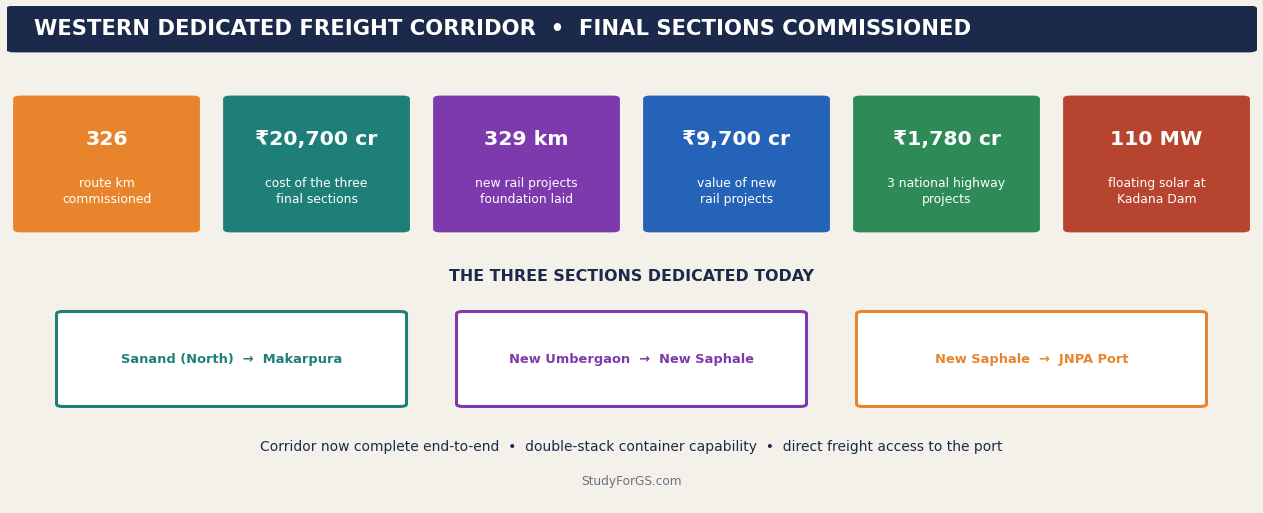
Three sections totalling 326 route km commissioned at over ₹20,700 crore — Sanand (North)-Makarpura, New Umbergaon-New Saphale and New Saphale-JNPA.
The last link gives the corridor direct freight access to Jawaharlal Nehru Port Authority (JNPA), Maharashtra.
Foundation stones laid for three rail projects covering 329 km worth over ₹9,700 crore, including the Vadodara-Ratlam third and fourth lines and Vishwamitri-Dabhoi doubling.
Three national highway projects worth ₹1,780 crore cleared, including six-laning of Kamrej-Chalthan on NH-48 with major bridges over the Tapi and Narmada.
State-sector works of ₹2,600 crore include Vadodara Ring Road Phase-II and a 110 MW floating solar plant at Kadana Dam.
Way forward
Freight modal share must now shift from road to rail; timely completion of the Eastern arm's extensions and last-mile port and industrial-park sidings will decide whether logistics cost actually falls.
Concept
Dedicated Freight Corridor Corporation of India Ltd (DFCCIL) is a Special Purpose Vehicle under the Ministry of Railways. DFCs allow double-stack container trains, higher axle loads and speeds of 100 kmph, and are a core pillar of PM GatiShakti and the National Logistics Policy, which targets cutting logistics cost as a share of GDP.
Stat tiles and corridor schematic showing the 326 km commissioned, ₹20,700 crore cost, and the Sanand-Makarpura, Umbergaon-Saphale and Saphale-JNPA sections leading to JNPA port. — StudyForGS
2. Defence Acquisition Council clears ₹1.10 lakh crore of capital acquisitions
The Defence Acquisition Council, chaired by the Defence Minister, granted Acceptance of Necessity to proposals across all three services. It is the largest single tranche of AoNs cleared this financial year.
Key facts
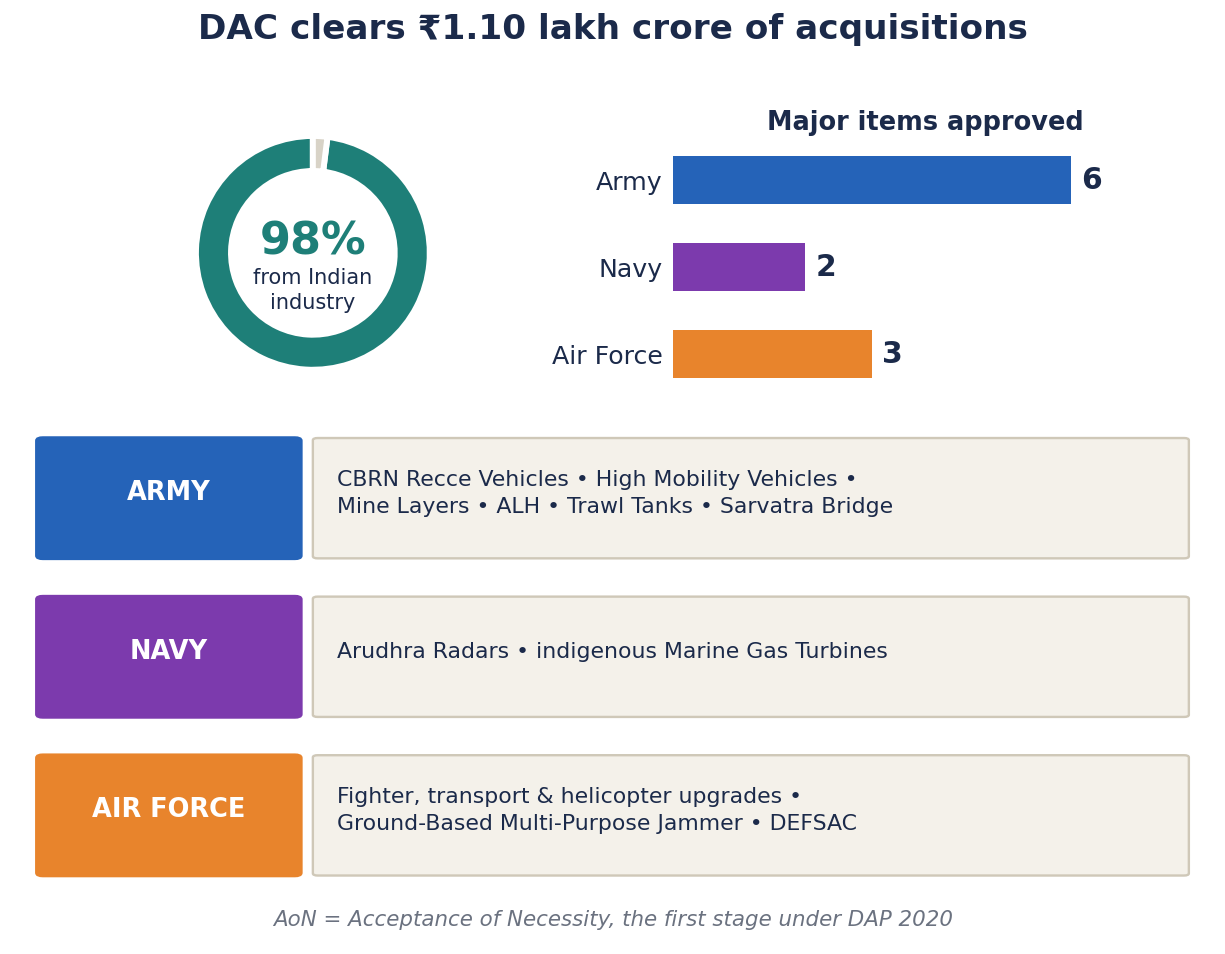
Total value approximately ₹1,10,000 crore, with about 98% of the value to be sourced from Indian industry.
Army: CBRN Reconnaissance Vehicles, High Mobility Vehicles, Self-Propelled Mechanical Mine Layers, Advanced Light Helicopters, Trawl Tanks and the Sarvatra Bridge System.
Navy: Arudhra radars and design and development of indigenous Marine Gas Turbines.
Air Force: fighter, transport and helicopter upgrades, a Ground-Based Multi-Purpose Jammer and the DEFSAC smart-card access system.
Acceptance of Necessity (AoN) is only the first administrative stage under the Defence Acquisition Procedure (DAP) 2020; tendering, trials and contract signature follow.
Way forward
AoN-to-contract conversion, not announcement value, is the real indicator; compressing trial timelines and widening the private-sector and MSME vendor base will determine delivery.
Concept
The DAC is the apex body for capital procurement in the Ministry of Defence, headed by the Raksha Mantri. Categories under DAP 2020 run from Buy (Indian-IDDM) — the most preferred, requiring indigenous design, development and manufacture — down to Buy (Global). CBRN stands for Chemical, Biological, Radiological and Nuclear.
Chart pairing a donut of the 98% indigenous sourcing share with a bar chart of major equipment approved for the Army, Navy and Air Force. — StudyForGS
3. EOS-05: India's first imaging satellite in geosynchronous orbit
GS-III: Space technology and its applications. Prelims: GSLV, GTO vs GSO vs LEO, hyperspectral imaging, Satish Dhawan Space Centre.
Context
The earth observation satellite EOS-05 was placed in a sub-geosynchronous transfer orbit and is raising itself to a geosynchronous slot. Unlike low-earth-orbit imagers that pass over a site for a few minutes, it can stare at the same region near-continuously.
Key facts
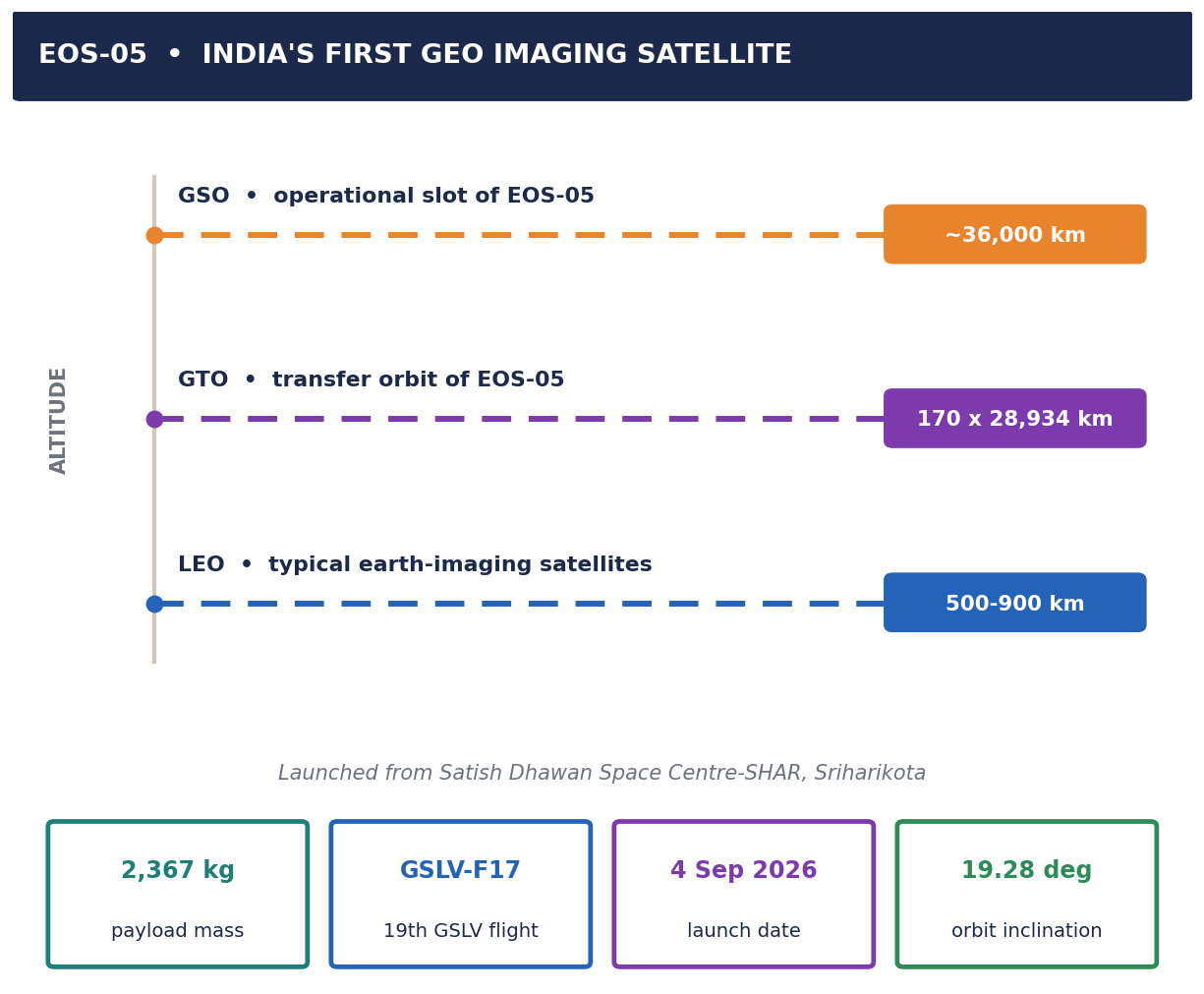
Launched on 4 September 2026 by GSLV-F17, the 19th flight of the GSLV, from Satish Dhawan Space Centre-SHAR, Sriharikota.
Payload mass about 2,367 kg; injected into a sub-Geosynchronous Transfer Orbit with perigee 170 km, apogee 28,934 km and inclination 19.28 degrees.
It is India's first imaging satellite operating from geosynchronous orbit, roughly 36,000 km above the equator.
Carries a hyperspectral earth-surface imager, allowing discrimination of crops, water bodies and surface materials by spectral signature.
Way forward
Geostationary imaging must be fused with the existing polar-orbiting Cartosat and RISAT constellations so that near-real-time alerts reach state disaster authorities, not just central agencies.
Concept
A geosynchronous orbit has an orbital period equal to earth's rotation (about 24 hours) at roughly 35,786 km; a geostationary orbit is the special case with zero inclination, appearing fixed over a point on the equator. GSLV uses an indigenous cryogenic upper stage burning liquid hydrogen and liquid oxygen.
Schematic comparing low earth orbit, geosynchronous transfer orbit and geosynchronous orbit altitudes with EOS-05 mission fact tiles. — StudyForGS
4. NITI Aayog launches PACT and ZET Marketplace for zero-emission freight
GS-III: Infrastructure, energy transition, conservation and pollution. Prelims: NITI Aayog, e-MHD trucks, net-zero 2070, PM E-DRIVE.
Context
NITI Aayog launched the Platform for Aggregating Clean Transport (PACT) along with a Zero Emission Trucking (ZET) Marketplace to accelerate electric truck deployment on identified freight corridors through demand aggregation rather than fresh subsidy.
Key facts
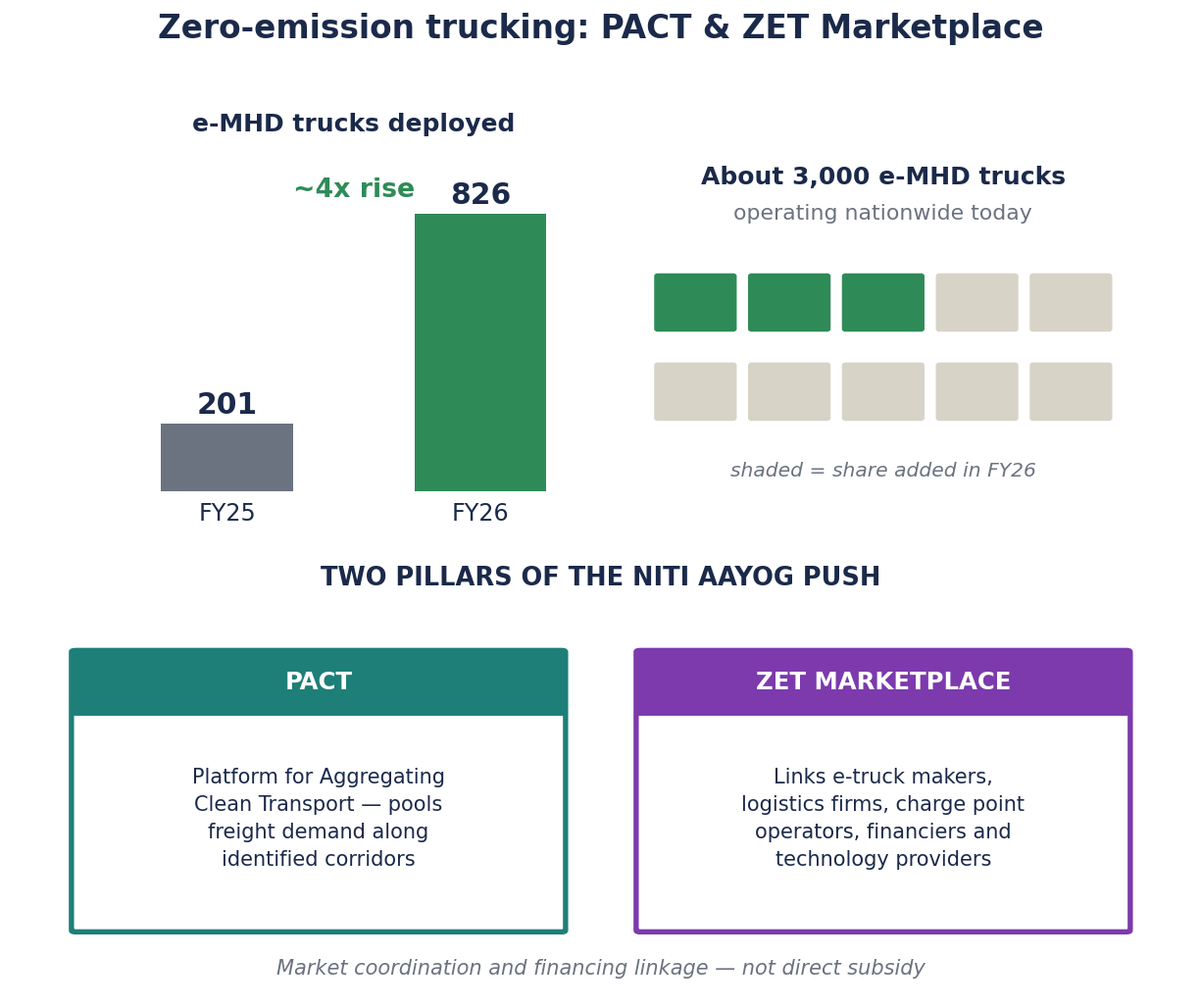
PACT aggregates freight demand from shippers and logistics providers and channels it into deployment along identified corridors.
The ZET Marketplace links e-truck manufacturers, logistics firms, charge point operators, financiers and technology providers.
Electric medium and heavy-duty truck deployments rose from 201 units in FY25 to 826 units in FY26 — roughly a four-fold increase.
About 3,000 e-MHD trucks are estimated to be operating nationwide at present.
Partner ministries are the Ministry of Road Transport and Highways and the Ministry of Heavy Industries; the model is market coordination and financing linkage, not direct subsidy.
Way forward
Charging depots along freight corridors and cheaper long-tenor finance are the binding constraints; total-cost-of-ownership parity, not sticker price, will drive fleet switching.
Concept
Road freight is among the hardest-to-abate segments: heavy-duty trucks are a small share of the vehicle fleet but a disproportionate share of transport emissions and diesel demand. This feeds India's net-zero by 2070 pledge and the Nationally Determined Contributions under the Paris Agreement.
Bar chart of electric medium and heavy-duty truck deployments rising from 201 in FY25 to 826 in FY26, beside a pillar diagram of the PACT and ZET Marketplace structure. — StudyForGS
5. Bodhan AI releases four open multilingual education models as Digital Public Goods
GS-II: Education and government policies. GS-III: Awareness in IT and computers. Prelims: Digital Public Goods, DPI, NEP 2020, foundation models.
Context
A centre of excellence at IIT Madras released four open-weight Indian-language foundation models for education, positioned as Digital Public Goods within a Bharat Education AI Stack, along with student and teacher assistant bots.
Key facts
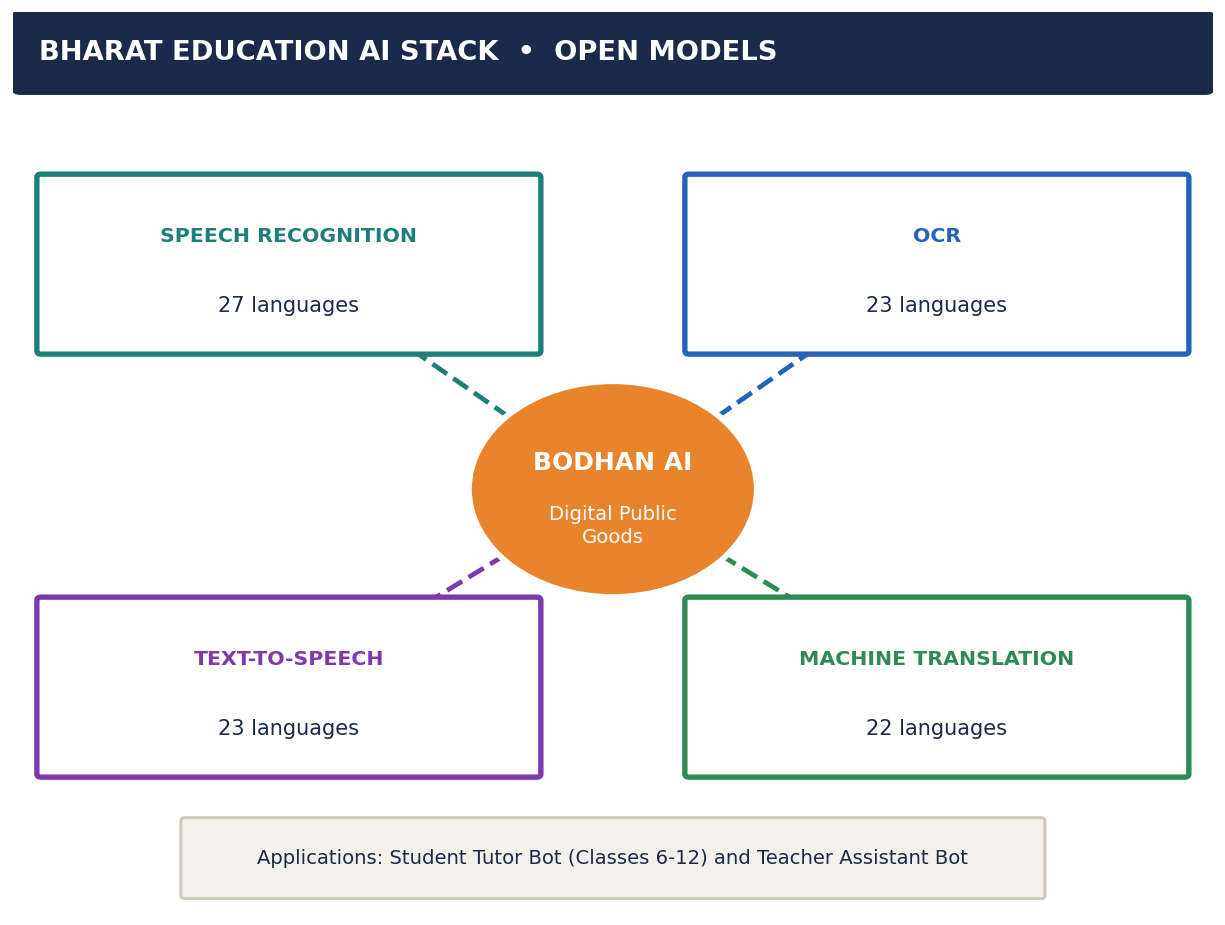
Four models released — automatic speech recognition covering 27 Indian languages, and OCR and text-to-speech covering 23 languages each.
A machine translation model covers 22 languages, aligned to the Eighth Schedule of the Constitution.
Applications include a Student Tutor Bot for Classes 6-12 and a Teacher Assistant Bot.
Models are released as open weights and designated Digital Public Goods, allowing free reuse by states and edtech developers.
Positioned as the education layer of India's Digital Public Infrastructure, alongside identity and payments layers.
Way forward
Value will come from classroom integration and teacher training, not model releases; low-bandwidth offline deployment is essential for rural government schools.
Concept
Digital Public Goods are open-source software, open data, open AI models, open standards and open content that adhere to privacy and applicable laws and help attain the Sustainable Development Goals. India's DPI model — identity, payments and data exchange — is now being extended to education under NEP 2020's mother-tongue instruction goal.
Mind-map of the Bharat Education AI Stack showing speech recognition in 27 languages, OCR and text-to-speech in 23, translation in 22, and the tutor and teacher bot applications. — StudyForGS
6. Centre notifies Chief Justices for eight High Courts
GS-II: Structure, organisation and functioning of the Judiciary. Prelims: Articles 214-231, collegium, Memorandum of Procedure, NJAC verdict.
Context
The Ministry of Law and Justice notified the appointment of Chief Justices to eight High Courts, following Supreme Court Collegium recommendations. The move fills long-pending leadership vacancies across several large High Courts.
Key facts
Appointments cover the Patna, Calcutta, Rajasthan, Bombay, Punjab & Haryana, Chhattisgarh, Madhya Pradesh and Jammu & Kashmir and Ladakh High Courts.
Article 217 governs the appointment of High Court judges by the President, after consultation with the Chief Justice of India, the Governor of the state and, for a puisne judge, the Chief Justice of that High Court.
Article 216 provides that a High Court shall consist of a Chief Justice and such other judges as the President may appoint.
The collegium for High Court Chief Justices comprises the CJI and the two senior-most Supreme Court judges.
The process operates under the Memorandum of Procedure, a document still not finalised between the executive and the judiciary.
Way forward
Timely notification of collegium recommendations and a finalised Memorandum of Procedure with fixed timelines would reduce the vacancy-pendency spiral in High Courts.
Concept
The collegium system evolved through the Three Judges Cases (1981, 1993, 1998). The 99th Constitutional Amendment and the NJAC Act, 2014 sought to replace it but were struck down in 2015 for violating judicial independence, part of the basic structure. Article 222 allows the President to transfer a judge from one High Court to another.
7. India to host expanded 11-nation BRICS Summit at Bharat Mandapam
IRUPSC: Prelims + Mains (International Relations, GS-II)
Syllabus linkage
GS-II: Bilateral, regional and global groupings involving India. Prelims: BRICS members, New Development Bank, Contingent Reserve Arrangement, chairmanship.
Context
New Delhi is in final preparations to host the BRICS Summit under India's chairmanship. It is the first summit since the grouping's expansion settled at eleven members, and comes amid pressure on global trade rules.
Key facts
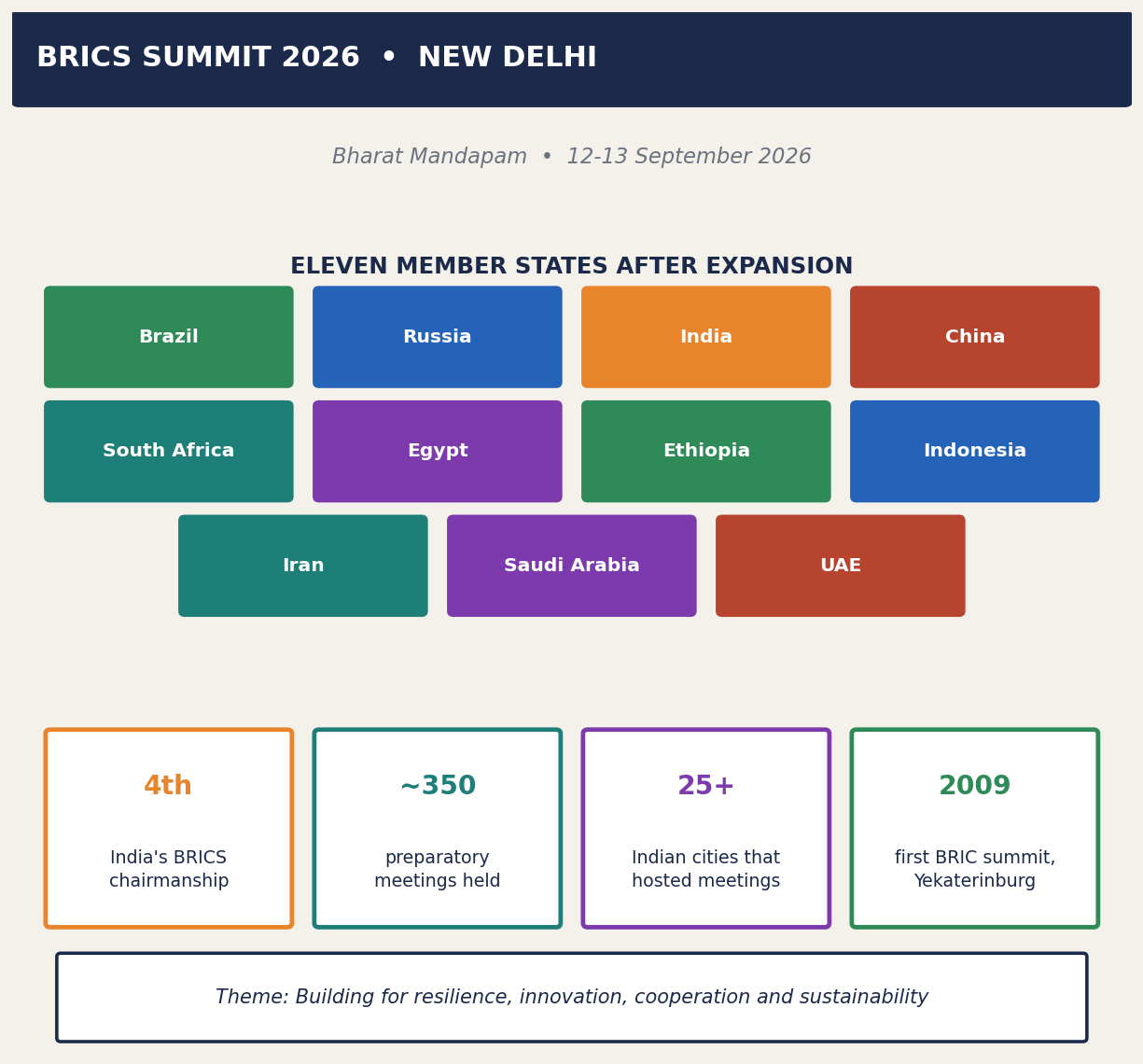
Scheduled for 12-13 September 2026 at Bharat Mandapam, New Delhi; theme is 'Building for resilience, innovation, cooperation and sustainability'.
This is India's fourth BRICS chairmanship, supported by around 350 preparatory meetings across more than 25 Indian cities.
Membership stands at 11 countries — Brazil, Russia, India, China, South Africa, Egypt, Ethiopia, Indonesia, Iran, Saudi Arabia and the UAE.
India's stated priorities include more balanced intra-BRICS trade, trade in services, resilient global value chains and improved access to finance for small businesses.
BRICS institutions include the New Development Bank (NDB), headquartered in Shanghai, and the Contingent Reserve Arrangement (CRA).
Way forward
India's balancing act is to keep BRICS a Global South economic platform on trade, finance and technology without letting it harden into an anti-Western bloc that complicates its other partnerships.
Concept
BRIC was coined in 2001; the first summit was held in 2009 at Yekaterinburg, with South Africa joining in 2010 to form BRICS. The NDB was created by the Fortaleza Declaration (2014). Chairmanship rotates annually and the summit is the apex of a year-long sherpa and ministerial track.
Full-width panel showing the eleven BRICS member states, India's four chairmanships, summit dates and venue, and the grouping's share of world population and output. — StudyForGS
8. UN General Assembly declares 27 November as day against child, early and forced marriage
IRUPSC: Prelims + Mains (International Relations & Social Justice, GS-II)
Syllabus linkage
GS-II: Important international institutions; issues relating to women and children. Prelims: UNGA resolutions, SDG 5, PCMA 2006.
Context
The UN General Assembly adopted without a vote a resolution designating an International Day for the Elimination of Child, Early and Forced Marriage. India was among the co-sponsoring countries.
Key facts
Resolution A/RES/80/309 was adopted without a vote during the 80th session of the UN General Assembly.
All 193 UN Member States supported it; more than 70 countries co-sponsored, including India.
The observance date is 27 November, with the first observance in 2026.
UNGA resolutions on such observances are recommendatory, not legally binding on member states.
In India the governing law is the Prohibition of Child Marriage Act, 2006, which sets 18 years for women and 21 years for men.
Way forward
Symbolic observance matters less than convergence between education retention, cash-transfer and child-protection schemes at the district level, where marriage-age violations actually cluster.
Concept
SDG Target 5.3 seeks to eliminate all harmful practices including child, early and forced marriage by 2030. India is a party to the CEDAW and the Convention on the Rights of the Child. The UNGA is the only UN organ with universal membership, where each state has one vote.
9. India-US trade agreement said to be in final legal drafting stage
GS-II: India and its bilateral relations; effect of policies of developed countries. GS-III: External sector, trade. Prelims: BTA, WTO, tariff terms.
Context
The US Ambassador to India indicated that the bilateral trade agreement is essentially settled in principle and is in the final legal drafting stage, with Indian officials travelling for concluding rounds.
Key facts
The agreement is described as 'in principle almost done', with only final legal scrubbing pending.
The United States has been among India's largest trading partners and a major destination for Indian services exports.
Sensitive Indian red lines have historically included agriculture, dairy and genetically modified products.
A Bilateral Trade Agreement (BTA) differs from a comprehensive Free Trade Agreement in coverage and depth of tariff elimination.
Trade agreements must be consistent with WTO Article XXIV on customs unions and free-trade areas.
Way forward
The test is whether market access gains for labour-intensive exports outweigh concessions demanded on agriculture and digital trade; parliamentary and stakeholder scrutiny of the final text matters.
Concept
Most Favoured Nation (MFN) treatment requires equal tariff treatment for all WTO members; National Treatment requires no discrimination between imported and domestic goods once inside the market. Reciprocal tariffs depart from MFN and are a key point of contention in current global trade practice.
10. State of India's Environment 2026 flags changing tiger behaviour and invasive spread
An annual environment report highlighted that tiger behaviour is shifting as reserves saturate and invasive vegetation degrades prey habitat, pushing conflict into human-dominated landscapes.
Key facts
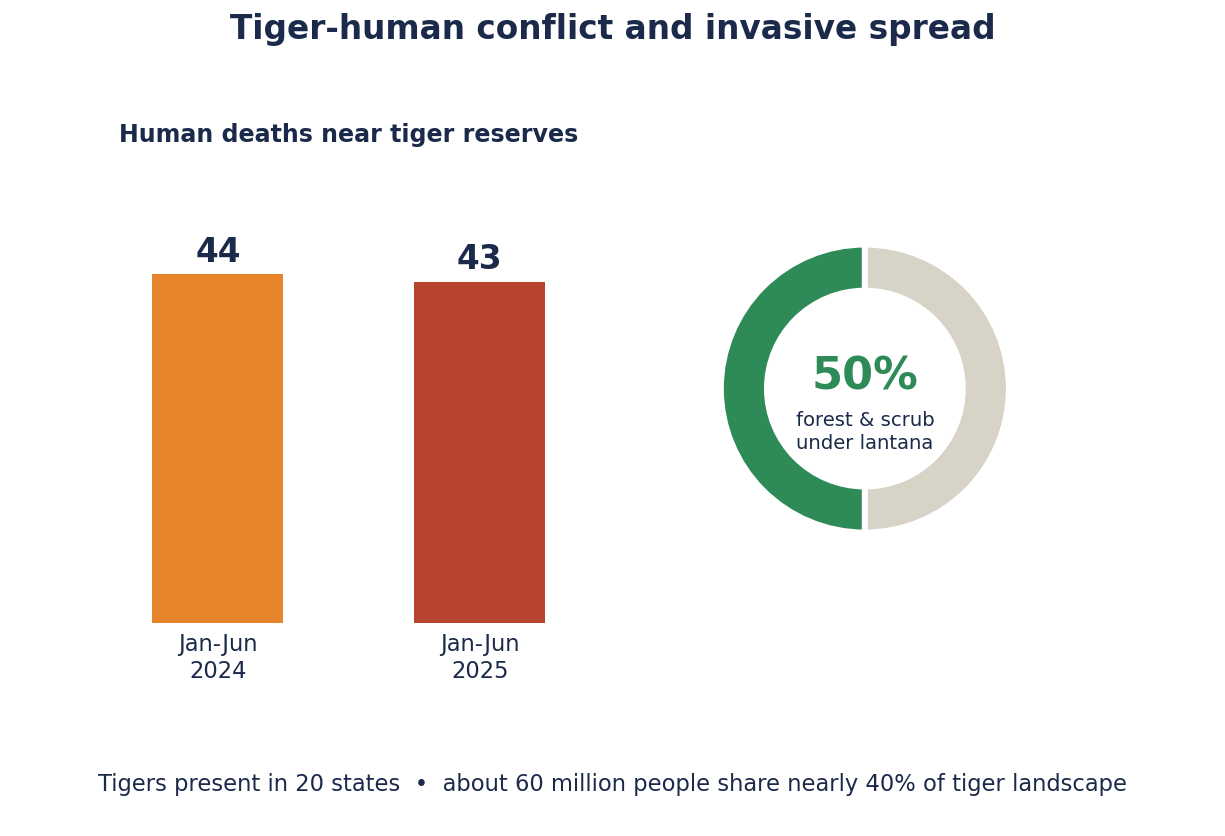
43 people were killed near tiger reserves between January and June 2025, against 44 in the same period of 2024.
Tigers are present in 20 states; about 60 million people share nearly 40% of tiger-occupied landscape.
Lantana camara, an ornamental introduced in the 1800s, now covers about 50% of India's forest and scrubland area.
Lantana creates predator-friendly structure in prey-poor landscapes, making livestock an easier target for tigers.
Reserves at saturation capacity push dispersing tigers into buffer and human-use areas, raising conflict.
Way forward
Conflict management must move from compensation to prevention — lantana removal with prey-base restoration, secured corridors and community-led early warning around buffer villages.
Concept
Project Tiger was launched in 1973; the National Tiger Conservation Authority (NTCA) is a statutory body under the Wildlife (Protection) Act, 1972, as amended in 2006. Tiger reserves have a core or critical tiger habitat and a buffer zone. Invasive alien species are a recognised direct driver of biodiversity loss.
Chart pairing tiger-reserve human fatalities for January to June in 2024 and 2025 with a donut showing lantana covering about half of forest and scrubland. — StudyForGS
11. Botanical Survey of India records new plant species in Agasthyamala Biosphere Reserve
GS-III: Biodiversity and conservation. Prelims: Agasthyamala Biosphere Reserve, Western Ghats, UNESCO MAB, Melastomataceae, endemism.
Context
A new woolly-haired flowering plant species was described from the Agasthyamala Biosphere Reserve straddling Kerala and Tamil Nadu, adding to the Western Ghats' record of endemism.
Key facts
The species is named Osbeckia ulotricha, belonging to the family Melastomataceae.
It was recorded at elevations of 1,200 to 1,500 metres in the Kerala-Tamil Nadu stretch of the reserve.
The description was published in the international taxonomic journal Lilloa.
Agasthyamala was designated a UNESCO Biosphere Reserve in 2016 and lies in the southern Western Ghats.
The Western Ghats are one of the world's biodiversity hotspots and a UNESCO World Heritage Site.
Way forward
New descriptions from a well-studied range show survey gaps persist; sustained taxonomic capacity and habitat protection above 1,000 metres are needed before such micro-endemics are lost.
Concept
A biosphere reserve under the UNESCO Man and the Biosphere (MAB) Programme has three zones — core, buffer and transition. Endemic species occur naturally in one geographic area only. India's Botanical Survey of India (1890) and Zoological Survey of India (1916) are the nodal taxonomic organisations.
Data point of the day
₹1,99,853 crore (+14.8% year-on-year)
Gross GST collection, August 2026 Domestic revenue rose 9.3% to about ₹1.37 lakh crore while import IGST surged 29% to ₹62,604 crore. Refunds jumped 67.9% to ₹31,795 crore, so net collection grew a slower 8.3% to about ₹1.68 lakh crore. April-August gross stood at ₹10.43 lakh crore, up 11%.
Prelims rapid-fire
Arudhra is an indigenous medium power radar cleared for the Indian Navy by the Defence Acquisition Council.
JNPA in Navi Mumbai, Maharashtra is India's largest container-handling port and the western terminus of the WDFC.
Osbeckia ulotricha, the newly described plant, belongs to the family Melastomataceae.
Article 217 deals with the appointment and conditions of office of a High Court judge.
The New Development Bank, a BRICS institution, is headquartered at Shanghai, China.
Kadana Dam, site of a new 110 MW floating solar plant, is on the Mahi river in Gujarat.
Practice MCQs — UPSC Prelims pattern
Q1. With reference to the Western Dedicated Freight Corridor (WDFC), consider the following statements:
1. It is implemented by a Special Purpose Vehicle under the Ministry of Railways.
2. Its western terminus provides direct freight connectivity to the Jawaharlal Nehru Port Authority.
3. Dedicated Freight Corridors permit double-stack container train operation.
Which of the statements given above are correct?
1 and 2 only
2 and 3 only
1 and 3 only
1, 2 and 3
Show answer
Answer: D All three are correct. DFCCIL is the SPV under the Ministry of Railways; the last commissioned section links the corridor to JNPA; and DFCs are engineered for double-stack container movement with higher axle loads.
Q2. Consider the following statements about a geosynchronous orbit:
1. Its orbital period is approximately equal to the earth's rotation period.
2. Every geosynchronous orbit is necessarily geostationary.
3. It lies at an altitude of roughly 36,000 km above the earth's surface.
Which of the statements given above is/are correct?
1 only
1 and 3 only
2 and 3 only
1, 2 and 3
Show answer
Answer: B Statements 1 and 3 are correct. Statement 2 is wrong: a geostationary orbit is the special case of a geosynchronous orbit with zero inclination over the equator, so an inclined geosynchronous orbit is not geostationary.
Mains practice question
Q. Completing the Dedicated Freight Corridors is a necessary but not sufficient condition for reducing India's logistics cost. Critically examine, with reference to modal-share targets and last-mile connectivity. (250 words, 15 marks)
Hint / approach
Open with the freight modal-share problem — rail's declining share against road. Use today's WDFC completion and the JNPA link as the supply-side gain. Then argue the binding constraints: first-and-last-mile sidings, warehousing and multimodal parks, terminal charges, and empty-return imbalance. Link to PM GatiShakti, the National Logistics Policy and the zero-emission trucking push. Conclude on integrated corridor economics rather than track alone.
📌 One-line revision: WDFC complete with 326 km and ₹20,700 crore; DAC clears ₹1.10 lakh crore at 98% indigenous; EOS-05 is India's first geosynchronous imager; BRICS-11 meets at Bharat Mandapam on 12-13 September; August GST gross ₹1,99,853 crore, up 14.8%.