Friday, 6 November 2026 · IST · Uttar Pradesh + National · 9 items · 2 MCQs
Uttar Pradesh has doubled ex-gratia for disaster deaths to ₹8 lakh and raised crop-loss relief by up to about 30% for losses since April, while Ayodhya prepares about 30 lakh diyas for the 10th Deepotsav on 7 November. Recent cabinet decisions on four link expressways (₹17,542 crore) and East Asian investment enclaves near the Noida-Jewar airport round out the UP picture; nationally, Fast Track Special Courts were extended to 2031 and Agniveers got a two-year extension option.
Today at a glance — things to remember
UP disaster death ex-gratia doubled to ₹8 lakh; irrigated crop-loss relief ₹22,000/ha.
GS-III Disaster Management, Agriculture & farmer welfare; GS-VI UP agriculture and disaster profile
Context
Ahead of Diwali, the state government revised relief norms for losses caused by rain, floods and drought between 1 April and 4 November 2026.
Key facts
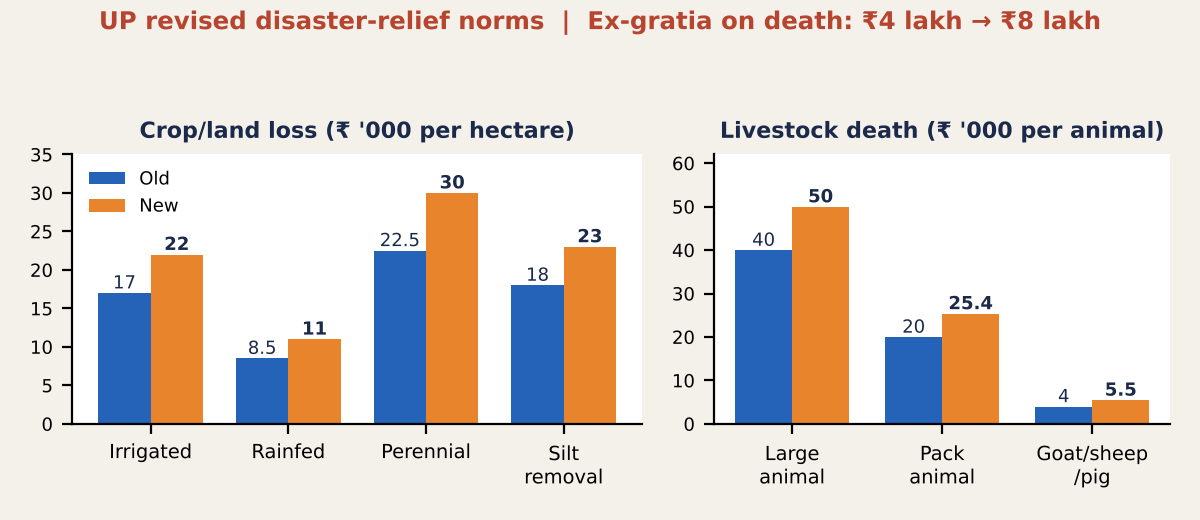
Ex-gratia for death in a natural disaster raised from ₹4 lakh to ₹8 lakh (doubled).
Crop loss per hectare: irrigated ₹17,000 → ₹22,000; rainfed ₹8,500 → ₹11,000; perennial/agroforestry ₹22,500 → ₹30,000.
Livestock: large animal ₹40,000 → ₹50,000; goat/sheep/pig ₹4,000 → ₹5,500; poultry ₹100 → ₹130 per bird.
Fully destroyed house: ₹1.85 lakh (plains) / ₹2.06 lakh (hills); relief-camp aid for 30 days, drought drinking-water aid for 90 days.
Paid under SDRF/NDRF norms; over 10 lakh farmers expected to benefit.
Way forward
UP is India's largest foodgrain producer and its Terai and eastern districts are flood-prone; higher relief norms cushion small farmers, but must be paired with faster loss assessment and wider crop-insurance coverage.
Concept
SDRF is constituted under Section 48 of the Disaster Management Act, 2005; the Centre funds 75% of SDRF for general-category states.
Grouped bar chart comparing old and new UP relief rates: crop loss per hectare (irrigated 17 to 22 thousand rupees, rainfed 8.5 to 11, perennial 22.5 to 30, silt removal 18 to 23) and livestock per animal (large 40 to 50 thousand, pack 20 to 25.4, goat/sheep/pig 4 to 5.5); death ex-gratia 4 to 8 lakh rupees. — StudyForGS
2. 10th Ayodhya Deepotsav on 7 Nov: 30 lakh diyas across 56 ghats of the Saryu
GS-I Indian culture, fairs & festivals; GS-V UP culture, heritage and tourism
Context
Final preparations are underway in Ayodhya for the state-organised Deepotsav on the eve of Diwali (7 November).
Key facts
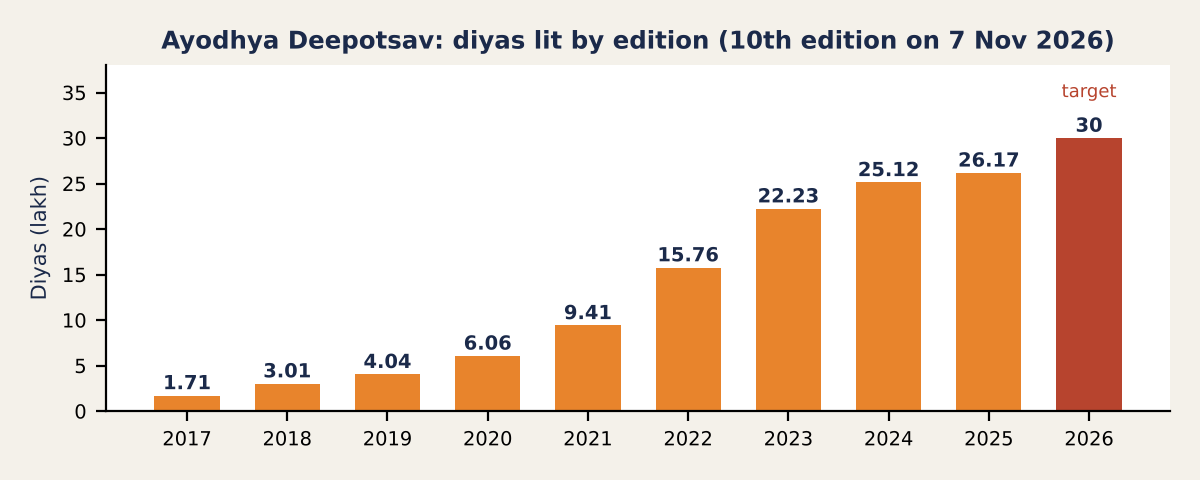
10th edition; the festival began in 2017 with 1.71 lakh diyas.
Target of about 30 lakh diyas on 56 ghats; 2025 set a world record with 26.17 lakh diyas.
Saryu Maha Aarti by 2,147 archaks (2,128 in 2025, a Guinness record); about 2,100 drones to depict Ramayana episodes.
New open-air theatre at Ram ki Paidi (~₹23.68 crore, Tourism Dept Phase-2, Shri Ayodhya Ji Teerth Vikas Parishad) for year-round cultural shows.
Way forward
Deepotsav has become UP's flagship cultural-tourism brand; it boosts the local potters' economy (earthen diyas) and religious-tourism circuits, while raising the need for crowd and river-pollution management.
Concept
Ayodhya lies on the right bank of the Saryu (Ghaghara); the district was renamed from Faizabad in 2018.
Bar chart of diyas lit at Ayodhya Deepotsav by year: 1.71 lakh in 2017, 3.01 lakh 2018, 4.04 lakh 2019, 6.06 lakh 2020, 9.41 lakh 2021, 15.76 lakh 2022, 22.23 lakh 2023, 25.12 lakh 2024, 26.17 lakh 2025 and a 30 lakh target in 2026. — StudyForGS
3. 30-day ad hoc Diwali bonus for UP state employees; 75% to go into PF
GS-III Investment models, industrial policy; GS-VI UP economy and industrial development
Context
A Singapore business delegation met the CM in Lucknow this week; the state is courting East Asian capital for country-specific townships.
Key facts
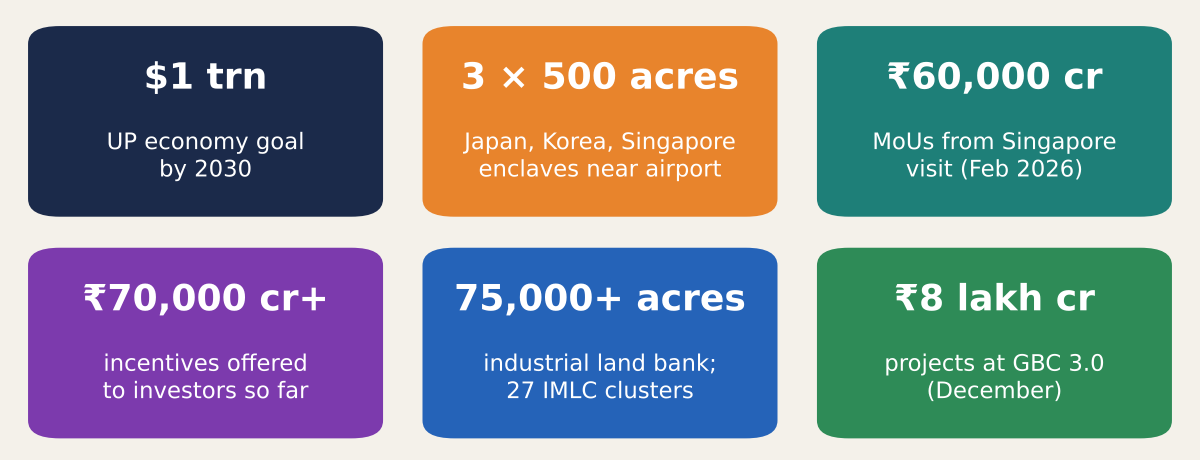
Three 500-acre enclaves (Japan, South Korea, Singapore) planned by YEIDA near the airport, now named Narendra Modi International Airport, Noida-Jewar (Oct 2026).
Proposed 'Singapore City' in YEIDA Sector 7: semiconductors, data centres, AI, logistics, green hydrogen.
UP makes about 55% of India's mobile phones; Feb 2026 Singapore visit yielded MoUs worth ₹60,000 crore.
Ground Breaking Ceremony 3.0 in December to launch projects worth about ₹8 lakh crore.
Way forward
Country-specific enclaves (on the lines of Japanese industrial townships) offer plug-and-play land, language and regulatory comfort—vital for converting MoUs into actual investment.
Six stat tiles: 1 trillion dollar UP economy goal by 2030; three 500-acre enclaves for Japan, Korea and Singapore; 60,000 crore rupees MoUs from Singapore visit; over 70,000 crore rupees incentives offered; over 75,000 acres industrial land bank with 27 clusters; 8 lakh crore rupees projects at Ground Breaking Ceremony 3.0. — StudyForGS
5. Four link expressways worth ₹17,542 crore (≈322 km) to knit UP's expressway grid
GS-III Infrastructure; GS-VI UP infrastructure, expressways & regional development
Context
The state cabinet (27 October) cleared 22 proposals, led by four link expressways to connect existing corridors.
Key facts
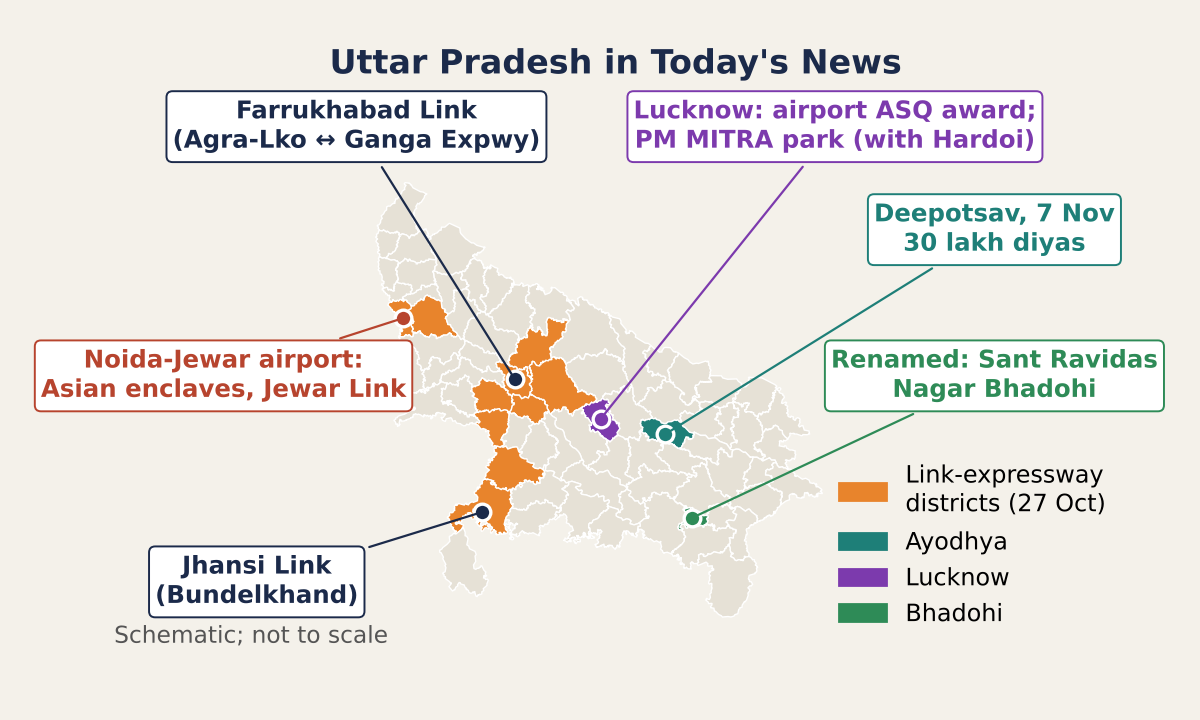
Farrukhabad Link (~90.9 km): Agra-Lucknow Expressway ↔ Ganga Expressway via Etawah, Kannauj, Mainpuri, Farrukhabad, Hardoi, Shahjahanpur.
Agra-Lucknow ↔ Purvanchal Expressway link (50.94 km); Jhansi Link (~106 km) for Bundelkhand.
Jewar Link (~74 km): Noida-Jewar airport ↔ Ganga Expressway via Bulandshahr.
Same cabinet: Cyber Security Operations Centre via IIT Kanpur's C3iHub; master developer for PM MITRA textile park (1,000 acres, Lucknow-Hardoi).
Way forward
Link expressways convert standalone corridors into a network, cutting freight time between western UP, the NCR airport hub, Bundelkhand and Purvanchal—key to the $1-trillion economy goal.
Concept
Expressways in UP are built by UPEIDA (UP Expressways Industrial Development Authority), set up in 2007.
Map of Uttar Pradesh districts highlighting the link-expressway districts in saffron (Etawah, Kannauj, Mainpuri, Farrukhabad, Hardoi, Shahjahanpur, Jhansi, Jalaun, Gautam Buddha Nagar, Bulandshahr) and marking Ayodhya (Deepotsav), Lucknow (airport award, PM MITRA park), Bhadohi (renamed Sant Ravidas Nagar Bhadohi) and the Noida-Jewar airport. — StudyForGS
6. Tech-led governance: UP-AIM, Startup Procurement Scheme and SAF policy approved
GS-III Science & technology, energy; GS-II e-governance; GS-VI UP policies
Context
October cabinet meetings approved a cluster of technology and new-economy policies.
Key facts
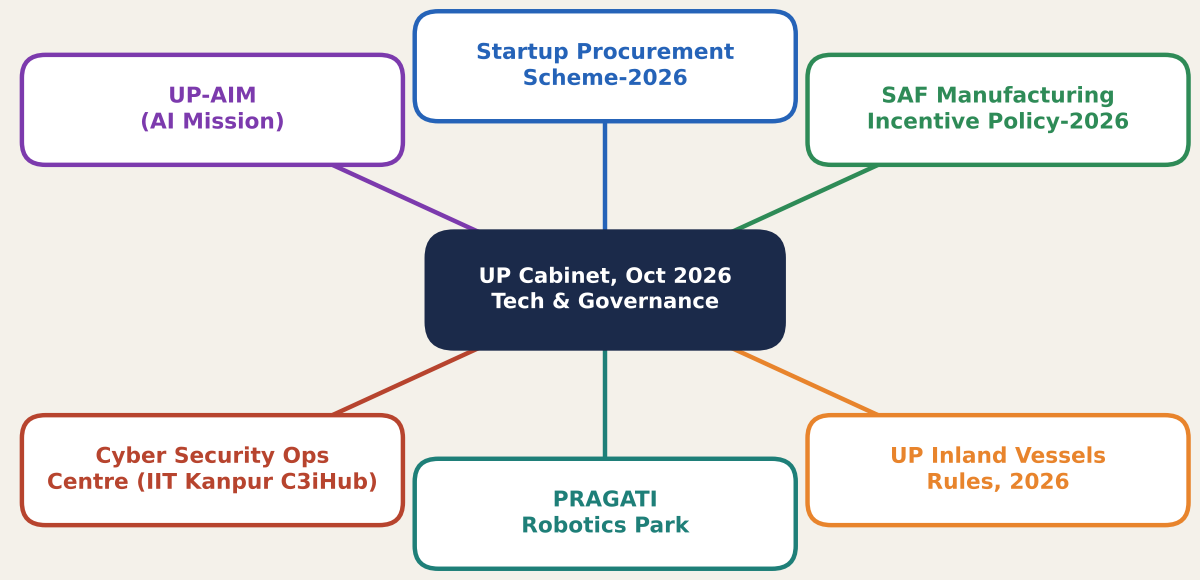
UP Artificial Intelligence Mission (UP-AIM) to set up and run state AI initiatives.
UP Startup Procurement Scheme-2026 to raise government purchases from startups.
UP Sustainable Aviation Fuel (SAF) Manufacturing Incentive Policy-2026; PRAGATI Robotics Park; UP Inland Vessels Rules, 2026.
Also: 6,650 AC e-buses in 18 cities over four years on the Gross Cost Contract (GCC) model.
Way forward
Public procurement is one of the strongest demand-side levers for startups; paired with an AI mission and SAF incentives, UP is positioning itself in sunrise sectors beyond traditional manufacturing.
Concept
Under the GCC model, the government pays the operator a fixed per-km fee and retains fare revenue and risk.
Mind-map centred on UP Cabinet October 2026 tech and governance decisions with six branches: UP-AIM AI Mission, Startup Procurement Scheme-2026, SAF Manufacturing Incentive Policy-2026, Cyber Security Operations Centre via IIT Kanpur C3iHub, PRAGATI Robotics Park, and UP Inland Vessels Rules 2026. — StudyForGS
7. Fast Track Special Courts scheme extended to 2031 with ₹3,788 crore; courts to rise to 850
NATIONALUPPSC: Prelims + Mains GS-II
Syllabus linkage
GS-II Judiciary, welfare of vulnerable sections (women & children)
Context
The Union Cabinet (4 Nov) continued the Centrally Sponsored Scheme for FTSCs for rape and POCSO cases for FY 2026-27 to 2030-31.
Key facts
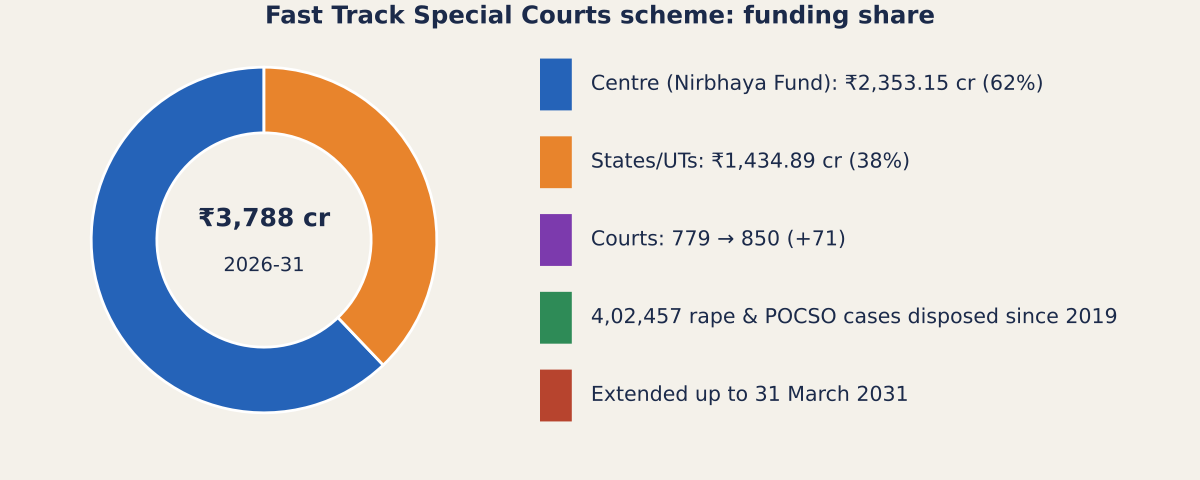
Outlay ₹3,788.04 crore: Centre ₹2,353.15 crore from the Nirbhaya Fund, states ₹1,434.89 crore.
Courts to increase from 779 to 850; 399 of the existing courts are exclusive POCSO courts.
Over 4,02,457 cases disposed since launch on 2 October 2019; each court has a judicial officer, a Special PP and 6 staff.
Way forward
States with large POCSO pendency, including UP, gain dedicated capacity; speedy trials are central to deterrence and victim-centric justice.
Concept
FTSCs flow from the Criminal Law (Amendment) Act, 2018; the Nirbhaya Fund was created in 2013.
Donut chart of the 3,788 crore rupee FTSC outlay for 2026-31: Centre via Nirbhaya Fund 2,353.15 crore (62%) and states/UTs 1,434.89 crore (38%); courts rise from 779 to 850; 4,02,457 cases disposed since 2019. — StudyForGS
8. Agniveers not absorbed after 4 years may serve 2 more years under Agnipath
NATIONALUPPSC: Prelims + Mains GS-III
Syllabus linkage
GS-III Internal security & defence; GS-II government policies
Context
After a four-year review of the scheme launched in 2022, the Union Cabinet approved an additional engagement option.
Key facts
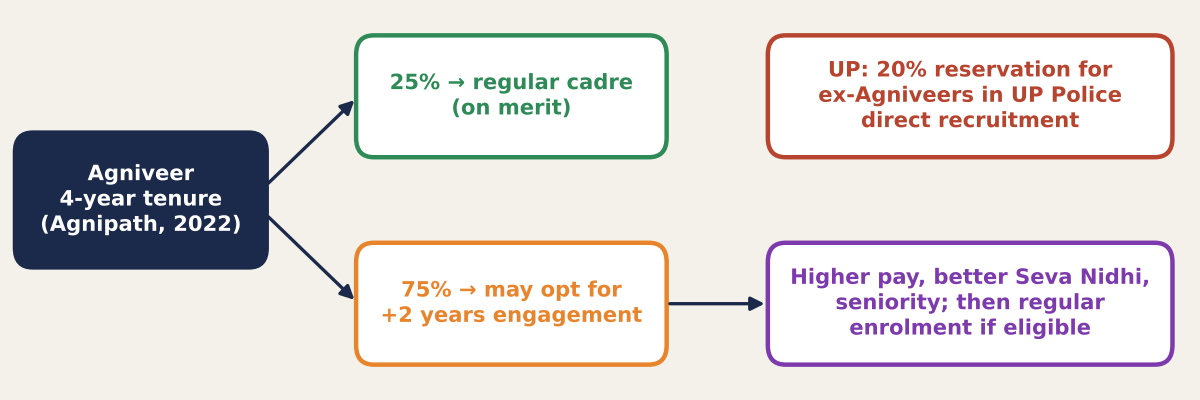
25% of each batch selected for regular cadre on merit; the remaining 75% may opt for two more years.
During the extension: higher pay, improved Seva Nidhi package and seniority benefits; regular enrolment possible if eligible.
UP link: the state provides 20% reservation for ex-Agniveers in UP Police direct recruitment.
Way forward
The change addresses the biggest criticism of Agnipath—short tenure and post-service insecurity—while keeping the armed forces' youthful profile.
Flowchart: Agniveer 4-year tenure under Agnipath (2022) branches into 25% regular cadre on merit and 75% who may opt for two more years with higher pay, better Seva Nidhi and seniority, then regular enrolment if eligible; side note on UP's 20% reservation for ex-Agniveers in UP Police. — StudyForGS
9. QS Asia University Rankings 2027: India has 325 institutions, but top-100 entrants slip
EDUCATIONUPPSC: Prelims + Mains GS-II
Syllabus linkage
GS-II Education, human resources
Context
The 2027 edition assessed 1,722 universities from 26 higher-education systems on 11 indicators.
Key facts
India: 325 institutions (up from 294), second only to mainland China (448).
Only 6 Indian institutions in the top 100, all declined; IIT Delhi best-ranked (59 → 66).
Rankings fell for ~71% of Indian universities; University of Hong Kong ranked first.
Way forward
Quantity is rising but research output, faculty ratios and international outlook need NEP-2020 reforms to translate into quality.
Data point of the day
30 lakh
Ayodhya Deepotsav diyas target (10th edition) Up from 1.71 lakh in the first edition (2017) and 26.17 lakh in 2025.
Prelims rapid-fire
Lucknow's Chaudhary Charan Singh Intl Airport: ACI ASQ Awards 2025 incl. Best Airport at Arrivals – Globally
Noida International Airport (Jewar): Renamed Narendra Modi International Airport, Noida-Jewar (Oct 2026)
Bhadohi district: Renamed Sant Ravidas Nagar Bhadohi (Oct 2026)
Suhas L.Y. (UP Sports Secretary): Bronze, men's singles SL4 para-badminton, Asian Para Games 2026
Sainik School, Mainpuri: 9.524 ha land transferred free of cost (cabinet, 27 Oct)
Prayagraj: 845 residential units approved for High Court officials
Practice MCQs — UPPSC Prelims pattern
Q1. With reference to Uttar Pradesh's revised disaster-relief norms (November 2026), consider the following statements:
1. Ex-gratia for death in a natural disaster has been raised to ₹8 lakh.
2. Compensation for crop loss on irrigated land is now ₹22,000 per hectare.
3. The relief is paid entirely from the state's own budget outside the SDRF/NDRF framework.
Which of the statements given above is/are correct?
1 only
1 and 2 only
2 and 3 only
1, 2 and 3
Show answer
Answer: B Death ex-gratia rose from ₹4 lakh to ₹8 lakh and irrigated crop loss from ₹17,000 to ₹22,000/ha. Relief is paid under SDRF/NDRF norms, so statement 3 is wrong.
Q2. The proposed Farrukhabad Link Expressway in Uttar Pradesh will connect which of the following?
Purvanchal Expressway and Gorakhpur Link Expressway
Agra-Lucknow Expressway and Ganga Expressway
Yamuna Expressway and Bundelkhand Expressway
Ganga Expressway and Purvanchal Expressway
Show answer
Answer: B The ~90.9 km Farrukhabad Link joins the Agra-Lucknow Expressway with the Ganga Expressway via Etawah, Kannauj, Mainpuri, Farrukhabad, Hardoi and Shahjahanpur.
Mains practice question
Q. Uttar Pradesh has doubled disaster ex-gratia and raised crop-loss relief. Examine how far enhanced relief norms can reduce farmers' vulnerability to climate extremes in the state, and suggest complementary measures. (125 words, GS-VI)
Hint / approach
Intro: UP's flood (Terai, east) and drought (Bundelkhand) exposure. Body: gains—higher ₹/ha, livestock and housing cover, SDRF/NDRF basis; limits—delayed assessment, tenant farmers, under-insurance. Way forward: PMFBY with tech-based yield estimation, early warning, climate-resilient seeds, FPO-linked storage. Conclude with resilience over relief.
📌 One-line revision: Death ex-gratia ₹8 lakh | Deepotsav 10th edition, 30 lakh diyas | 4 link expressways ₹17,542 cr | FTSCs 850 till 2031 | Agniveer +2 years for 75%.