Monday, 19 October 2026 · IST · Uttar Pradesh + National · 10 items · 2 MCQs
On Navratri, the UP government expanded the CM Farmers' Scholarship Scheme (grant raised to ₹60,000) and the CM highlighted women-empowerment numbers such as the ₹12,000 Anganwadi honorarium. This week also saw Mainpuri's Sauj Jheel take India's Ramsar tally to 103, the Allahabad High Court order panchayat polls within 3 months on the existing 27% OBC quota, and a 39-proposal Cabinet package including the UP AI Mission.
Today at a glance — things to remember
UP Anganwadi honorarium now ₹12,000/month; 1.20 crore women in SHGs.
CM Farmers' Scholarship: seats doubled (45→90, 15→30), grant ₹60,000.
Sauj Jheel (Mainpuri) is a Ramsar site — India 103, UP 14.
Allahabad HC: panchayat polls within 3 months on existing 27% OBC quota.
UP Cabinet: UP-AIM, ₹1,725 cr skill zones, SAF Policy-2026.
New Noida (DNGIR): 209.11 sq km, 80 villages, Master Plan 2041.
10th Ayodhya Deepotsav on 5–7 Nov with 33 lakh diyas.
Ethanol 2026-27: zero sugar diversion; grain feedstocks favoured.
SC: children's Internet access is a right under Art. 21 + 19(1)(a).
GS-II: welfare schemes for vulnerable sections, SHGs | GS-VI: UP social-sector schemes
Context
On Maha Ashtami (18 Oct) the CM listed state measures on women's safety, nutrition and income; 19 Oct was declared a Maha Navami public holiday.
Key facts
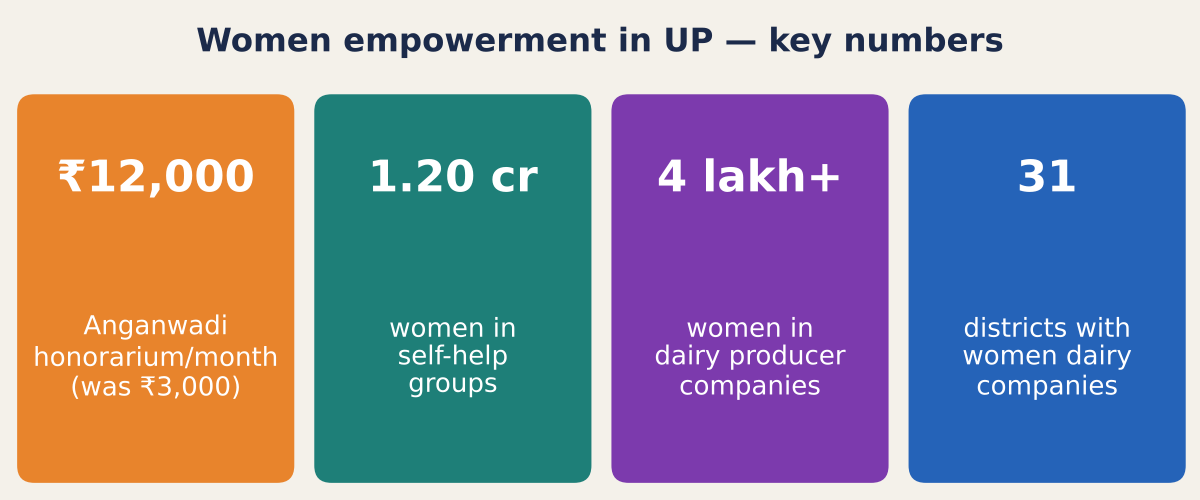
Anganwadi workers' monthly honorarium raised from ₹3,000 to ₹12,000 (four-fold), with health insurance cover.
More than 1.20 crore women are linked to self-help groups (SHGs) in UP.
4 lakh+ women in 31 districts are members of women-led dairy producer companies — Balinee, Samarthya, Kashi, Baba Gorakhnath, Srijani.
Take-home ration (THR) production handed to SHG women; BC Sakhi brings banking to gram panchayats; Lakhpati Didi targets sustainable incomes.
Way forward
Women's collectives (SHGs, dairy companies, BC Sakhi) are UP's main lever for rural income and nutrition delivery — useful data for Mains answers on women-led development.
Concept
Women-led development: moving from women as beneficiaries to women as drivers of growth via collectives and financial inclusion.
Four stat tiles: Anganwadi honorarium ₹12,000 (was ₹3,000); 1.20 crore women in SHGs; 4 lakh+ women in dairy producer companies; 31 districts covered. — StudyForGS
2. CM Farmers' Scholarship Scheme: seats doubled, grant raised to ₹60,000
GS-III: agricultural education & extension | GS-VI: UP agriculture schemes
Context
Announced on 18 Oct; the scheme is run by the State Agricultural Produce Market Board (Mandi Parishad) for farmers' children in agri courses.
Key facts
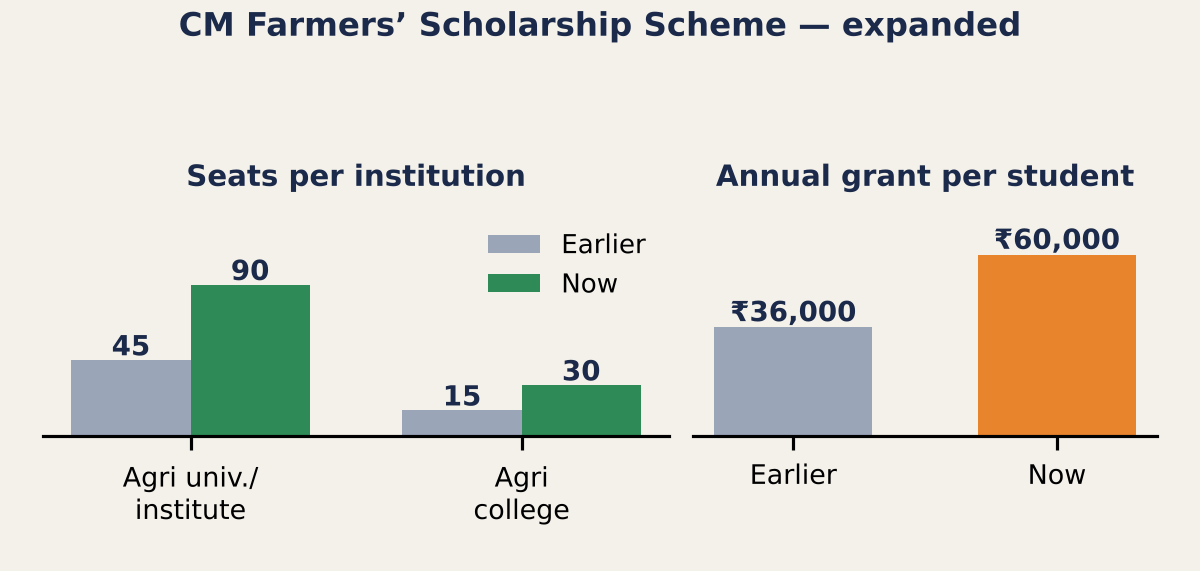
Seats per agricultural university/institute: 45 → 90; per agricultural college: 15 → 30.
Annual grant per student raised from ₹36,000 to ₹60,000.
Covers UG & PG courses in agriculture, home science, horticulture, forestry and animal husbandry.
Coverage: 11 agri universities/institutes and 61 agri colleges; about ₹22.90 crore paid to 6,454 students (2017-18 to 2025-26).
Way forward
Building a pipeline of trained agri-professionals from farm families supports diversification into horticulture, dairy and agri-tech — key to raising farm incomes in UP.
Grouped bar chart: seats per university 45 to 90 and per college 15 to 30; annual grant ₹36,000 to ₹60,000. — StudyForGS
3. Sauj Jheel (Mainpuri) declared Ramsar site — India 103, UP 14
Ramsar Convention: signed 2 Feb 1971 at Ramsar (Iran), in force 1975; World Wetlands Day = 2 Feb.
Way forward
Ramsar tag brings international recognition and a management-plan obligation; floodplain lakes in UP face farm encroachment and siltation, so community-led conservation is vital.
Concept
Ramsar 'wise use' principle: conservation plus sustainable use of wetlands for people and nature.
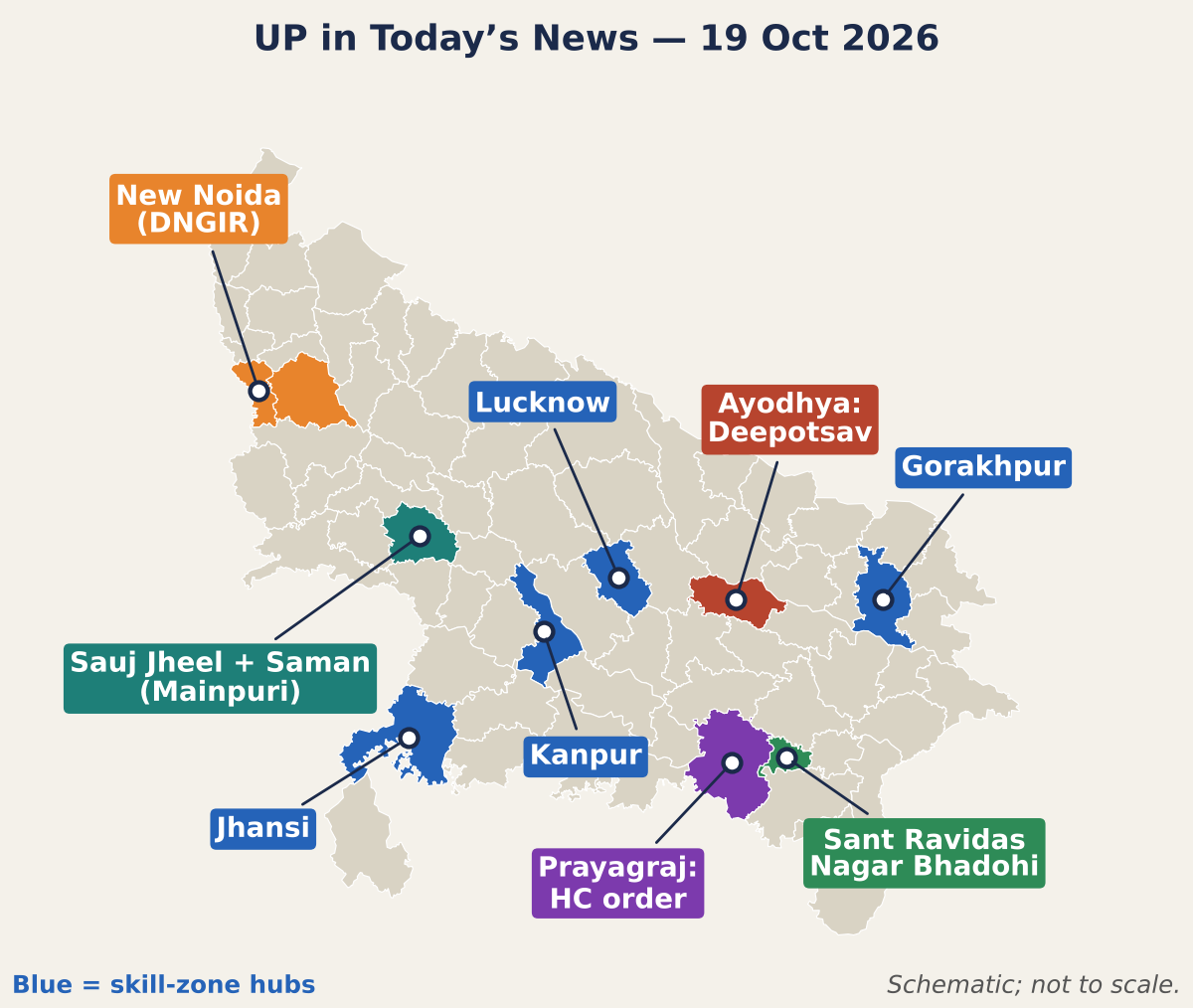
Locator map of Uttar Pradesh districts highlighting Mainpuri (Sauj Jheel and Saman), Gautam Buddha Nagar–Bulandshahr (New Noida), Prayagraj (High Court), Ayodhya (Deepotsav), Bhadohi (renamed) and skill-zone hubs Lucknow, Kanpur, Gorakhpur and Jhansi. — StudyForGS
4. Allahabad HC: hold panchayat polls within 3 months on existing 27% OBC quota
GS-II: local self-government (73rd Amendment), reservation | GS-V: UP Panchayati Raj
Context
In Dashrath Yadav vs State of UP (reported 15 Oct), a Division Bench directed the State and State Election Commission (SEC) to complete panchayat elections within 3 months.
Key facts
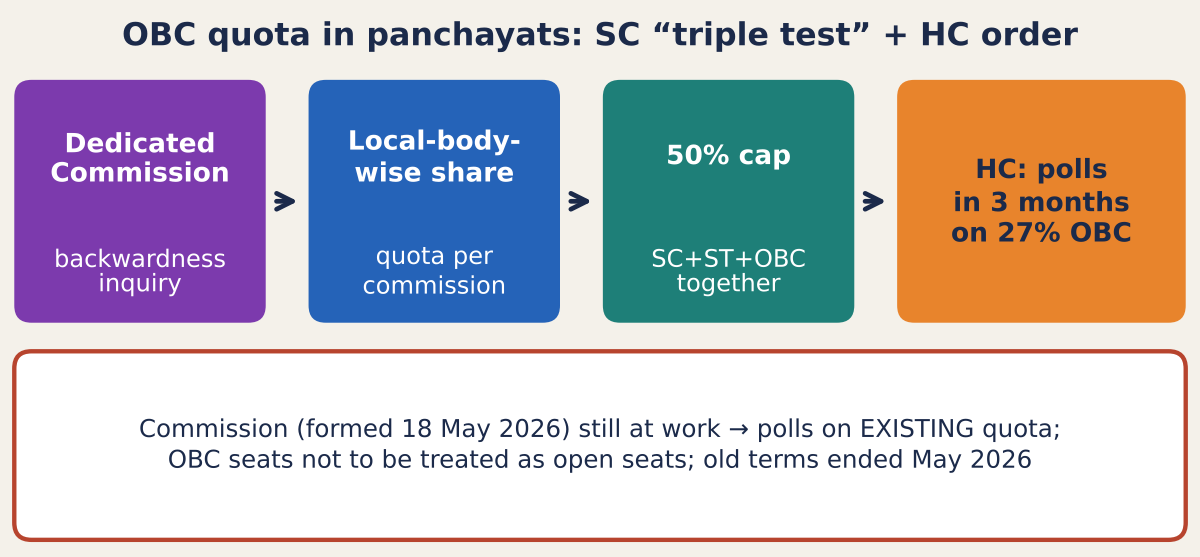
Polls to be held under the existing reservation, including 27% OBC; cannot wait for the Dedicated Backward Classes Commission (formed 18 May 2026).
OBC-reserved seats must not be treated as open seats merely because the inquiry is pending.
Terms of earlier bodies ended May 2026; the 25 May 2026 order making outgoing pradhans Administrators was upheld.
Challenge to Sections 12(3-A) and 12-BB(3) of the UP Panchayat Raj Act, 1947 under Article 243-E rejected.
State must give the SEC staff, funds and security.
Way forward
The order prioritises the constitutional mandate of timely elections (Art. 243-E: 5-year term) over delays, while leaving the SC's 'triple test' for future quota revision.
Flowchart of the Supreme Court triple test for OBC quota in local bodies leading to the High Court order to hold polls in 3 months on the existing 27% OBC quota. — StudyForGS
5. UP Cabinet's 39-proposal package: AI Mission, ₹1,725-cr skill zones, SAF policy
GS-III: IT, skilling, energy, startups | GS-VI: UP industrial & IT policies
Context
Cabinet chaired by CM Yogi Adityanath (reported 10 Oct) cleared 39 proposals aimed at the new economy.
Key facts
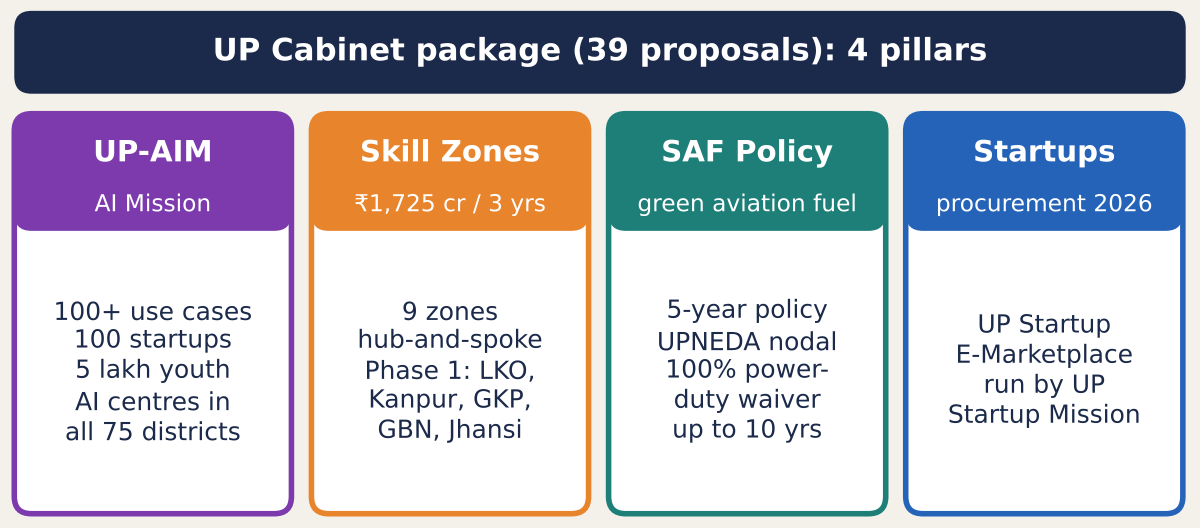
UP Artificial Intelligence Mission (UP-AIM): society under IT & Electronics Dept; 100+ AI use cases, 100 AI startups, 5 lakh youth trained, AI centres in all 75 districts.
Sardar Vallabhbhai Patel Skill Training & Employment Zone scheme: ₹1,725 crore over 3 years; 9 zones (hub-and-spoke); phase 1 at Lucknow, Kanpur, Gorakhpur, Gautam Buddha Nagar, Jhansi.
Sustainable Aviation Fuel (SAF) Policy-2026: 5 years; nodal agency UPNEDA; 100% electricity-duty exemption up to 10 years.
UP Startup Procurement Scheme-2026 creates a UP Startup E-Marketplace; interest-waiver scheme on old tax dues; Model Building Regulations, 2026 approved.
Way forward
Linking AI, skilling and green fuels to district hubs is UP's bid to turn its demographic size into a USD 1-trillion-economy workforce.
Four-pillar diagram of the UP Cabinet package: UP-AIM, Sardar Patel skill zones, SAF policy and startup procurement with key numbers. — StudyForGS
6. New Noida (DNGIR) sets up 3 circles to develop 80 villages
GS-I/III: urbanisation, industrial corridors, land acquisition | GS-VI: UP infrastructure
Context
The Dadri–Noida–Ghaziabad Investment Region (New Noida) created administrative circles 11, 12 and 14 for land acquisition and development (14 Oct).
Key facts
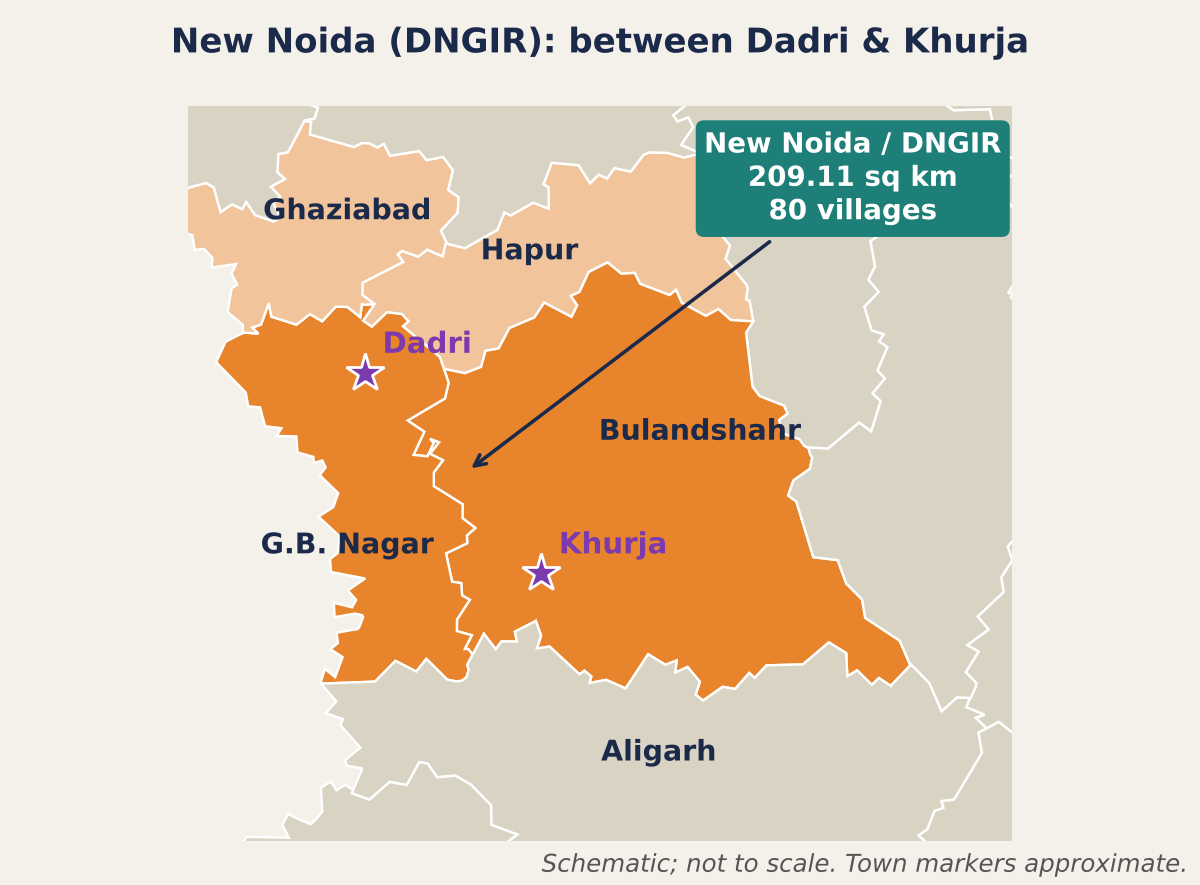
Area 209.11 sq km across 80 villages between Dadri (Gautam Buddha Nagar) and Khurja (Bulandshahr).
Master Plan 2041; planned population about 6 lakh.
Four phases: 2023-27, 2027-32, 2032-37, 2037-41.
Compensation: phases 1–2 on Greater Noida model (6% abadi plot); phases 3–4 on YEIDA model (7%).
Way forward
A planned industrial city beside the Jewar airport–DFC belt can decongest Noida, but fair compensation and farmer consent will decide its pace.
Zoomed district map of western UP highlighting Gautam Buddha Nagar and Bulandshahr with markers for Dadri and Khurja, showing the New Noida (DNGIR) zone. — StudyForGS
GS-I: Indian culture, festivals | GS-VI: UP tourism & heritage
Context
Preparations are under way for the tenth edition of Deepotsav on the Saryu riverfront.
Key facts
33 lakh earthen lamps along ~2 km of the Saryu riverfront incl. Ram Ki Paidi; dates 5–7 Nov 2026.
About 65 lakh wicks and 55,000 litres of oil; ~34,000 volunteers.
Cultural programmes on a special stage at Ram Ki Paidi; focus on security, traffic and cleanliness.
Way forward
Deepotsav is a flagship of UP's religious-tourism economy (Ayodhya–Kashi–Prayagraj circuit), supporting potters, ODOP crafts and the hospitality sector.
8. Ethanol 2026-27: zero sugar diversion — sugar-based feedstocks excluded
NATIONAL · ECONOMYUPPSC: Prelims + Mains GS-III
Syllabus linkage
GS-III: energy security, agriculture–industry linkages (UP sugar belt)
Context
Oil marketing companies' tender (16–17 Oct) for ~11 billion litres for the supply year starting November excludes cane juice, sugar syrup and B-heavy molasses.
Key facts
Procurement shifts to maize, damaged foodgrains, surplus FCI rice and C-heavy molasses.
Reasons: record retail sugar prices, weak cane yields in Maharashtra/Karnataka, festive buffer stocks.
India has already achieved E20 blending; capacity ~2,000 crore litres; E25/E27 and flex-fuel under study.
UP angle: India's top cane state loses the juice/B-heavy route — distilleries must pivot to grain and C-heavy molasses.
Way forward
Balancing food (sugar) security with fuel security needs a diversified feedstock basket and timely cane-price payments to UP farmers.
9. Supreme Court: children have a fundamental right to access the Internet
NATIONAL · POLITYUPPSC: Prelims + Mains GS-II
Syllabus linkage
GS-II: fundamental rights, child protection, digital governance
Context
A Bench led by Justices J.B. Pardiwala and Vinod K. Chandran opposed blanket social-media bans for children.
Key facts
Right flows from Article 21 read with Article 19(1)(a); builds on Anuradha Bhasin (2020).
Suggested parental consent, age-appropriate safeguards and a 'child mode' for social-media accounts.
Way forward
Regulate, don't ban: safety-by-design protects children while keeping digital education open — relevant for UP's tablet/smartphone schemes for students.
10. PLFS 2025: rural female labour-force participation jumps to 45.9%
NATIONAL · ECONOMYUPPSC: Prelims + Mains GS-I/III
Syllabus linkage
GS-I: role of women | GS-III: employment, inclusive growth
Context
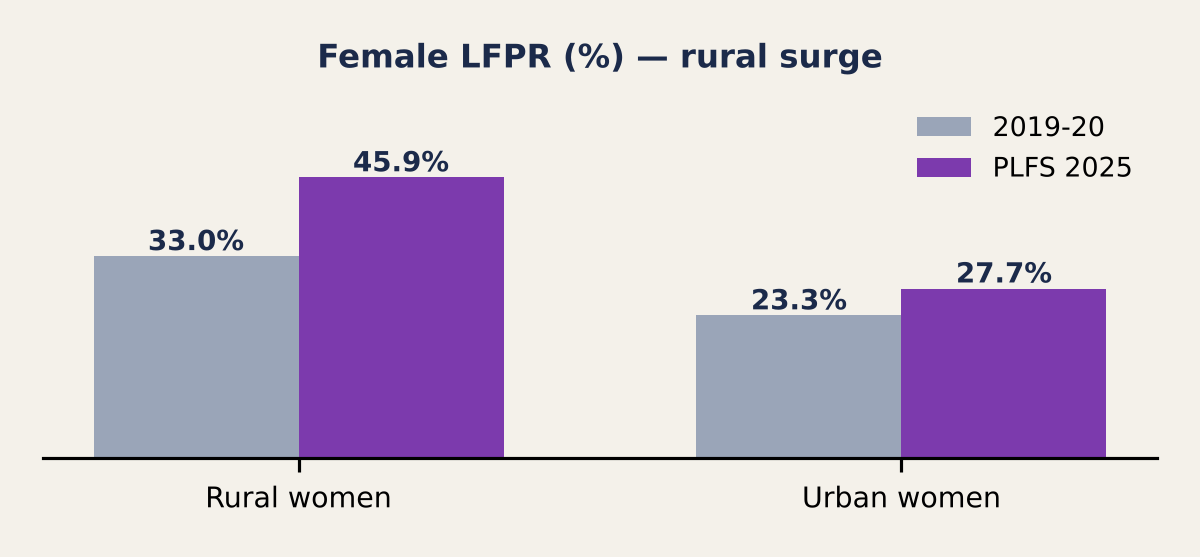
Periodic Labour Force Survey data compare female LFPR with 2019-20.
Rise is largely self-employment/unpaid family work — quality of jobs remains a concern.
Way forward
Converting participation into paid, formal work (SHG enterprises, dairy, care economy) is the next step — ties directly to UP's women-collective model above.
Grouped bar chart of female LFPR: rural 33.0% to 45.9%, urban 23.3% to 27.7% between 2019-20 and PLFS 2025. — StudyForGS
Data point of the day
India 103 | UP 14
Ramsar sites Sauj Jheel (Mainpuri) is Ramsar Site No. 2603; UP is second only to Tamil Nadu.
Prelims rapid-fire
Renaming: Bhadohi district renamed Sant Ravidas Nagar Bhadohi (Cabinet, Oct 2026)
Rajya Sabha: All 10 UP seats filled unopposed: BJP 8, SP 2; BSP left with no UP member; outgoing terms end 25 Nov
Award: UP 1st in PMAY-U Beneficiary-Led Construction; 3rd in PMAY-U 2.0 grounding (5 Oct)
Urban rules: Model Building Regulations, 2026: no FAR cap on roads >45 m; deemed approval in 60 days; high-rise audit every 5 years
Sports: Major Dhyan Chand Sports University, Meerut; “Medal Lao, Naukri Pao” = govt jobs for medallists
Festival: 19 Oct: Maha Navami public holiday in UP; CM performed Kanya Pujan at Gorakhnath Temple, Gorakhpur
Practice MCQs — UPPSC Prelims pattern
Q1. Sauj Jheel, which took India's Ramsar tally to 103 in October 2026, is located in which district of Uttar Pradesh — the only UP district that now has two Ramsar sites?
Etawah
Mainpuri
Unnao
Hardoi
Show answer
Answer: B Sauj Jheel lies in the Ganga floodplain of Mainpuri, which already had Saman Bird Sanctuary; UP now has 14 Ramsar sites.
Q2. Which of the following is NOT a part of the Supreme Court's 'triple test' for OBC reservation in local bodies?
A dedicated commission to inquire into backwardness
Specifying quota proportion local-body-wise
Total SC/ST/OBC reservation not exceeding 50%
Approval of the quota by the State Legislature by two-thirds majority
Show answer
Answer: D The triple test (Vikas Kishanrao Gawali, 2021) = dedicated commission + local-body-wise proportion + 50% cap; no legislative two-thirds approval is required.
Mains practice question
Q. “Women's collectives are becoming the backbone of rural transformation in Uttar Pradesh.” Examine with reference to SHGs, women-led dairy companies and BC Sakhi. (125 words)
Hint / approach
Intro: 1.20 crore SHG women, 4 lakh+ in dairy cos. (31 districts) → Body: income (Lakhpati Didi), nutrition (THR by SHGs), finance (BC Sakhi), PLFS rural female LFPR 45.9% → Challenges: low-value work, market access, credit → Way forward: FPO/market linkages, digital skilling, care infrastructure.