Monday, 12 October 2026 · IST · Uttar Pradesh + National · 10 items · 2 MCQs
Government paddy purchase begins today in western Uttar Pradesh at an MSP of ₹2,441 per quintal against a 65 LMT target, while the state moves to raise old-age, destitute-women and divyang pensions from ₹1,000 to ₹1,500. The 9 October Cabinet package — UP-AIM, the Sustainable Aviation Fuel Policy-2026, 1,725 e-buses for 18 cities and a 20% quota for ex-Agniveers — forms the core of today's UP developments.
Today at a glance — things to remember
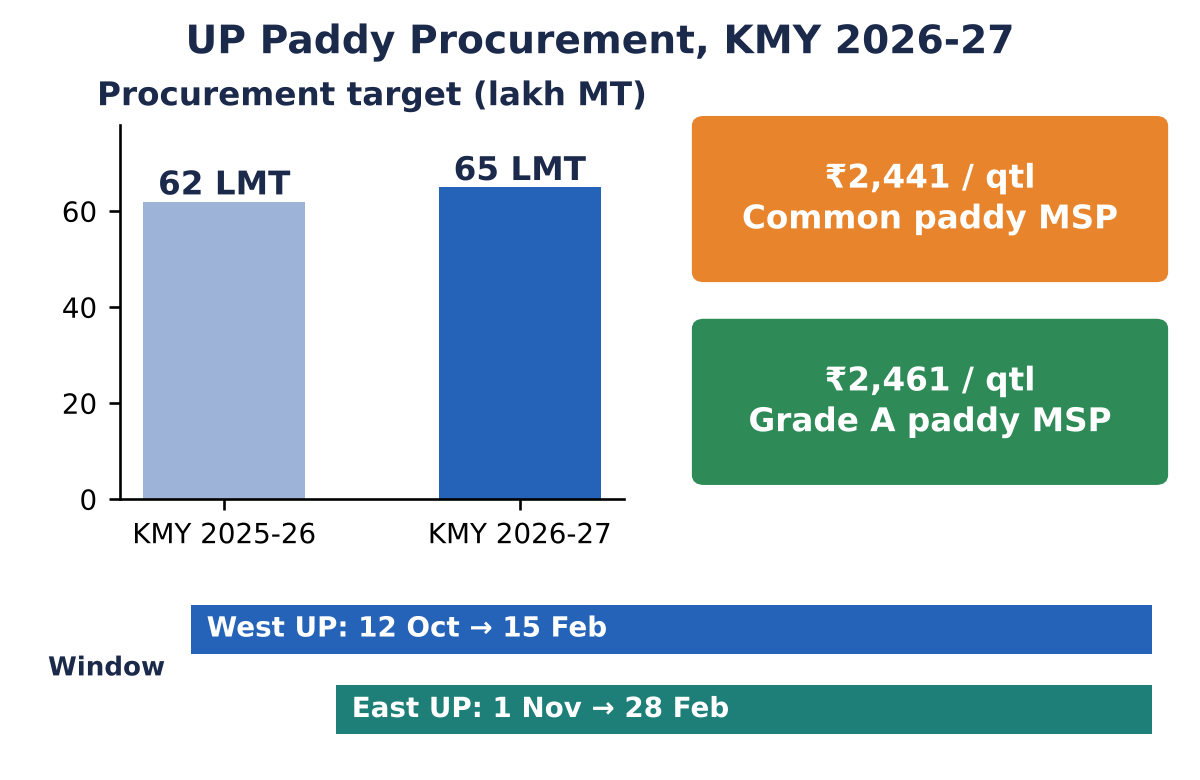
Paddy buying opens in western UP today (till 15 Feb); MSP ₹2,441/qtl, target 65 LMT.
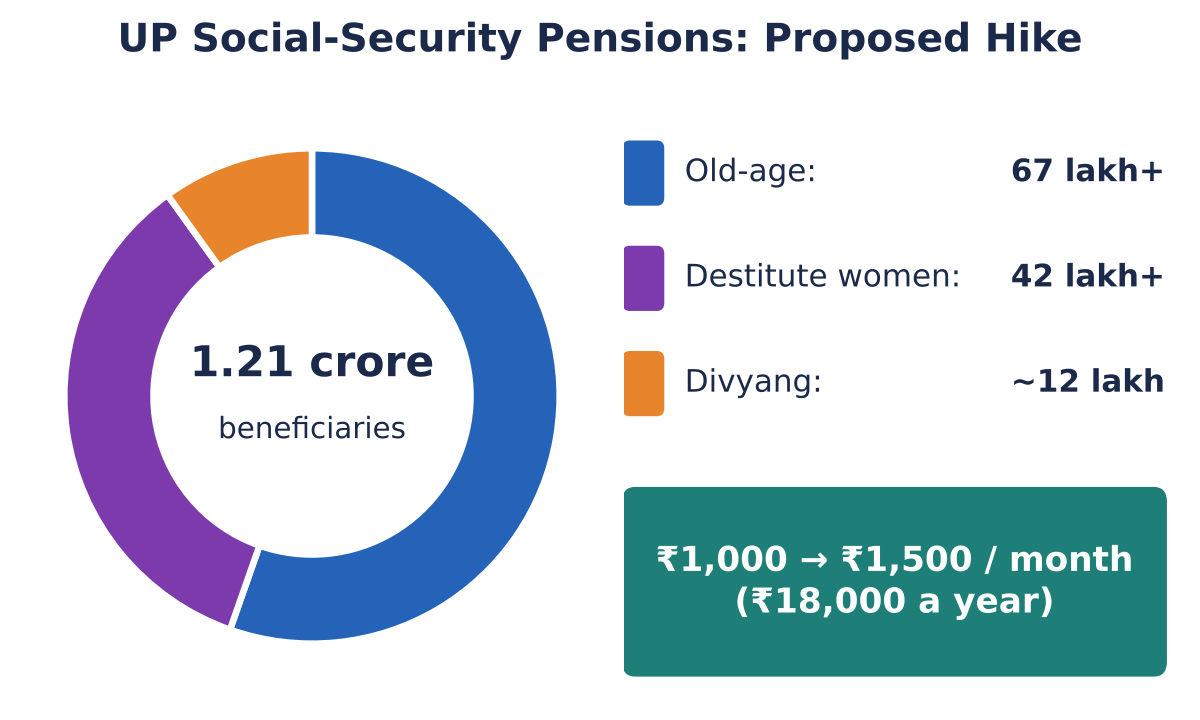
Pension for old-age, destitute women & divyang to rise ₹1,000 → ₹1,500; 1.21 crore beneficiaries.
Gomti falls up to 13 cm in Lucknow; embankment survey Faizullaganj–Naimisharanya ordered.
UPPCL to re-engage 25,000+ outsourced power workers; outer age 55 → 60.
UP-AIM approved: AI centres in 75 districts, 100 startups, 5 lakh youth to be trained.
SAF Policy-2026: farm residue to jet fuel; ultra-mega units above ₹1,500 crore; UPNEDA nodal.
1,725 AC e-buses for 18 cities on 12-year GCC model; ₹265-crore Lucknow bus terminal.
Ex-Agniveers get 20% quota in police, prisons, forest, transport; ₹1,725-crore skill zones in 9 zones.
NHRC's 33rd Foundation Day: CJI calls safe, reliable water part of Article 21.
INS Mangrol — 3rd ASW shallow water craft from Cochin Shipyard, 80%+ indigenous.
Detailed notes
1. Paddy procurement begins in western UP today; 65 LMT target for KMY 2026-27
Under the paddy procurement policy for Kharif Marketing Year (KMY) 2026-27 cleared by the UP Cabinet on 9 October, government purchase opens in western UP from today.
Key facts
Procurement window: western UP 12 Oct 2026 – 15 Feb 2027; eastern UP 1 Nov 2026 – 28 Feb 2027.
MSP: ₹2,441 per quintal (common) and ₹2,461 per quintal (Grade A) paddy.
State target raised to 65 lakh metric tonnes (LMT) from 62 LMT last season.
Online farmer registration is mandatory to sell at government purchase centres.
Way forward
Timely procurement prevents distress sales below MSP during the harvest glut, and the split West/East calendar matches UP's different harvesting cycles.
Concept
MSP is announced by the Union Government on the recommendation of the CACP for 22 mandated crops; states procure paddy for the central pool under centralised or decentralised procurement.
Bar chart: UP paddy procurement target rising from 62 LMT to 65 LMT, with MSP of ₹2,441 (common) and ₹2,461 (Grade A) per quintal and the West/East procurement windows. — StudyForGS
2. State moves to raise social-security pensions from ₹1,000 to ₹1,500 a month
GS-II: Welfare schemes for vulnerable sections | GS-V: UP social-sector schemes
Context
The proposal has in-principle approval and now awaits Cabinet clearance; funds may come through the second supplementary budget expected in December.
Key facts
Monthly pension to rise ₹1,000 → ₹1,500 (₹12,000 → ₹18,000 a year).
Covers about 1.21 crore people: 67 lakh+ old-age, 42 lakh+ destitute women and ~12 lakh divyang pensioners.
Last revision was in 2017 (₹500 → ₹1,000).
If approved, the higher amount could start from the third quarter of FY 2026-27.
Way forward
A 50% hike for 1.21 crore people is among the state's largest direct-transfer expansions; at full coverage the extra outgo is an estimated ₹7,000 crore+ a year — a welfare-versus-fiscal trade-off useful for Mains.
Concept
Article 41 (DPSP) directs the State to provide public assistance in old age, sickness and disablement; the Centre's National Social Assistance Programme (NSAP) is topped up by states.
Donut chart of about 1.21 crore UP pension beneficiaries: 67 lakh old-age, 42 lakh destitute women and 12 lakh divyang, with the proposed hike from ₹1,000 to ₹1,500 a month. — StudyForGS
3. Gomti flood eases in Lucknow; embankment survey from Faizullaganj to Naimisharanya
After flood-like conditions in low-lying Lucknow localities, the Gomti fell by up to 13 cm in a day, officials said on 12 October.
Key facts
Barrage gates to stay open until the river falls below 105.60 m.
Irrigation department to survey a proposed embankment from Faizullaganj (Lucknow) to Naimisharanya (Sitapur).
52 boats and a relief camp at Hayat Nagar were deployed earlier in the week; upstream gauges at Neemsar (Sitapur) were already falling.
The Gomti, a groundwater-fed tributary of the Ganga, rises at Gomat Taal near Pilibhit and joins the Ganga near Kaithi (Ghazipur).
Way forward
Floodplain encroachment and drainage bottlenecks turn a modest river rise into an urban disaster — a classic Mains case for flood-plain zoning and drainage planning in UP cities.
Concept
Under the Disaster Management Act, 2005, the UP State Disaster Management Authority (chaired by the Chief Minister) prepares the state disaster management plan.
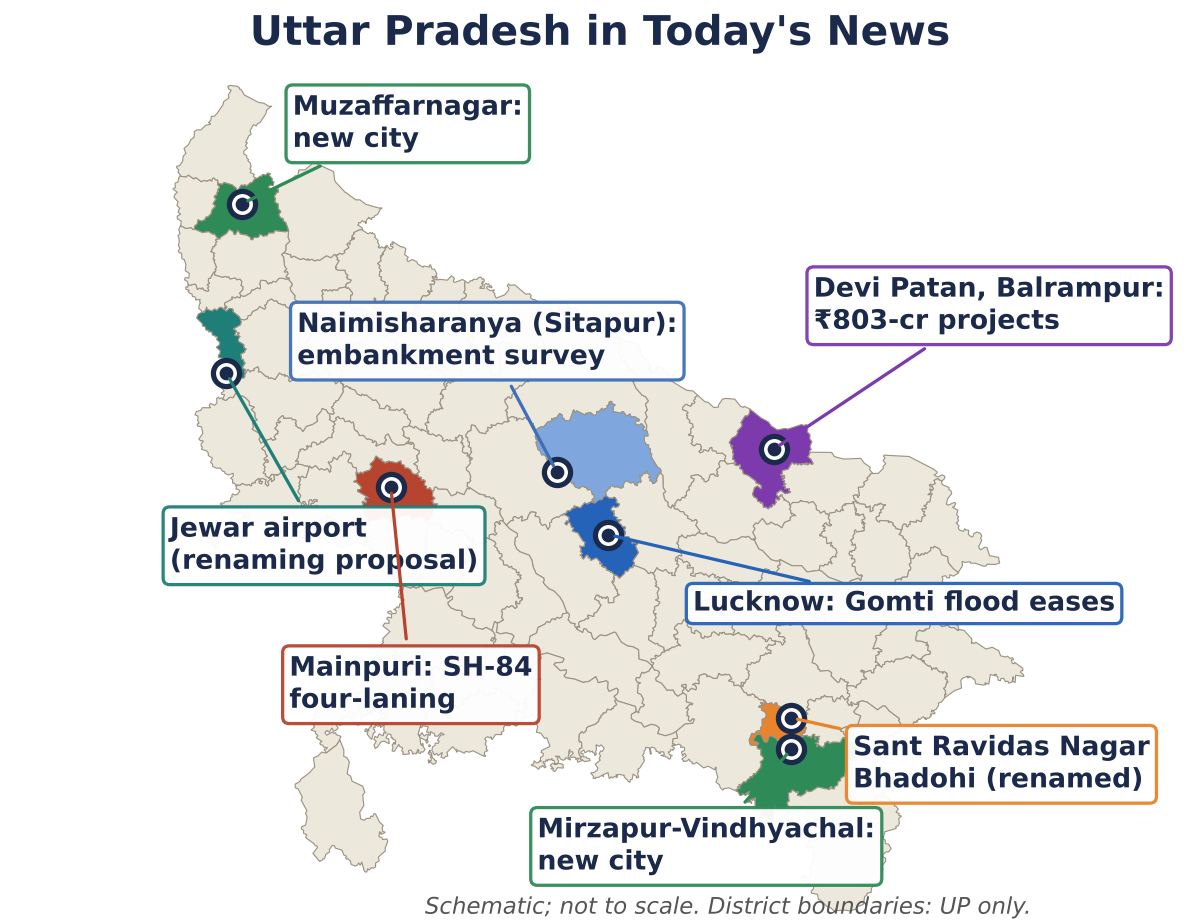
Schematic map titled Uttar Pradesh in Today's News, with district boundaries and markers for Lucknow and Sitapur (Gomti flood), Balrampur (Devi Patan), Bhadohi (renaming), Gautam Buddha Nagar (Jewar airport), Mirzapur and Muzaffarnagar (new city scheme) and Mainpuri (SH-84). — StudyForGS
4. Way cleared to re-engage 25,000+ outsourced power workers; service age raised to 60
GS-III: Energy sector, labour issues | GS-V: UP public sector undertakings
Context
UP Power Corporation Ltd (UPPCL) agreed with employee unions on 12 October to reopen service for outsourced staff removed over the past two years.
Key facts
More than 25,000 outsourced electricity workers removed earlier can be re-engaged (of ~85,000 employed two years ago).
Outer age limit for outsourced service raised from 55 to 60 years.
Workers above 55 need a fitness certificate from a registered medical practitioner and an affidavit of willingness.
Contracts with outsourcing agencies will be amended to extend service periods.
Way forward
Restores field manpower in distribution networks before the festive peak-demand season and spotlights the wider issue of contractualisation in public utilities.
GS-III: Science & technology, IT, employment | GS-VI: UP IT & startup policy
Context
Among 39 proposals cleared on 9 October, UP-AIM will work as an independent society under the IT & Electronics Department.
Key facts
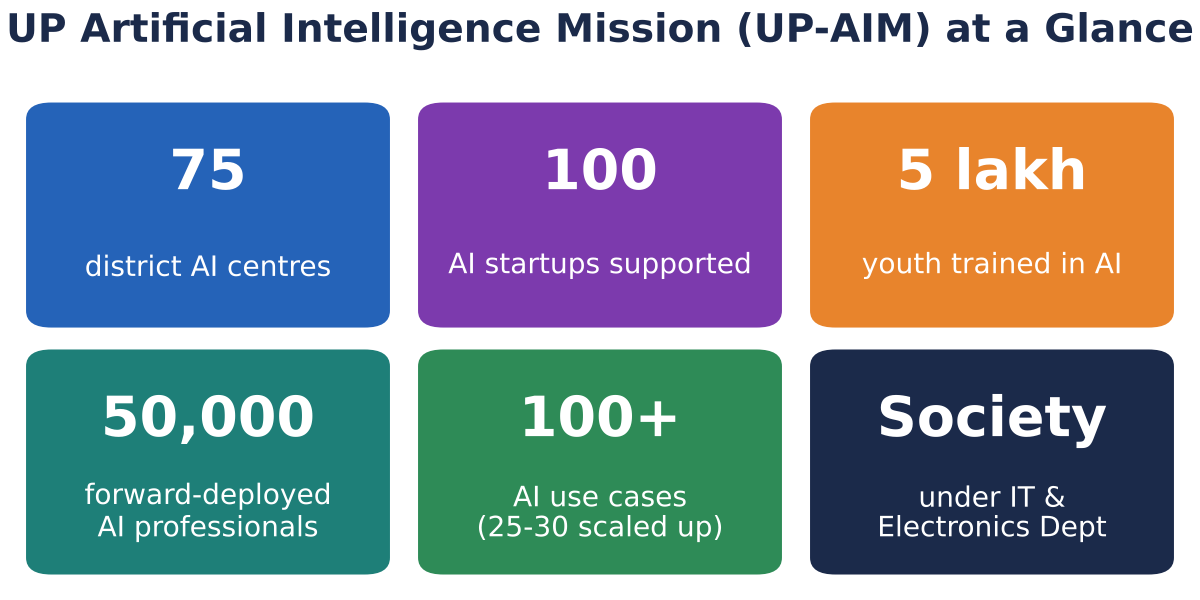
AI centres in all 75 districts for training, innovation, jobs and entrepreneurship.
Support for at least 100 AI startups; 5 lakh youth to be trained in AI skills.
50,000 forward-deployed AI professionals; 100+ AI use cases, of which 25-30 will be scaled up.
Same meeting cleared the UP Startup Procurement Scheme-2026 — a UP Startup E-Marketplace for government buying from registered startups.
Way forward
Aligns UP with the national IndiaAI Mission, can bring AI into district-level governance and builds employable digital skills for the state's large youth population.
Concept
IndiaAI Mission (2024): ₹10,371.92 crore national programme with pillars such as AI compute capacity, datasets platform (AIKosh), innovation centres and startup financing.
Stat tiles for UP-AIM: 75 district AI centres, 100 AI startups, 5 lakh youth trained, 50,000 AI professionals and 100+ AI use cases. — StudyForGS
6. UP Sustainable Aviation Fuel (SAF) Manufacturing Promotion Policy-2026 approved
GS-III: Energy, environment, investment | GS-VI: UP industrial & energy policy
Context
The policy seeks to make UP a SAF manufacturing hub by using its farm-residue, sugarcane and ethanol base.
Key facts
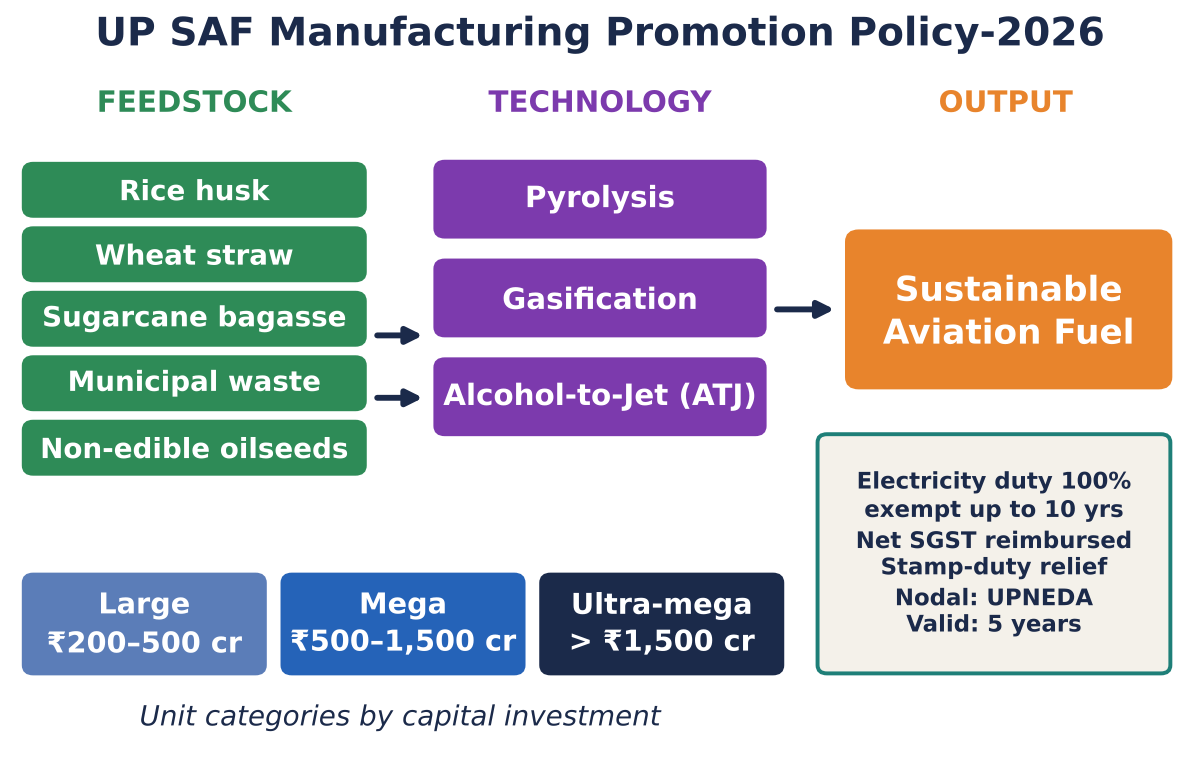
Feedstock: rice husk, wheat straw, sugarcane bagasse, municipal waste and non-edible oilseeds.
Technologies: pyrolysis, gasification and Alcohol-to-Jet (ATJ).
Unit categories: Large ₹200–500 crore, Mega ₹500–1,500 crore, Ultra-mega above ₹1,500 crore.
100% electricity-duty exemption for up to 10 years, net SGST reimbursement, stamp-duty relief; UPNEDA is nodal agency; policy valid 5 years.
Way forward
Turns stubble and bagasse into a high-value fuel — cutting crop-residue burning, supporting sugar mills and helping India meet its SAF blending goals.
Concept
India's indicative SAF blending targets for international flights: 1% by 2027 and 2% by 2028.
Flowchart of the UP SAF Policy-2026: feedstock (rice husk, wheat straw, bagasse, municipal waste, non-edible oilseeds) to technologies (pyrolysis, gasification, Alcohol-to-Jet) to SAF, with Large, Mega and Ultra-mega investment categories and key incentives. — StudyForGS
7. 1,725 AC electric buses for 18 cities; integrated bus terminal for Lucknow
GS-III: Infrastructure, urban transport, clean energy | GS-VI: UP urban development
Context
The Cabinet approved e-bus services on a Gross Cost Contract (GCC) model with private operators for 12 years.
Key facts
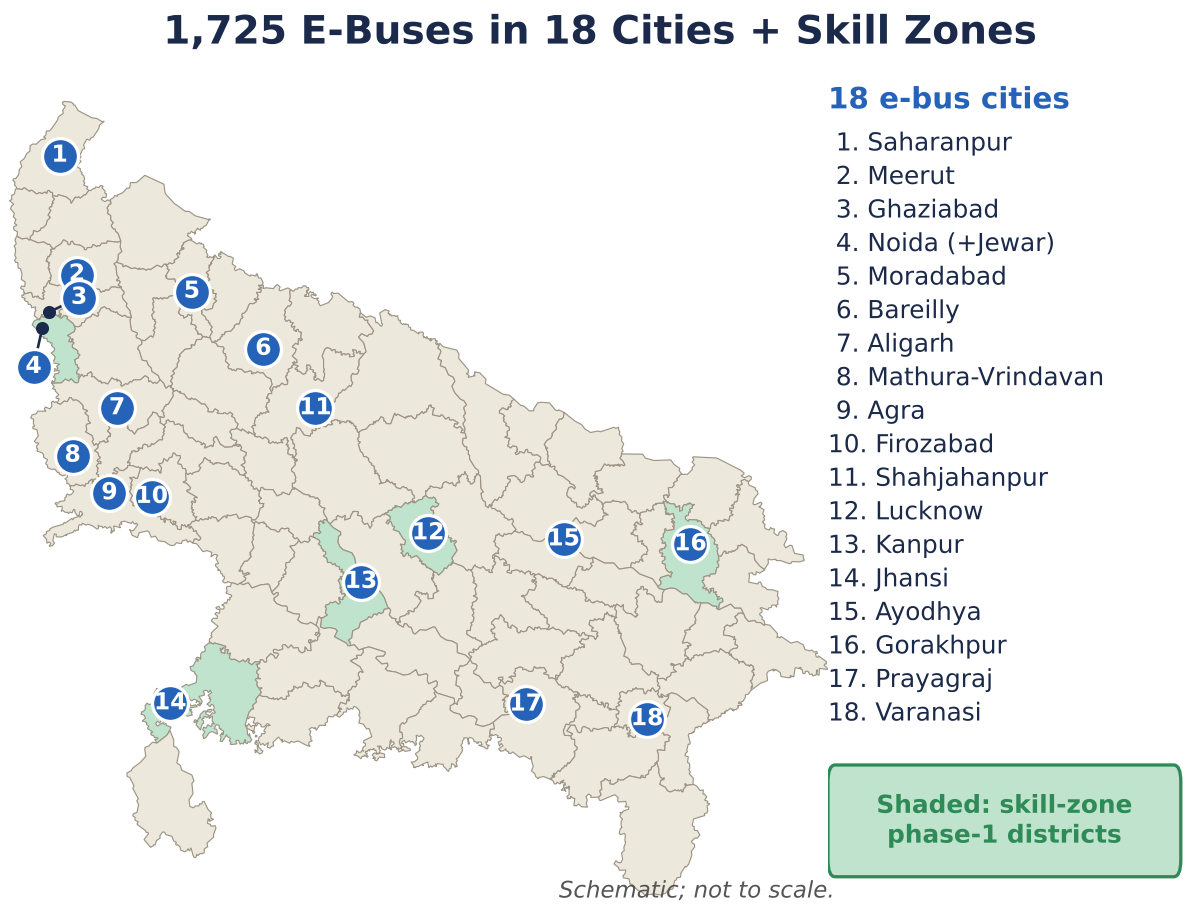
1,725 air-conditioned e-buses across 18 cities, including Lucknow, Kanpur, Varanasi, Prayagraj, Ayodhya, Gorakhpur and Noida (with Jewar).
Operators buy buses and chargers and handle staff and maintenance; fares fixed by the state; depot land given free by civic bodies/Noida Authority.
At present 743 e-buses run in 15 municipal corporations.
Integrated bus terminal at Vrindavan Vihar Yojana, Lucknow on PPP, estimated at ₹265 crore.
Way forward
GCC shifts capital risk to operators and pays them per km — the model used under PM e-Bus Sewa — helping cleaner air in NCR and other big UP cities.
Concept
Gross Cost Contract: the authority keeps fare revenue and pays the operator a fixed rate per km, unlike the net-cost model where the operator keeps the fares.
Schematic map of Uttar Pradesh with 18 numbered markers for the e-bus cities and shaded districts for the five phase-1 skill-zone centres: Lucknow, Kanpur Nagar, Gorakhpur, Gautam Buddha Nagar and Jhansi. — StudyForGS
8. 20% quota for ex-Agniveers; ₹1,725-crore Sardar Patel Skill & Employment Zones
GS-II: Government policies, recruitment | GS-III: Skilling & employment | GS-V: UP governance
Context
Two youth-employment decisions from the 9 October Cabinet meeting.
Key facts
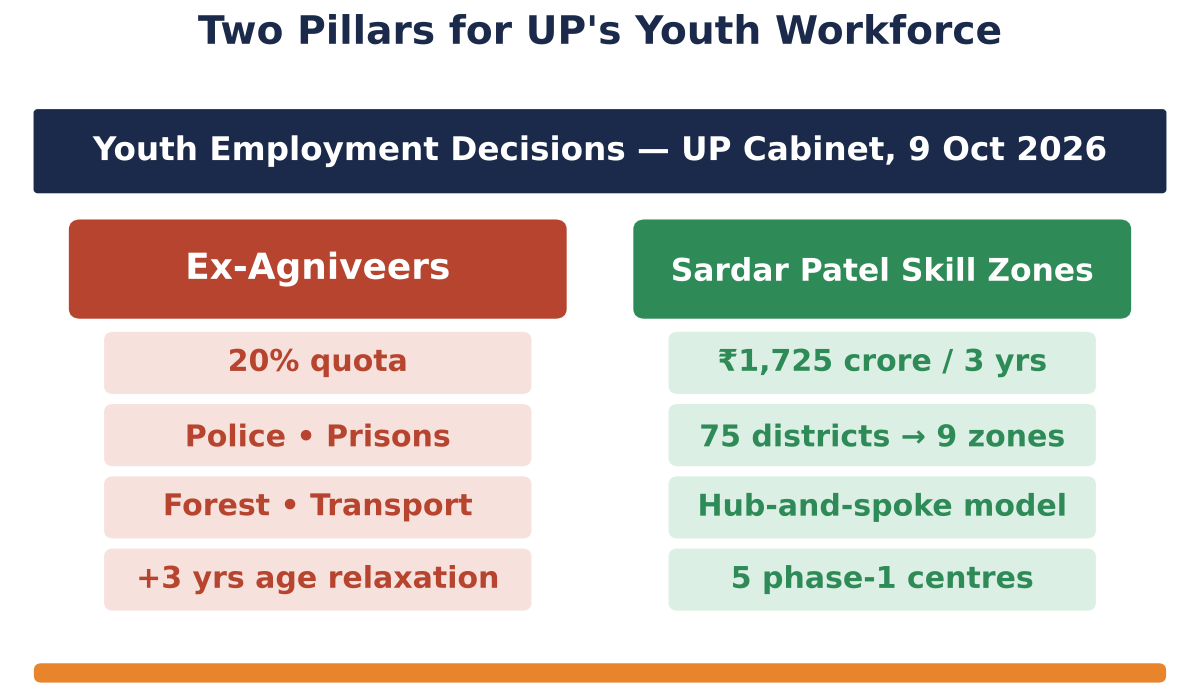
Former Agniveers get 20% reservation in police, prisons, forest and transport department posts.
3-year upper age relaxation; they keep the benefit of their original reservation category.
Sardar Vallabhbhai Patel Skill Training and Employment Zone scheme: ₹1,725 crore over 3 years; 75 districts in 9 zones (hub-and-spoke).
Phase-1 centres: Lucknow, Kanpur, Gorakhpur, Gautam Buddha Nagar, Jhansi, with hostels and placement cells.
Way forward
Gives Agnipath's four-year soldiers a second career in uniformed services, while the zone model ties skilling to placement — both aimed at UP's huge youth workforce.
Concept
Agnipath scheme (2022): recruitment to the armed forces for 4 years; up to 25% of each batch can be retained as regular cadre.
Two-pillar diagram: left pillar for ex-Agniveers (20% quota in police, prisons, forest, transport; 3-year age relaxation), right pillar for the Sardar Patel Skill Zones (₹1,725 crore, 3 years, 9 zones, 5 phase-1 centres). — StudyForGS
9. NHRC marks 33rd Foundation Day; CJI says right to water means safe, reliable supply
POLITYUPPSC: Prelims + Mains GS-II
Syllabus linkage
GS-II: Statutory bodies, human rights, Article 21
Context
At Vigyan Bhawan, New Delhi on 12 October, the Chief Justice of India addressed the Commission's national conference on the right to water.
Key facts
CJI Surya Kant: under Article 21, water must be safe, reliable and accessible — a mere tap connection is not access to water.
NHRC was set up on 12 October 1993 under the Protection of Human Rights Act, 1993; chairperson Justice V. Ramasubramanian.
Over 24 lakh cases registered in 33 years with disposal above 98%; NHRC India mobile app launched.
UN General Assembly recognised safe drinking water and sanitation as a human right in 2010.
Way forward
Links a statutory body's work with the expanding reading of Article 21 — useful for questions on NHRC's powers and on water as a human right.
Concept
NHRC is a statutory (not constitutional) body; its chairperson — a former CJI or former Supreme Court judge — is appointed by the President on the recommendation of a committee headed by the Prime Minister.
10. Navy commissions INS Mangrol, its third anti-submarine warfare shallow water craft
NATIONALUPPSC: Prelims + Mains GS-III (Security)
Syllabus linkage
GS-III: Maritime security, defence indigenisation
Context
Commissioned in Mumbai on 12 October, the vessel strengthens coastal anti-submarine defence.
Key facts
Built by Cochin Shipyard Ltd; the third Anti-Submarine Warfare Shallow Water Craft (ASW-SWC) from the yard.
Over 80% indigenous content.
Role: hunt submarines in coastal waters, working with maritime patrol aircraft, helicopters and other warships.
Named after Mangrol, a fishing harbour town in Gujarat's Junagadh district.
Way forward
Shallow-water ASW craft close a gap in coastal defence against submarine threats in the Indian Ocean and showcase Aatmanirbhar shipbuilding.
Concept
The Navy ordered 16 ASW-SWCs: 8 from GRSE (Arnala class) and 8 from Cochin Shipyard (Mahe class).
Data point of the day
1.21 crore
Social-security pensioners in UP Proposed monthly pension ₹1,500 (from ₹1,000); last raised in 2017
Prelims rapid-fire
Renaming: Noida International Airport (Jewar, Gautam Buddha Nagar) → proposed Narendra Modi International Airport, Noida-Jewar (needs Centre's approval).
Renaming: Bhadohi district → Sant Ravidas Nagar Bhadohi; known for GI-tagged hand-made carpets.
Culture: CM at Devi Patan, Tulsipur (Balrampur) — a Shaktipeeth — launched 78 projects worth ₹803 crore on Navratri day 1 (11 Oct).
Welfare: Ujjwala beneficiaries to get two free LPG refills in FY 2026-27 (Diwali & Holi); outlay ₹2,142.78 crore.
Urban: New City Promotion Scheme: ₹115 crore first instalment to Mirzapur-Vindhyachal & Muzaffarnagar authorities (FY27 provision ₹3,500 crore).
Practice MCQs — UPPSC Prelims pattern
Q1. Consider the following statements about the Uttar Pradesh Sustainable Aviation Fuel Manufacturing Promotion Policy-2026: 1. UPNEDA is the nodal agency for the policy. 2. Units with capital investment above ₹1,500 crore are classified as 'Ultra-mega'. 3. It offers 100% electricity-duty exemption for up to 20 years. Which of the statements given above are correct?
1 only
2 and 3 only
1 and 2 only
1, 2 and 3
Show answer
Answer: c UPNEDA is the nodal agency and ultra-mega units are those above ₹1,500 crore. The electricity-duty exemption is for up to 10 years, not 20.
Q2. With reference to the Gomti river, consider the following statements: 1. It originates from Gomat Taal near Pilibhit. 2. It is a tributary of the Ghaghara. 3. Lucknow and Jaunpur are located on its banks. Which of the statements given above are correct?
1 and 2 only
1 and 3 only
2 and 3 only
1, 2 and 3
Show answer
Answer: b The Gomti rises at Gomat Taal near Pilibhit and flows past Lucknow, Sultanpur and Jaunpur to join the Ganga (not the Ghaghara) near Kaithi in Ghazipur district.
Mains practice question
Q. Social-security pensions and procurement at MSP are two key instruments of inclusive growth in Uttar Pradesh. Critically examine their welfare and fiscal implications in the light of recent decisions. (125 words)
Hint / approach
Intro: pension hike proposal (₹1,000 → ₹1,500 for 1.21 crore) and 65 LMT paddy target. Body: welfare gains (income floor for elderly, widows, divyang; no distress sales), fiscal cost (~₹7,000 crore+ a year, supplementary budget), delivery issues (DBT, registration, timely payment, leakages). Way forward: index pensions to inflation, strengthen decentralised procurement, social audits.
📌 One-line revision: Paddy buying opens in western UP (65 LMT, MSP ₹2,441) • Pension ₹1,000 → ₹1,500 proposed for 1.21 crore • UP-AIM: AI centres in 75 districts • SAF Policy-2026 (UPNEDA) • 1,725 e-buses in 18 cities • 20% ex-Agniveer quota • NHRC Day: water under Article 21.