Daily Current Affairs for Uttar Pradesh PSC (UPPCS)
UPPSC Current Affairs — 8 September 2026
UP Textile Conclave (UPTEX-2026) opens in Lucknow with the UP Tex Mitra portal and over ₹4,000 crore in weaver support; CM honours Anganwadi workers in Ayodhya; state rolls out a Student Mental-Health Policy for all universities.
Tuesday, 8 September 2026 · IST · Uttar Pradesh + National · 8 items · 2 MCQs
Uttar Pradesh's day was led by the two-day UP Textile Conclave-2026 in Lucknow, where the government launched the UP Tex Mitra portal and disbursed more than ₹4,000 crore across weaver and powerloom schemes while pushing a 'global textile hub' vision. The CM simultaneously honoured Anganwadi workers in Ayodhya with statewide appointment-letter distribution, and the higher-education department finalised a three-tier Student Mental-Health and Well-Being Policy with support cells in every college and university.
Today at a glance — things to remember
UP Textile Conclave-2026 opens in Lucknow; UP Tex Mitra portal and two new weaver schemes launched.
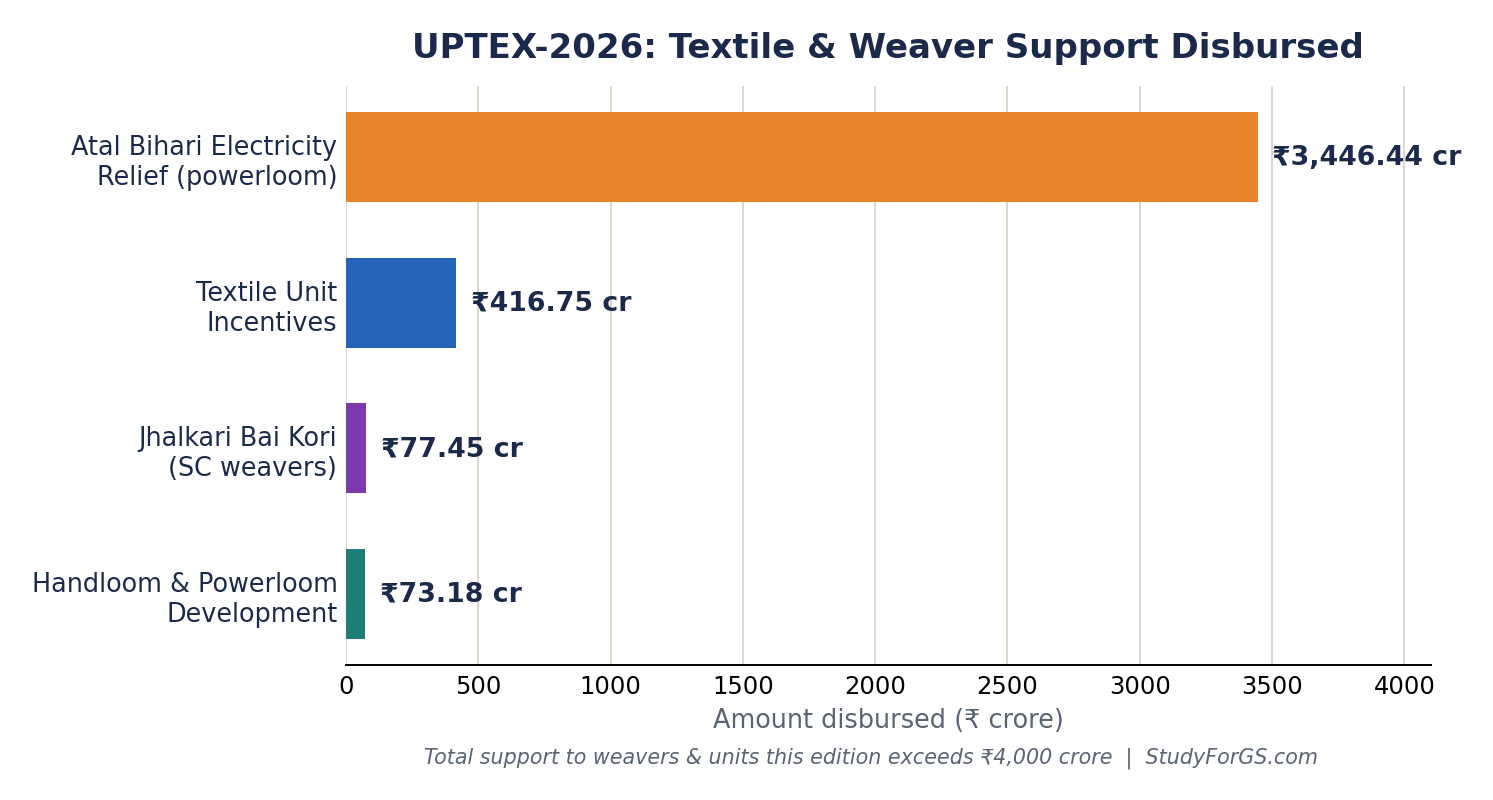
Over ₹4,000 crore disbursed on day one—₹3,446.44 cr power relief to 99,929 powerloom weavers, ₹416.75 cr to 157 units.
PM MITRA mega textile park on 1,000 acres coming up at the Lucknow–Hardoi border.
CM honours 12,000–15,000 Anganwadi workers in Ayodhya; appointment letters distributed statewide.
UP finalises a three-tier Student Mental-Health & Well-Being Policy with support cells in every college and university.
594-km Meerut–Prayagraj Ganga Expressway, UP's longest, targeted to open in 2026.
Uttar Pradesh remains India's No. 1 state in GI-tagged products (10-year renewable protection).
Defence Acquisition Council clears ~₹1.10 lakh crore buys, 98% from domestic industry.
India frames its 2026 BRICS chairmanship as 'non-West, not anti-West'.
ISRO's EOS-05 launched via GSLV-F17 as IN-SPACe deepens private-sector space role.
Detailed notes
1. UP Textile Conclave 2026 (UPTEX-2026) opens in Lucknow; UP Tex Mitra portal launched
CM Yogi Adityanath inaugurated the two-day UP Textile Conclave-2026 at Indira Gandhi Pratishthan, Lucknow (8–9 September 2026), positioning UP as a future global textile hub.
Key facts
Launched the UP Tex Mitra portal plus the Mukhyamantri Handloom Weaver Prosperity Scheme and a Textile Sector Training & Skill Development Scheme.
₹416.75 crore distributed to 157 textile units; Letters of Comfort issued to 214 units for expansion and diversification.
₹3,446.44 crore electricity relief for 99,929 powerloom weavers (Atal Bihari scheme); ₹77.45 crore to 4,039 SC weavers (Jhalkari Bai Kori scheme); ₹73.18 crore to 4,122 weavers (Handloom & Powerloom Development).
PM MITRA mega textile park coming up on 1,000 acres at the Lucknow–Hardoi border, boundary-wall work nearly complete.
Way forward
Textiles are UP's largest traditional employer and the backbone of the ODOP programme; the conclave links weaver welfare, skilling and large-scale investment, a high-yield theme for UP economy and industry questions.
Concept
ODOP (One District One Product) and PM MITRA (Mega Integrated Textile Region & Apparel) parks anchor UP's textile-led industrialisation.
Horizontal bar chart of UPTEX-2026 disbursements: Atal Bihari electricity relief ₹3,446.44 cr, textile unit incentives ₹416.75 cr, Jhalkari Bai Kori ₹77.45 cr, Handloom & Powerloom ₹73.18 cr. — StudyForGS
2. CM honours Anganwadi workers in Ayodhya; appointment letters distributed statewide
On 8 September 2026 the Chief Minister felicitated Anganwadi workers, helpers and meritorious children at a mega ceremony in Ayodhya, telecast to every district.
Key facts
About 12,000–15,000 workers and helpers from the Ayodhya division participated, with parallel ceremonies across all UP districts.
Appointment letters were distributed to newly selected workers and outstanding supervisors were recognised.
The programme reinforces the Integrated Child Development Services (ICDS) delivery network for nutrition and early-childhood care.
Way forward
Anganwadi centres are the frontline of ICDS and Poshan Abhiyaan; strengthening this workforce ties directly to nutrition, women & child development and rural welfare in UP.
Concept
ICDS/Poshan Abhiyaan uses Anganwadi centres for supplementary nutrition, pre-school education and health referrals.
3. UP finalises Student Mental-Health & Well-Being Policy for all colleges and universities
UPPSC GS-II (education, health governance) + UP-special GS-VI; also GS-IV (well-being)
Context
The higher-education department (meeting of 7 September 2026) approved a uniform Student Mental-Health and Well-Being Policy for every state higher-education institution.
Key facts
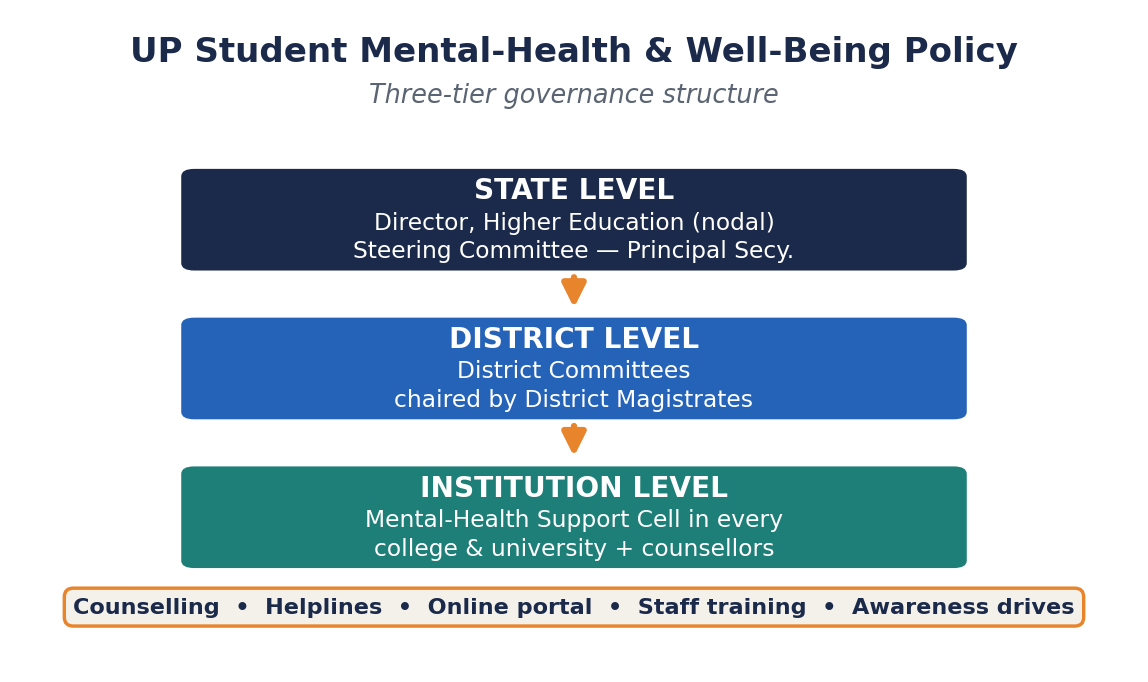
Mental-Health Support Cells to be set up in every college and university, with confidential counselling, helplines and an online assessment portal.
Three-tier governance: Director of Higher Education as state nodal officer, a Steering Committee under the Principal Secretary, and district committees chaired by District Magistrates.
Staff training, awareness drives and an integrated monitoring dashboard target exam anxiety, career stress and emotional well-being.
Way forward
It is one of India's first state-wide student mental-health frameworks in higher education—an example-rich item for governance, education and social-sector answers specific to UP.
Concept
Institutional mental-health cells operationalise the mental-health dimension of NEP 2020 and the Mental Healthcare Act, 2017.
Three-tier flowchart of the UP student mental-health policy: state level (Director/Steering Committee), district level (DM committees), institution level (support cells + counsellors). — StudyForGS
4. Ganga Expressway—UP's longest—nears completion, targeted to open in 2026
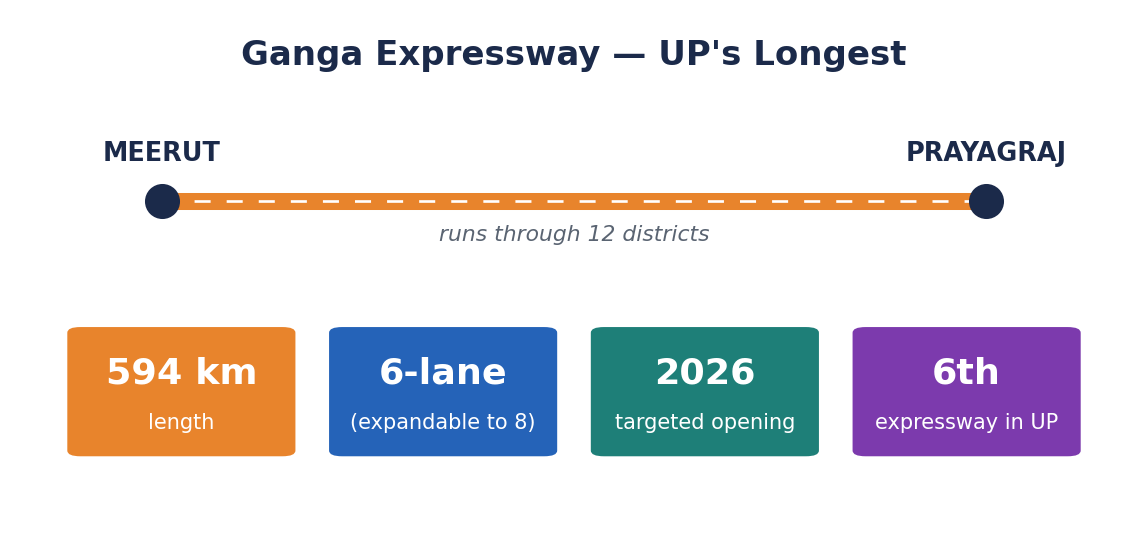
The 594-km access-controlled Ganga Expressway from Meerut to Prayagraj is in its final stretch and targeted to open in 2026.
Key facts
Six-lane (expandable to eight), running through roughly a dozen districts including Budaun, Hardoi, Unnao and Raebareli.
It becomes UP's sixth and longest expressway, ahead of the Purvanchal (341 km) and Bundelkhand (296 km) expressways.
The corridor is designed to cut Meerut–Prayagraj travel time sharply and open industrial and logistics clusters along the route.
Way forward
UP's expressway grid is central to its logistics and investment pitch; the Ganga Expressway is the flagship of a network exceeding 1,700 km, a recurring UP infrastructure theme.
Concept
Access-controlled expressways under UPEIDA anchor UP's 'growth corridor' industrialisation model.
Route schematic of the Ganga Expressway from Meerut to Prayagraj with stat chips: 594 km, 6-lane, 2026 opening, 6th expressway in UP. — StudyForGS
5. Uttar Pradesh remains India's No. 1 state in GI-tagged products
Uttar Pradesh continues to lead the country in Geographical Indication (GI) tags, reflecting the depth of its craft and agri clusters.
Key facts
GI tags protect region-specific products such as Banarasi silk, Bhadohi carpets, Firozabad glassware and a range of ODOP items.
The tags dovetail with the ODOP programme, boosting exports and artisan incomes across districts.
A GI tag is granted for an initial 10 years (renewable) under the Geographical Indications of Goods (Registration & Protection) Act, 1999.
Way forward
GI tags recur in UPPSC Prelims and connect culture, economy and IPR; UP's leadership is a ready UP-special fact for heritage and craft-economy answers.
Concept
GI is an intellectual-property right identifying goods originating from a specific geography with qualities due to that origin.
6. Defence Acquisition Council clears ~₹1.10 lakh crore buys, 98% from domestic industry
NATIONALUPPSC: Prelims + Mains GS-III
Syllabus linkage
UPPSC GS-III (defence, security, economy)
Context
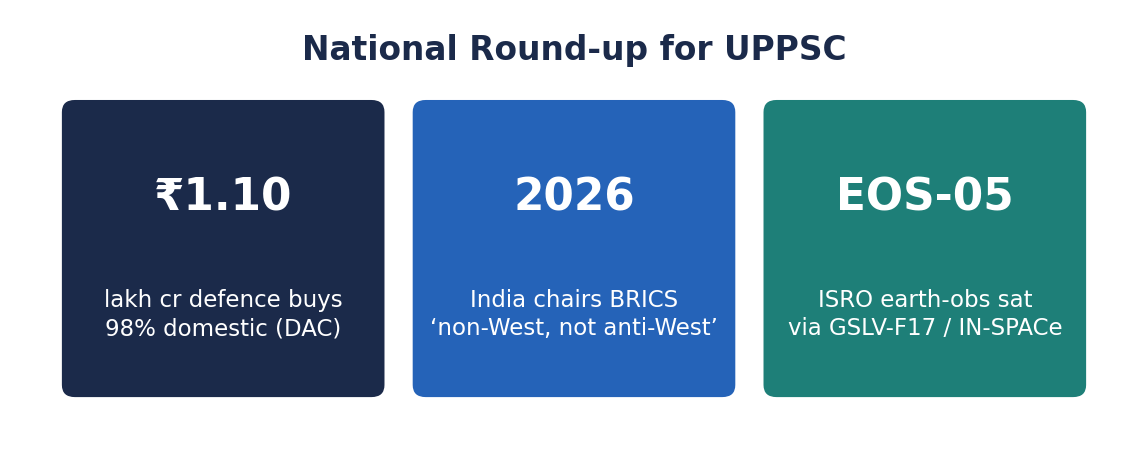
The Defence Acquisition Council approved procurement worth about ₹1.10 lakh crore, with an overwhelming share sourced from Indian industry.
Key facts
Around 98% of the value is earmarked for domestic sourcing, deepening the Atmanirbhar Bharat push in defence.
Approvals span CBRN reconnaissance vehicles, advanced helicopters, indigenous marine gas turbines and Arudhra radars.
Indigenous marine gas turbines cut dependence on foreign suppliers for naval propulsion.
Way forward
Defence indigenisation is a staple of GS-III (internal security, defence economy) and shows the shift from importer to domestic manufacturing.
Concept
The DAC is the apex Ministry of Defence body approving capital acquisitions and categorising them (Buy Indian-IDDM etc.).
Stat tiles for national round-up: ₹1.10 lakh crore defence buys (98% domestic), India chairs BRICS 2026, ISRO EOS-05 via GSLV-F17. — StudyForGS
7. India's BRICS chairmanship: 'non-West, not anti-West'
NATIONALUPPSC: Prelims + Mains GS-II
Syllabus linkage
UPPSC GS-II (international relations, global groupings)
Context
As it steers BRICS in 2026, India frames the grouping as a platform for reform of global institutions rather than a bloc against the West.
Key facts
BRICS seeks greater voice for emerging economies in bodies like the IMF and World Bank.
The New Development Bank (est. 2014) offers alternative development financing to members.
India pursues 'strategic autonomy'—engagement without exclusive alignment.
Way forward
BRICS, multipolarity and reform of global governance are core GS-II international-relations themes with steady exam relevance.
Concept
BRICS (Brazil, Russia, India, China, South Africa + newer members) pushes a multipolar, reformed global order.
Under the Indian Space Policy 2023, ISRO is shifting toward advanced R&D and exploration while opening operations to private players via IN-SPACe.
Key facts
The EOS-05 earth-observation satellite was placed in orbit by a GSLV-class launch (GSLV-F17).
IN-SPACe promotes and authorises non-government (private) space activity.
Earth-observation data supports agriculture, disaster management and remote sensing.
Way forward
Space-sector reform and applications are frequent in GS-III science & tech; the ISRO–IN-SPACe model shows public-private restructuring.
Concept
IN-SPACe is the single-window promoter-cum-regulator for private space activity under the Space Policy 2023.
Data point of the day
₹4,000+ crore
UPTEX-2026 weaver & textile support Combined disbursal across powerloom electricity relief, SC-weaver, handloom and textile-unit incentive schemes on day one of the conclave.
Prelims rapid-fire
Portal: UP Tex Mitra portal launched to support textile businesses & weavers.
Scheme: Mukhyamantri Handloom Weaver Prosperity Scheme rolled out for handloom weavers.
Infra: PM MITRA mega textile park (1,000 acres) coming up at the Lucknow–Hardoi border.
Expressway: 594-km Ganga Expressway (Meerut–Prayagraj) set to become UP's longest.
Heritage: UP remains India's No. 1 state by number of GI-tagged products.
Governance: Mental-Health Support Cells to be set up in every UP college & university.
Practice MCQs — UPPSC Prelims pattern
Q1. With reference to the PM MITRA scheme, consider the following: 1) It sets up mega integrated textile parks. 2) A PM MITRA park is coming up at the Lucknow–Hardoi border in Uttar Pradesh. Which is/are correct?
1 only
2 only
Both 1 and 2
Neither 1 nor 2
Show answer
Answer: C PM MITRA (Mega Integrated Textile Region & Apparel) parks are being developed across states, and UP's park is on 1,000 acres at the Lucknow–Hardoi border. Both statements are correct.
Q2. A Geographical Indication (GI) tag in India is initially granted for a period of:
5 years
10 years
15 years
20 years
Show answer
Answer: B Under the Geographical Indications of Goods (Registration & Protection) Act, 1999, a GI is registered for 10 years and is renewable. Uttar Pradesh leads India in the number of GI tags.
Mains practice question
Q. Uttar Pradesh's expressway grid and textile-park push are presented as engines of industrial growth and employment. Examine how such infrastructure- and cluster-led initiatives can transform the state's economy, and the challenges involved. (250 words)