Friday, 9 October 2026 · IST · Uttarakhand + National · 10 items · 2 MCQs
Uttarakhand sounded its earthquake early-warning sirens in a statewide test today, days after a M 4.9 quake struck Chamoli, while the Dhami Cabinet's first-ever meeting in Champawat cleared a 3% fiscal-deficit cap, a ₹200 crore skill scheme and a new irrigation law. Nationally, the RBI raised the repo rate to 5.50%, the Nobel Prizes 2026 honoured optogenetics, IceCube neutrinos, asymmetric autocatalysis and poet Anne Carson, and EAM Jaishankar toured Ghana, Côte d'Ivoire and Ethiopia.
Today at a glance — things to remember
Statewide EEW siren test at 11 AM: 112 sirens, 169 sensors, alerts on Bhudev app.
M 4.9 quake hit Chamoli on 6 Oct (depth 13 km); tremors felt in Delhi-NCR.
Banbasa Cabinet: fiscal deficit cap 3% of GSDP, debt ceiling 30% of GSDP.
₹200 crore higher-education skill scheme for 1.19 lakh students.
Dinesh Arya (BJP) set for unopposed Rajya Sabha win from Uttarakhand.
Vishwanath–Shakti Temple Corridor announced for Uttarkashi.
Disaster management; physical geography of Uttarakhand (seismic Zones IV–V). Prelims pointers: Bhudev app, USDMA, IIT Roorkee, NCS, P- and S-waves.
Context
On 9 October 2026 at 11 AM, the state sounded its earthquake early-warning (EEW) sirens as a test, with a test alert on the Bhudev app. It follows a M 4.9 quake (NCS) in Chamoli on 6 October at about 10:23 PM, felt up to Delhi-NCR.
Key facts
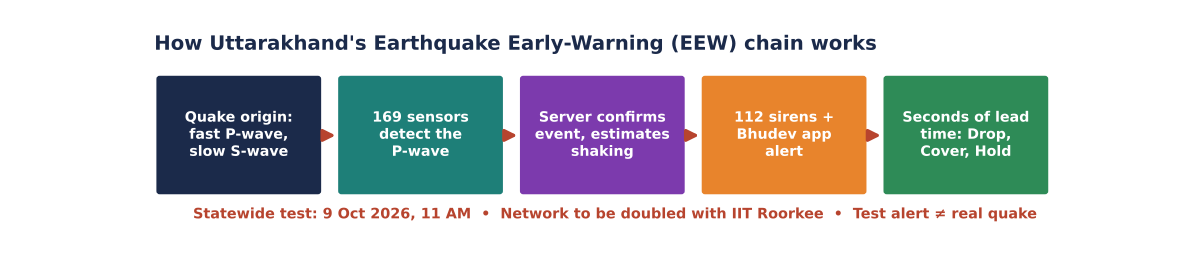
Network: 112 sirens and 169 sensors installed; plan to double both at 5–10 km spacing (proposal with IIT Roorkee).
Bhudev app sends a vibrating, beeping alert — keep it updated with location access on.
EEW exploits the gap between fast P-waves and destructive S-waves, giving seconds of lead time.
Chamoli epicentre ~50 km south of Joshimath, depth 13 km; no casualties reported.
Disaster Management Secretary Vinod Kumar Suman: the siren test is not a real alert — no panic.
Way forward
Densify sensors in Zone V districts, link sirens to schools and hospitals, hold regular mock drills and enforce seismic building codes in hill towns.
Concept
Seismic zoning (BIS IS 1893): Uttarakhand lies in the high-hazard Zones IV–V; the Main Central Thrust (MCT) and Main Boundary Thrust (MBT) cross the state. USDMA functions under the Disaster Management Act, 2005; NCS (MoES) is the nodal agency for quake monitoring.
Flowchart of Uttarakhand's earthquake early-warning chain: 169 sensors detect P-waves, the central server confirms the event, and alerts go out through 112 sirens and the Bhudev app seconds before S-waves arrive. — StudyForGS
2. Banbasa Cabinet: fiscal deficit capped at 3% of GSDP; new Irrigation Bill to replace 1873 canal law
State finances, fiscal federalism, local bodies. Prelims pointers: FRBM, GSDP, State Finance Commission (Art. 243-I/243-Y).
Context
In its first-ever meeting in Champawat district (NHPC guest house, Banbasa, 4 Oct 2026), the Dhami Cabinet cleared 24 proposals, led by new fiscal rules and a modern irrigation law.
Key facts
Uttarakhand FRBM (Amendment) Bill, 2026: fiscal deficit cap 3% of GSDP (2026–31); cumulative debt ceiling 30% of GSDP (2026-27 to 2030-31); relaxation for disasters and security emergencies.
Uttarakhand Irrigation and Drainage Bill, 2026 to replace the Northern India Canal and Drainage Act, 1873.
Sixth State Finance Commission report on PRIs and ULBs to be tabled in the next Assembly session.
Public agencies to keep 92% of proceeds from asset monetisation (Investment & Infrastructure Act amended).
Poultry-feed subsidy moves from e-Rupee (CBDC) to DBT in Aadhaar-seeded accounts.
Way forward
Pair the fiscal cap with own-tax buoyancy and a disaster-risk fiscal buffer, since calamity costs recur in hill districts.
Concept
FRBM Act, 2003 (Centre) set the template; states enacted their own fiscal responsibility laws on the 12th Finance Commission's advice. The State Finance Commission is constituted by the Governor every 5 years under Art. 243-I (Panchayats) and Art. 243-Y (Municipalities).
Stat-tile row of the Banbasa Cabinet decisions: 24 proposals, 3% of GSDP fiscal deficit cap, 30% of GSDP debt ceiling, Rs 200 crore skill scheme, 1.19 lakh students, Rs 66.29 crore for Pantnagar airport. — StudyForGS
3. ₹200 crore skill scheme for 1.19 lakh students; land rights, PAN checks and university norms revised
Human resource development, employment and state welfare schemes; land reforms in Uttarakhand. Prelims: scheme name, outlay, beneficiaries.
Context
The Banbasa Cabinet also launched the Mukhyamantri Uchcha Shiksha Kaushal Samvardhan Yojana, 2026 to make graduates job- and enterprise-ready, alongside decisions on land rights, property registration and private universities.
Key facts
Outlay ≈₹200 crore over 5 years; ~1.19 lakh students of government and private universities and affiliated colleges.
Mandatory PAN verification in property sale and purchase to curb fake PAN use.
Private university norms: minimum built-up area 2,500 sq m (hills) and 20,000 sq m (plains).
Bhumidhari (ownership) rights for eligible Class-3/4 lessees; transferable rights in Lalkuan (Nainital); Class-4 land in Jaunsar-Bawar regularised at 2004 circle rates for one year.
New Sub-Registrar office at Narendranagar (Tehri) for 133 revenue villages; ₹66.29 crore for Pantnagar greenfield airport expansion.
Way forward
Link skilling to local growth sectors — tourism, horticulture, AYUSH and IT — so that it checks palayan from hill districts.
Concept
Bhumidhari = ownership with transferable rights under the UP Zamindari Abolition and Land Reforms Act, 1950 (as adapted in Uttarakhand). Jaunsar-Bawar (Dehradun) is the tribal homeland of the Jaunsari community, a Scheduled Tribe area.
4. Rajya Sabha: BJP's Dinesh Arya set for unopposed win from Uttarakhand
Parliament — composition and election of the Rajya Sabha; Uttarakhand's representation. Prelims: Art. 80, Fourth Schedule, STV.
Context
BJP's Dinesh Arya filed his nomination on 6 Oct for the seat held by Naresh Bansal (term ends 25 Nov 2026). With no Congress candidate, he is set to be declared elected unopposed after the withdrawal window; polling, if needed, was fixed for 16 Oct.
Key facts
Uttarakhand has 3 Rajya Sabha and 5 Lok Sabha seats.
RS members are elected by elected MLAs through STV (single transferable vote) with an open ballot.
If candidates equal vacancies, the Returning Officer declares them elected (Sec. 53(2), RP Act, 1951).
Way forward
Parties should balance Kumaon–Garhwal and social representation; open ballot plus the Tenth Schedule keep RS polls clean.
Concept
Art. 80: RS maximum 250 (238 elected + 12 nominated); seats allotted by the Fourth Schedule; members serve 6 years, with one-third retiring every 2 years — the RS is a permanent House.
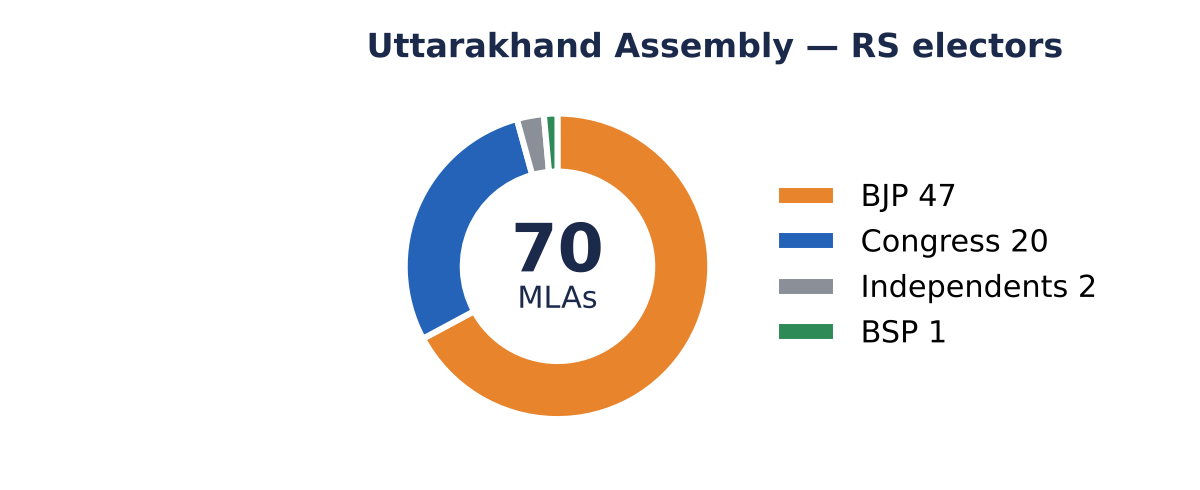
Donut chart of the 70-member Uttarakhand Legislative Assembly: BJP 47, Congress 20, Independents 2, BSP 1. — StudyForGS
5. Uttarkashi: CM announces Vishwanath–Shakti Temple Corridor
Religious heritage and pilgrimage tourism of Uttarakhand; eco-sensitive zones. Prelims: Kashi Vishwanath (Uttarkashi), Shakti temple trishul, Bhagirathi ESZ.
Context
On 7 Oct 2026 in Uttarkashi, CM Pushkar Singh Dhami announced a corridor linking the Kashi Vishwanath Temple and the Shakti Temple, and said a proposal for a Kendriya Vidyalaya at Bhatwari will be sent to the Centre.
Key facts
Uttarkashi, on the Bhagirathi, is called the "Kashi of the North"; gateway to Gangotri and Yamunotri.
The Shakti Temple houses a giant ancient metal trishul (trident) bearing an inscription.
CM flagged off the Seva Jyoti Kalash Yatra and cited Lakhpati Didi for SHG women's incomes.
CM claimed 44% reverse migration — the state's marker of progress against palayan.
Way forward
Design the corridor within Bhagirathi Eco-Sensitive Zone rules and town carrying capacity, with disaster-safe construction.
Concept
Bhagirathi ESZ — about 100 km from Gaumukh to Uttarkashi, notified by MoEFCC in 2012 under the Environment (Protection) Act, 1986. Temple-corridor model: Kashi Vishwanath Dham (Varanasi), Mahakal Lok (Ujjain).
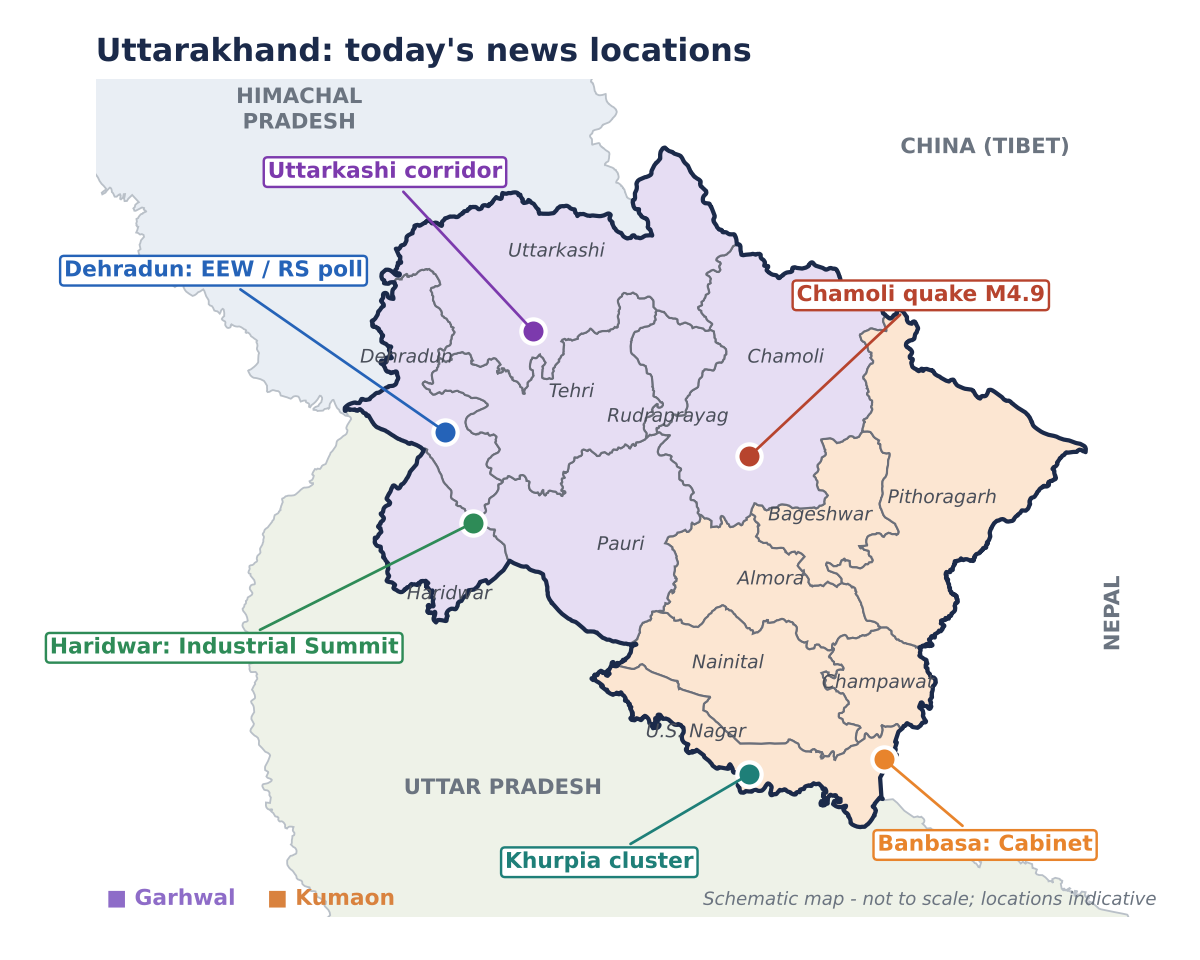
Schematic district map of Uttarakhand with Garhwal and Kumaon divisions shaded, marking today's news locations: Chamoli quake epicentre, Uttarkashi corridor, Dehradun, Haridwar summit, Banbasa Cabinet meeting and Khurpia manufacturing cluster. — StudyForGS
6. RBI hikes repo rate by 25 bps to 5.50% — first hike in over three years
On 7 Oct 2026, the six-member MPC under Governor Sanjay Malhotraunanimously raised the repo rate from 5.25% to 5.50% and shifted its stance from neutral to "calibrated tightening", citing crude oil, food prices and rupee pressure.
Key facts
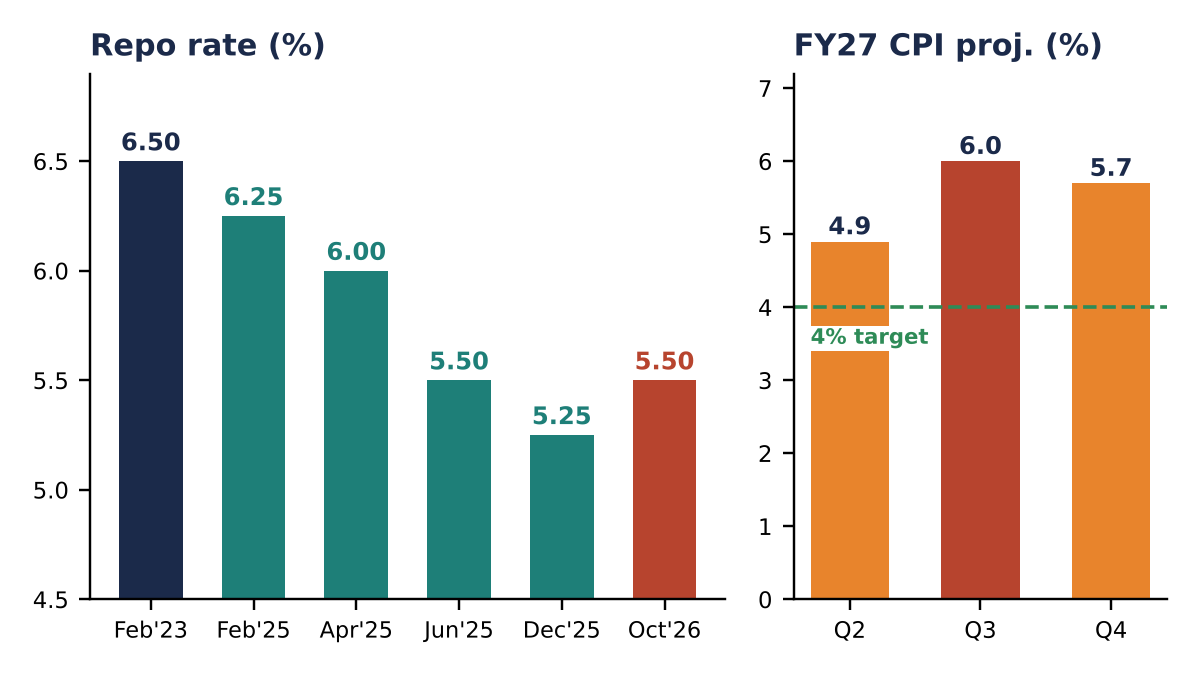
First hike since Feb 2023 (to 6.5%); follows 125 bps of cuts in 2025.
FY27 projections: real GDP 7.1%; CPI 5.2% (up from 5.0%) — Q3 6.0%, Q4 5.7%.
Risks: re-escalating West Asia conflict, volatile crude, weak monsoon / El Niño hurting rabi.
Governor: next move can only be a hike or pause; retail CPI was 4.82% in Aug 2026 (base 2024=100).
Way forward
Back monetary tightening with food-supply management and fuel-tax buffers, so imported inflation is fought on several fronts.
Concept
MPC — statutory body under the RBI Act, 1934 (Sec. 45ZB, inserted 2016): 6 members (3 RBI + 3 Centre-appointed); target CPI 4% ± 2%. Repo = rate at which RBI lends to banks; SDF is the floor and MSF the ceiling of the LAF corridor.
Step chart of India's policy repo rate from 6.50% in 2023 through 2025 cuts to 5.25%, then the October 2026 hike to 5.50%, with FY27 quarterly CPI projections. — StudyForGS
7. Nobel Prizes 2026: optogenetics, cosmic neutrinos, mirror-image chemistry and Anne Carson
Science and technology developments; awards and honours. Prelims: laureates, fields, IceCube, chirality, optogenetics.
Context
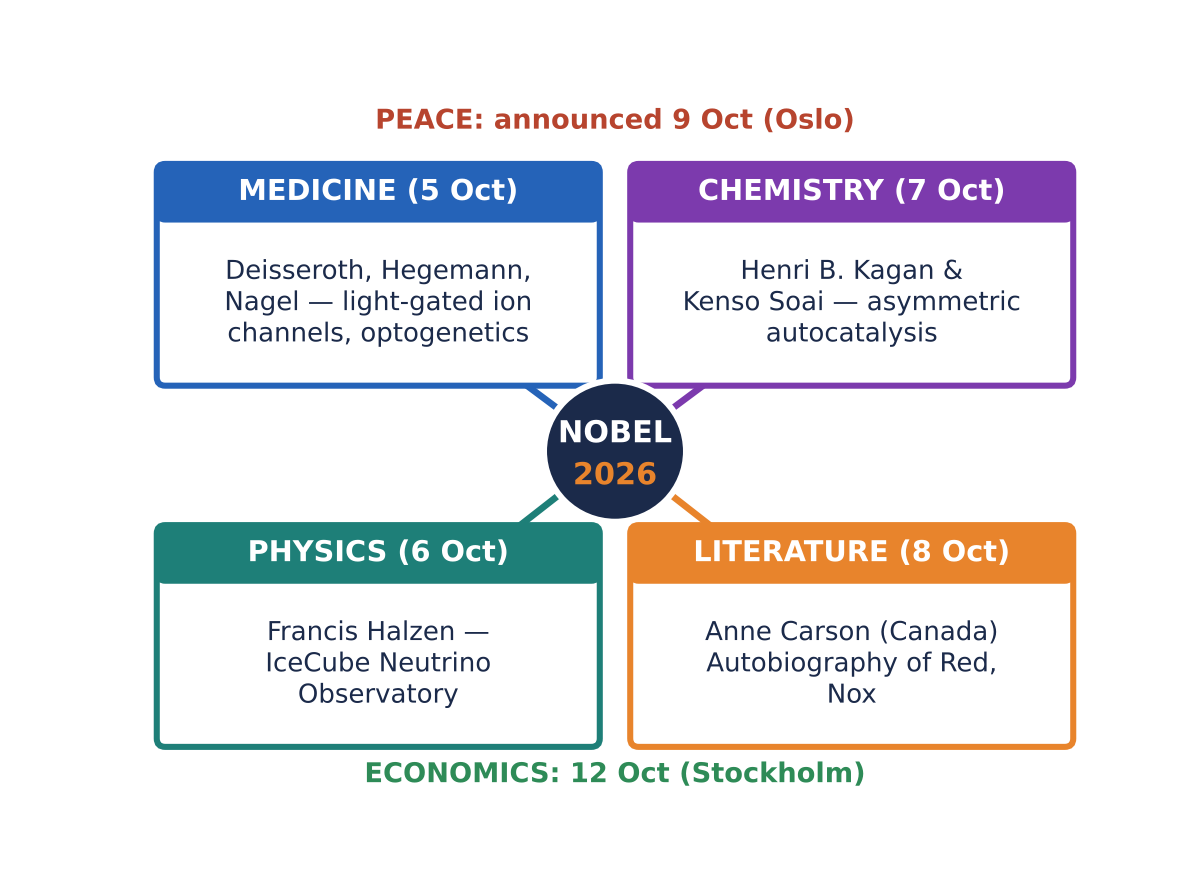
The Nobel week (5–12 Oct) has named four sets of laureates; the Peace Prize is announced today (9 Oct) in Oslo and the Economics prize on 12 Oct.
Key facts
Medicine: Karl Deisseroth, Peter Hegemann, Georg Nagel — light-gated ion channels and optogenetics.
Physics: Francis Halzen — IceCube Neutrino Observatory (South Pole) and high-energy cosmic neutrinos.
Chemistry: Henri B. Kagan and Kenso Soai — non-linear effects and asymmetric autocatalysis.
Literature: Canadian poet-classicist Anne Carson (*Autobiography of Red*, *Nox*).
Way forward
For India: sustain funding for the India-based Neutrino Observatory (INO) and neuroscience tools such as optogenetics.
Concept
Prizes under Alfred Nobel's will (1895), first awarded 1901; Peace by the Norwegian Nobel Committee (Oslo), others in Stockholm; Economics prize instituted 1968 by Sveriges Riksbank. Chirality = mirror-image (left/right-handed) molecules.
Mind-map of the Nobel Prizes 2026: Medicine for optogenetics, Physics for IceCube neutrinos, Chemistry for asymmetric autocatalysis, Literature for Anne Carson, with Peace due on 9 October and Economics on 12 October. — StudyForGS
8. Jaishankar's Africa outreach: Ghana, Côte d'Ivoire and Ethiopia (6–10 Oct)
IRUKPSC: Prelims + Mains (International Relations)
Syllabus linkage
India and its relations with Africa; regional groupings. Prelims: African Union, ECOWAS, ITEC, capitals.
Context
EAM S. Jaishankar is on a five-day tour: Accra (2 MoUs), Abidjan (defence and counter-terror talks) and Addis Ababa, where he chairs a Regional Heads of Mission conference.
Key facts
Ghana: met President John Dramani Mahama; MoUs ZSI–University of Ghana and ICAR–CSIR-Crops Research Institute.
India–Ghana ties are a Comprehensive Partnership (upgraded during the PM's 2025 visit).
Côte d'Ivoire: talks with Defence Minister Téné Birahima Ouattara on anti-terrorism and training.
Outreach to the African Union (HQ Addis Ababa; G20 member since 2023 under India's presidency) and ECOWAS.
Way forward
Turn goodwill into lines of credit, pharma and digital public infrastructure partnerships across West Africa and the Horn.
Concept
South-South Cooperation; India-Africa Forum Summit (first 2008, New Delhi); ITEC (1964) for capacity building. ECOWAS = Economic Community of West African States (1975).
9. 10th India Mobile Congress opens on theme 'Scale Without Boundaries'
Telecom, digital infrastructure and cyber security. Prelims: IMC, D2M, DoT, 6G.
Context
PM Narendra Modi inaugurated IMC 2026 on 8 Oct at Yashobhoomi, New Delhi (7–10 Oct), organised by DoT and COAI, stressing affordable tech for the Global South and tech-led action against cyber fraud.
Key facts
1.5 lakh+ attendees from 100+ countries; 500+ exhibitors; 600 startups.
Nine anchor sectors incl. 5G/6G, AI networks, semiconductors, satellite (non-terrestrial) networks, quantum communication.
Indigenous chip for Direct-to-Mobile (D2M) — live TV on phones without SIM or data.
Alongside: NCCDFI 2026 cyber-security conference by NIELIT (9–10 Oct).
Way forward
Advance Bharat 6G goals, settle satcom spectrum rules and scale Sanchar Saathi against fraud calls.
Concept
D2M = broadcasting video directly to handsets over terrestrial spectrum (like FM radio for TV). Bharat 6G Vision (2023) targets 6G leadership by 2030; TRAI set up in 1997.
10. World Post Day (9 Oct) opens National Postal Week
SOCIETYUKPSC: Prelims + Mains (Governance & Important Days)
Syllabus linkage
Important days; financial inclusion and last-mile service delivery. Prelims: UPU, IPPB, PIN code.
Context
India marks World Post Day with the 2026 theme "One Postal Network, Infinite Possibilities"; National Postal Week runs 9–15 Oct, showcasing India Post's role in financial inclusion and digital services.
Key facts
Marks the founding of the Universal Postal Union (UPU) in Bern, 1874; day declared at the 1969 Tokyo Congress.
India joined the UPU on 1 July 1876; PIN code introduced on 15 Aug 1972.
Showcase: N-Gen Post Offices, Jan Sewa Connect Post Offices, Dak Sewa and Dak Mitra apps.
India Post Payments Bank (IPPB) launched 2018; runs alongside Special Campaign 6.0 (2–31 Oct).
Way forward
Use post offices as last-mile hubs for DBT, insurance, e-commerce and passports in remote hill and border villages.
Concept
UPU — UN specialised agency since 1948, HQ Bern (Switzerland). India's National Postal Day is 10 Oct.
Data point of the day
29,000+ units | 1.27 lakh jobs
Uttarakhand MSME push — new units set up and jobs created Shared by CM Pushkar Singh Dhami at the 7th Uttarakhand Industrial Summit & Expo-2026 in Haridwar (8 Oct). Backed by a single-window system (206+ services, 26 departments), Nivesh Mitra, a ₹200 crore startup venture fund, Ek Janpad Do Utpad, and a 1,002-acre integrated manufacturing cluster at Khurpia (Udham Singh Nagar). The state is a 'Top Achiever' in the Business Reform Action Plan and ranked first in its category in the Export Preparedness Index 2024.
Prelims rapid-fire
Cabinet's first meeting in Champawat district: Banbasa (NHPC guest house), 4 Oct
Chamoli quake, 6 Oct (NCS): M 4.9, depth 13 km, ~50 km S of Joshimath
Law replaced by new Irrigation & Drainage Bill: Northern India Canal and Drainage Act, 1873
IMC 2026 theme (10th edition): "Scale Without Boundaries", Yashobhoomi
Nobel Chemistry 2026: Henri B. Kagan & Kenso Soai — asymmetric autocatalysis
Practice MCQs — UKPSC Prelims pattern
Q1. With reference to the Uttarakhand Fiscal Responsibility and Budget Management (Amendment) Bill, 2026, consider the following statements: 1. It caps the annual fiscal deficit at 3% of GSDP for 2026–31. 2. It sets a cumulative debt ceiling of 30% of GSDP. 3. It allows no relaxation of the limits under any circumstances. Which of the statements given above is/are correct?
1 only
1 and 2 only
2 and 3 only
1, 2 and 3
Show answer
Answer: b The Bill caps the fiscal deficit at 3% of GSDP and debt at 30% of GSDP, but permits relaxation for disasters and security emergencies, so statement 3 is wrong.
Q2. The 'Bhudev' mobile application, recently in news in Uttarakhand, is related to:
Digitisation of land records
Earthquake early warning
Char Dham Yatra registration
Forest fire alerts
Show answer
Answer: b Bhudev, developed with IIT Roorkee for USDMA, delivers earthquake early-warning alerts; it carried today's test alert alongside 112 sirens.
Mains practice question
Q. Uttarakhand lies in one of India's most seismically active belts. Discuss the role of earthquake early-warning systems in disaster risk reduction and suggest measures to make hill settlements earthquake-resilient. (250 words)
Hint / approach
Intro: MCT/MBT, Zones IV–V, Chamoli M 4.9 (6 Oct). Body: how EEW works (P- vs S-waves), state network (112 sirens, 169 sensors, Bhudev), limits (seconds of lead time, blind zone near epicentre). Measures: building codes, retrofitting schools/hospitals, mock drills, land-use zoning, Sendai Framework. Conclude: warning + preparedness + resilient construction.