Vasundhara Tal gets Uttarakhand's first GLOF early-warning system; Census 2027 reference date for snow-bound Uttarakhand; UPSC turns 100 and Rabi MSP 2027-28 announced
Thursday, 1 October 2026 · IST · Uttarakhand + National · 11 items · 2 MCQs
Uttarakhand began installing its first real-time glacial-lake early-warning system at Vasundhara Tal (Chamoli), while 00:00 hrs of 1 October 2026 became the Census 2027 reference date for the state's snow-bound areas and the Char Dham Yatra crossed a record 53.23 lakh pilgrims. Nationally, UPSC completed 100 years, the Cabinet hiked Rabi MSP 2027-28 (wheat ₹2,610) and cleared the ₹1,86,405 crore Green Energy Corridor Phase-III.
Today at a glance — things to remember
Vasundhara Tal (Chamoli): Uttarakhand's first GLOF early-warning system; work 29 Sep–15 Oct 2026.
Uttarakhand has 344 glacial lakes; 13 are high-risk.
Census 2027 reference date for snow-bound areas: 00:00 hrs, 1 Oct 2026; revisional round 1–5 Oct.
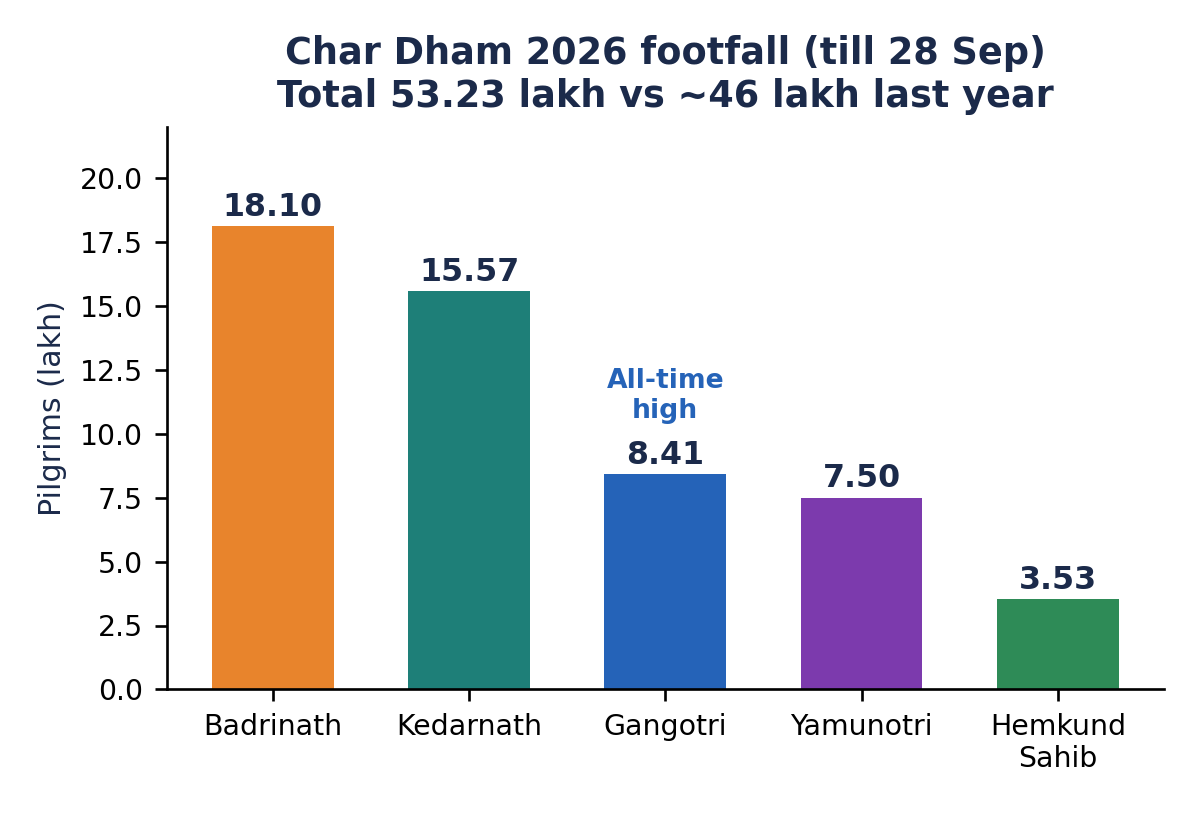
Char Dham 2026: record 53,23,401 pilgrims; Gangotri all-time high 8.41 lakh.
Haridwar Kumbh 2027: 32 sectors, AI alerts, up to 20 crore devotees expected.
PRAGATI-50: Dehradun & Haridwar among 50 model sanitation cities (SBM-U 2.0).
Geography of Uttarakhand + Disaster Management | Prelims: GLOF, Chamoli district, Wadia Institute of Himalayan Geology (Dehradun).
Context
A 22-scientist team led by the Wadia Institute of Himalayan Geology began installing an automated early-warning system (EWS) at the high-risk glacial lake Vasundhara Tal in Chamoli on 29 September 2026; the work window runs till 15 October 2026.
Key facts
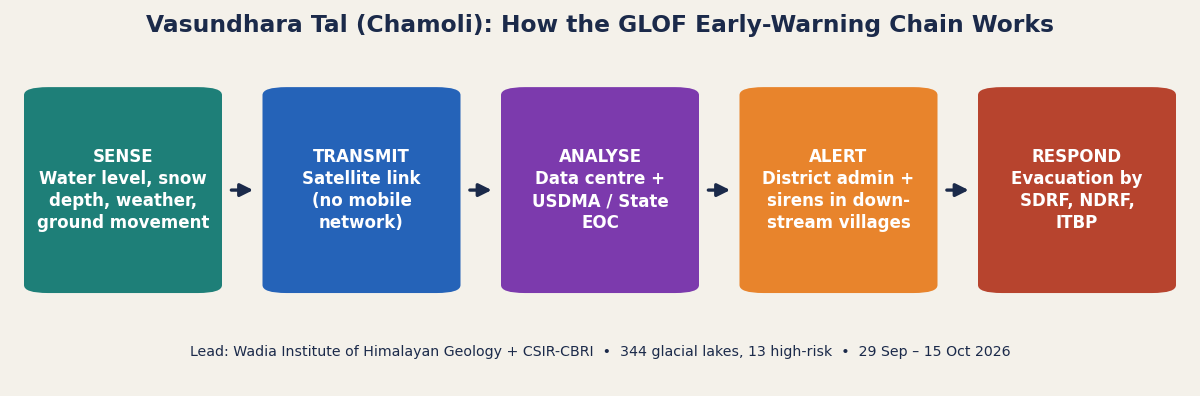
Sensors track water level, weather, snow depth, sub-surface temperature, ground movement and water flow; data travels via satellite due to poor mobile connectivity.
Partners: CSIR-CBRI Roorkee, USDMA, the National GLOF Risk Mitigation Programme, SDRF, NDRF and ITBP.
Uttarakhand has 344 glacial lakes (2023 assessment), of which 13 are high-risk; Vasundhara Tal is one of them.
A lesson from the 2013 Kedarnath and 2021 Chamoli (Rishiganga) disasters, both linked to glacial/high-altitude hazards.
Way forward
Extend EWS to all 13 high-risk lakes, link sirens to downstream villages, run community drills and feed data to the State Emergency Operations Centre.
Concept
GLOF (Glacial Lake Outburst Flood) = sudden release of water when a moraine or ice dam fails, often triggered by avalanches, landslides, earthquakes or heavy rain. Risk is rising with glacier retreat due to warming.
Flowchart of the Vasundhara Tal GLOF early-warning chain: sensors at the lake, satellite link, data centre and USDMA, alert to district and sirens in downstream villages, followed by evacuation by SDRF, NDRF and ITBP. — StudyForGS
2. Census 2027: Snow-bound Uttarakhand's population count frozen at 00:00 hrs, 1 October 2026; revisional round begins
Polity & Governance; demography of Uttarakhand | Prelims: Census Act, 1948, reference date, Union List (Entry 69).
Context
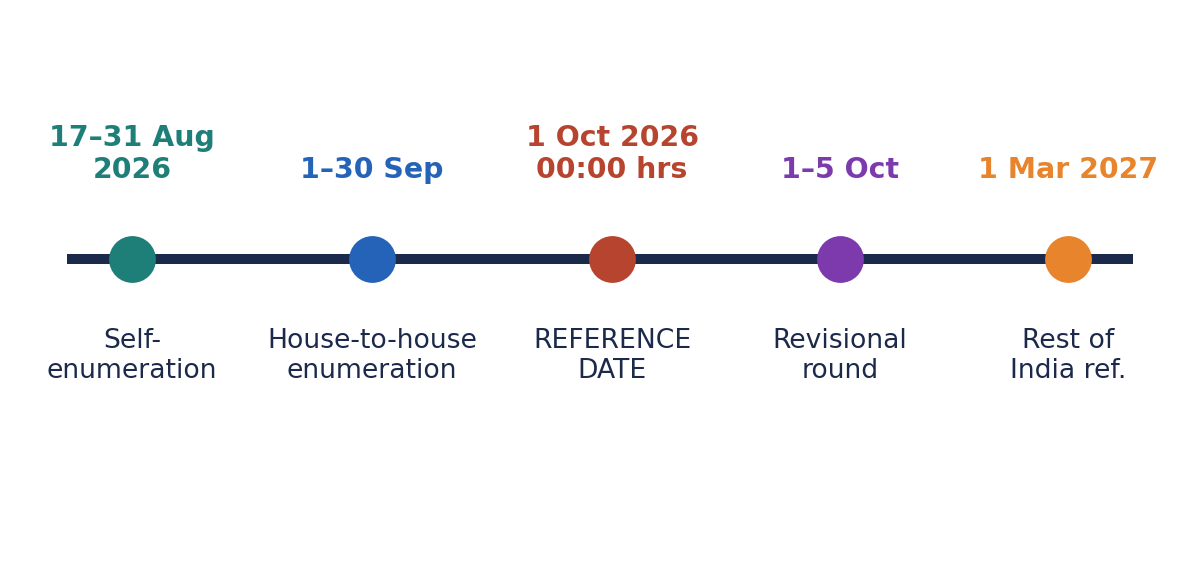
For the snow-bound non-synchronous areas of Uttarakhand, Himachal Pradesh, J&K and Ladakh, the reference date of Census 2027 is 00:00 hrs on 1 October 2026. After house-to-house enumeration (1–30 September), the revisional round runs 1–5 October 2026.
Key facts
Self-enumeration window in these areas: 17–31 August 2026; enumeration: 1–30 September 2026.
For the rest of India, the reference date is 00:00 hrs, 1 March 2027.
India's 16th Census (8th since Independence) and the first digital census, with caste enumeration included.
Notified by the MHA under the Census Act, 1948; Phase-I (Houselisting) began on 1 April 2026.
Way forward
Ensure full coverage of high-altitude border villages and seasonal migrants; data will shape delimitation and hill planning against palayan (out-migration).
Concept
Census is a Union List subject (Entry 69, Seventh Schedule), conducted by the Registrar General & Census Commissioner (MHA). Uttarakhand 2011: population 1.01 crore, sex ratio 963, literacy 78.8%.
Timeline of Census 2027 for snow-bound areas: self-enumeration 17 to 31 August 2026, house-to-house enumeration 1 to 30 September, reference date 00:00 hours 1 October 2026, revisional round 1 to 5 October, and the rest of India's reference date 1 March 2027. — StudyForGS
3. Char Dham Yatra 2026 hits record 53.23 lakh pilgrims; Gangotri sees highest-ever footfall despite Chirbasa landslide
As of 28 September 2026, the four shrines recorded 53,23,401 pilgrims against about 46 lakh in the same period last year. The yatra, halted on 26 September for heavy rain, resumed on 28 September; over 1,500 pilgrims were rescued after a landslide at Chirbasa on the Kedarnath trek (Rudraprayag).
Hemkund Sahib: 3,52,765 devotees, the first time in several years above 3 lakh.
Joint rescue by SDRF, NDRF and DDRF; pilgrims shifted to Gaurikund.
District Magistrates empowered to suspend or regulate the yatra based on local weather and route conditions.
Way forward
Adopt carrying-capacity-based daily caps, slope-stability mapping of trek routes and weather-linked registration to balance tourism with Himalayan fragility.
Concept
Char Dham: Yamunotri & Gangotri (Uttarkashi), Kedarnath (Rudraprayag; Mandakini), Badrinath (Chamoli; Alaknanda). The Char Dham all-weather road is about 889 km long.
Bar chart of Char Dham Yatra 2026 footfall as of 28 September: Badrinath 18.10 lakh, Kedarnath 15.57 lakh, Gangotri 8.41 lakh, Yamunotri 7.5 lakh, and Hemkund Sahib 3.53 lakh; total 53.23 lakh versus about 46 lakh last year. — StudyForGS
4. Haridwar Kumbh 2027: Major works near completion; 32-sector, AI-enabled crowd plan for up to 20 crore devotees
Culture of Uttarakhand + crowd/disaster management | Prelims: Kumbh cycle, UNESCO Intangible Heritage (2017), Har-ki-Pauri.
Context
Officials said on 30 September 2026 that major bridges and roads for the Kumbh Mela 2027 at Haridwar are nearly complete; focus has shifted to temporary tent settlements, lighting, drinking water and sanitation.
Key facts
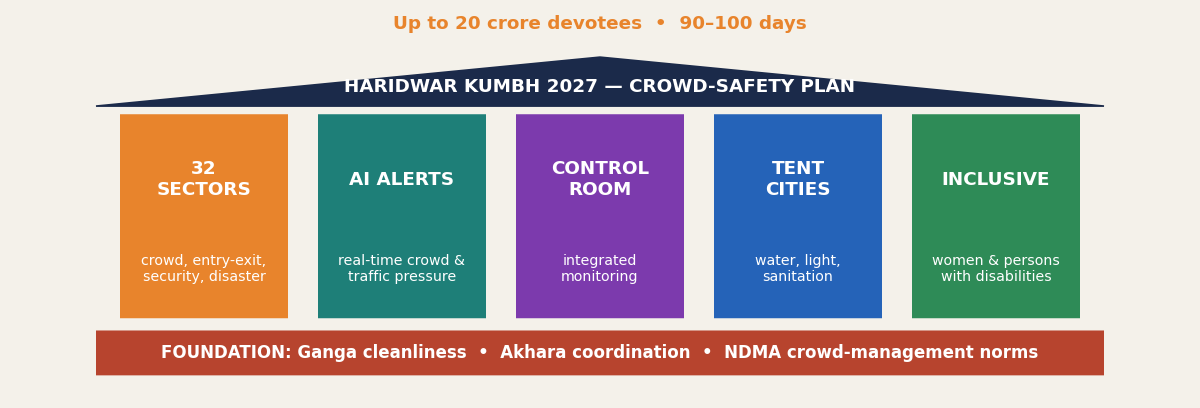
Expected footfall: up to 20 crore devotees over 90–100 days.
Mela area split into 32 sectors for crowd control, entry-exit, security and disaster management.
AI-based real-time alerts on crowd and traffic pressure; an integrated control room.
Special arrangements for women and persons with disabilities; coordination with Akharas; Ganga cleanliness built in.
Way forward
Follow NDMA crowd-management guidelines, simulate stampede scenarios at ghats and bottlenecks, and enforce Namami Gange norms of zero untreated discharge.
Concept
Kumbh Mela is on UNESCO's Representative List of Intangible Cultural Heritage (2017). Venues: Haridwar (Ganga), Prayagraj (Sangam), Ujjain (Shipra) and Nashik (Godavari).
Pillar diagram of the Haridwar Kumbh 2027 crowd-management plan with five pillars: 32 sectors, AI real-time alerts, integrated control room, tent cities with water and sanitation, and inclusive arrangements for women and persons with disabilities, all resting on Ganga cleanliness and Akhara coordination. — StudyForGS
5. Dehradun & Haridwar among 50 model cities under PRAGATI-50; Chief Secretary orders real-time monitoring of all STPs
The Union Housing & Urban Affairs Ministry launched PRAGATI-50 on 29 September 2026, choosing 50 cities across 24 states as sanitation models, including Dehradun and Haridwar. On 30 September, Chief Secretary Anand Bardhan ordered a centralised real-time monitoring system for all sewage treatment plants (STPs).
Key facts
PRAGATI-50 runs under Swachh Bharat Mission-Urban 2.0 toward Garbage Free Cities; progress tracked via KPIs and reviews every two months.
Add-ons: Swachh Bharat Test Bed & Innovation Centre at Durgapur (with CSIR-CMERI) and 13 startups onboarded via IIT Kanpur.
Uttarakhand Pollution Control Board to monitor STPs of large commercial and group-housing complexes.
DMs to review the 25-point programme monthly; data on Pirul collection and community income to be compiled.
Way forward
Link STP data to Ganga water-quality stations, penalise non-compliance and scale Pirul-based livelihoods to cut forest-fire fuel load.
Concept
SBM-U 2.0 (2021) targets garbage-free cities and used-water management. Pirul (Chir pine needles) is highly inflammable and a key forest-fire driver; the state buys it under 'Pirul Lao–Paise Pao'.
6. Rajya Sabha polls on 16 October: Uttarakhand's lone vacancy as Naresh Bansal's term ends; BJP finalising nominee
Indian Polity — Parliament | Prelims: Article 80, Fourth Schedule, open ballot, Uttarakhand's seats in Parliament.
Context
The Election Commission has announced biennial polls to 11 Rajya Sabha seats — 10 in Uttar Pradesh and 1 in Uttarakhand — with voting on 16 October 2026. The Uttarakhand seat falls vacant as Naresh Bansal's term ends; the state BJP has sent a panel of contenders to its central leadership.
Key facts
Uttarakhand has 3 Rajya Sabha and 5 Lok Sabha seats; its 70-member Assembly forms the electoral college.
Members are elected by elected MLAs through proportional representation by single transferable vote (STV).
Open ballot for RS polls was introduced in 2003 by amending the RP Act, 1951.
Term is 6 years; about one-third of members retire every 2 years (Art. 83(1)).
Way forward
Hill-state concerns such as migration, disasters and border villages need a strong voice in the Council of States, which represents federal interests.
Concept
Article 80: maximum strength 250 (238 elected + 12 nominated); state-wise seats in the Fourth Schedule. Rajya Sabha is a permanent body, not subject to dissolution.
7. UPSC turns 100: PM releases commemorative coin, stamp and '100 Landmark Judgements' book at Bharat Mandapam
Constitutional bodies | Prelims: Articles 315–323, Lee Commission, GoI Act 1935, removal of members (Art. 317).
Context
On 1 October 2026, the Union Public Service Commission completed 100 years; the Prime Minister attended the centenary celebrations at Bharat Mandapam, New Delhi, ending a year-long observance that began on 1 October 2025.
Key facts
Public Service Commission set up on 1 October 1926 on the Lee Commission (1924) recommendation; first Chairman Sir Ross Barker.
Became the Federal PSC under the GoI Act, 1935; renamed UPSC on 26 January 1950.
Releases: commemorative coin, postage stamp and the book '100 Landmark Judgements – Shaping the Policies of UPSC and PSCs in India'.
'Shatabdi Samaroh – Manthan' on 30 September discussed civil-service evolution and administrative innovation.
Way forward
Shorten recruitment cycles, use tech-enabled secure exams and keep reforms merit-based while safeguarding the Commission's independence.
Concept
UPSC: constitutional body (Part XIV, Arts 315–323); members appointed by the President for 6 years or till 65 years of age. UKPSC (Haridwar) is the state counterpart under Art. 315.
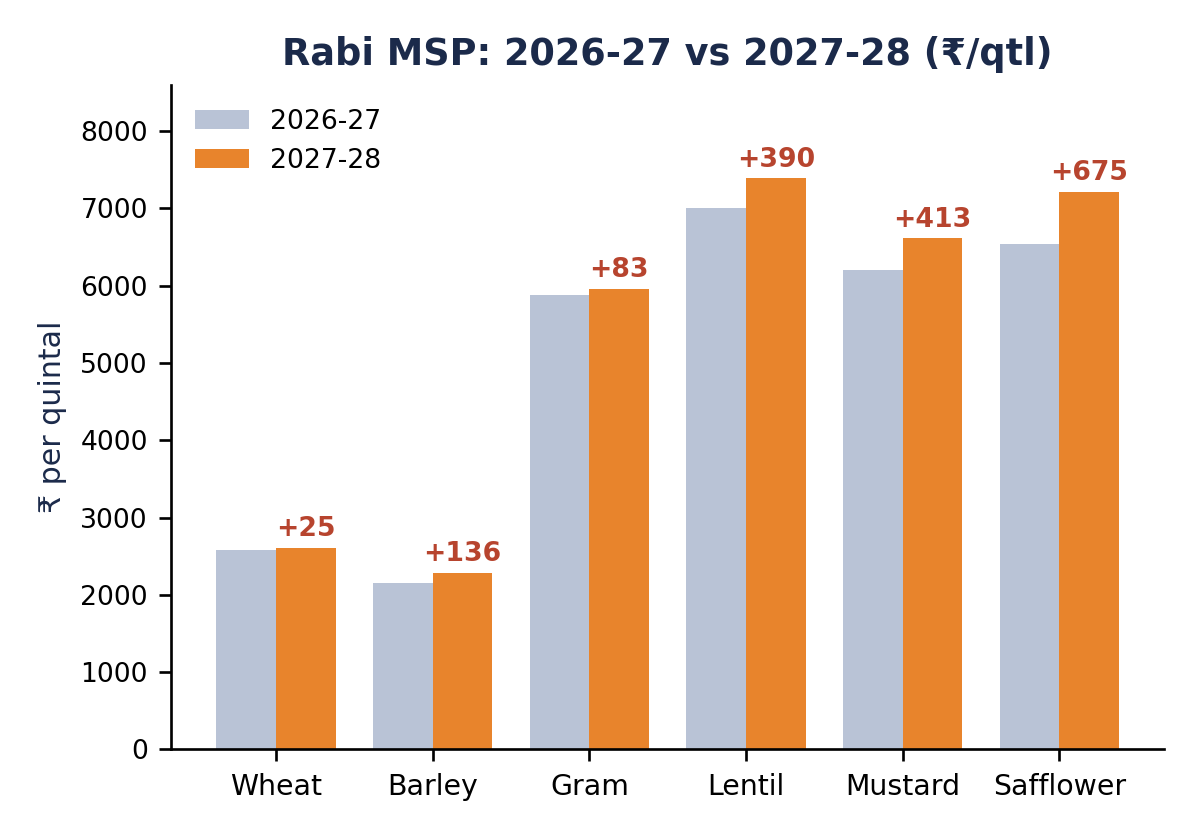
8. Rabi MSP 2027-28: Safflower up ₹675, mustard ₹413, lentil ₹390; wheat raised by just ₹25 to ₹2,610 per quintal
The CCEA on 30 September 2026 raised MSPs of all six mandated rabi crops for Rabi Marketing Season 2027-28, favouring pulses and oilseeds; the estimated payout to farmers is ₹90,962 crore.
Wheat production cost cited at ₹1,264/qtl, so MSP is more than double the cost.
Wheat hike only ₹25 versus ₹160 last year — a nudge towards diversification into oilseeds and pulses.
Way forward
Back higher MSP with assured procurement of pulses and oilseeds (PM-AASHA); hill farmers of Uttarakhand need better mandi access for barley and lentil.
Concept
MSP is announced for 22 mandated crops (plus FRP for sugarcane) on CACP recommendations; the 2018-19 Budget fixed MSP at at least 1.5 × A2+FL cost.
Grouped bar chart comparing Rabi MSP in rupees per quintal for 2026-27 and 2027-28: wheat 2,585 to 2,610, barley 2,150 to 2,286, gram 5,875 to 5,958, lentil 7,000 to 7,390, mustard 6,200 to 6,613, safflower 6,540 to 7,215. — StudyForGS
9. Cabinet clears ₹1.86 lakh crore Green Energy Corridor Phase-III to evacuate 135 GW renewables, with 50 GWh battery storage
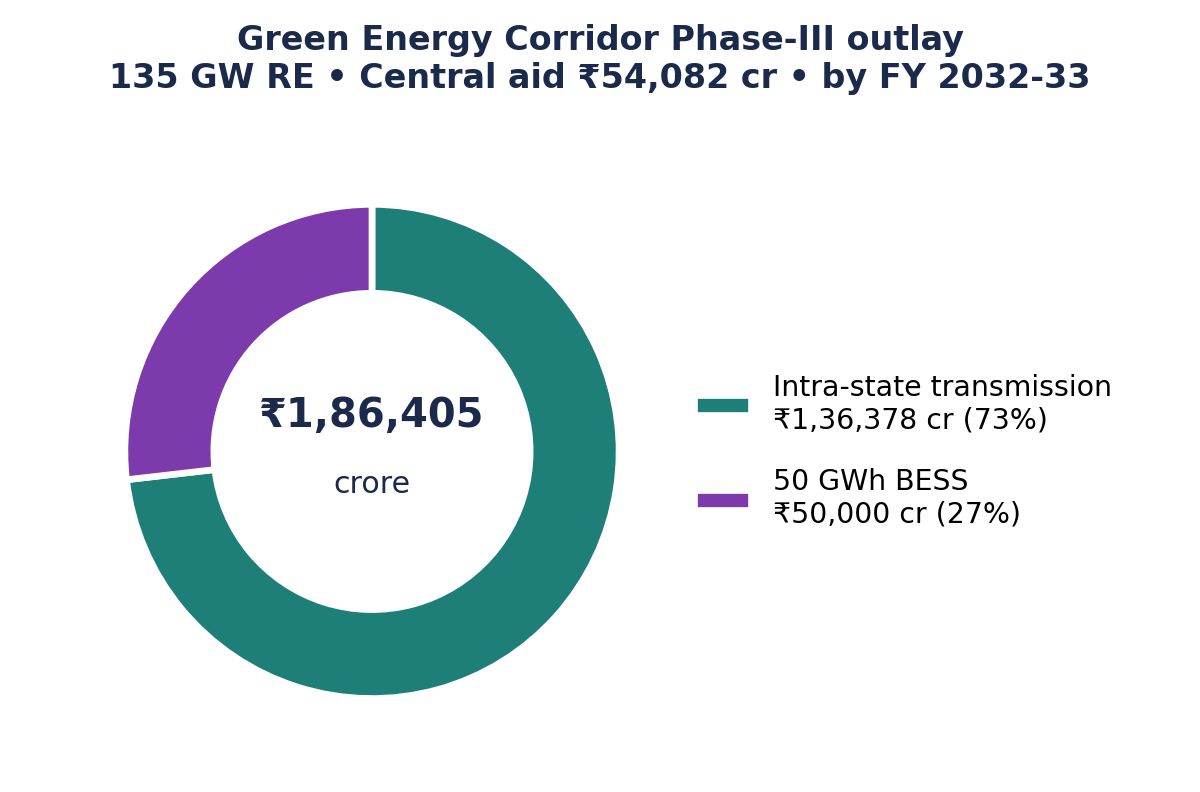
On 30 September 2026, the Union Cabinet approved Green Energy Corridor (GEC) Phase-III for intra-state transmission (InSTS) with a total outlay of ₹1,86,405 crore, to evacuate up to 135 GW of renewable power by FY 2032-33.
Key facts
Central financial assistance: ₹54,082 crore (about 29%) to offset transmission charges.
₹1,36,378 crore for intra-state lines and substations; ₹50,000 crore for 50 GWh of Battery Energy Storage Systems (BESS).
New projects via Tariff Based Competitive Bidding (TBCB), upgrades on cost-plus; implemented by State Transmission Utilities.
Supports the goal of 900 GW non-fossil capacity by 2035.
Way forward
Hill states like Uttarakhand can pair storage with grid strengthening to absorb small hydro and rooftop solar; quick land and forest clearances are key.
Concept
GEC Phase-I covered ISTS + InSTS in 8 RE-rich states; Phase-II (2022) covered InSTS in 7 states. BESS stores surplus solar for non-solar hours, aiding grid stability.
Donut chart of the Green Energy Corridor Phase-III outlay of 1,86,405 crore rupees: 1,36,378 crore for intra-state transmission (73 percent) and 50,000 crore for 50 GWh battery storage (27 percent), with central assistance of 54,082 crore. — StudyForGS
10. Bankers' Books Evidence Act, 2026 comes into force today, replacing the colonial-era 1891 law
The Bankers' Books Evidence Act, 2026, which got Presidential assent on 13 August 2026, takes effect from 1 October 2026, modernising how bank records are proved in courts.
Key facts
Technology-neutral: recognises records in physical, electronic, digital, virtual and cloud forms.
Digital records cannot be rejected solely for format; safeguards for authenticity, integrity and cyber-security.
Certification via First & Second Schedules with manual, digital or electronic signatures as per the IT Act, 2000.
Courts must record 'special cause' in writing before summoning bank officials where the bank is not a party.
Way forward
Train judges and bank staff on e-certification and extend the framework to other financial-sector entities by notification, as the Act allows.
Concept
Part of the drive to replace colonial-era laws, like BNS, BNSS and BSA (2023) replacing the IPC, CrPC and Evidence Act. The BSA treats electronic records as primary evidence.
11. WHO–UNICEF report: School drinking-water coverage in India jumps to 97%, but 5 crore children still lack school sanitation
REPORTUKPSC: Prelims + Mains (Social Justice — Health & Education)
Syllabus linkage
Social sector — health & education | Prelims: JMP, SDG 6 & SDG 4.a, Swachh Vidyalaya.
Context
The WHO–UNICEF Joint Monitoring Programme (JMP) report 'Progress on drinking water, sanitation and hygiene in schools 2015–2025' shows big gains in India's school water access, but sanitation lags.
Key facts
Schools with basic drinking water: 55% (2015) → 97% (2025), a 42-percentage-point jump.
Basic sanitation coverage is 81%; about 5 crore (50 million) Indian children attend schools without sanitation services, the highest globally.
India lacks 2025 data on handwashing facilities with soap and water.
Report urges focus on usability and maintenance of toilets, not just construction.
Way forward
Fund O&M of school toilets under Samagra Shiksha, ensure usable gender-separate toilets in remote hill schools and restore hygiene data in UDISE+.
Concept
SDG 6: clean water & sanitation; SDG 4.a: safe school facilities. Swachh Vidyalaya Abhiyan (2014) aimed at separate toilets for girls and boys in every school; the JMP was set up in 1990.
Data point of the day
₹2.03 lakh crore (+14.7% YoY)
Gross GST collection, September 2026 Net GST after refunds rose 18.1% to ₹1.76 lakh crore; imports surged 26% to ₹65,525 crore and domestic GST grew 10.1% to ₹1.38 lakh crore. April–September gross: ₹12.46 lakh crore (+11.6%). State-wise domestic data show Uttarakhand at ₹1,277 crore, down 23% from ₹1,665 crore, while Assam (+88%) and UP (+18%) led growth.
Prelims rapid-fire
1 October: International Day of Older Persons — UNGA resolution 45/106 (1990); first observed in 1991.
1 October is also National Voluntary Blood Donation Day in India (since 1975).
Hemkund Sahib (Chamoli) lies at about 4,632 m near Lokpal lake; footfall in 2026: 3,52,765.
Asian Games 2026 (Aichi-Nagoya): India's women's compound archery team won gold beating China 238-234.
UKPSC headquarters: Haridwar; constituted under Article 315 after the state's formation on 9 November 2000.
Wadia Institute of Himalayan Geology is in Dehradun; it works under the Department of Science & Technology.
Practice MCQs — UKPSC Prelims pattern
Q1. With reference to Census 2027, consider the following statements: 1. For the snow-bound areas of Uttarakhand, the reference date is 00:00 hours of 1 October 2026. 2. 'Census' is a subject in the Concurrent List. 3. The Census is conducted under the Census Act, 1948. Which of the statements given above is/are correct?
1 only
1 and 3 only
2 and 3 only
1, 2 and 3
Show answer
Answer: B Statement 2 is wrong: Census is in the Union List (Entry 69). Statements 1 and 3 are correct — the snow-bound reference date is 1 October 2026 and the exercise is notified under the Census Act, 1948.
Q2. Which one of the following pairs of a Char Dham shrine and its district is NOT correctly matched?
Kedarnath – Rudraprayag
Badrinath – Chamoli
Gangotri – Tehri Garhwal
Yamunotri – Uttarkashi
Show answer
Answer: C Gangotri lies in Uttarkashi district, like Yamunotri. Kedarnath is in Rudraprayag and Badrinath in Chamoli. In 2026, Gangotri recorded its highest-ever footfall of 8.41 lakh.
Mains practice question
Q. Glacial lakes are emerging as a major disaster risk in the Uttarakhand Himalaya. Discuss the causes of GLOF risk in the state and evaluate the role of early-warning systems in disaster risk reduction. (150 words, 10 marks)
Hint / approach
Intro: 344 lakes, 13 high-risk; Vasundhara Tal EWS (2026). Causes: glacier retreat, moraine dams, cloudbursts, seismicity, unplanned construction. EWS role: real-time sensors, satellite link, lead time for evacuation, 2013/2021 lessons. Limits: last-mile sirens, maintenance, community trust. Conclude with Sendai Framework and NDMA GLOF guidelines.
📌 One-line revision: Revise: Vasundhara Tal GLOF EWS (Chamoli) | Census snow-bound ref. date 1 Oct 2026 | Char Dham 53.23 lakh | UPSC est. 1926 | Wheat MSP ₹2,610 | GEC-III 135 GW | GST ₹2.03 lakh crore