Tuesday, 15 September 2026 · IST · Uttarakhand + National · 9 items · 2 MCQs
Uttarakhand dominates the day: Union Home Minister Amit Shah chaired a six-state meeting to revive the long-stalled Kishau Multipurpose Project on the Tons river, and the Char Dham Yatra 2026 began its post-monsoon second phase with over 50.6 lakh pilgrims already completed. Nationally, retail (CPI) inflation rose to 4.82% in August 2026 — above the RBI's 4% target for a third straight month — as India also hosted the expanded 11-member BRICS Summit in New Delhi.
Today at a glance — things to remember
Amit Shah chairs 6-state meeting on the Kishau Multipurpose Project (Tons river).
Char Dham Yatra 2026 second phase begins 15 September.
Over 50.6 lakh pilgrims done; 64 lakh+ registrations this season.
Revised Homestay Scheme pushes community / cluster tourism to curb 'palayan'.
Uttarakhand UCC online marriage registrations cross 4.7 lakh.
Retail CPI inflation rises to 4.82% in August 2026.
Food inflation at 5.95%; onion prices up 48% YoY.
India hosts the expanded 11-member BRICS Summit in New Delhi.
Bengaluru Space Expo 2026 spotlights India's private-space push.
Uttarakhand stays India's first state with a GEP index.
Detailed notes
1. Amit Shah chairs 6-state meeting to revive Kishau Multipurpose Project
Uttarakhand geography & river systems; inter-state water disputes; infrastructure & energy; centre-state relations.
Context
Union Home Minister Amit Shah chaired a meeting of six states on 15 September 2026 to push the long-delayed Kishau Multipurpose Project, ending an eight-year deadlock.
Key facts
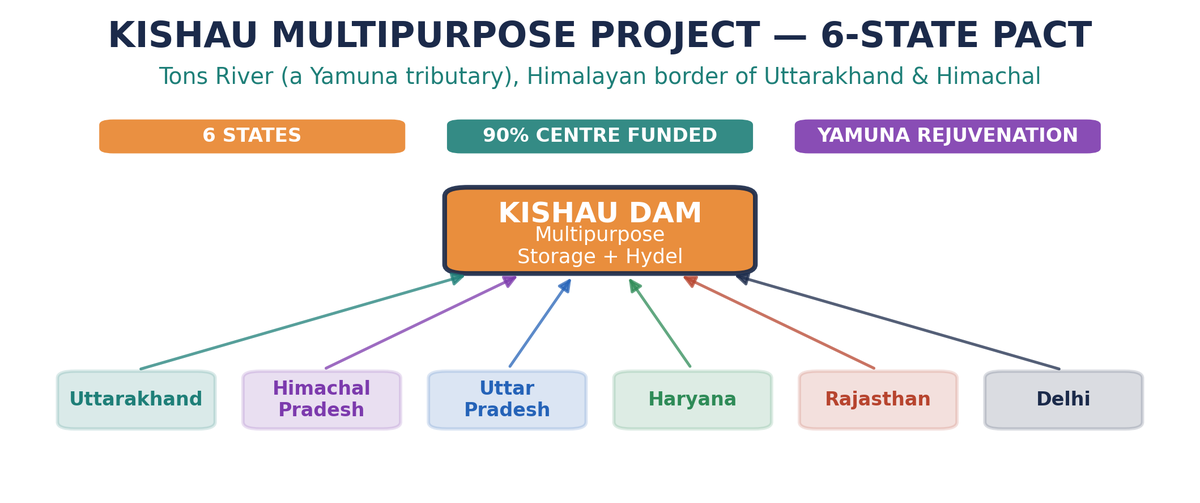
Built on the Tons river, the largest tributary of the Yamuna, on the Uttarakhand–Himachal Pradesh border.
Six states: Uttarakhand, Himachal Pradesh, Uttar Pradesh, Haryana, Rajasthan and Delhi.
Centre to bear 90% of the water-component cost; the six states share the remaining 10%.
Purposes: irrigation, hydro-power, drinking water and Yamuna rejuvenation.
An MoU for implementation was agreed and is to go before the Union Cabinet.
Way forward
Fast-track environmental and rehabilitation clearances in a fragile Himalayan zone while honouring the agreed inter-state water-and-power sharing formula.
Concept
Multipurpose river-valley projects serve irrigation, power, flood control & water supply. The Tons joins the Yamuna near Kalsi (Dehradun); Yamuna is itself a tributary of the Ganga.
Schematic of the Kishau Dam on the Tons river showing the six participating states and the 90:10 centre-state cost split. — StudyForGS
2. Char Dham Yatra 2026 enters disaster-resilient second phase
The Char Dham Yatra began its post-monsoon second phase on 15 September 2026, with authorities focusing on crowd management and disaster resilience after a deadly monsoon.
Key facts
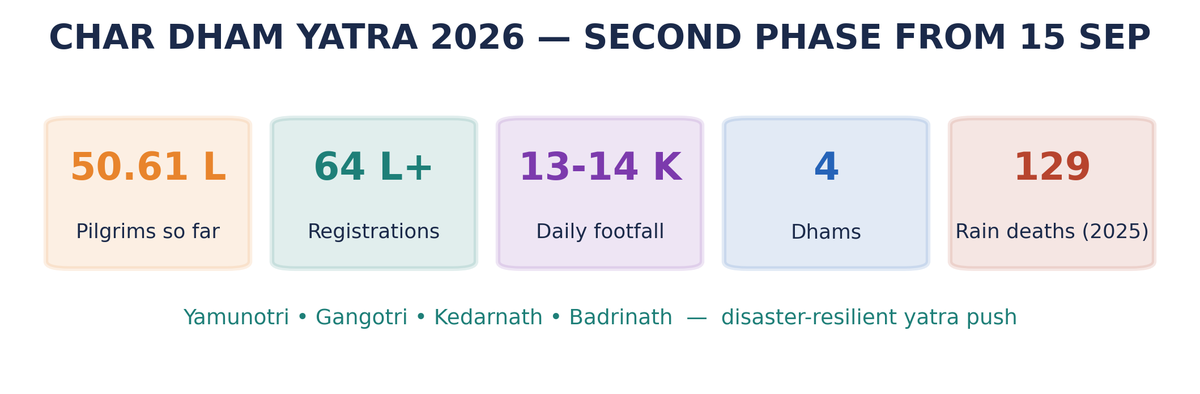
The four shrines: Yamunotri, Gangotri, Kedarnath and Badrinath.
Over 50.6 lakh pilgrims have completed the yatra; 64 lakh+ registrations so far.
Current daily footfall of 13,000–14,000; helicopter services resumed 15 September.
Heavy monsoon rain killed about 129 pilgrims/people during this year's season.
Landslide-monitoring systems deployed on vulnerable stretches; bottlenecks cleared.
Way forward
Enforce scientific carrying-capacity caps, real-time registration control and all-weather route engineering to balance faith tourism with Himalayan fragility.
Concept
Carrying capacity = maximum visitors an ecosystem can sustain without degradation. Uttarakhand's disaster machinery: USDMA (state) and DDMA (district) under the DM Act, 2005, with SDRF Uttarakhand.
3. Revised Homestay Scheme bets on community tourism to curb 'palayan'
UTTARAKHANDUKPSC: Prelims + Mains (Economy & Society — Uttarakhand)
Syllabus linkage
Hill-area development; out-migration ('palayan'); rural livelihoods & tourism; state schemes.
Context
Uttarakhand has revised its Homestay Scheme, introducing community-based (cluster) tourism for the first time to spread tourism income and check out-migration.
Key facts
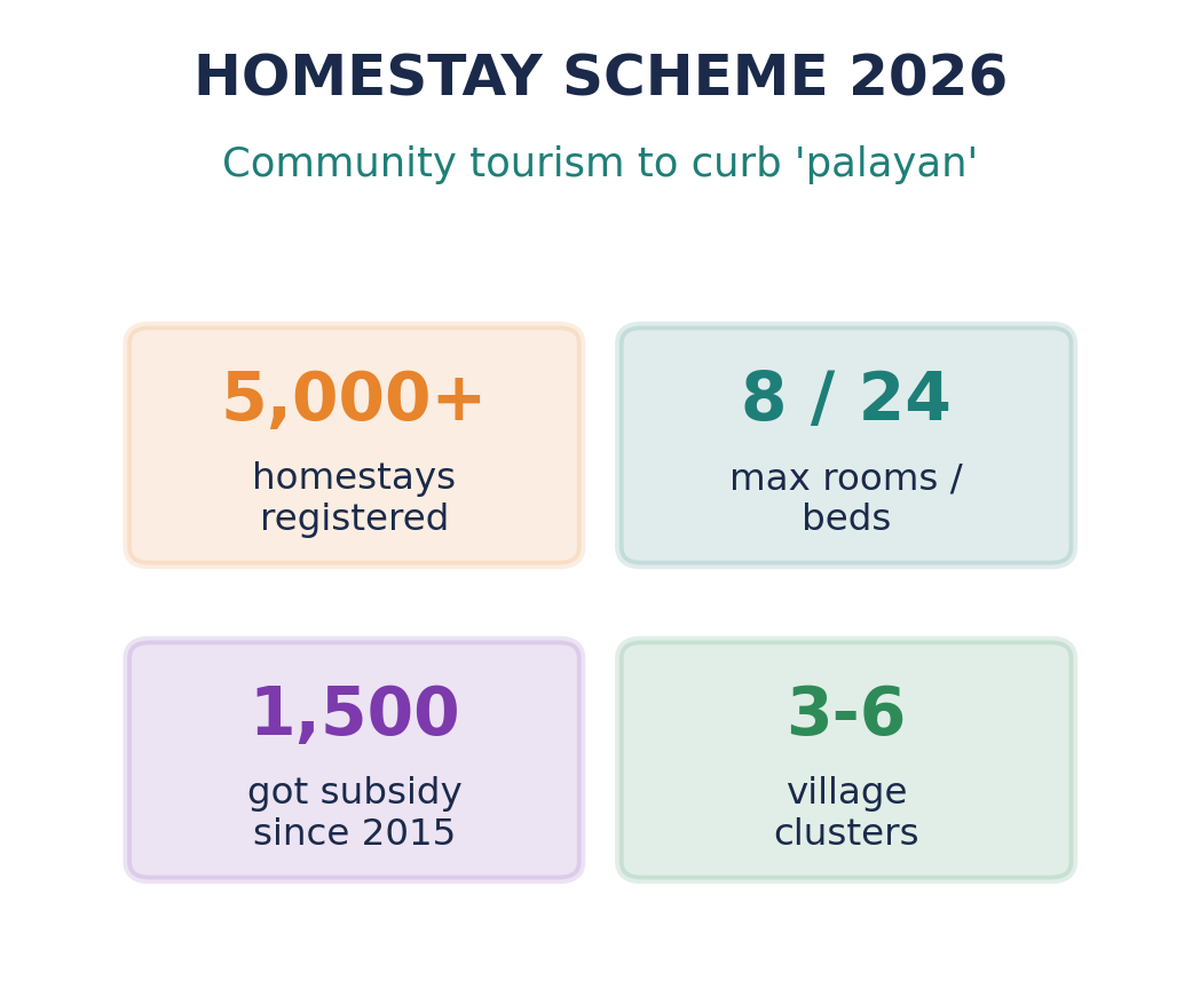
New Community-Based Tourism Units group 8–10 homestays across clusters of 3–6 villages.
Room cap raised from 6 to 8; beds capped at 24; validity 5 years with online renewal.
A new BnB category added for both rural and urban areas.
Over 5,000 homestays registered; about 1,500 owners aided since the 2015 launch.
Aim: local self-employment so residents 'do not migrate to cities' — tackling palayan.
Way forward
Pair the scheme with skilling, market linkages and last-mile roads so hill homestays become viable year-round livelihoods.
Concept
Palayan = large-scale out-migration from Uttarakhand's hill districts, addressed by the Rural Development & Migration Commission (Palayan Aayog), headquartered at Pauri.
Stat tiles for the 2026 Homestay Scheme: 5000+ homestays, 8 rooms/24 beds, 1500 subsidised since 2015, 3-6 village clusters. — StudyForGS
4. UCC in Uttarakhand: online marriage registrations cross 4.7 lakh
Uniform Civil Code; DPSP (Article 44); state legislation; personal law reform.
Context
Uttarakhand's Uniform Civil Code (UCC) — India's first by a state — continues to be rolled out, with online marriage registration reshaping personal-law compliance.
Key facts
UCC took effect on 27 January 2025; the UCC Amendment Ordinance, 2026 further eased rules.
Over 4.7 lakh marriages registered online in about a year.
Covers marriage, divorce, succession and mandatory live-in relationship registration.
Draws constitutional backing from Article 44 (DPSP) on a uniform civil code.
Tribal communities under Schedule protections are exempted.
Way forward
Track implementation data and grievance redress to ensure the code simplifies rather than burdens citizens, especially in remote hill areas.
Concept
Article 44 directs the State to secure a UCC. It is a Directive Principle — non-justiciable but a goal of governance; Uttarakhand is the first state to enact one post-Independence.
Environmental economics; ecosystem services; green accounting; Himalayan conservation.
Context
Uttarakhand remains the first Indian state to institutionalise a Gross Environment Product (GEP) index, valuing the state's natural capital alongside GDP.
Key facts
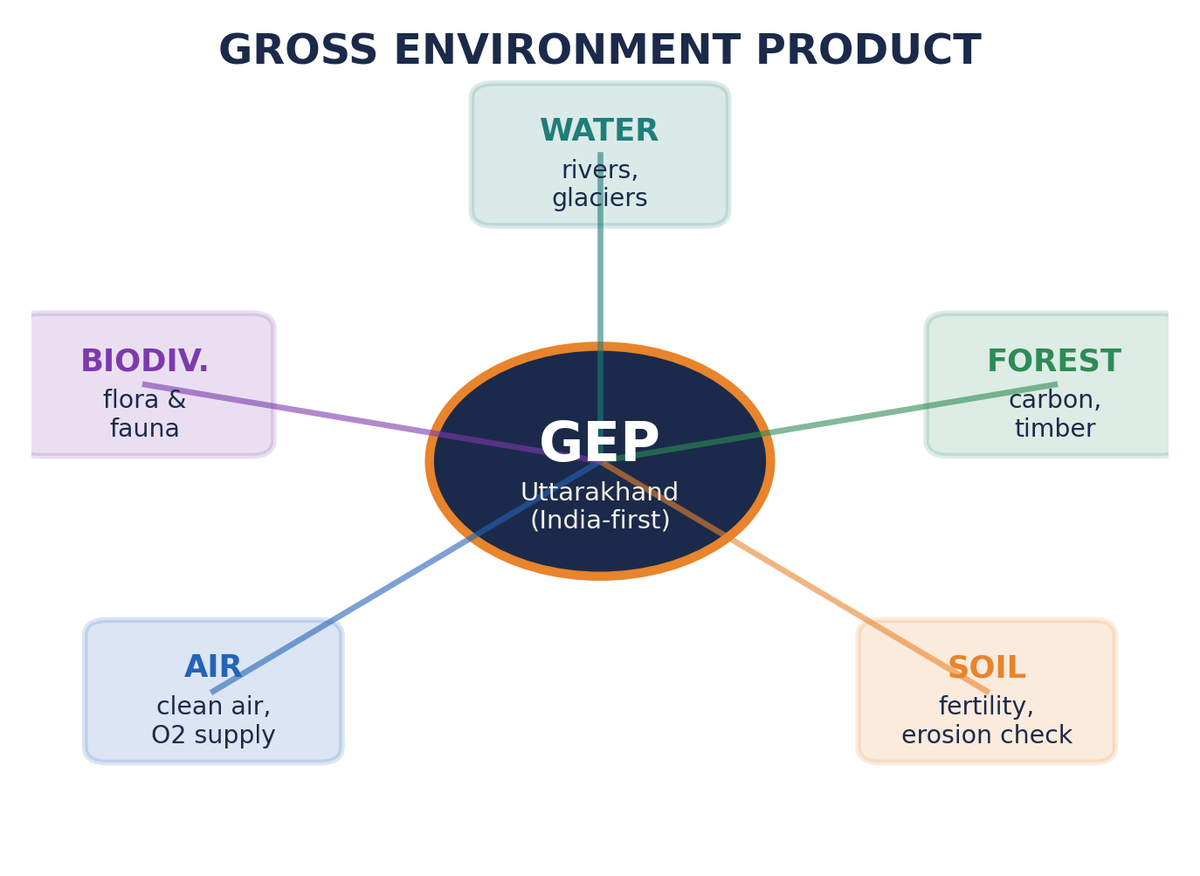
GEP measures the economic value of ecosystem services — much like GDP does for the economy.
Launched in Uttarakhand in 2024; assessed across air, water, soil and forest.
Aligns with the state's push on green growth and payment for ecosystem services.
Reinforces Uttarakhand's role as a water tower and carbon sink for the plains.
Supports arguments for larger green bonus / GST-type compensation to Himalayan states.
Way forward
Standardise GEP methodology and link it to fiscal transfers so ecological stewardship is financially rewarded.
Concept
Ecosystem services (provisioning, regulating, supporting, cultural) underpin green accounting, which internalises environmental costs beyond conventional GDP.
Mind-map of Gross Environment Product with Uttarakhand at the centre and five ecosystem-service nodes: water, forest, soil, air, biodiversity. — StudyForGS
6. India hosts the expanded 11-member BRICS Summit in New Delhi
IRUKPSC: Prelims + Mains (International Relations)
Syllabus linkage
India & the world; multilateral groupings; Global South; economic diplomacy.
Context
India hosted the expanded BRICS Summit at Bharat Mandapam, New Delhi (12–13 September 2026), marking two decades of the grouping under a resilience-and-innovation theme.
Key facts
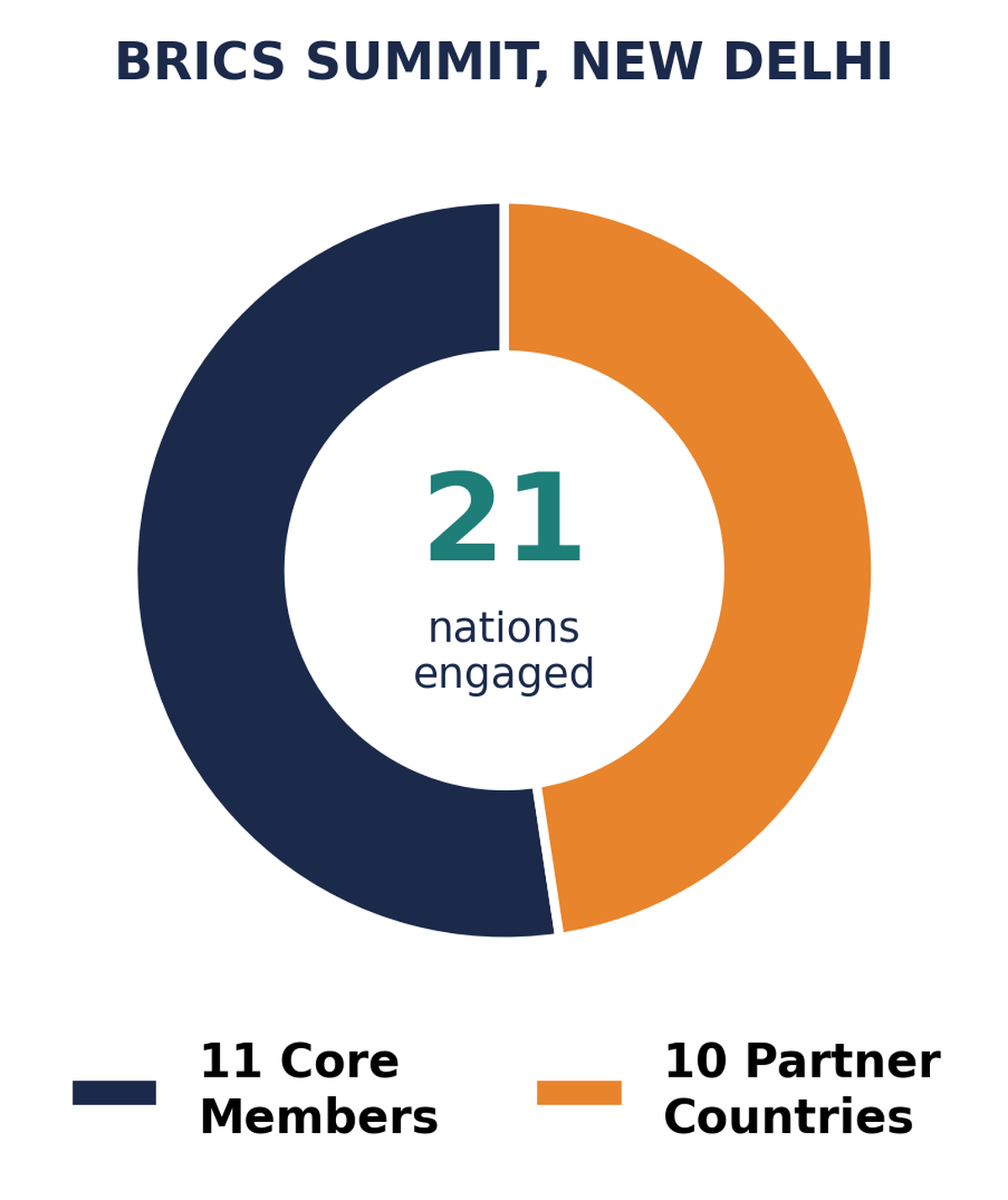
BRICS now has 11 core members including India, Brazil, Russia, China, South Africa, plus Egypt, Ethiopia, Iran, UAE, Saudi Arabia and Indonesia.
Around 10 partner countries engage in the wider framework.
Agenda: cross-border payments, local-currency trade, AI, MSMEs and climate resilience.
India's theme stressed 'Humanity First' and reform of multilateral institutions.
Signals a stronger Global South voice in world economic governance.
Way forward
Convert summit declarations into concrete payment-system and trade mechanisms without diluting India's strategic autonomy.
Concept
BRICS (coined from Brazil-Russia-India-China, later +South Africa) is a plurilateral bloc of major emerging economies; its New Development Bank (NDB) is headquartered in Shanghai.
Donut chart showing BRICS with 11 core members and 10 partner countries, totalling 21 nations engaged. — StudyForGS
7. Retail inflation quickens to 4.82% in August 2026
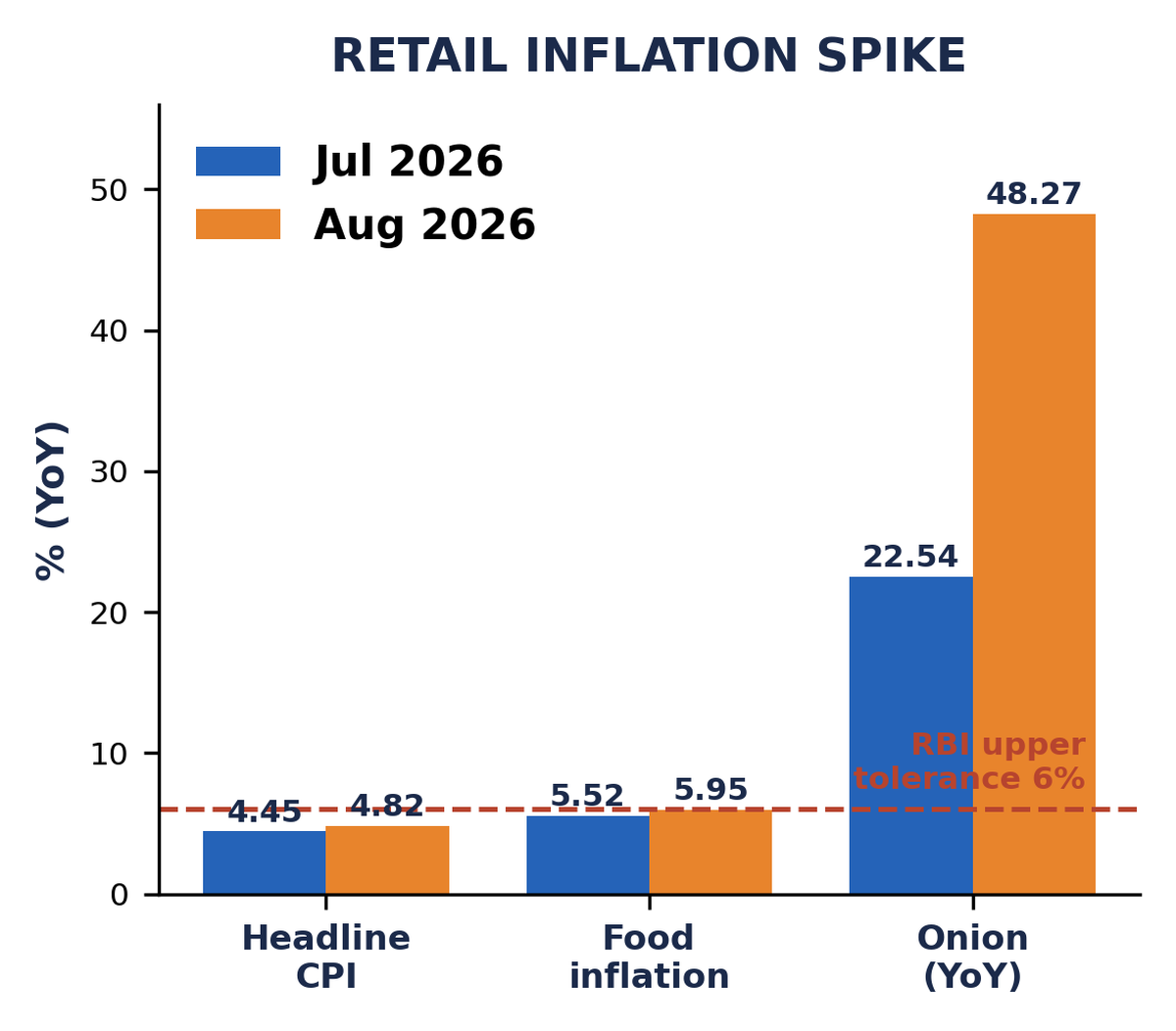
India's retail (CPI) inflation rose to 4.82% in August 2026 from 4.45% in July — staying above the RBI's 4% target for a third straight month.
Key facts
CPI headline: 4.82% (Aug) vs 4.45% (Jul).
Food inflation climbed to 5.95%; onion inflation jumped to 48.27% YoY.
RBI's flexible-inflation-targeting band is 4% ±2% (i.e. 2–6%).
The next Monetary Policy Committee (MPC) meets on 5–7 October 2026.
Elevated prices may delay any further repo-rate cut.
Way forward
Ease supply-side pressure on vegetables via buffer stocking and better cold-chain logistics to anchor inflation expectations.
Concept
CPI tracks retail prices of a fixed basket (base 2012); inflation targeting was adopted in 2016, with a 4% ±2% target set by the government in consultation with the RBI.
Grouped bar chart comparing July and August 2026 for headline CPI, food inflation and onion inflation against the RBI 6% upper tolerance. — StudyForGS
8. Bengaluru Space Expo 2026 showcases India's private-space push
Space technology; ISRO; private sector & innovation; national missions.
Context
The ISRO chairman opened the Bengaluru Space Expo 2026, urging deeper industry collaboration to scale India's growing space economy.
Key facts
India's rockets have now carried 430+ satellites for 34 nations, a point PM Modi hailed at a Paris space summit.
Focus on private-sector participation, satellites and launch-vehicle manufacturing.
IN-SPACe and NSIL anchor commercialisation of the space sector.
Aligns with the goal of expanding India's share of the global space economy.
Builds on missions like Chandrayaan and Aditya-L1.
Way forward
Sustain policy certainty and funding so start-ups can move from demonstrators to reliable commercial launch and satellite services.
Concept
IN-SPACe is the single-window promoter/regulator for private space activity; NSIL is ISRO's commercial arm; Antrix was the earlier marketing arm.
9. No bank charge on UPI up to Rs 2,000; Aadhaar deepens welfare delivery
ECONOMYUKPSC: Prelims (Economy & Governance)
Syllabus linkage
Digital economy; financial inclusion; DBT & Aadhaar; governance tech.
Context
Official clarifications reaffirmed no bank charge on UPI payments up to Rs 2,000, even as Aadhaar is being woven deeper into welfare delivery.
Key facts
UPI person-to-merchant payments up to Rs 2,000 carry no MDR/charge for users.
UPI is operated by the National Payments Corporation of India (NPCI).
Aadhaar (issued by UIDAI) underpins Direct Benefit Transfer (DBT).
Expansion raises fresh privacy and consent questions in digital governance.
Digital rails have made India a global leader in real-time payments.
Way forward
Protect a zero-MDR small-value regime while ensuring data-protection safeguards under the DPDP framework.
Concept
MDR (Merchant Discount Rate) is the fee a merchant pays on a digital transaction; NPCI is an umbrella body promoted by the RBI and banks; UIDAI issues Aadhaar.
Data point of the day
4.82%
India retail (CPI) inflation, August 2026 Up from 4.45% in July and above the RBI's 4% target (band 2–6%) for a third straight month; food inflation at 5.95%.
Prelims rapid-fire
The Kishau Multipurpose Project is on the Tons river, largest tributary of the Yamuna.
Uttarakhand is India's first state to launch a Gross Environment Product (GEP) index (2024).
The Char Dham: Yamunotri, Gangotri, Kedarnath, Badrinath.
August 2026 CPI inflation = 4.82%; RBI target 4% (±2%).
India hosted the 11-member BRICS Summit at Bharat Mandapam, New Delhi.
Uttarakhand's UCC took effect on 27 Jan 2025; online marriage registrations crossed 4.7 lakh.
Practice MCQs — UKPSC Prelims pattern
Q1. The Kishau Multipurpose Project, recently in the news, is being built on which river?
Alaknanda
Tons
Bhagirathi
Sharda (Kali)
Show answer
Answer: B The Kishau dam is on the Tons, the largest tributary of the Yamuna, on the Uttarakhand–Himachal Pradesh border.
Q2. Consider the following about Gross Environment Product (GEP): 1) Uttarakhand is the first Indian state to launch a GEP index. 2) It measures the economic value of ecosystem services such as air, water, soil and forest. Which is/are correct?
1 only
2 only
Both 1 and 2
Neither 1 nor 2
Show answer
Answer: C Both statements are correct — Uttarakhand launched India's first GEP index (2024), valuing air, water, soil and forest ecosystem services.
Mains practice question
Q. Uttarakhand faces a recurring trade-off between pilgrimage-driven tourism and Himalayan ecological fragility. Discuss with reference to Char Dham Yatra crowd management and disaster resilience.
Hint / approach
Link carrying capacity, 2013 Kedarnath tragedy, landslide/GLOF risk, USDMA-DDMA-SDRF machinery, registration caps, all-weather roads and eco-sensitive zones.
📌 One-line revision: Kishau (Tons/Yamuna) 6-state pact • Char Dham Phase-2 from 15 Sep (50.6 L pilgrims) • CPI 4.82% • BRICS-11 at New Delhi • GEP = UK first.