Thursday, 29 October 2026 · IST · Madhya Pradesh + National · 10 items · 2 MCQs
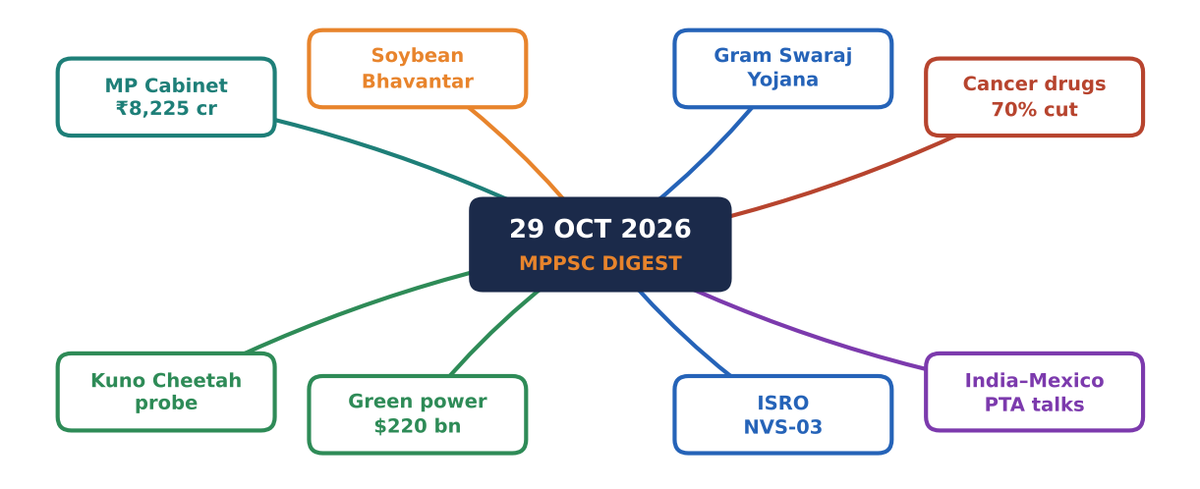
Madhya Pradesh dominates today's agenda: a high-level panel will probe a cheetah death at Kuno, while the Mohan Yadav Cabinet's ₹8,225 crore package funds irrigation, CAMPA afforestation and welfare, alongside the Soybean Bhavantar price-support scheme. Nationally, the Union Cabinet approved the ₹7,396 crore PM Viksit Gram Swaraj Yojana for panchayat capacity-building, the NPPA capped trade margins on 137 anti-cancer drugs to cut prices up to 70% from Nov 9, and India began preferential-trade talks with Mexico as ISRO prepared to launch the NVS-03 navigation satellite.
Today at a glance — things to remember
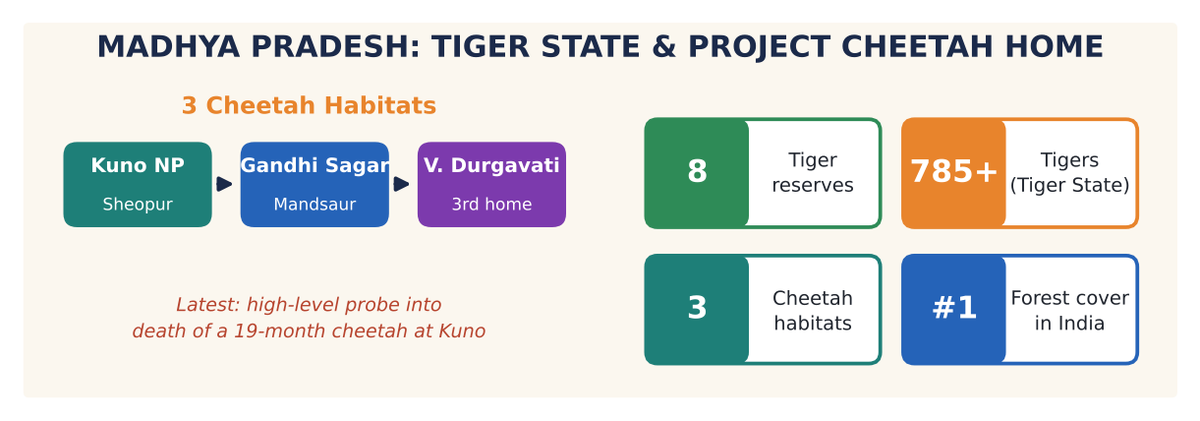
Kuno NP: high-level team to probe death of a 19-month-old cheetah (MP).
A high-level committee has been constituted to investigate the death of a 19-month-old cheetah at Kuno National Park in Madhya Pradesh, the flagship site of Project Cheetah — the world's first inter-continental large-carnivore translocation.
Key facts
Kuno National Park lies in Sheopur district of MP's Chambal region, on the Kuno river.
Project Cheetah began in September 2022 with cheetahs from Namibia and later South Africa.
MP has a third cheetah habitat at Veerangana Durgavati Tiger Reserve, after Kuno and Gandhi Sagar (Mandsaur).
The cheetah is the only large carnivore to have gone extinct in India (1952) and been reintroduced.
Way forward
Strengthen veterinary monitoring, prey-base augmentation and habitat corridors; expand the founder population across multiple sites to cut single-site risk.
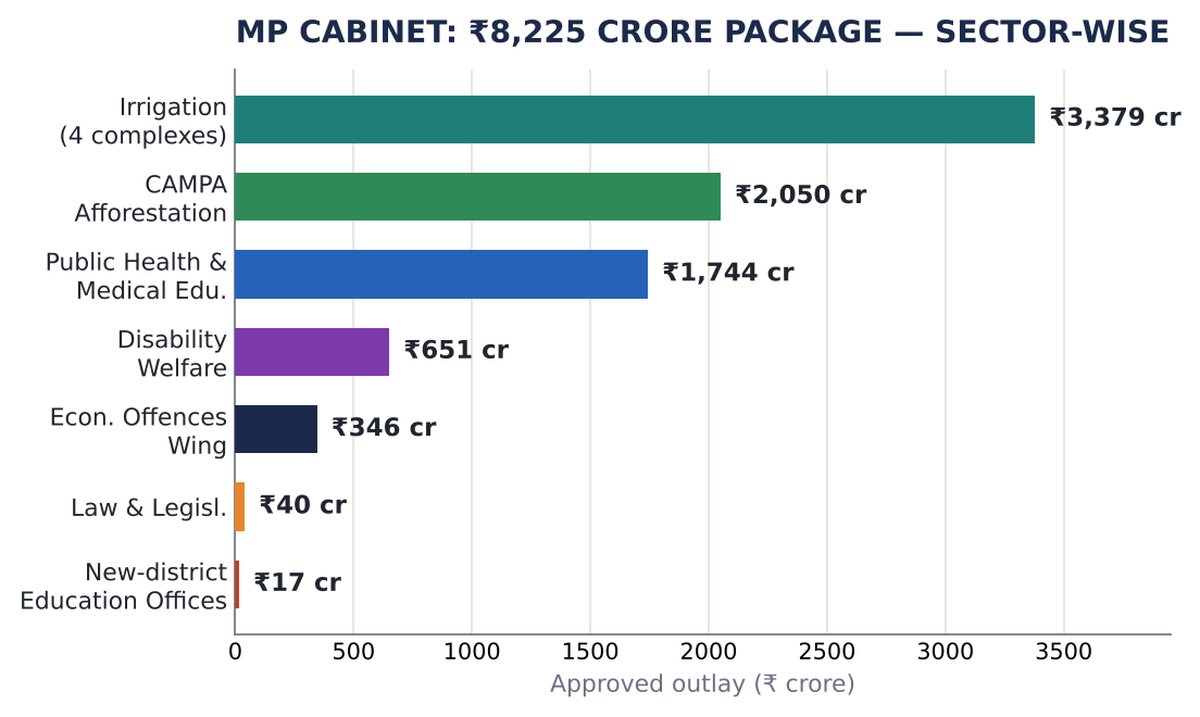
The Madhya Pradesh Cabinet, chaired by CM Dr Mohan Yadav, approved projects and financial proposals worth over ₹8,225 crore spanning irrigation, forests, health and welfare.
Key facts
₹3,378.69 cr for four irrigation projects incl. the Chhindwara Irrigation Complex (₹2,611 cr) and Pench Diversion.
₹2,050.03 cr under CAMPA for afforestation, catchment restoration and village relocation from protected areas.
₹1,743.58 cr for Public Health & Medical Education (2026–31).
₹651.25 cr for welfare of Persons with Disabilities; new DEO offices for 4 new districts (Niwari, Mauganj, Pandhurna, Maihar).
Way forward
Ensure time-bound execution of micro-irrigation to raise cropping intensity and transparent CAMPA utilisation aligned with forest-dwellers' rights.
Concept
CAMPA (Compensatory Afforestation Fund Act, 2016); 16th Finance Commission period (2026–31); Narmada valley command areas.
Horizontal bar chart of MP Cabinet's ₹8,225 cr package by sector. — StudyForGS
MP has rolled out the Soybean Bhavantar (price-deficiency) Scheme for the kharif 2026 season and incorporated the Jabalpur–Indore Economic Corridor Development Company, a state SPV.
Key facts
Bhavantar pays the gap between MSP and sale/model price via DBT when market rates fall below MSP — under the central PM-AASHA umbrella.
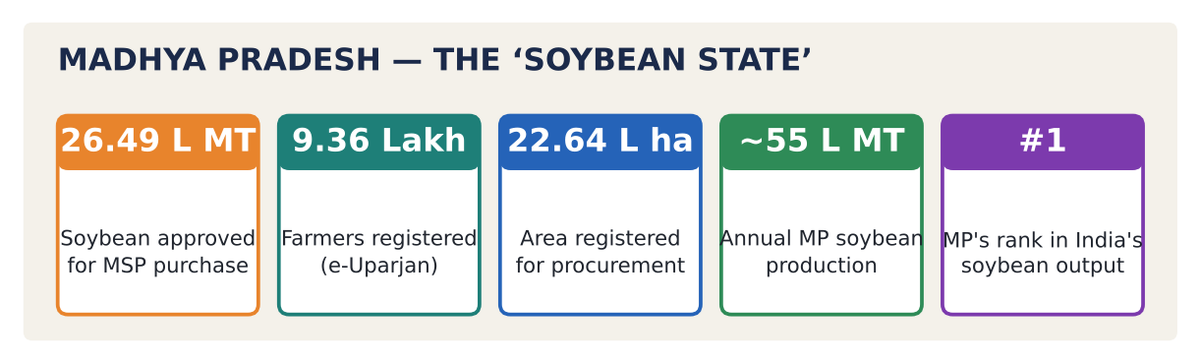
Farmers register on the e-Uparjan portal; MP is India's largest soybean producer (the 'Soybean State', Malwa black soils).
The Jabalpur–Indore Economic Corridor SPV has ₹100 cr initial paid-up capital for industrial, logistics, food-processing and IT parks and GCCs.
Centre sanctioned 26.49 lakh MT of soybean MSP procurement for MP (9.36 lakh farmers, 22.64 lakh ha).
Way forward
Pair price support with value-addition (soy processing), warehousing and crop diversification to cut price-crash risk.
Madhya Pradesh continues to consolidate its status as India's 'Tiger State' and the leading hub of Project Cheetah, having opened a third cheetah habitat this year.
Key facts
MP holds the highest tiger population among states and the largest forest cover by area in India.
Cheetah habitats: Kuno NP (Sheopur), Gandhi Sagar WLS (Mandsaur) and Veerangana Durgavati TR.
Major tiger reserves: Kanha, Bandhavgarh, Pench, Panna, Satpura, Sanjay-Dubri.
Panna is a UNESCO-listed Biosphere Reserve; MP's forests anchor the Narmada, Chambal, Betwa, Tapti, Son basins.
Way forward
Develop wildlife tourism responsibly, strengthen anti-poaching and inter-state corridors, and fund conservation via CAMPA and eco-development.
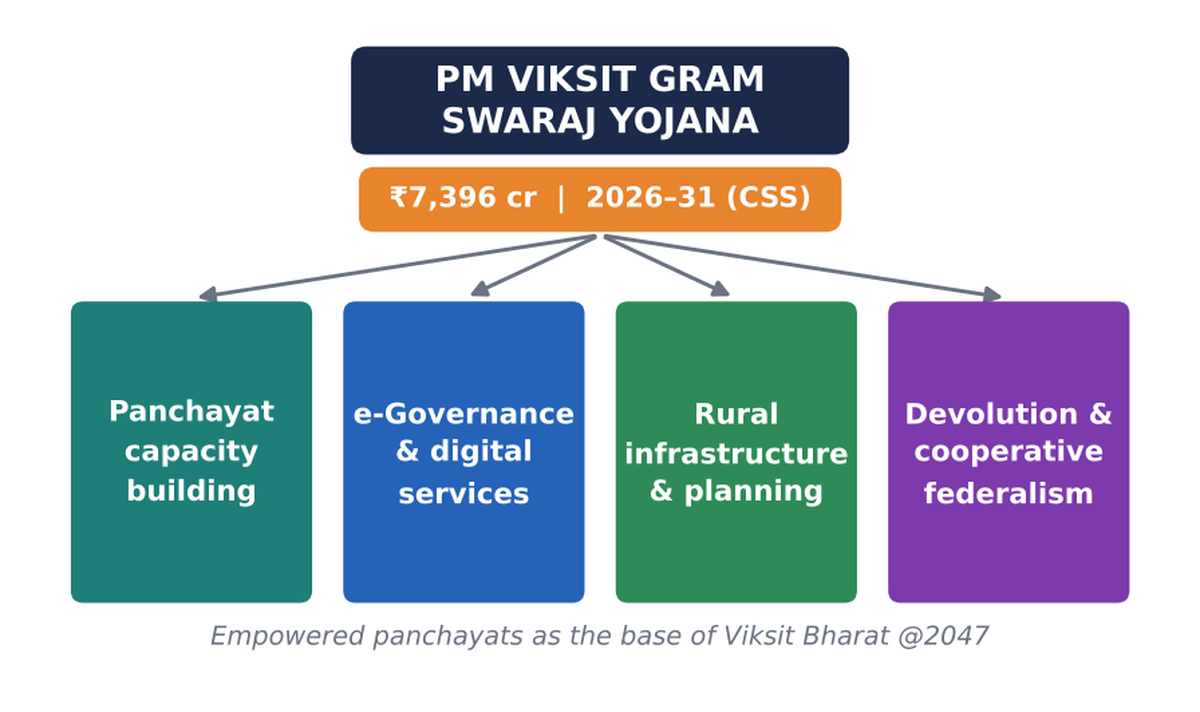
The Union Cabinet approved the PM Viksit Gram Swaraj Yojana, a Centrally Sponsored Scheme for 2026–27 to 2030–31, to strengthen panchayati-raj institutions.
Key facts
Outlay of about ₹7,396 crore for panchayat capacity-building, e-governance and rural planning.
Builds on the Rashtriya Gram Swaraj Abhiyan (RGSA) to deepen grassroots democracy.
Aligns panchayats with Viksit Bharat @2047 and localisation of the SDGs.
Flows alongside 16th Finance Commission devolution to local bodies.
Way forward
Ensure devolution of the 3Fs (funds, functions, functionaries), digital Gram Sabhas and outcome-based capacity building.
GS-II health governance; Prelims: NPPA, DPCO 2013, NLEM, Jan Aushadhi.
Context
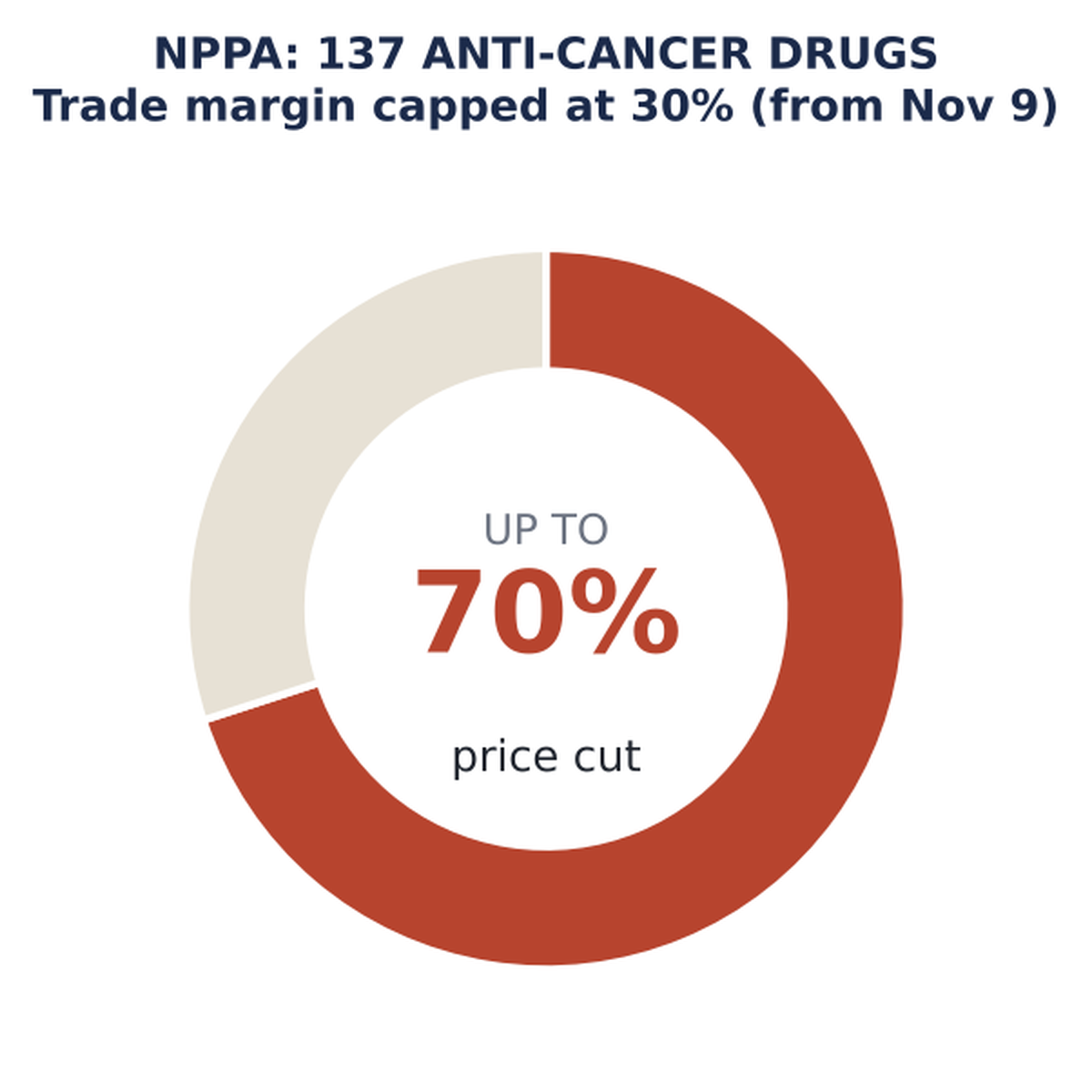
The NPPA rationalised trade margins on 137 non-scheduled anti-cancer drugs, capping them at 30%, cutting retail prices by up to 70% from 9 November 2026.
Key facts
Applies to immunotherapy and targeted-therapy (non-scheduled) cancer medicines.
Trade Margin Rationalisation (TMR) invoked under Para 19 of the DPCO, 2013 in public interest.
NPPA functions under the Department of Pharmaceuticals, Ministry of Chemicals & Fertilizers.
Complements Jan Aushadhi and price caps on scheduled drugs under the NLEM.
Way forward
Monitor compliance along the supply chain; expand affordable access via Jan Aushadhi Kendras and insurance under Ayushman Bharat.
The Supreme Court sharply criticised the rising 'digital arrest' cyber-fraud, remarking that 'digital arrest is digital dacoity' and must be dealt with ruthlessly.
Key facts
In a digital arrest scam, fraudsters impersonate officials and coerce victims via video call to transfer money.
The Court flagged the need for stronger enforcement and victim protection.
Links to safeguards under the BNS/BNSS and the IT Act, 2000.
Cyber-fraud can be reported on the 1930 helpline / national cybercrime portal.
Way forward
Scale cyber-forensics, inter-agency coordination and mass digital-literacy campaigns.
Concept
Cyber-crime; IT Act, 2000; I4C (Indian Cyber Crime Coordination Centre); digital public safety.
10. Cabinet Clears Khelo India Sports-Goods & Container Manufacturing Schemes
GS-III manufacturing & industrial policy; Prelims: Make in India, PLI, PM GatiShakti.
Context
The Union Cabinet cleared the Khelo India Sports Goods Manufacturing Scheme and a Container Manufacturing Promotion Scheme to build globally competitive manufacturing ecosystems.
Key facts
Aims to make India a global hub for sports-goods manufacturing and cut imports.
The container scheme promotes domestic shipping-container production to aid logistics and EXIM trade.
Supports Make in India, Atmanirbhar Bharat and PLI-style self-reliance.
Expected to boost MSMEs, exports and employment.
Way forward
Anchor manufacturing clusters near ports and sports hubs with quality certification and skilling.
Concept
Make in India; PLI schemes; MSME competitiveness; logistics-cost reduction (PM GatiShakti).
Data point of the day
$220 billion
Green-Power Finance Need (India, by FY2030) Investment India requires by FY30 to fund its green-power (renewable) transition — underscoring the capital scale behind the 500 GW non-fossil capacity goal.
Prelims rapid-fire
Kuno National Park, home of Project Cheetah, lies in Sheopur district of MP on the Kuno river (a Chambal tributary).
Madhya Pradesh is India's 'Tiger State' and has the largest forest cover by area in the country.
Soybean Bhavantar (price-deficiency) payments are made under the central PM-AASHA umbrella scheme.
NPPA functions under the Department of Pharmaceuticals, Ministry of Chemicals & Fertilizers.
NavIC, served by ISRO's NVS series, is India's regional navigation system (~1,500 km beyond borders).
CAMPA = Compensatory Afforestation Fund Management and Planning Authority (Act of 2016).
Practice MCQs — MPPSC Prelims pattern
Q1. With reference to Project Cheetah, consider the following statements:
1. Kuno National Park is situated in the Chambal region of Madhya Pradesh.
2. The cheetahs translocated to India were sourced from Namibia and South Africa.
3. Veerangana Durgavati Tiger Reserve has been developed as a cheetah habitat in MP.
Which of the statements given above are correct?
1 and 2 only
2 and 3 only
1 and 3 only
1, 2 and 3
Show answer
Answer: D All three are correct. Kuno NP is in the Chambal region (Sheopur); cheetahs came from Namibia (2022) and South Africa (2023); Veerangana Durgavati is MP's third cheetah habitat.
Q2. The 'Bhavantar Bhugtan Yojana', seen recently in the news in Madhya Pradesh, is best described as:
A crop-insurance scheme
A price-deficiency payment scheme compensating farmers when market prices fall below MSP
An interest-subvention scheme for farm loans
A minimum-income guarantee for landless labourers
Show answer
Answer: B Bhavantar is a Price Deficiency Payment (PDPS) scheme under the PM-AASHA umbrella; it pays the gap between MSP and the sale/model price via DBT when market rates fall below MSP.
Mains practice question
Q. Madhya Pradesh has emerged as a national leader in wildlife conservation while remaining India's largest soybean producer. Examine the challenge of balancing biodiversity conservation (Project Cheetah, Tiger State) with agrarian and irrigation expansion in the state. (250 words)
Hint / approach
Link Kuno/Durgavati cheetah habitats and tiger reserves with CAMPA afforestation funding; contrast with new irrigation complexes and soybean/agri expansion; weave in PESA, tribal livelihoods, eco-sensitive zones, river basins and the sustainable-development balance.