Friday, 16 October 2026 · IST · Madhya Pradesh + National · 11 items · 2 MCQs
Madhya Pradesh dominates the day: the state Cabinet approved proposals worth about ₹27,050 crore, created a wholly state-owned company for the Jabalpur-Bhopal-Indore Industrial Corridor and revived the Bhavantar Bhugtan Yojana for soybean growers under PM-AASHA. Nationally, the RBI raised the repo rate to 5.50% and shifted to 'calibrated tightening', the Supreme Court sought the Centre's reply on lifelong immunity for Election Commissioners, and India launched its bid for a UN Security Council non-permanent seat for 2028-29.
Today at a glance — things to remember
MP Cabinet approves proposals worth about ₹27,050 crore
New state company for Jabalpur-Bhopal-Indore Industrial Corridor (₹100 cr capital)
Bhavantar Bhugtan Yojana back for soybean; register on e-Uparjan by 17 Oct
Project Cheetah: Kuno count rises to 60 cheetahs (41 India-born)
MPPSC Mains GS-III (MP economy, industry, infrastructure); Prelims — state schemes, institutions & current affairs of MP.
Context
The Madhya Pradesh Cabinet, chaired by the CM in Bhopal, approved proposals worth about ₹27,050 crore and cleared a wholly state-owned company to develop the Jabalpur-Bhopal-Indore Industrial Corridor.
Key facts
Corridor company formed via Industries Dept with ₹100 crore initial share capital.
Phase one covers about 10,000 acres; land-management & zoning powers with the firm.
Expected to draw over ₹3 lakh crore investment and create over 6 lakh jobs in 3 years.
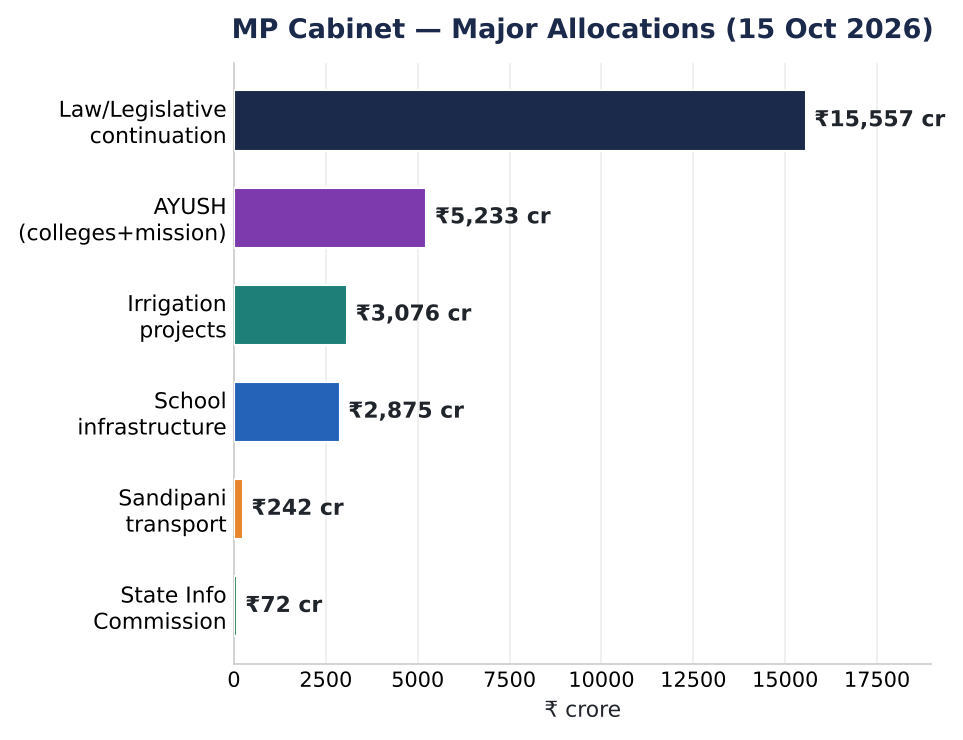
Big heads: Law/Legislative continuation ₹15,557 cr, AYUSH colleges ₹3,535 cr, irrigation ₹3,076 cr, school infra ₹2,875 cr.
Way forward
Time-bound land pooling, single-window clearances and skilling must follow so the corridor converts intent into jobs and MSME linkages.
Concept
Industrial corridors are planned manufacturing + logistics belts anchored on transport spines; MP already hosts nodes of the Delhi-Mumbai Industrial Corridor (DMIC).
Bar chart of major Madhya Pradesh Cabinet allocations on 15 October 2026 by head, in rupees crore. — StudyForGS
2. Bhavantar Bhugtan Yojana returns for soybean growers under PM-AASHA
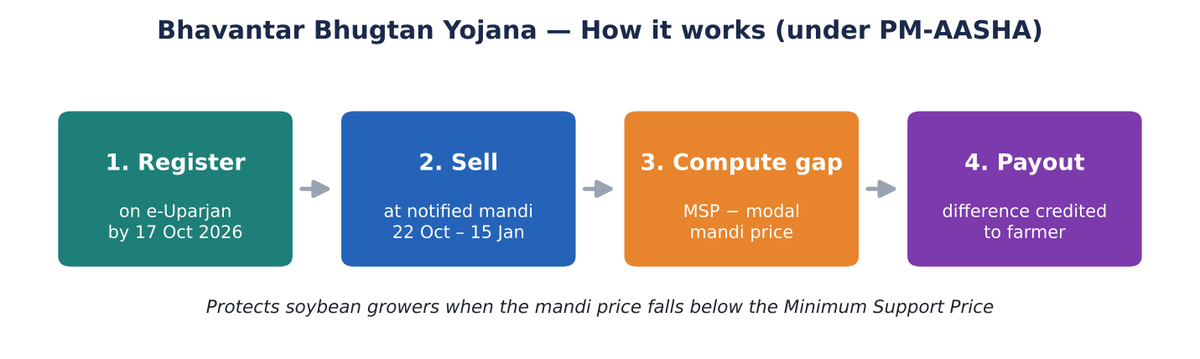
The Cabinet revived the Bhavantar Bhugtan Yojana for the 2026 kharif soybean crop under the Centre's PM-AASHA umbrella, to protect growers when mandi prices fall below MSP.
Key facts
Farmers must register on the e-Uparjan portal by 17 October 2026.
Sales window at notified mandis: 22 October 2026 to 15 January 2027.
MP is India's largest soybean producer — the 'Soybean State'.
Bhavantar pays the gap between MSP and the average modal mandi price.
Way forward
Transparent price discovery and timely payouts are key; pairing with procurement avoids distress sales in a bumper year.
Concept
PM-AASHA (2018) bundles Price Support Scheme, Price Deficiency Payment (the Bhavantar model) and private procurement to ensure MSP to farmers.
Flowchart of the Bhavantar Bhugtan Yojana steps from e-Uparjan registration to the price-difference payout. — StudyForGS
3. Project Cheetah: Kuno population rises to 60; Botswana lineage enters India
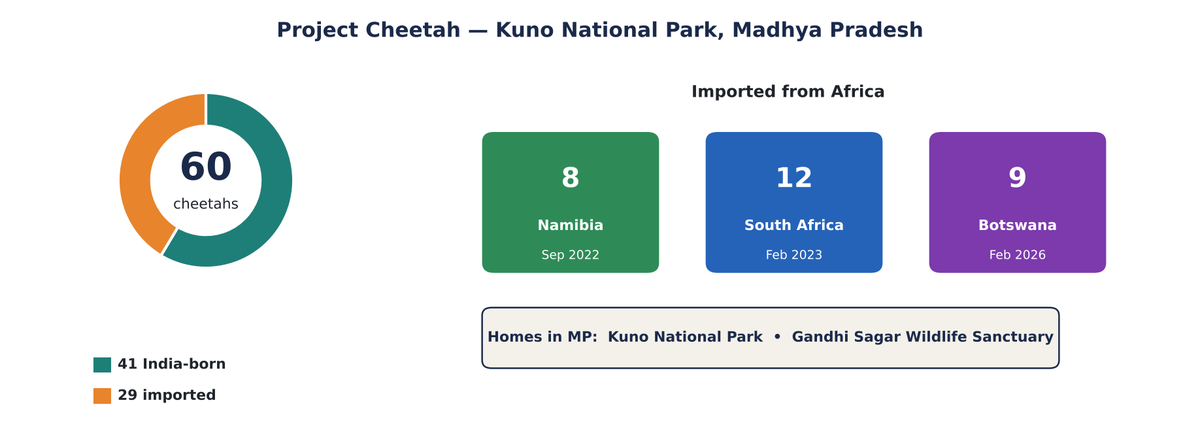
India's cheetah count reached 60 after a litter of 5 cubs was born on 5 October 2026 at Kuno National Park, Madhya Pradesh — introducing the Botswanan genetic lineage.
Key facts
Of 60 cheetahs, 41 are India-born; 29 were flown in from Africa.
Imports: 8 from Namibia (Sep 2022), 12 from South Africa (Feb 2023), 9 from Botswana (Feb 2026).
Kuno holds the bulk; Gandhi Sagar Wildlife Sanctuary (MP) is the second home.
MP is the 'Tiger State' and has India's largest forest cover.
Way forward
Building a second viable population at Gandhi Sagar and curbing cub mortality are vital for a self-sustaining metapopulation.
Concept
Project Cheetah (2022) is the world's first inter-continental large-carnivore translocation; Kuno lies on the Kuno river, a Chambal tributary, in Sheopur district.
Fact schematic of Project Cheetah showing total 60, India-born vs imported split, and source countries. — StudyForGS
4. MP creates 4 fast-track courts for exam paper-leak and cheating cases
Madhya Pradesh set up four fast-track courts to speedily try exam paper-leak and cheating cases, reinforcing the state's anti-malpractice law for recruitment and board exams.
Key facts
Dedicated courts aim to cut pendency and ensure time-bound trials.
Complements the state's public-examination anti-malpractice framework.
Protects the credibility of exams like those of MPPSC / MP ESB.
Way forward
Swift convictions plus secure question-paper logistics and tech safeguards can deter leaks more than courts alone.
Concept
Fast-track courts are special courts for speedy disposal of specified cases; several states have enacted laws against unfair means in public examinations.
5. MP pitches an investor-friendly Semiconductor Policy
The CM urged showcasing Madhya Pradesh's investor-friendly semiconductor policy to attract chip-ecosystem investment, aligning the state with the national India Semiconductor Mission.
Key facts
Policy offers incentives for fabs, ATMP/OSAT units and design firms.
Builds on MP's push via Global Investors Summit momentum.
Targets high-value jobs and electronics supply-chain anchoring.
Complements the Centre's Semicon India programme.
Way forward
Reliable power, water and skilled talent plus stable incentives will decide whether investment intent becomes operational fabs.
Concept
A semiconductor fab fabricates chips on silicon wafers; ATMP/OSAT covers assembly, testing, marking and packaging — the labour-intensive back-end.
6. RBI hikes repo rate to 5.50%, shifts stance to 'calibrated tightening'
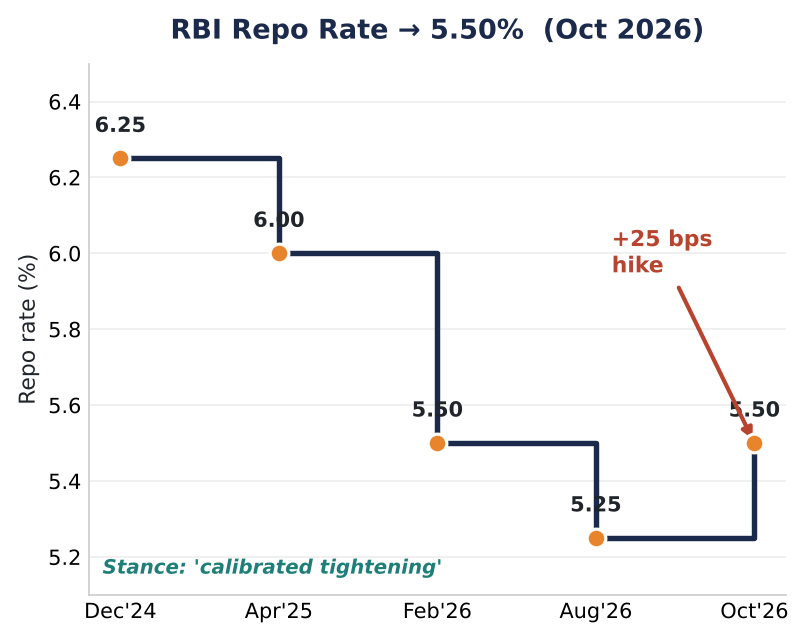
The RBI Monetary Policy Committee raised the repo rate by 25 bps to 5.50% and changed its stance to 'calibrated tightening' — the first hike in over three years, signalling inflation vigilance.
Key facts
Repo rate up from 5.25% to 5.50% (+25 bps).
Stance moved to 'calibrated tightening' from neutral/accommodative.
MPC has 6 members and meets bi-monthly; targets 4% (+/-2%) CPI inflation.
Higher repo tends to raise EMIs and lending rates.
Way forward
Policy must balance price stability with growth; transmission to deposit and lending rates will be watched closely.
Concept
Repo rate is the rate at which the RBI lends to banks against securities; raising it is a contractionary step to cool demand and inflation.
Step chart showing the RBI repo rate rising from 5.25 percent to 5.50 percent in October 2026. — StudyForGS
7. Supreme Court notices Centre on lifelong immunity for Election Commissioners
The Supreme Court issued notice to the Centre on a plea challenging Section 16 of the CEC and Other Election Commissioners Act, 2023, which grants the CEC and ECs immunity from civil/criminal proceedings for official acts, even after office.
Key facts
Challenge is to Section 16 of the 2023 Act.
Immunity covers acts done in discharge of official duties.
The ECI is a constitutional body under Article 324.
Petition filed by an electoral-reform body; Centre to reply.
Way forward
Courts will weigh functional independence of the ECI against accountability; a reasoned balance preserves trust in elections.
Concept
Article 324 vests superintendence of elections in the ECI; appointment of CEC/ECs is now governed by the 2023 Act following an earlier SC verdict.
8. India launches bid for UN Security Council non-permanent seat for 2028-29
IRMPPSC: Prelims + Mains GS-II (International Relations)
India's EAM launched the campaign for a UN Security Council non-permanent seat for 2028-29; the seat for the Asia-Pacific group is being contested by Tajikistan.
Key facts
The UNGA vote is expected in June 2027.
A candidate needs a two-thirds majority (at least 129 votes).
UNSC has 5 permanent and 10 non-permanent members.
India has served as a non-permanent member 8 times.
Way forward
India must rally cross-regional support and leverage Global South goodwill while pressing the larger case for UNSC reform.
Concept
Non-permanent UNSC members serve two-year terms, elected by the UNGA with regional quotas; they lack the veto held by the P5.
9. India's merchandise exports jump 23% in September 2026
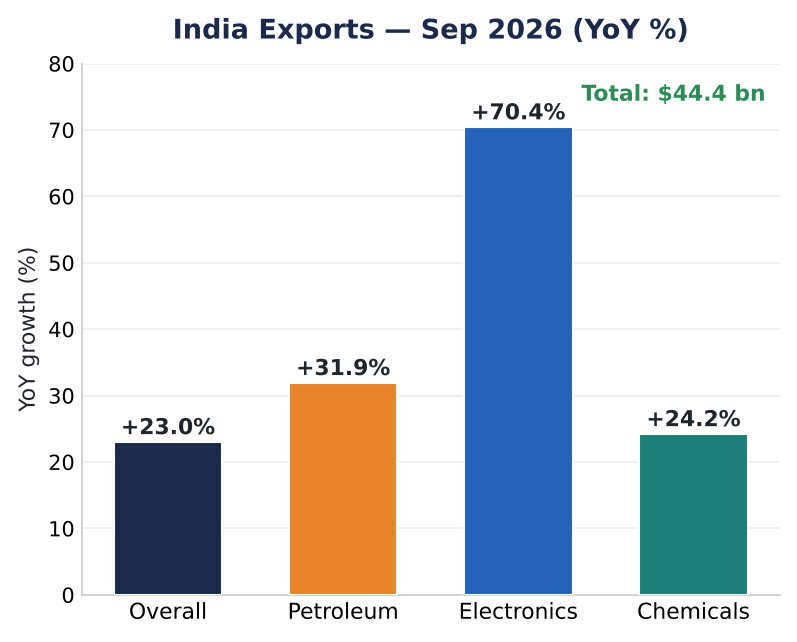
Merchandise exports rose 23.04% year-on-year in September 2026 to $44.4 billion, led by petroleum, electronics and chemicals; imports rose 8% to $74.61 billion.
Launched at the World Health Summit (Berlin), a Lancet Commission report identifies 17 threats to humanity up to 2100, measured in DALYs (disability-adjusted life years).
Key facts
A threat is 'catastrophic' if it could cause 1 billion+ DALYs.
Obesity is flagged as the single largest health loss.
Aid cuts could cause up to 1.5 billion DALYs, with Sub-Saharan Africa worst-hit.
DALY = years of healthy life lost to illness, disability or early death.
Way forward
Preventive health, resilient financing and climate action are needed together to blunt these long-horizon threats.
Concept
DALYs combine years of life lost and years lived with disability; they are a standard WHO/Global Burden of Disease metric.
11. WINDS weather-sensor network to back crop insurance (PMFBY)
The WINDS (Weather Information Network and Data System), run by the Mahalanobis National Crop Forecast Centre, plans a dense sensor grid to make PMFBY crop-insurance payouts faster and data-driven.
Rollout is slow: only 9.4% of AWSs and 4% of rain gauges installed so far.
Land shortage is the main bottleneck to installation.
Hyperlocal weather data cuts disputes in weather-indexed insurance.
Way forward
Faster land allotment and maintenance of sensors are essential for timely, dispute-free PMFBY settlements.
Concept
PMFBY (2016) is India's flagship crop-insurance scheme; WINDS feeds granular weather data to settle claims transparently.
Data point of the day
₹3 lakh crore+
MP Industrial Corridor (Jabalpur-Bhopal-Indore) Expected investment over 3 years; Phase one ~10,000 acres, targeting over 6 lakh jobs. The new state company starts with ₹100 crore share capital.
Prelims rapid-fire
MP is India's largest soybean producer — the 'Soybean State'.
MP is the 'Tiger State' with the country's highest tiger population.
Kuno National Park lies on the Kuno river, a tributary of the Chambal.
RBI repo rate is now 5.50%; MPC stance is 'calibrated tightening'.
PM-AASHA is the Centre's umbrella scheme for farmers' price support (MSP).
Q1. With reference to the Bhavantar Bhugtan Yojana revived in Madhya Pradesh, consider the following:
1. It operates under the Centre's PM-AASHA umbrella.
2. It is aimed at soybean growers for the 2026 kharif season.
3. It pays farmers the difference between MSP and the market (mandi) price.
Which of the above are correct?
1 and 2 only
2 and 3 only
1 and 3 only
1, 2 and 3
Show answer
Answer: D Bhavantar is a price-deficiency model under PM-AASHA, revived for 2026 kharif soybean, paying the gap between MSP and the modal mandi price. All three statements are correct.
Q2. With reference to Project Cheetah in India, which statement is correct?
Kuno National Park is located in Rajasthan.
Cheetahs were first brought from Namibia and South Africa, and later from Botswana.
India's cheetahs are all wild-caught from Africa with no India-born individuals.
Gandhi Sagar Wildlife Sanctuary is in Gujarat.
Show answer
Answer: B Cheetahs came from Namibia (2022), South Africa (2023) and Botswana (2026). Kuno and Gandhi Sagar are in Madhya Pradesh, and India now has 41 India-born cheetahs.
Mains practice question
Q. "Industrial corridors can transform a landlocked state's economy only if land, logistics and skilling move in step." Examine in the context of Madhya Pradesh's new Jabalpur-Bhopal-Indore Industrial Corridor.
Hint / approach
Define industrial corridors; link to DMIC nodes in MP; discuss ₹3 lakh crore investment & 6 lakh jobs potential; flag land pooling, single-window clearances, power/water and skilling as success conditions; conclude on inclusive, job-rich industrialisation.