Wednesday, 23 September 2026 · IST · Bihar + National · 10 items · 2 MCQs
Bihar dominated the day: the Samrat Choudhary Cabinet advanced employment, AI and EV schemes even as record floods left over 46 lakh people affected across 15 districts, while the Economic Survey showed the state economy crossing ₹9.92 lakh crore with 8.6% real growth. Nationally, the Supreme Court ruled that refusing to sing the national song cannot be criminally penalised, India pushed a UNSC seat bid and 'reformed multilateralism' at UNGA-81, and SEBI closed the Hindenburg-linked Adani case for ₹1.5 crore.
Today at a glance — things to remember
Samrat Choudhary Cabinet meets in Patna; festive-season employment & job-creation proposals in focus.
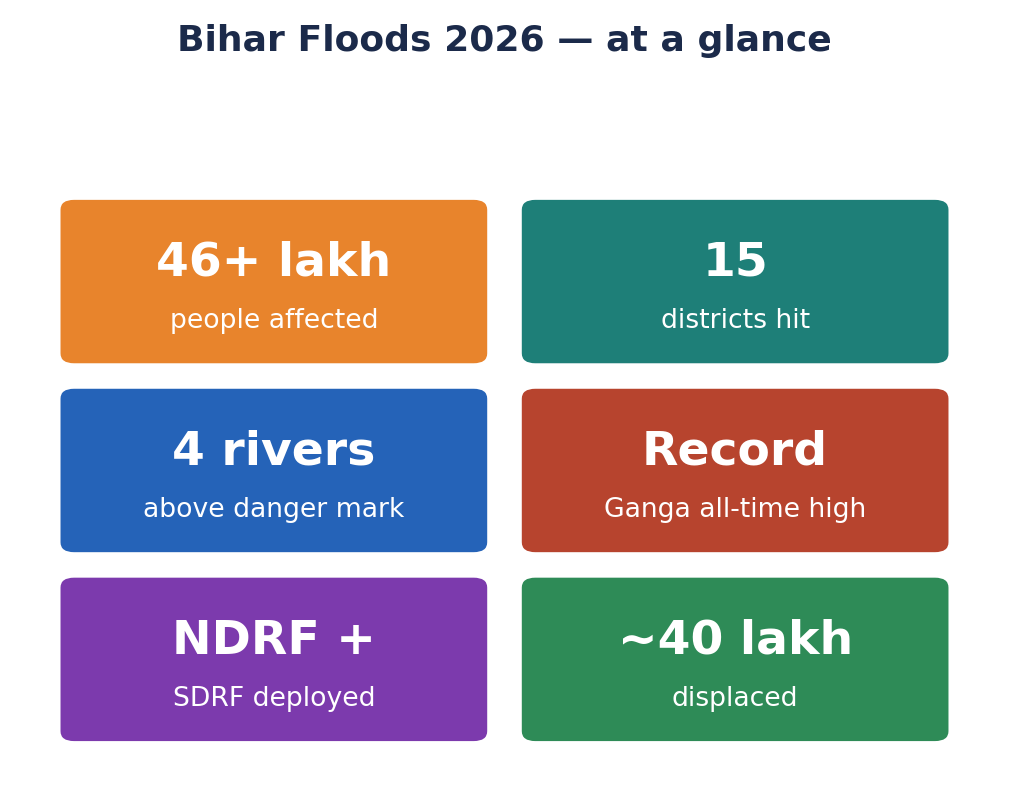
Bihar floods: 46+ lakh people hit across 15 districts as Ganga, Kosi & Gandak stay above danger mark.
State executive & cabinet system; Bihar schemes on employment, industry & welfare — high-yield for the Prelims Bihar section and GS-II governance.
Context
The Bihar Cabinet, chaired by Chief Minister Samrat Choudhary, met in Patna on 23 September 2026 to weigh a fresh batch of employment, welfare and post-creation proposals ahead of the festive season, building on flagship decisions cleared through 2026.
Key facts
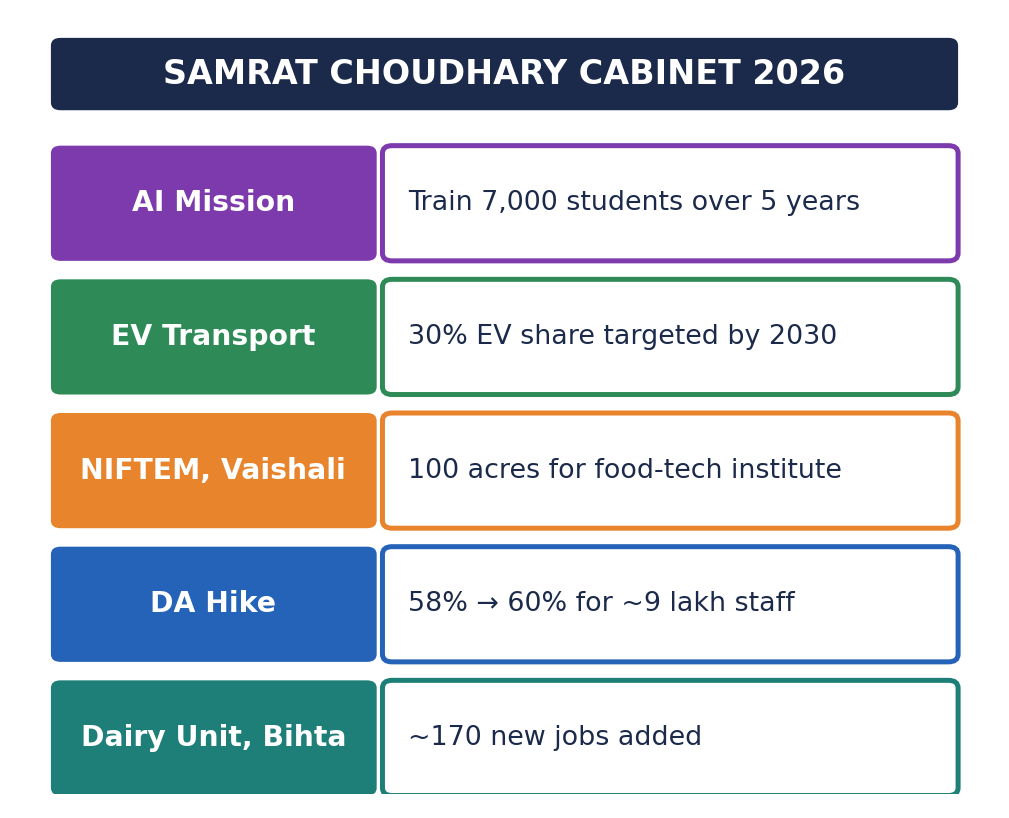
Bihar AI Mission aims to train 7,000 students over 5 years; a new Bihta dairy unit adds ~170 jobs.
The CM's environment-friendly transport scheme targets a 30% EV share by 2030, with incentives for women buyers.
DA was raised to 60% for ~9 lakh employees & 3.5 lakh pensioners; 100 acres in Vaishali went to a NIFTEM food-tech institute.
Way forward
Timely rollout and skilling capacity will decide whether these schemes yield jobs and private investment rather than mere announcements.
Concept
The Council of Ministers is collectively responsible to the Vidhan Sabha (Art. 164); 'cabinet decisions' are executive policy, distinct from Assembly legislation.
Pillar diagram of the Samrat Choudhary Cabinet's flagship 2026 decisions: AI Mission, EV scheme, NIFTEM Vaishali, DA hike and Bihta dairy unit. — StudyForGS
2. Bihar floods hit 46 lakh as Ganga breaks records
Bihar's rivers, flood-prone geography and disaster management — a perennial BPSC theme in both Prelims and GS-II.
Context
Bihar is battling one of its worst flood spells of the decade, with the Ganga breaching all-time-high water marks and Himalayan rivers swelling after heavy upstream rain.
Key facts
Over 46 lakh people across 15 districts are affected; earlier estimates put displacement near 40 lakh (4 million).
The Ganga, Kosi, Gandak and Bagmati are all above the danger mark, with embankment breaches reported.
NDRF and SDRF teams, boats and relief camps are deployed; North Bihar's Kosi–Gandak belt is worst hit.
Way forward
Lasting relief lies in silt management, embankment strengthening and Indo-Nepal coordination on barrage releases — not just annual rescue.
Concept
Bihar is India's most flood-prone state: about 73% of its area is flood-prone. The Kosi is called the 'Sorrow of Bihar' for its shifting course.
Stat-tile row on Bihar floods 2026: 46+ lakh affected, 15 districts, 4 rivers above danger, Ganga at record level, NDRF/SDRF deployed. — StudyForGS
3. Why the Kosi–Gandak flood cycle keeps repeating
River systems of Bihar, barrages and embankments; interlinkage with Nepal — GS-II geography and governance.
Context
This year's deluge has renewed focus on river management, as barrage discharges and weak embankments turned monsoon surplus into disaster across the plains.
Key facts
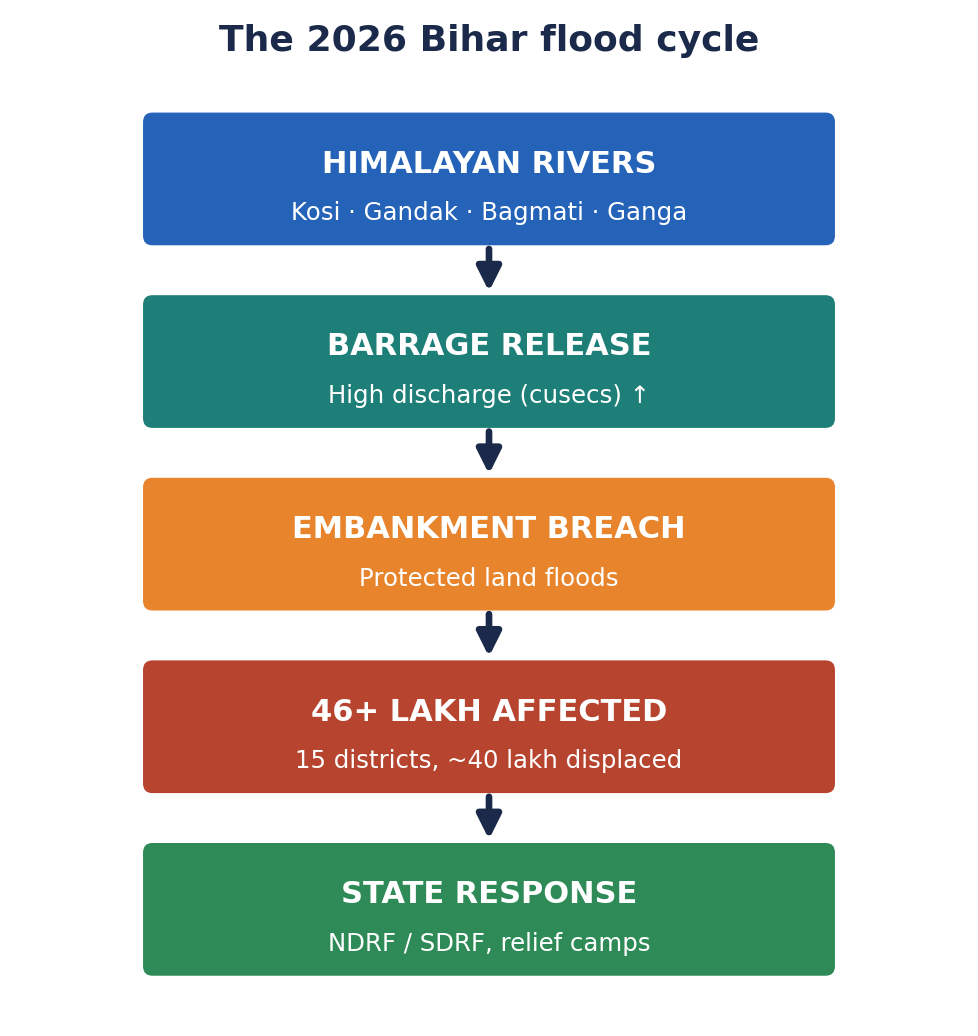
Bihar's flood rivers — Kosi, Gandak, Bagmati, Burhi Gandak — originate in the Nepal/Himalaya and dump heavy silt on the plains.
High-cusec releases from the Kosi and Gandak barrages raise downstream risk within hours.
Embankment breaches convert protected land into flood zones; siltation steadily raises riverbeds.
Way forward
Experts urge catchment-area treatment, desilting and real-time Indo-Nepal data-sharing over purely structural embankments.
Concept
Embankments give short-term protection but can worsen floods by trapping silt and raising riverbeds — a core Bihar geography debate.
Flowchart of the Bihar flood cycle: Himalayan rivers to barrage release to embankment breach to 46 lakh affected to state response. — StudyForGS
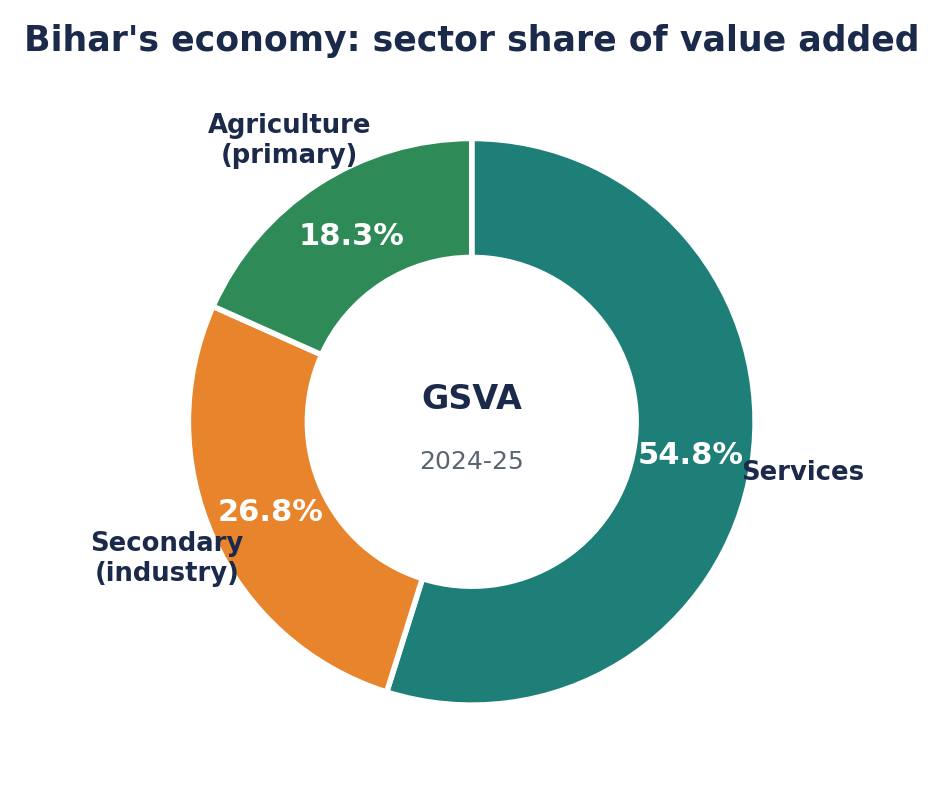
4. Bihar economy crosses ₹9.9 lakh crore, outpaces India
Bihar's economy, growth, per-capita income and sectoral structure — named directly in the BPSC GS-II syllabus.
Context
The latest Bihar Economic Survey (2025-26) shows the state growing faster than the national economy, though per-capita income remains well below the India average.
Key facts
Bihar's GSDP reached ₹9,91,997 crore at current prices in 2024-25.
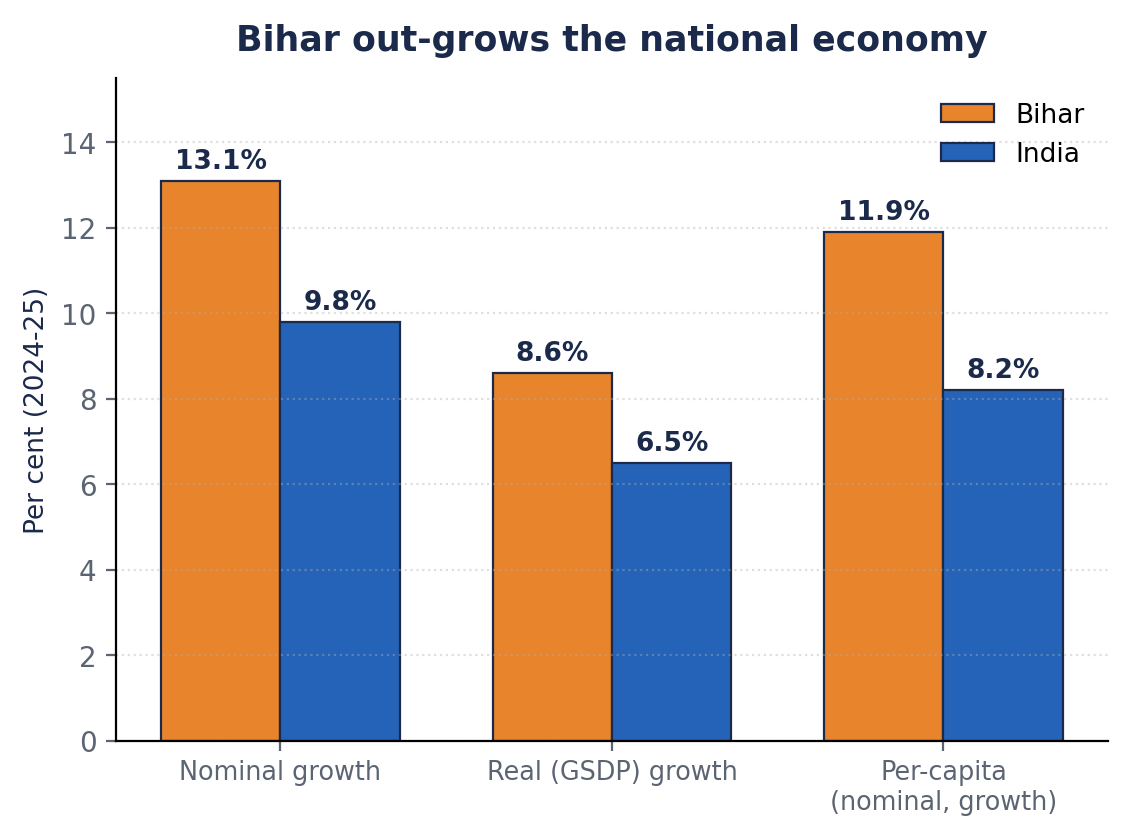
Real growth was 8.6%, ahead of India's 6.5%; nominal growth was 13.1%.
Per-capita income was ₹76,490 — still among India's lowest; the secondary sector grew 11.1%.
Way forward
Sustaining double-digit growth needs faster industrialisation and private investment to lift the low per-capita base.
Concept
GSDP is the state analogue of GDP; per-capita income = net state income ÷ population, a key development indicator.
Grouped bar chart comparing Bihar and India on nominal growth, real GSDP growth and per-capita growth for 2024-25. — StudyForGS
5. Mithila Makhana's GI boom reshapes Bihar's farm economy
High Courts, judicial review and administrative accountability — GS-II polity with a Bihar hook.
Context
The Patna High Court has again used judicial review to check administrative excess, ordering that compensation be recovered from erring officials in a rights matter.
Key facts
A Patna HC bench held a District Magistrate-level action illegal and ordered ₹1 lakh compensation be realised from the responsible officials.
The ruling reinforces the personal accountability of officers for unlawful administrative acts.
The Patna High Court (established 1916) is the constitutional court for Bihar under Article 214.
Way forward
'Cost-on-officials' orders deter arbitrary state action and strengthen citizens' remedies against maladministration.
Concept
Judicial review (Arts. 226/227) lets High Courts quash illegal executive action and grant relief — a basic-structure feature.
7. SC: no criminal penalty for refusing the national song
POLITYBPSC: Prelims + Mains GS-II (Polity — Fundamental Rights)
Syllabus linkage
Fundamental Rights, freedom of conscience and free speech — core GS-II and Prelims polity.
Context
The Supreme Court held that the State cannot criminally punish conscientious objectors who decline to sing the national song, protecting respectful silence.
Key facts
The Court read Articles 25 & 26 (freedom of conscience and religion) to bar compelled patriotic expression.
It relied on Bijoe Emmanuel v. State of Kerala (1986), the classic 'National Anthem' free-conscience case.
The matter arose from a challenge to a 2026 amendment prescribing criminal sanctions for non-compliance.
Way forward
Patriotism by persuasion, not coercion, keeps symbolic law within constitutional free-speech limits.
Concept
Article 19(1)(a) free speech includes the right to silence; Art. 25 protects freedom of conscience.
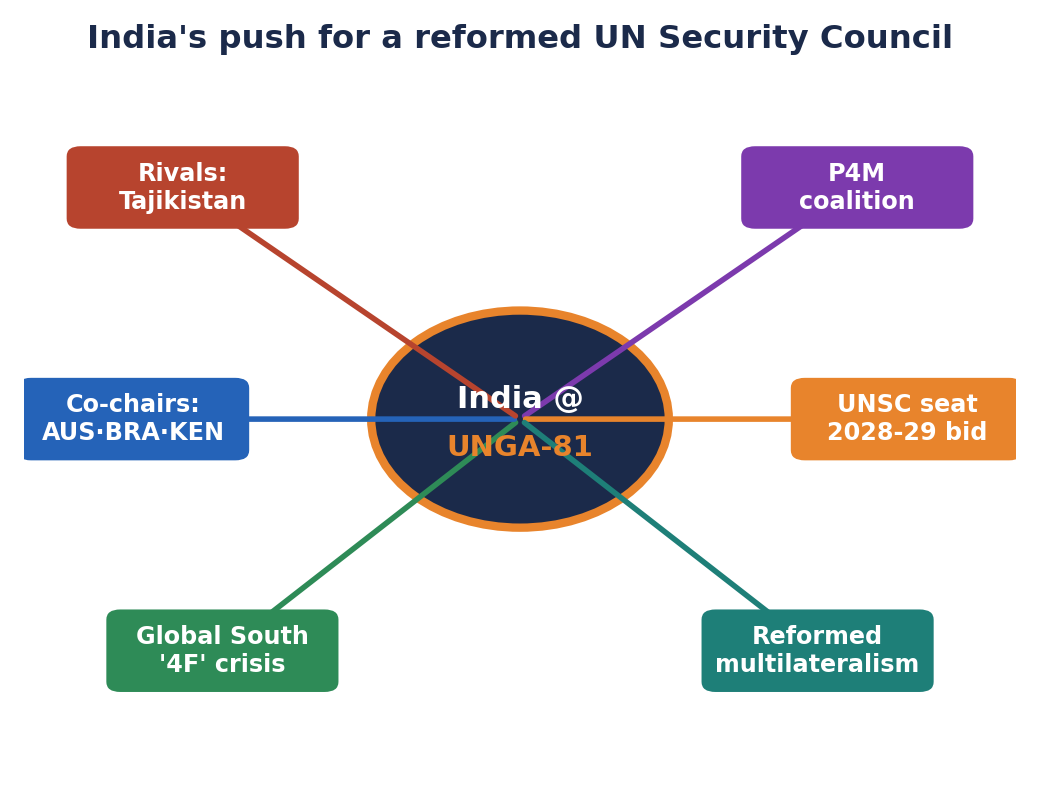
8. India drives UNSC bid & 'reformed multilateralism' at UNGA-81
IRBPSC: Prelims + Mains GS-II (International Relations)
Syllabus linkage
India and the UN, global-governance reform — GS-II IR and Prelims on international institutions.
Context
At the 81st UN General Assembly, India pressed its case for a permanent UNSC seat and joined a coalition for institutional reform.
Key facts
India joined the Partnership for Multilateralism (P4M), co-chairing with Australia, Brazil, Barbados and Kenya.
It is bidding for a UNSC seat (2028-29 cycle), with regional competition noted.
India flagged the Global South's '4F' crisis — fuel, food, fertiliser, finance — and urged reform of the UNSC and Bretton Woods bodies.
Way forward
Sustained coalition-building and credibility on Global-South issues are key to any UNSC reform breakthrough.
Concept
The UNSC has 5 permanent (P5) veto-holding members and 10 elected; reform needs Charter amendment backed by the P5.
Mind map of India at UNGA-81: P4M coalition, UNSC 2028-29 bid, reformed multilateralism, Global South 4F crisis, co-chairs and rivals. — StudyForGS
9. SEBI settles Hindenburg-linked Adani case for ₹1.5 crore
Renewable energy and role of S&T in development — GS-II sci-tech, with a Bihar potential angle.
Context
Placing solar panels over irrigation canals is emerging as a land-free route to clean power, saving both land and water.
Key facts
Canal-top PV (CTPV) needs no extra land; a Punjab project saved about 100 acres.
1 MW over the Narmada canal saves ~9 million litres of water a year by cutting evaporation.
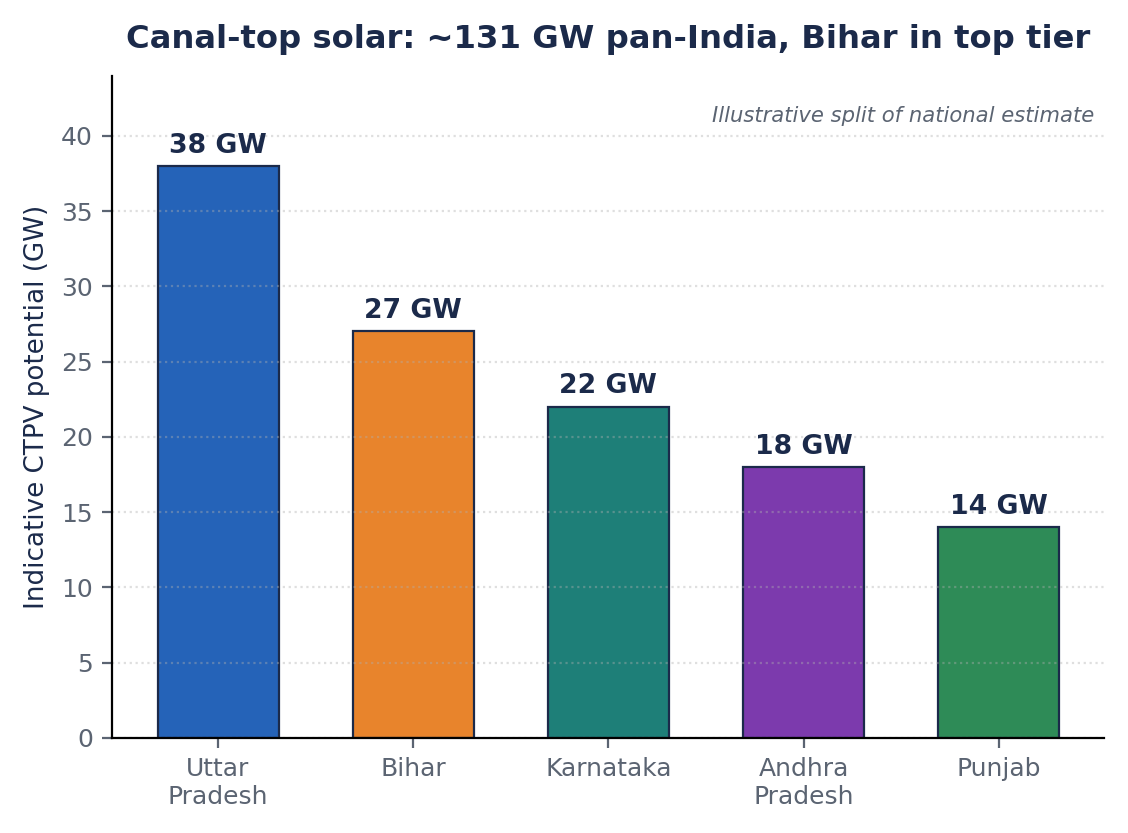
National CTPV/canal-bank potential is pegged near 131 GW, with Bihar, UP, Karnataka, AP and Punjab ranking high.
Way forward
Lower structural costs and viability-gap support can scale CTPV alongside rooftop and floating solar.
Concept
CTPV differs from floating solar; both cut land use and evaporation, aiding India's 500 GW non-fossil by 2030 goal.
Bar chart of indicative canal-top solar (CTPV) potential by state, with Bihar in the top tier of a ~131 GW national estimate. — StudyForGS
Data point of the day
₹9.92 lakh crore
Size of Bihar's economy (GSDP, current prices, 2024-25) Bihar's GSDP grew 8.6% in real terms in 2024-25 — faster than India's 6.5% — even as per-capita income (₹76,490) stayed among the country's lowest. Secondary-sector growth of 11.1% signals a gradual industrial pickup.
Prelims rapid-fire
Battle of Haifa (23 September 1918): Indian cavalry (Jodhpur, Mysore, Hyderabad Lancers) freed Haifa in WWI — marked as Haifa Day.
UP Gangsters Act, 1986: SC flagged that defining a 'crime' cannot be left to executive discretion — the Article 20(1) legality principle.
Critical minerals: India is eyeing lithium & nickel processing (including a Mali venture) to build its EV-battery ecosystem.
Special Intensive Revision (SIR): SC found ~33 lakh Delhi voter notices 'mechanically issued'; disposal deadline 29 October.
Shahi Litchi (Muzaffarpur) and Jardalu mango (Bhagalpur) carry GI tags — frequent BPSC Prelims picks.
Q1. With reference to Bihar's rivers, consider the following statements: 1. The Kosi originates in the Nepal/Himalaya. 2. The Kosi is known as the 'Sorrow of Bihar'. 3. The Gandak is a tributary of the Ganga. Which of the above are correct?
1 and 2 only
2 and 3 only
1 and 3 only
1, 2 and 3
Show answer
Answer: D All three are correct. The Kosi rises in the Himalaya/Nepal, is called the 'Sorrow of Bihar' for its shifting course, and the Gandak (Narayani) is a left-bank tributary of the Ganga.
Q2. The case 'Bijoe Emmanuel v. State of Kerala (1986)' is chiefly associated with which fundamental right?
Right to property
Freedom of conscience and religion
Right to constitutional remedies
Right against exploitation
Show answer
Answer: B It upheld students' freedom of conscience (Arts. 19(1)(a) & 25) in the National Anthem case — cited in the 2026 national-song ruling.
Mains practice question
Q. Bihar is India's most flood-prone state. Examine the geographical causes of recurring floods in north Bihar and suggest a sustainable river-management strategy. (BPSC Mains, GS-II)
📌 One-line revision: Remember today: Bihar GSDP ₹9.92 lakh crore (8.6% real growth) • 46 lakh flood-affected across 15 districts • SC: no penalty for refusing the national song • India's P4M & UNSC push at UNGA-81 • Canal-top solar ~131 GW potential.