Download the PDF
| 📄 PDF details | ✅ Information |
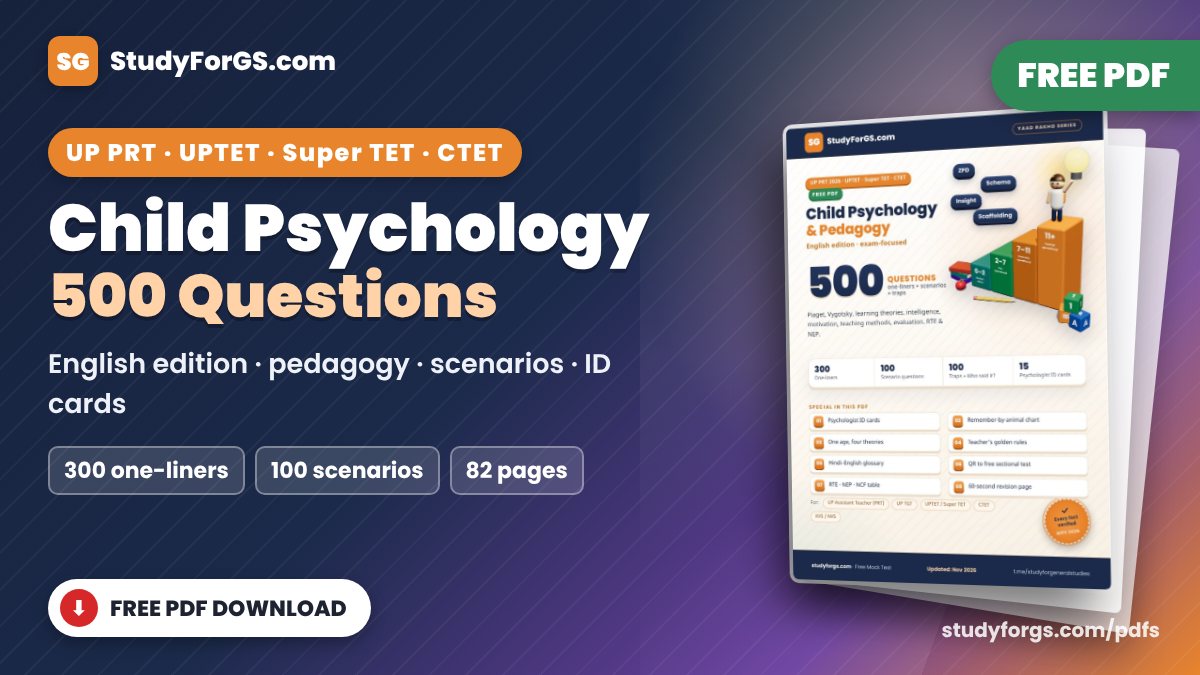
| 📌 PDF name | Child Psychology & Pedagogy — 500 Questions (Yaad Rakho Series, English) |
| 🎯 Useful for | UP Assistant Teacher (PRT) 2026, UPTET, Super TET, CTET Paper 1 & 2, KVS / NVS PRT, other state teacher recruitment exams |
| 📚 Chapters | 7 chapters — child development; development theories (Piaget, Vygotsky, Kohlberg, Erikson, Freud); learning; intelligence, personality, motivation & memory; inclusive education; pedagogy & methods; assessment, action research & policies — plus ID cards, animal chart, who-said-it, trap pairs, 100 scenarios, RTE-NEP-NCF table, glossary |
| 🔢 Questions & pages | 500 one-liner questions & answers · 82 pages |
| 🗣️ Medium | Simple English · highlighted answers · trap + trick box in every chapter · 'why' and 'why not the others' for every scenario · QR codes to free tests |
| 🖨️ Format | A4 PDF — for print and mobile |
| ✍️ Prepared by | StudyForGS.com |
| 📥 Download | Use the red button in the box below 👇 |
7 chapters in the PDF
Child psychology — superfast quick revision table
| 📌 Topic | ✅ Fact |
| Jean Piaget | Cognitive development — 4 stages: sensorimotor (0–2), pre-operational (2–7), concrete operational (7–11), formal operational (11+) |
| Lev Vygotsky | Sociocultural theory — Zone of Proximal Development (ZPD), scaffolding, private speech |
| Lawrence Kohlberg | Moral development — 3 levels, 6 stages: pre-conventional, conventional, post-conventional |
| Erik Erikson | Psychosocial development — 8 stages; the first is trust vs mistrust |
| Sigmund Freud | Psychoanalysis — id, ego, superego; 5 psychosexual stages |
| Ivan Pavlov | Classical conditioning — dog, bell and salivation experiment |
| Edward L. Thorndike | Trial and error — cat, puzzle box; laws of readiness, exercise and effect |
| B. F. Skinner | Operant conditioning — rats and pigeons, Skinner box, reinforcement |
| Wolfgang Köhler | Insight learning — chimpanzee Sultan; Gestalt |
| Albert Bandura | Social / observational learning — Bobo doll experiment (1961) |
| Howard Gardner | Theory of multiple intelligences (1983) |
| Abraham Maslow | Hierarchy of needs (1943) — self-actualisation at the top |
| RTE Act 2009 | Free and compulsory education for ages 6–14; in force from 1 April 2010; Section 12(1)(c) — 25% seats; Section 17 — bans physical punishment and mental harassment |
| NEP 2020 | 5+3+3+4 structure; foundational stage 3–8 years; mother tongue / local language as medium at least till Class 5 |
| NIPUN Bharat · Mission Prerna | NIPUN Bharat 5 July 2021 (FLN by Class 3); Mission Prerna (Uttar Pradesh) September 2019 |
Top 42 one-liners (from the PDF)
- Child Development: Concepts, Stages, Heredity & EnvironmentOf growth and development, which concept is broader?→ Development
- Child Development: Concepts, Stages, Heredity & EnvironmentDevelopment does not occur in a straight line; what shape is its course considered to have?→ Spiral / circular
- Child Development: Concepts, Stages, Heredity & EnvironmentWhat is the first stage of prenatal development (about the first two weeks) called?→ Germinal stage
- Child Development: Concepts, Stages, Heredity & EnvironmentWho called adolescence the period of "Storm and stress"?→ G. Stanley Hall
- Child Development: Concepts, Stages, Heredity & EnvironmentWho coined the term "Eugenics"?→ Francis Galton (1883)
- Child Development: Concepts, Stages, Heredity & EnvironmentWhat are the units that carry hereditary traits from generation to generation called?→ Genes
- Development Theories: Piaget, Vygotsky, Kohlberg, Erikson, Freud, Bruner, Language DevelopmentWhat is the age range of Piaget's Pre-operational stage?→ 2 to 7 years
- Development Theories: Piaget, Vygotsky, Kohlberg, Erikson, Freud, Bruner, Language DevelopmentWhat is changing an old schema or creating a new one according to new information called?→ Accommodation
- Development Theories: Piaget, Vygotsky, Kohlberg, Erikson, Freud, Bruner, Language DevelopmentAccording to Vygotsky, what is the correct sequence of speech development?→ Social → Private → Inner speech
- Development Theories: Piaget, Vygotsky, Kohlberg, Erikson, Freud, Bruner, Language DevelopmentSocial contract and universal ethical principles come under which level of Kohlberg?→ Post-conventional
- Development Theories: Piaget, Vygotsky, Kohlberg, Erikson, Freud, Bruner, Language DevelopmentWhat is the Erikson crisis of children in primary classes (about 6–12 years)?→ Industry vs Inferiority
- Development Theories: Piaget, Vygotsky, Kohlberg, Erikson, Freud, Bruner, Language DevelopmentAccording to Bruner, what are the three modes of representing knowledge in the correct order?→ Enactive → Iconic → Symbolic
- Learning: Theories, Curve, Transfer & FactorsSalivation stopping when only the bell is rung repeatedly without giving food is called what?→ Extinction
- Learning: Theories, Curve, Transfer & FactorsThe Law of use and disuse is part of which primary law of Thorndike?→ Law of Exercise
- Learning: Theories, Curve, Transfer & FactorsGiving reinforcement after a fixed time has passed, like a monthly salary, is which schedule?→ Fixed interval
- Learning: Theories, Curve, Transfer & FactorsWho propounded the theory of social learning / Observational learning?→ Albert Bandura
- Learning: Theories, Curve, Transfer & FactorsThe early study of the learning plateau was done on learning which skill?→ Telegraphy (telegraph messages)
- Learning: Theories, Curve, Transfer & FactorsAccording to Bandura, what is the belief in one's own ability to perform a task successfully called?→ Self-efficacy
- Intelligence, Personality, Motivation, Memory, Attention & EmotionIf the mental age of a 10-year-old child is 12 years, what will be his Intelligence Quotient?→ 120
- Intelligence, Personality, Motivation, Memory, Attention & EmotionWhich eighth intelligence did Gardner add later?→ Naturalistic intelligence
- Intelligence, Personality, Motivation, Memory, Attention & EmotionWho developed the Thematic Apperception Test (TAT)?→ Murray and Morgan (1935)
- Intelligence, Personality, Motivation, Memory, Attention & EmotionHow many levels are there in Maslow's original (1943) hierarchy?→ Five
- Intelligence, Personality, Motivation, Memory, Attention & EmotionWho stated the capacity of Short-term memory as 7 ± 2 units?→ George Miller (1956)
- Intelligence, Personality, Motivation, Memory, Attention & EmotionWho classified intelligence into abstract, mechanical (concrete) and social intelligence?→ Thorndike
- Individual Differences, Inclusive Education & CWSNTeaching by changing content, pace and activity according to the individual differences in a class is called what?→ Differentiated instruction
- Individual Differences, Inclusive Education & CWSNWhich type of thinking is mainly found in a Creative child?→ Divergent thinking
- Individual Differences, Inclusive Education & CWSNDifficulty in understanding numbers, calculation and mathematical operations is associated with which learning disability?→ Dyscalculia
- Individual Differences, Inclusive Education & CWSNHow many types of disabilities are recognised in the Rights of Persons with Disabilities (RPwD) Act 2016?→ 21
- Individual Differences, Inclusive Education & CWSNAll children study in the same class and the school adapts itself to them — which education is this?→ Inclusive education
- Individual Differences, Inclusive Education & CWSNWhich script for visually impaired children is based on six raised dots?→ Braille
- Pedagogy: Maxims, Methods, Micro-teaching, Lesson Planning & BloomReciting the whole poem first and then explaining it line by line is based on which maxim of teaching?→ Whole to part
- Pedagogy: Maxims, Methods, Micro-teaching, Lesson Planning & BloomWhich method is more suitable for teaching a new mathematical rule for the first time in a primary class?→ Inductive method
- Pedagogy: Maxims, Methods, Micro-teaching, Lesson Planning & BloomWhich school for children did Montessori open in Rome in 1907?→ Casa dei Bambini (Children's House)
- Pedagogy: Maxims, Methods, Micro-teaching, Lesson Planning & BloomWho is the originator of the Heuristic method, based on learning by finding out oneself?→ H. E. Armstrong
- Pedagogy: Maxims, Methods, Micro-teaching, Lesson Planning & BloomHow many students and what duration are usually kept in micro-teaching?→ 5–10 students, 5–10 minutes
- Pedagogy: Maxims, Methods, Micro-teaching, Lesson Planning & BloomIn which year was Bloom's Taxonomy of educational objectives first published?→ 1956
- Assessment, Action Research & Education PoliciesWhich assessment finds out progress from time to time during teaching and gives feedback?→ Formative assessment
- Assessment, Action Research & Education PoliciesWhat is the teaching done to remove the difficulty identified after diagnosis called?→ Remedial teaching
- Assessment, Action Research & Education PoliciesWhich evaluation compares a student's performance with other students of the group?→ Norm-referenced
- Assessment, Action Research & Education PoliciesWhich technique finds out the mutual social relationships of children in a class?→ Sociometry
- Assessment, Action Research & Education PoliciesAccording to Section 29 of RTE 2009, what should the medium of instruction be, as far as possible?→ The child's mother tongue
- Assessment, Action Research & Education PoliciesWhen was the NIPUN Bharat Mission launched?→ 5 July 2021
458 more questions — Download Free PDF
Frequently asked questions
Is this child psychology PDF really free?
Yes — no login, email or payment. Use the red button to download; share it, but please don't sell it.
How many questions does it have and what is inside?
500 questions in all: 300 one-liners in 7 chapters (child development 45, development theories 55, learning 55, intelligence-personality-motivation 45, inclusive education 30, pedagogy 40, assessment & policies 30), 50 who-said-it, 50 trap pairs and 100 scenario-based questions. Plus 15 psychologist ID cards, an animal chart, a 'one age, four theories' table, 10 golden rules, an RTE-NEP-NCF table, an 80-word Hindi–English glossary and a 60-second revision page.
Is it useful for UP Assistant Teacher (PRT) 2026?
Yes. PRT 2026 has 8 questions each on child psychology, pedagogy and life skills/management out of 120. This PDF fully covers the first two, and the scenario questions also help with the third.
What are scenario-based questions?
Questions on a classroom situation such as 'what should the teacher do?'. Each one gives the right answer, why it is right and why the other options are not.
Is there a Hindi edition?
Yes — the full Hindi edition is free too; open it from the 'हिंदी में पढ़ें' link above.
Where can I practise after reading?
Every chapter ends with a QR code to the free Child Psychology sectional test and the free UP PRT Full Mock 1.
Is it useful for CTET, UPTET and Super TET too?
Yes — the core child development and pedagogy syllabus (theories, learning, inclusive education, assessment, RTE-NEP) is the same across teacher exams.
More PDFs

[PDF] 📕 UPSC Prelims Hacked 2.0
13 Golden Rules tested against 1,268 real UPSC Prelims PYQs (2013–2025)
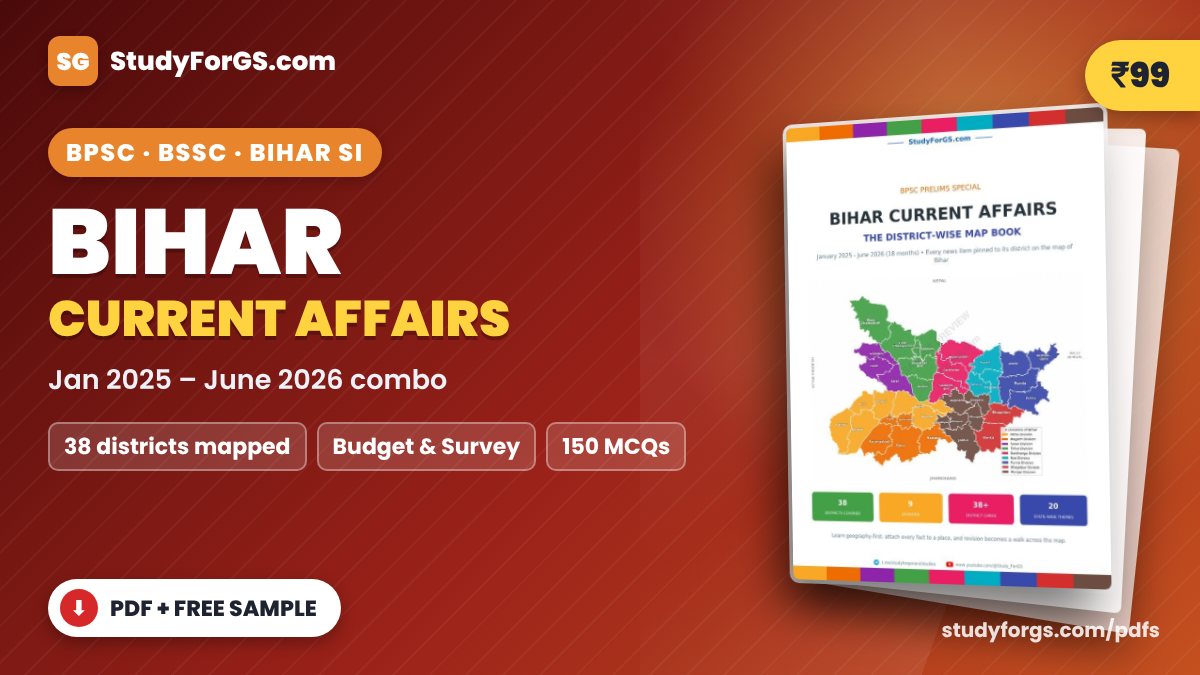
[PDF] 📕 Bihar Current Affairs Combo
Jan 2025 – June 2026 Bihar CA, district map book, budget & economic survey, 150 History MCQs
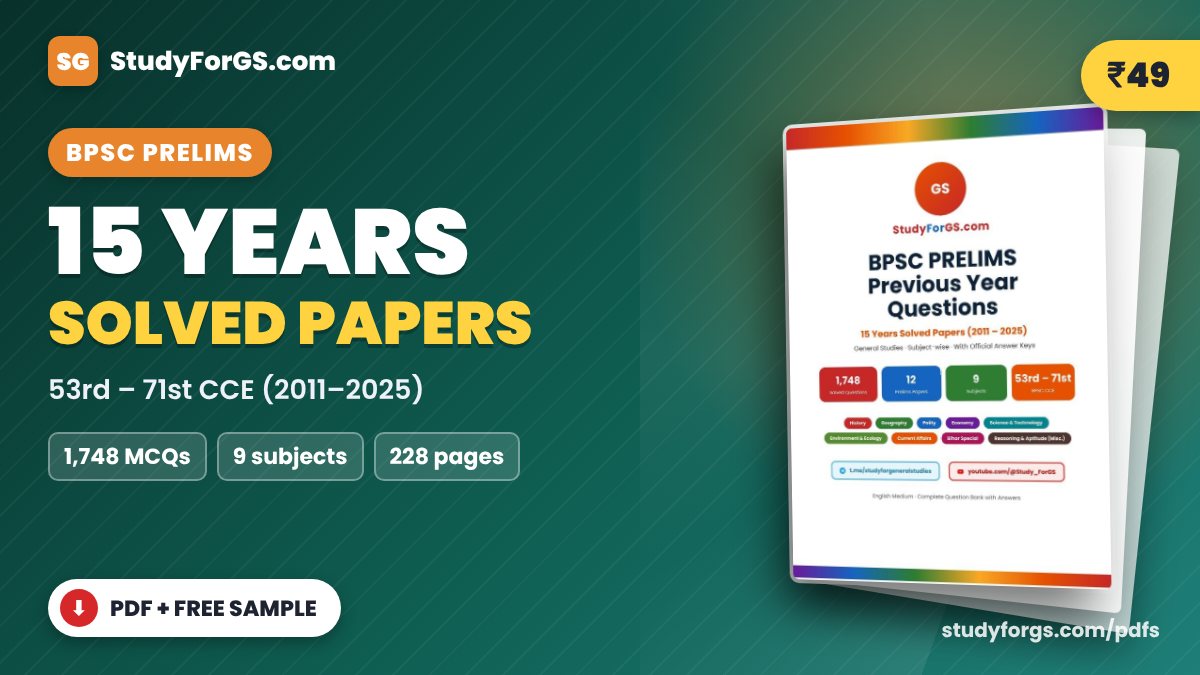
[PDF] 📕 BPSC Prelims 15 Years Solved Papers (2011-2025)
1,748 solved MCQs from 53rd–71st BPSC CCE, answers highlighted, 228 pages
Original study material by StudyForGS.com. Facts are as of 8 November 2026; where sources or exam answer keys differ, the note gives the basis.