Daily Current Affairs for Uttar Pradesh PSC (UPPCS)
UPPSC Current Affairs — 2 November 2026
CM unveils ₹520-crore projects in Gonda and reviews Ayodhya Deepotsav; Delhi–Varanasi bullet train corridor and ₹17,542-crore link expressways headline UP's infra push
Monday, 2 November 2026 · IST · Uttar Pradesh + National · 9 items · 2 MCQs
On 2 November the Chief Minister launched 69 projects worth over ₹520 crore in Gonda and reviewed preparations for the 10th Ayodhya Deepotsav. The week's big UP stories are the bullet-train Northern Corridor linking Delhi with Agra, Lucknow, Ayodhya and Varanasi, four new link expressways (~322 km, ₹17,542 crore), the ₹1,725-crore Sardar Patel skill scheme and a ₹104.28-crore Cyber Security Operations Centre. Nationally, October GST collections jumped 22.9% to ₹2.31 lakh crore.
Today at a glance — things to remember
Gonda: 69 projects worth over ₹520 crore in Mankapur and Gaura.
Ayodhya: CM reviews 10th Deepotsav; main lighting on 7 November.
Bullet train Northern Corridor approved — Delhi to Varanasi in about 3.5 hours; Namo Bridge ₹2,657 crore.
Four link expressways (~322 km, ₹17,542 crore) by UPEIDA in 3 years.
On 2 November the Chief Minister inaugurated and laid foundation stones for development works in Gonda district and distributed scheme benefits.
Key facts
69 projects worth over ₹520 crore — inaugurations and foundation stones.
Spread over the Mankapur and Gaura Assembly constituencies of Gonda district.
Approval letters and cheques handed to beneficiaries of state welfare schemes at the same event.
CM linked the upcoming Ayodhya Deepotsav to livelihoods for potters, farmers, labourers and small traders.
Way forward
District-level project bundles in eastern UP (Devipatan division) show the state's push to spread public assets beyond big cities — a ready example for Mains answers on balanced regional development.
Concept
Gonda is part of the Devipatan division along with Bahraich, Balrampur and Shrawasti; the region lies in the Terai-adjoining north-eastern plains of UP.
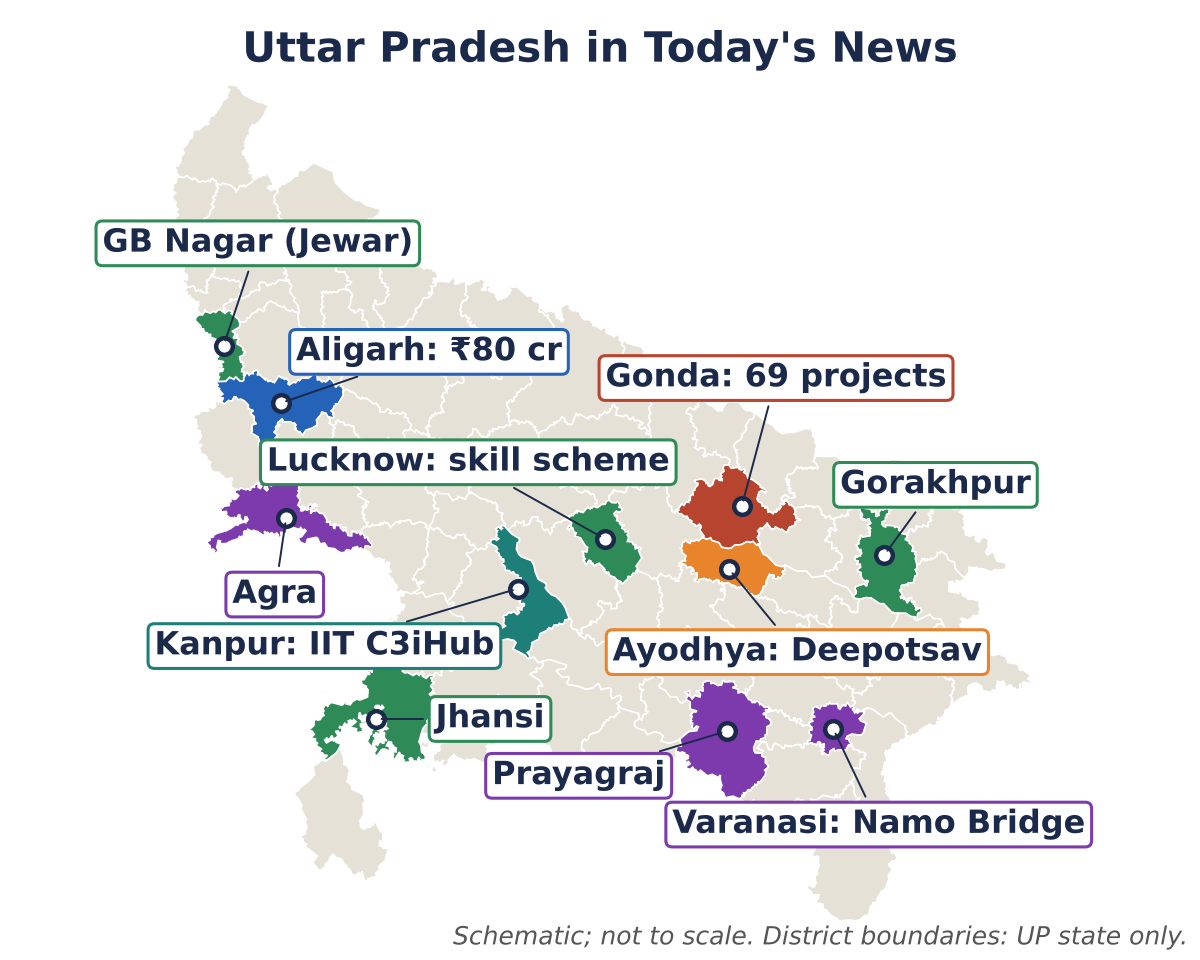
Map of Uttar Pradesh districts highlighting Gonda, Ayodhya, Lucknow, Kanpur Nagar, Varanasi, Aligarh, Gorakhpur, Jhansi and Gautam Buddha Nagar as places in today's news. — StudyForGS
2. Ayodhya: CM reviews preparations for the 10th Deepotsav (main lighting on 7 November)
GS-I Indian culture, fairs & festivals | GS-VI UP: cultural heritage, religious tourism economy
Context
The Chief Minister visited Ayodhya on 2 November to inspect Ram ki Paidi, the Saryu Aarti site and Ram Katha Park ahead of the festival.
Key facts
10th edition of Deepotsav (first held in 2017); main diya lighting on 7 November 2026, eve of Diwali.
Earthen lamps along the Saryu ghats including Ram ki Paidi; target reported at over 26 lakh diyas.
1 lakh diyas inside the Shri Ram Janmabhoomi Teerth Kshetra complex, lit by about 1,000 workers in 5 zones.
2025 edition:26,17,215 diyas and two Guinness World Records (largest oil-lamp display; most people doing diya aarti together).
Way forward
Deepotsav has become a template of 'culture-led economy': it drives demand for local potters and artisans, hotels and transport — a strong case study for UP's religious-tourism circuit (Ayodhya–Varanasi–Prayagraj).
Concept
Ayodhya lies on the right bank of the Saryu (Ghaghara); Faizabad district was renamed Ayodhya in 2018.
3. Bullet train 'Northern Corridor' approved: Delhi–Agra–Kanpur–Lucknow–Ayodhya–Varanasi; Namo Bridge for Varanasi
UP-INFRAUPPSC: Prelims + Mains GS-III (UP-special GS-VI: UP infrastructure)
The Union Railway Minister announced in Varanasi on 31 October that the Prime Minister has approved the Northern Corridor of the bullet-train network.
Key facts
Route: Delhi–Agra–Kanpur–Lucknow–Ayodhya–Prayagraj–Varanasi, onward to Patna, Siliguri and Guwahati.
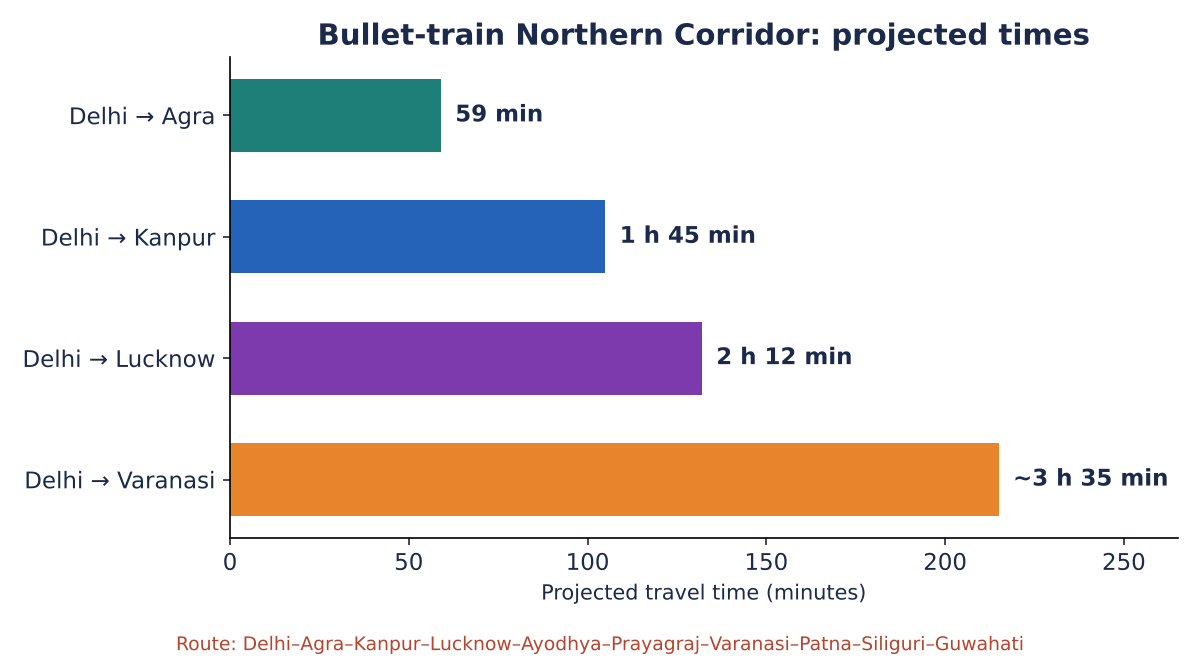
Projected times: Delhi–Agra 59 min, Delhi–Lucknow 2 h 12 min, Delhi–Varanasi about 3.5 h; Lucknow–Varanasi about 1 h 21 min.
Namo Bridge, Varanasi: 2.5 km double-decker over the Ganga — 6-lane road above, 4 rail lines below; cost ₹2,657 crore, target 2029.
First bullet-train corridor to pass through UP; fares indicated to be lower than air travel.
Way forward
High-speed rail would knit UP's six largest cultural-economic nodes into one corridor, cutting travel time by two-thirds and boosting tourism, services and real estate along the route; land acquisition and financing are the key challenges.
Concept
India's first high-speed rail project is the 508 km Mumbai–Ahmedabad corridor, built by NHSRCL with Japanese Shinkansen technology.
Horizontal bar chart of projected bullet-train travel times from Delhi: Agra 59 minutes, Kanpur 1 hour 45 minutes, Lucknow 2 hours 12 minutes, Varanasi about 3 hours 35 minutes. — StudyForGS
4. Cabinet clears four link expressways — about 322 km for ₹17,542 crore
GS-III Infrastructure — roads, PPP/EPC models | GS-VI UP: expressway network, Bundelkhand & western UP
Context
The state Cabinet on 27 October approved 22 proposals, the largest being four link expressways to stitch together UP's existing expressway grid.
Key facts
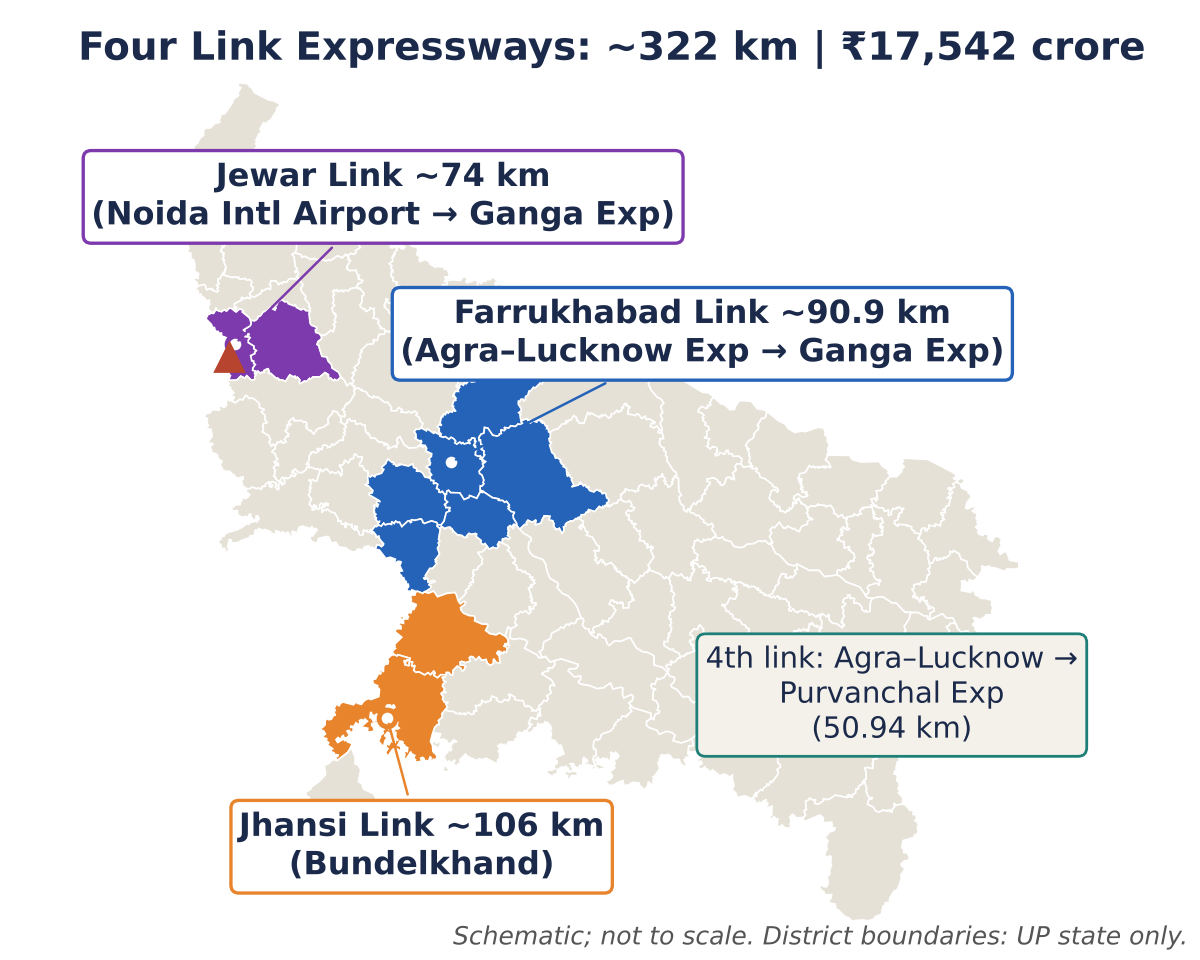
Farrukhabad Link (~90.9 km): Agra–Lucknow Expressway to Ganga Expressway (Etawah, Kannauj, Mainpuri, Farrukhabad, Hardoi, Shahjahanpur).
Agra–Lucknow to Purvanchal Expressway Link (50.94 km); Jhansi Link (~106 km) for Bundelkhand.
Jewar Link (~74 km): Noida International Airport to Ganga Expressway via Bulandshahr.
Total ₹17,542.06 crore, fully state-funded; built by UPEIDA on EPC model in 3 years + 5 years maintenance.
Way forward
Links convert separate expressways into a network, so freight from Bundelkhand or the Jewar airport hub can move across the state without city bottlenecks — vital for UP's industrial corridors and the $1-trillion economy goal.
Concept
UPEIDA (UP Expressways Industrial Development Authority) builds the state's expressways; the Ganga Expressway (Meerut–Prayagraj, 594 km) is UP's longest.
Map of Uttar Pradesh districts shading the districts served by the Farrukhabad, Jhansi and Jewar link expressways, with Noida International Airport marked. — StudyForGS
5. ₹1,725-crore Sardar Vallabhbhai Patel Skill Training and Employment Zone scheme launched
UP-SCHEMEUPPSC: Prelims + Mains GS-III (UP-special GS-V: UP schemes, employment)
Syllabus linkage
GS-III Employment & skill development | GS-V UP: state welfare and employment schemes
Context
The Chief Minister launched the scheme in Lucknow on 31 October, the 151st birth anniversary of Sardar Patel (Rashtriya Ekta Diwas).
Key facts
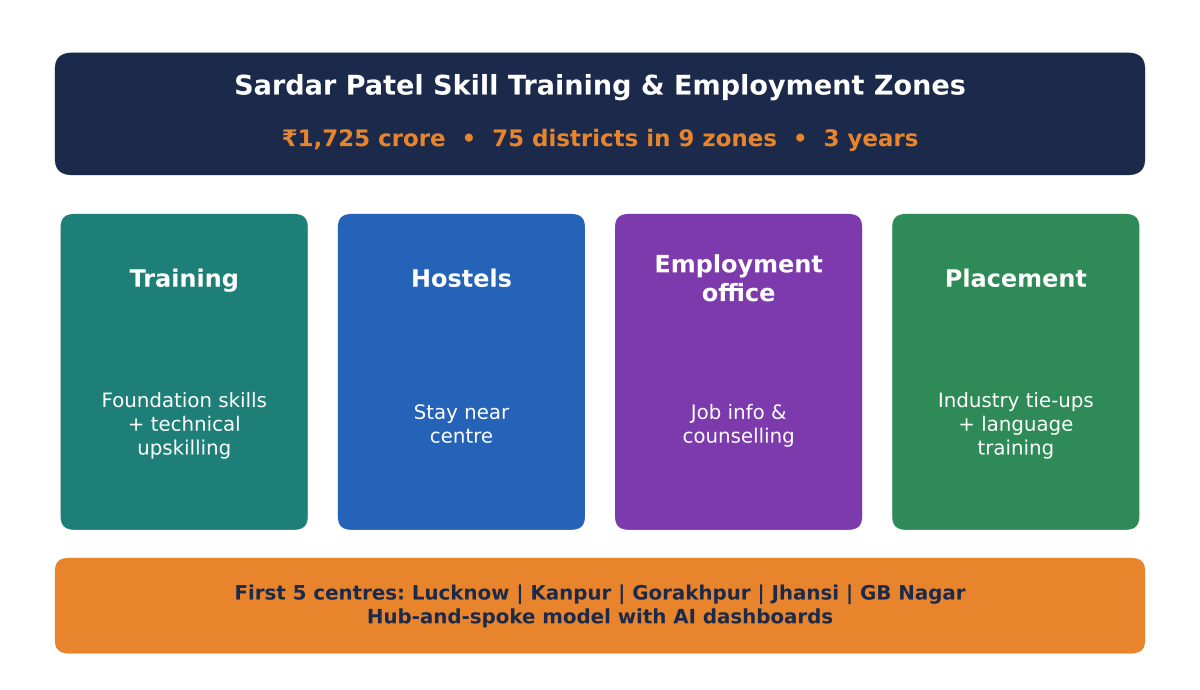
Outlay ₹1,725 crore, to be implemented over 3 years.
All 75 districts grouped into 9 zones; first 5 centres: Lucknow, Kanpur, Gorakhpur, Jhansi, Gautam Buddha Nagar.
Hub-and-spoke centres with training, hostels, employment offices and placement support.
Foundation skills for arts/commerce students, upskilling for ITI-polytechnic-engineering youth, language training for jobs abroad; AI-based dashboards to track outcomes.
Way forward
Linking training to placement and hostels addresses UP's core problem — a large young workforce with low employability; outcome tracking will decide whether it goes beyond certificates.
Concept
Rashtriya Ekta Diwas (31 October) has been observed since 2014 to mark Sardar Patel's birth anniversary; he integrated over 560 princely states.
Pillar diagram of the Sardar Patel skill scheme: ₹1,725 crore outlay, 75 districts in 9 zones, 5 first centres, 3-year rollout, and four service pillars—training, hostels, employment offices, placement. — StudyForGS
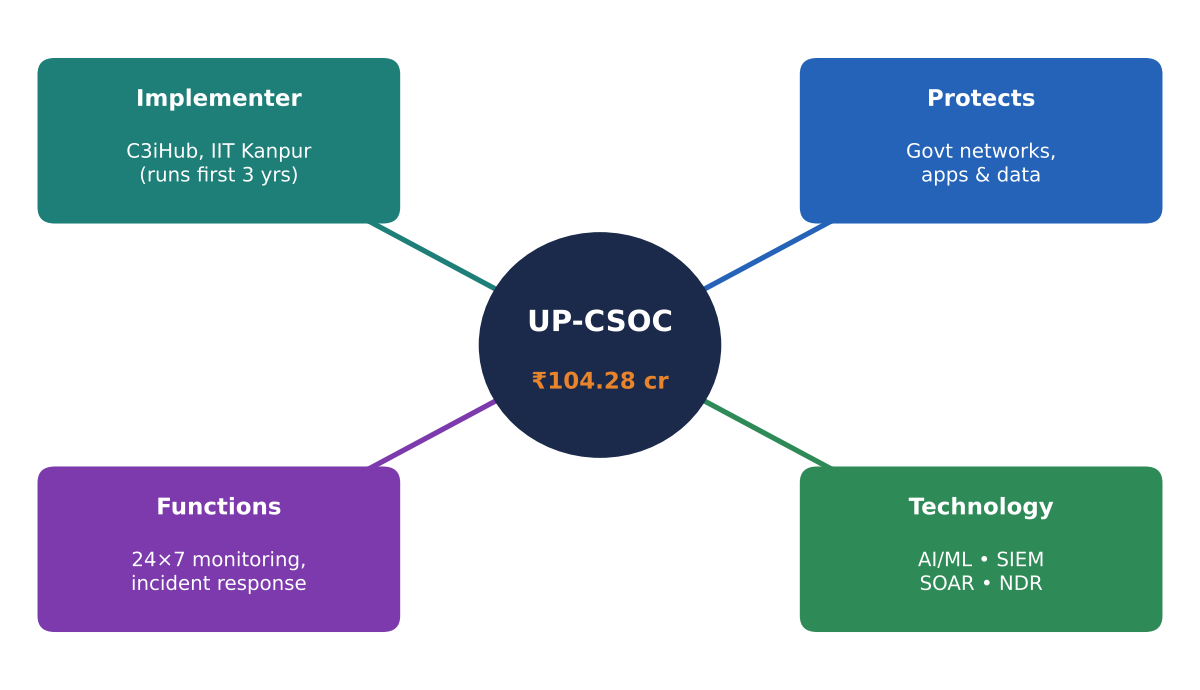
6. UP Cyber Security Operations Centre (UP-CSOC) approved at ₹104.28 crore with IIT Kanpur's C3iHub
C3iHub earlier set up SOCs for SAIL (Bhilai Steel Plant), NHAI and the Indian Ports Association.
Way forward
As more services move online, a dedicated state SOC protects citizen data and critical systems; using a home-grown IIT hub also builds local cyber capacity.
Concept
C3iHub is a Technology Innovation Hub under the National Mission on Interdisciplinary Cyber-Physical Systems (NM-ICPS); CERT-In is the national nodal agency under Section 70B of the IT Act, 2000.
Mind-map of UP-CSOC: centre node with branches for cost ₹104.28 crore, implementer C3iHub IIT Kanpur, functions such as 24x7 monitoring and incident response, and technologies AI/ML, SIEM, SOAR, NDR. — StudyForGS
7. Power bills: record 9.17% relief in November under fuel-cost adjustment, saving consumers about ₹645 crore
UP-ECONOMYUPPSC: Prelims + Mains GS-III (UP-special GS-VI: UP energy sector)
Syllabus linkage
GS-III Infrastructure — energy, power tariffs | GS-VI UP: power sector & DISCOM finances
Context
The state power corporation will cut November 2026 bills through the Fuel and Power Purchase Adjustment Surcharge (FPPAS).
Key facts
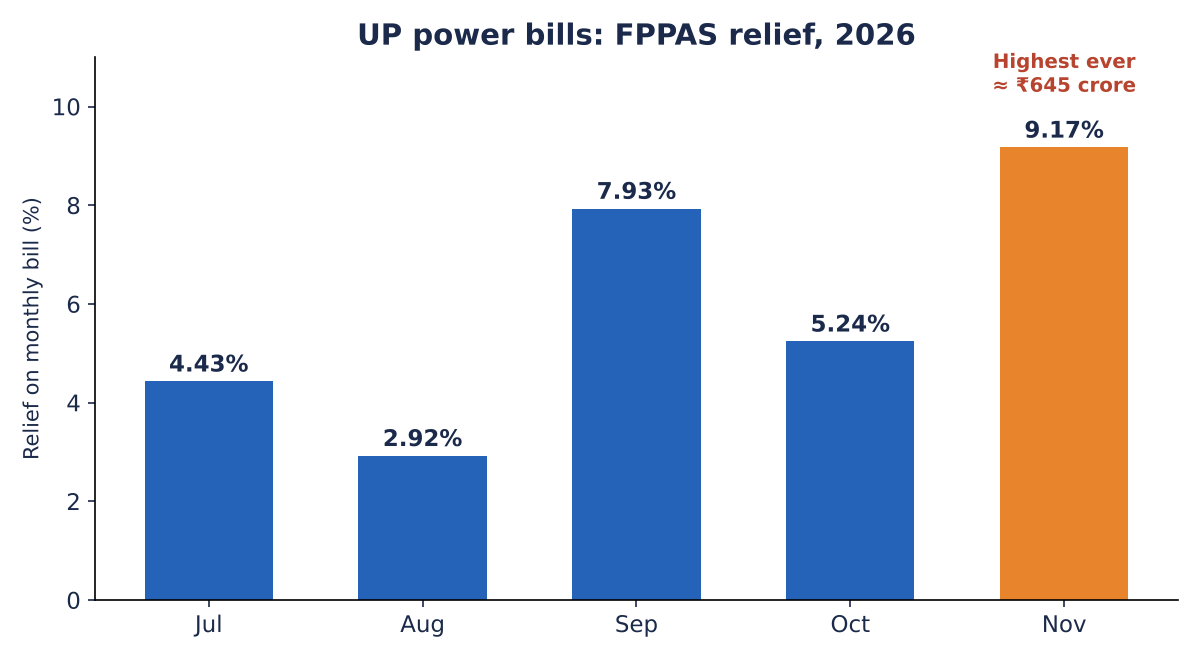
Relief of 9.17% on November 2026 bills — the highest so far under FPPAS.
Total saving for consumers about ₹645 crore; applies to domestic, commercial and other categories.
Fifth straight month of relief: Jul 4.43%, Aug 2.92%, Sep 7.93%, Oct 5.24%.
Mechanism: when actual fuel/power-purchase cost falls below the cost built into the tariff, the gap is passed back to consumers.
Way forward
Automatic pass-through makes tariffs more transparent and cost-reflective in both directions — consumers gain when costs fall, while DISCOMs avoid accumulating unrecovered costs when they rise.
Concept
Power tariffs in UP are set by the UP Electricity Regulatory Commission (UPERC), constituted under the Electricity Act, 2003.
Bar chart of monthly FPPAS bill relief in UP for 2026: July 4.43%, August 2.92%, September 7.93%, October 5.24%, November 9.17%. — StudyForGS
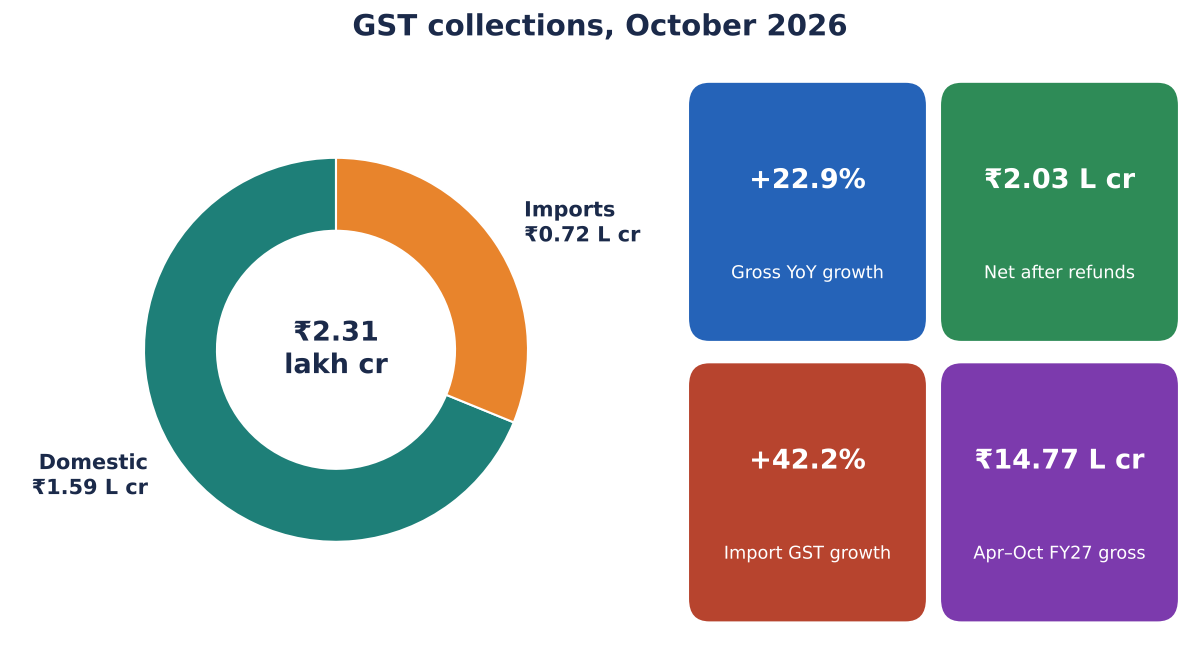
8. October GST collections jump 22.9% to ₹2.31 lakh crore; import GST up 42.2%
Buoyant GST strengthens both Union and state budgets (SGST share) — important for a large state like UP that relies on devolution and its own GST to fund capex.
Concept
GST came via the 101st Constitutional Amendment Act, 2016 and was rolled out on 1 July 2017; the GST Council is set up under Article 279A.
Donut chart splitting October 2026 gross GST of ₹2.31 lakh crore into domestic ₹1.59 lakh crore and imports ₹0.72 lakh crore, with tiles for 22.9% growth and net ₹2.03 lakh crore. — StudyForGS
9. PM opens Bharat Renewable Energy Summit & Expo 2026 at Bharat Mandapam (2–5 November); UP among 13 showcase states
GS-III Renewable energy, climate change | GS-II International groupings (ISA)
Context
The four-day summit, successor to RE-INVEST, opens in New Delhi on 2 November under the theme 'Invest. Innovate. Inspire.'
Key facts
130+ countries, 40+ ministers; 9 country partners incl. Australia, Denmark, EU, France, Germany, UK.
13 states/UTs showcase potential, including Uttar Pradesh.
Co-located: 9th Assembly of the International Solar Alliance (ISA) and 4th International Conference on Green Hydrogen.
Expo with 400+ exhibitors — solar, wind, green hydrogen, storage.
Way forward
A platform for UP to pitch its solar parks (Bundelkhand) and green-hydrogen policy to global investors, while India pushes towards its 500 GW non-fossil capacity goal for 2030.
Concept
The ISA was launched by India and France at COP21, Paris (2015); its headquarters is in Gurugram.
Data point of the day
~322 km | ₹17,542 crore
UP's new link expressways Four links approved on 27 October; to be built in 3 years by UPEIDA.
Prelims rapid-fire
Govt jobs rule: Character-verification rules tightened: candidates involved in violent activities aimed at changing the government barred from direct-recruitment posts; an FIR alone is not enough to disqualify.
PM MITRA Park: Master developer selection approved for the PM MITRA Mega Textile Park on 1,000 acres in Lucknow–Hardoi.
Sainik School:9.524 hectares of land transferred free for the Sainik School, Mainpuri.
Aligarh:₹80 crore for Talanagri Industrial Area (est. 1992) under the Atal Industrial Infrastructure Mission — ~1,300 plots, 40 km drains, 15 km roads.
Cashless care: Cashless medical treatment extended to Basic Education Department staff and non-teaching staff of secondary & Sanskrit schools, with dependents.
GI tags: UP holds 77 GI tags, the most of any state (e.g., Banarasi saree, Kannauj attar, Lucknow chikankari).
Practice MCQs — UPPSC Prelims pattern
Q1. With reference to the Sardar Vallabhbhai Patel Skill Training and Employment Zone Development Scheme of Uttar Pradesh, consider the following statements: 1. Its outlay is ₹1,725 crore. 2. Jhansi and Gorakhpur are among the first five centres. 3. It is to be implemented over five years. Which of the statements given above is/are correct?
1 only
1 and 2 only
2 and 3 only
1, 2 and 3
Show answer
Answer: B Outlay is ₹1,725 crore and the first five centres are Lucknow, Kanpur, Gorakhpur, Jhansi and Gautam Buddha Nagar; the scheme runs over 3 years, not 5.
Q2. The proposed Uttar Pradesh Cyber Security Operations Centre (UP-CSOC) will be implemented by C3iHub, which is located at:
IIT (BHU) Varanasi
IIT Kanpur
IIIT Allahabad
MNNIT Prayagraj
Show answer
Answer: B C3iHub is the Technology Innovation Hub for cyber security at IIT Kanpur under NM-ICPS; it will run UP-CSOC (₹104.28 crore) for the first 3 years.
Mains practice question
Q. “Expressways and high-speed rail are redrawing Uttar Pradesh's economic geography.” Examine this statement in the light of the new link expressways and the bullet-train Northern Corridor, and suggest how the benefits can reach Bundelkhand and Purvanchal. (UPPSC GS-VI, 200 words)
Hint / approach
Intro: UP's expressway grid + 322 km links + HSR corridor. Body: logistics cost, industrial corridors, airport hub (Jewar), tourism (Ayodhya–Varanasi); risks — land acquisition, regional imbalance, debt. Way forward: nodes/industrial clusters along routes, skill zones, district-level ODOP links. Conclude with $1-trillion goal.
📌 One-line revision: Gonda 69 projects ₹520 cr | Deepotsav 10th, 7 Nov | Bullet train Delhi–Varanasi ~3.5 h | Link expressways ~322 km, ₹17,542 cr | Skill zones ₹1,725 cr, 9 zones | UP-CSOC ₹104.28 cr, IIT Kanpur | Power relief 9.17% | GST ₹2.31 lakh cr (+22.9%)