Friday, 16 October 2026 · IST · Uttar Pradesh + National · 12 items · 2 MCQs
UPSIDA's 52nd board cut the allotment threshold for large industrial plots and cleared projects from Lalitpur to Kannauj, while Ayodhya's Ram temple earned FSSAI's 'Ati Vishisht' food-safety grade. The week's Cabinet package — an AI Mission, a Sustainable Aviation Fuel policy, 1,725 AC e-buses and a 20% quota for former Agniveers — dominates UP's policy agenda ahead of the 23 October MLC polls.
Today at a glance — things to remember
UPSIDA board cuts plot-allotment score from 60 to 50; Lalitpur pharma park on PPP.
GS-III: Industry & infrastructure | GS-VI: UP industrial policy, regional development
Context
The UP State Industrial Development Authority's 52nd board meeting (16 Oct), chaired by ACS (Infrastructure & Industrial Development) Alok Kumar, cleared a package to speed up land use for industry.
Key facts
Minimum evaluation score for allotment of plots above 500 sq m cut from 60 to 50 points.
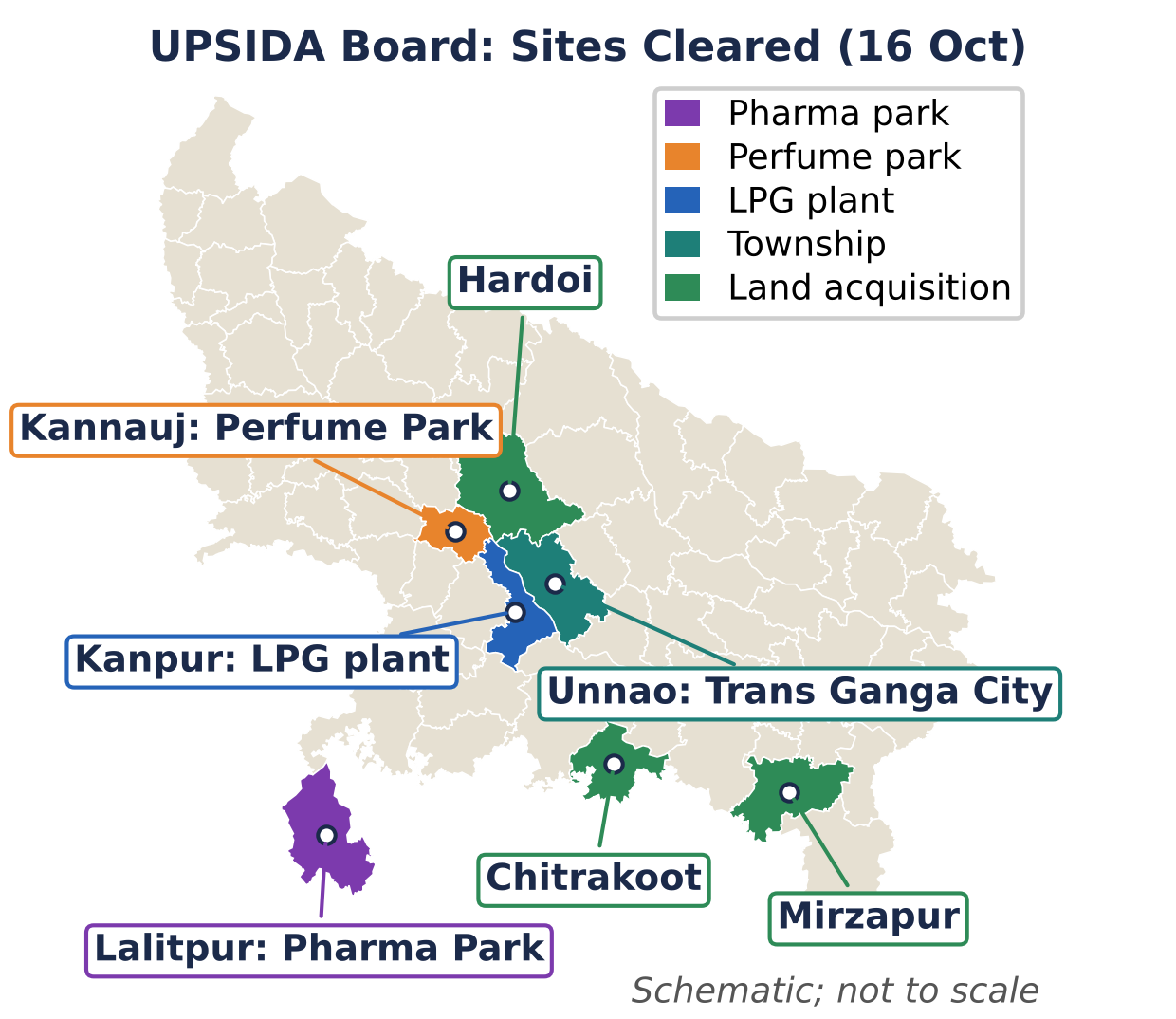
Pharmaceutical park in Lalitpur (Bundelkhand) to be developed on PPP mode.
Land acquisition cleared for industrial areas in Hardoi, Chitrakoot and Mirzapur; land in Kanpur Nagar for a BPCL LPG bottling plant and terminal.
Layout plan of Kannauj Perfume Park approved; revised layout of Trans Ganga City, Unnao cleared.
Way forward
Lower entry thresholds and cleared layouts help convert investment MoUs into ground-breakings — and sites in Bundelkhand (Lalitpur, Chitrakoot) and Vindhya (Mirzapur) spread industry beyond western UP.
Concept
UPSIDA (formerly UPSIDC) is the State's nodal body for industrial areas outside the Noida, Greater Noida and YEIDA authority zones.
Map of Uttar Pradesh districts highlighting Lalitpur (pharma park), Kannauj (perfume park), Kanpur Nagar (LPG plant), Unnao (Trans Ganga City) and Hardoi, Chitrakoot, Mirzapur (land acquisition). — StudyForGS
GS-II: Health & regulatory bodies | GS-V: UP culture, pilgrimage tourism
Context
Shri Ram Janmabhoomi Teerth Kshetra received the highest grade under FSSAI's Eat Right Place of Worship (BHOG) initiative; the certificate was presented in Ayodhya on 11 Oct 2026.
Key facts
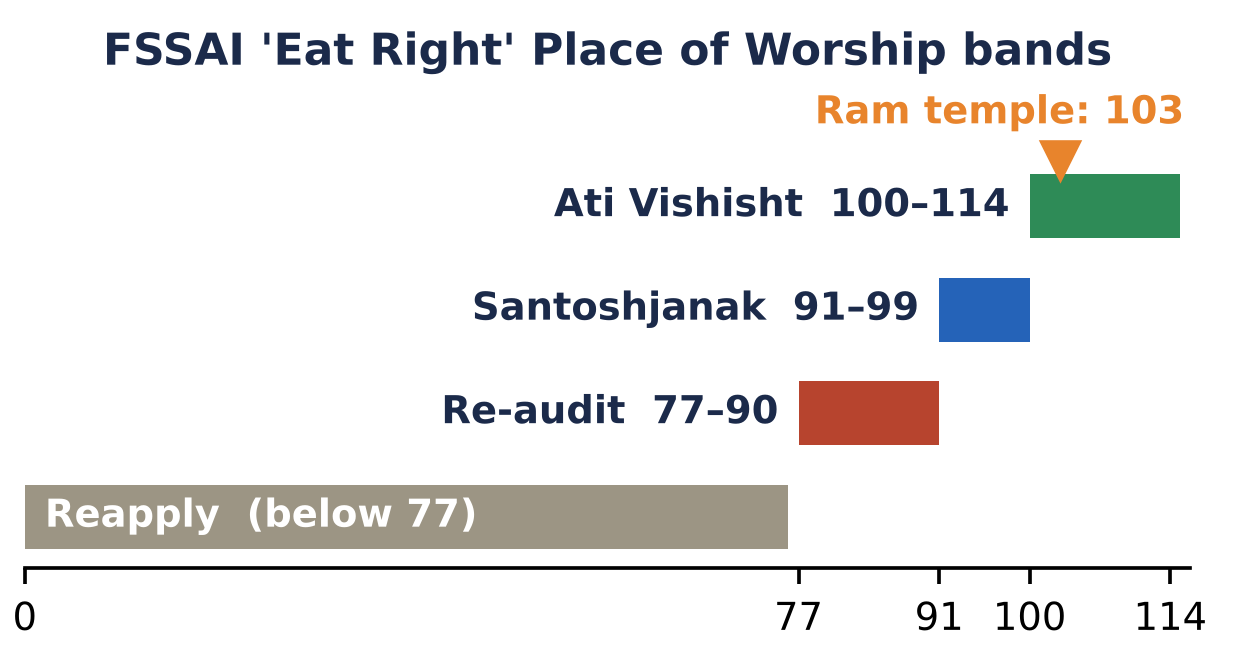
Score 103/114 on a 47-parameter checklist — kitchen hygiene, storage, serving areas, food handling.
Valid 2 years (11 Oct 2026 – 10 Oct 2028); the trust will hold fortnightly internal compliance reviews.
BHOG = Blissful Hygienic Offering to God — FSSAI initiative under Eat Right India for safe prasad and langar.
Bands: Ati Vishisht 100–114, Santoshjanak 91–99, 77–90 re-audit, below 77 reapply; Hanumangarhi, Kanak Bhawan and Devkali temple also certified.
Way forward
Rising pilgrim footfall has turned temple kitchens into mass food operations; certification links religious tourism with public-health standards — vital before Deepotsav crowds.
Concept
FSSAI is a statutory body under the Food Safety and Standards Act, 2006 (Ministry of Health & Family Welfare), headquartered in New Delhi.
Horizontal band chart of FSSAI Eat Right Place of Worship rating bands, with an arrow marking the Ayodhya Ram temple's score of 103 out of 114 in the Ati Vishisht band. — StudyForGS
3. UP Legislative Council: Graduate & Teacher constituency polls on 23 October
Art. 171(3): 1/12 of members elected by graduates of 3 years' standing and 1/12 by teachers (secondary level and above, 3 years).
UP Vidhan Parishad has 100 members; a member's term is 6 years, with one-third retiring every 2 years.
Way forward
UP is one of only six States with a bicameral legislature; the special graduate and teacher constituencies give educated voters a direct voice — a classic Prelims area.
Concept
Art. 169: Parliament can create or abolish a State Legislative Council by law, on a resolution of the Assembly passed by special majority; such a law is not a constitutional amendment under Art. 368.
4. UP-AIM: State AI Mission approved, with a ₹1,725-crore skill-zone scheme
GS-III: Science & technology, employment | GS-VI: UP schemes
Context
The Cabinet (9 Oct) approved the Uttar Pradesh Artificial Intelligence Mission as an independent society under the IT & Electronics Department.
Key facts
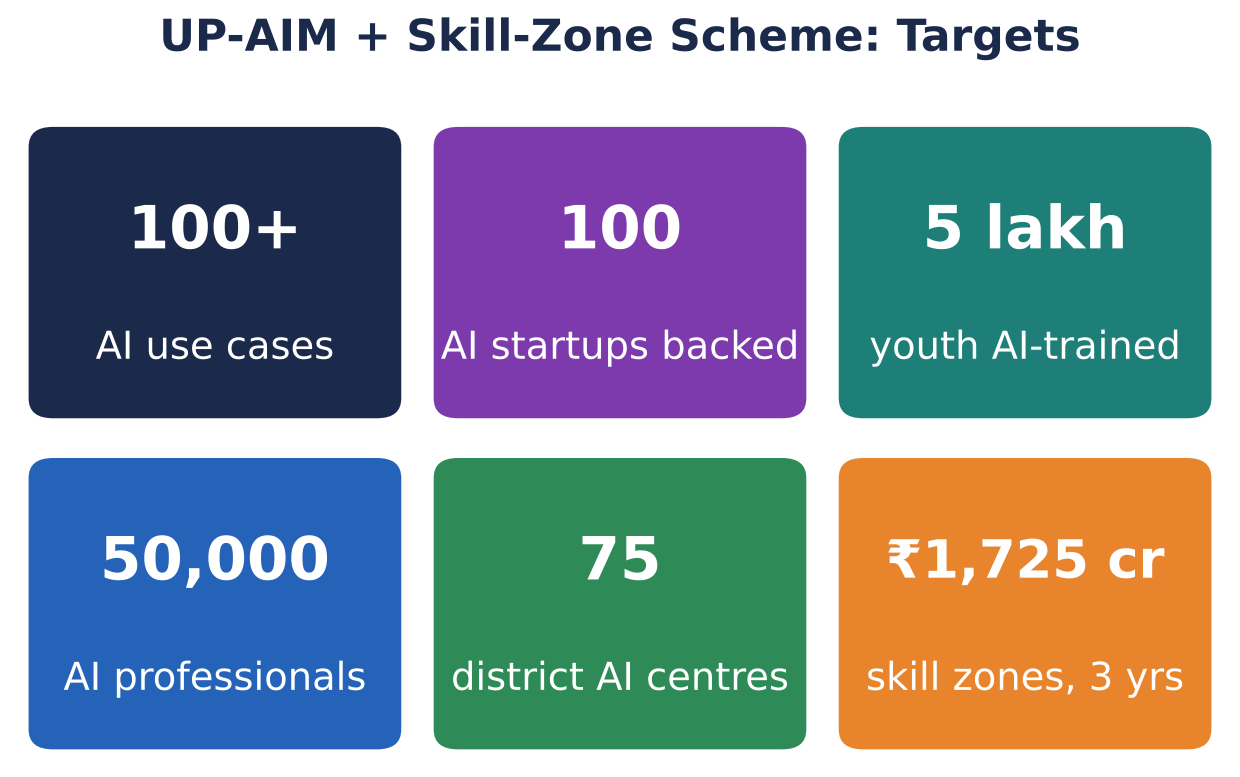
Targets: 100+ AI use cases (25–30 scaled up), support for 100 AI startups, 5 lakh youth trained, 50,000 forward-deployed AI professionals.
AI centres in all 75 districts and an integrated UP AI Stack with GPU-based computing.
Twin decision: Sardar Vallabhbhai Patel Skill Training & Employment Zone scheme — ₹1,725 crore over 3 years, 9 zones, hub-and-spoke.
First-phase centres: Lucknow, Kanpur, Gorakhpur, Gautam Buddha Nagar, Jhansi.
Way forward
Pairing state AI infrastructure with mass skilling is central to UP's trillion-dollar economy goal and dovetails with the national IndiaAI Mission.
Concept
IndiaAI Mission (2024, outlay ₹10,372 crore): compute capacity, datasets, foundation models, AI skilling and startup financing.
Six coloured stat tiles showing UP-AIM targets: 100+ AI use cases, 100 AI startups, 5 lakh youth trained, 50,000 AI professionals, AI centres in 75 districts, and the ₹1,725 crore skill-zone scheme. — StudyForGS
GS-III: Energy, environment, investment models | GS-VI: UP industrial & energy policy
Context
UP has become an early mover with a dedicated SAF manufacturing policy, approved by the Cabinet on 9 Oct.
Key facts
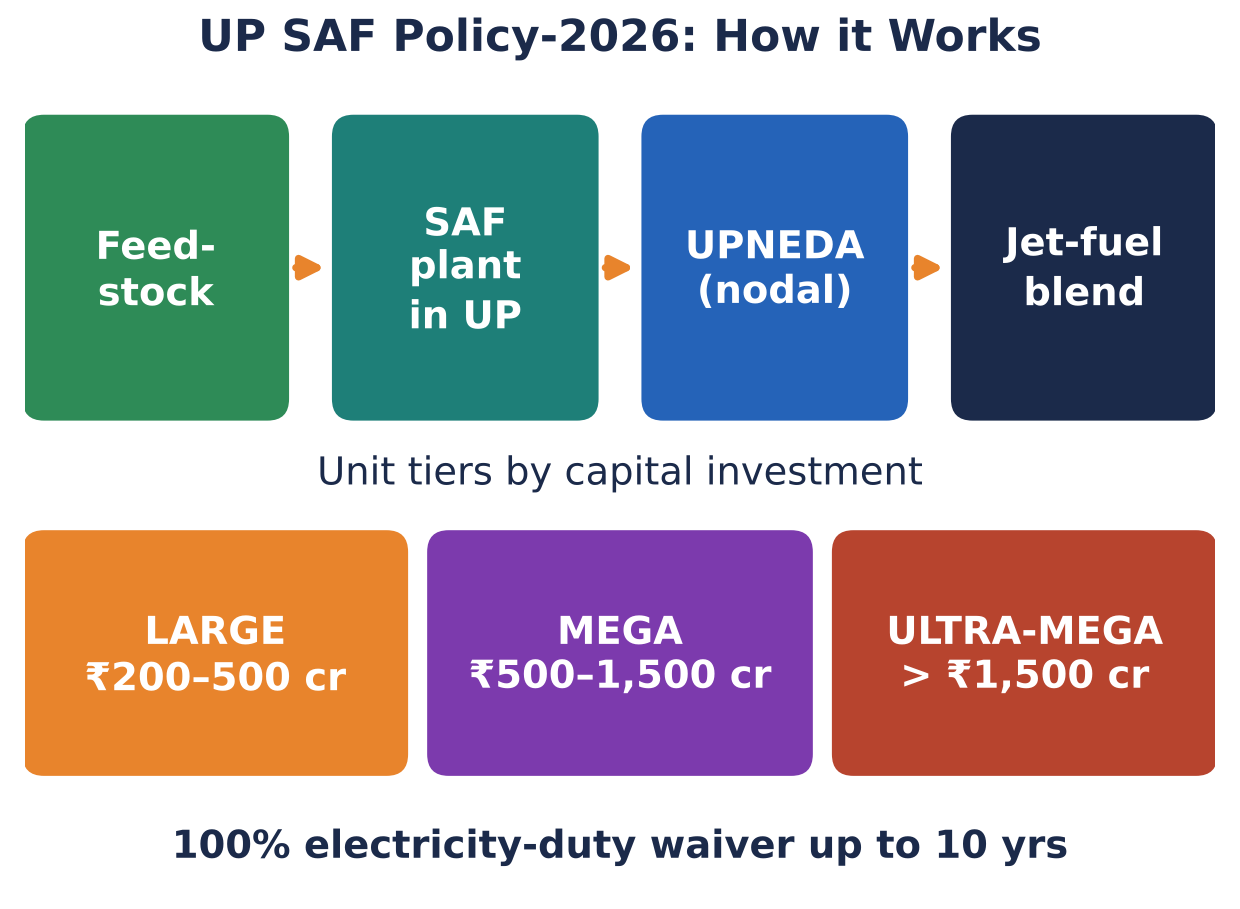
Unit tiers by capital investment: Large ₹200–500 cr, Mega ₹500–1,500 cr, Ultra-mega above ₹1,500 cr.
100% electricity-duty exemption for up to 10 years, plus stamp-duty relief, net SGST reimbursement, interest and skill subsidies, patent-fee reimbursement.
Nodal agency: UPNEDA, with an evaluation committee under its Director; policy life 5 years.
India's indicative SAF blending targets for international flights: 1% by 2027, 2% by 2028.
Way forward
SAF can turn crop residue, used cooking oil and cane ethanol into jet fuel — cutting stubble burning, raising farm incomes and building green jobs around the new Jewar aviation hub.
Concept
SAF is a 'drop-in' jet fuel made from bio or waste feedstocks; it is central to ICAO's CORSIA scheme for carbon-neutral growth of international aviation.
Flowchart of UP's SAF policy: feedstock to SAF plant to UPNEDA as nodal agency to jet-fuel blending, with three unit tiers — Large ₹200–500 crore, Mega ₹500–1,500 crore, Ultra-mega above ₹1,500 crore. — StudyForGS
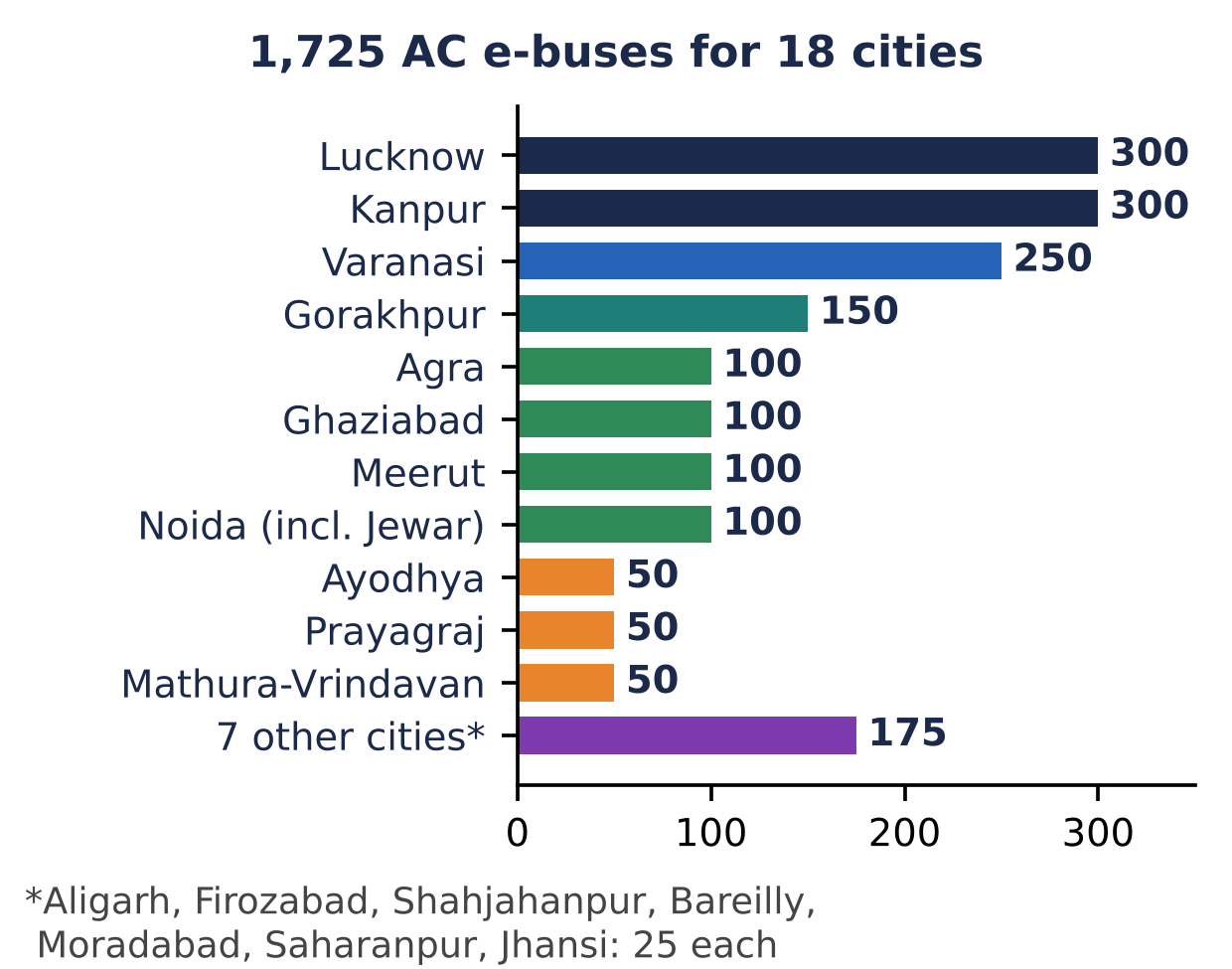
6. 1,725 AC electric buses for 18 cities on a 12-year GCC model
GCC model for 12 years: private operators buy and run buses and build charging depots; the State fixes fares.
Subsidy ₹40 lakh per 12-m bus and ₹35 lakh per 9-m bus; free depot land from municipal corporations and Noida Authority.
At present 743 e-buses run in 15 municipal corporations.
Way forward
Cleaner public transport targets cities that struggle with PM2.5 pollution, while GCC shifts operating risk to private operators and keeps fares in public control.
Concept
Gross Cost Contract: the operator is paid a fixed rate per km run, while fare revenue (and ridership risk) stays with the public authority.
Horizontal bar chart of e-bus allocation: Lucknow and Kanpur 300 each, Varanasi 250, Gorakhpur 150, Agra, Ghaziabad, Meerut and Noida 100 each, Ayodhya, Prayagraj and Mathura-Vrindavan 50 each, and seven other cities 25 each. — StudyForGS
7. 20% reservation for former Agniveers in four uniformed services
GS-II: Centre–State procedures | GS-V: UP districts, history & culture
Context
The Cabinet proposed renaming Noida International Airport and approved restoring the name 'Sant Ravidas Nagar Bhadohi' for the carpet district.
Key facts
Noida International Airport, Jewar (Gautam Buddha Nagar) → proposed 'Narendra Modi International Airport, Noida-Jewar'; the Union Cabinet decides airport names, followed by Gazette notification.
Phase 1 inaugurated in March 2026; it is Delhi-NCR's second international airport.
Bhadohi was carved out of Varanasi in 1994; renamed in 1997, 1999 and 2014 — this is its fourth major name change.
Power to alter district names: Sec. 6(2), UP Revenue Code, 2006. Sant Ravidas, a 15th-century Bhakti saint, was born in Varanasi.
Way forward
Renaming carries cultural and political symbolism, but the exam angle is procedure: airport names need Union approval, while districts are renamed by the State under its revenue law.
Concept
Bhadohi's hand-knotted carpets carry a GI tag; the Bhadohi–Mirzapur belt is India's largest hand-made carpet cluster.
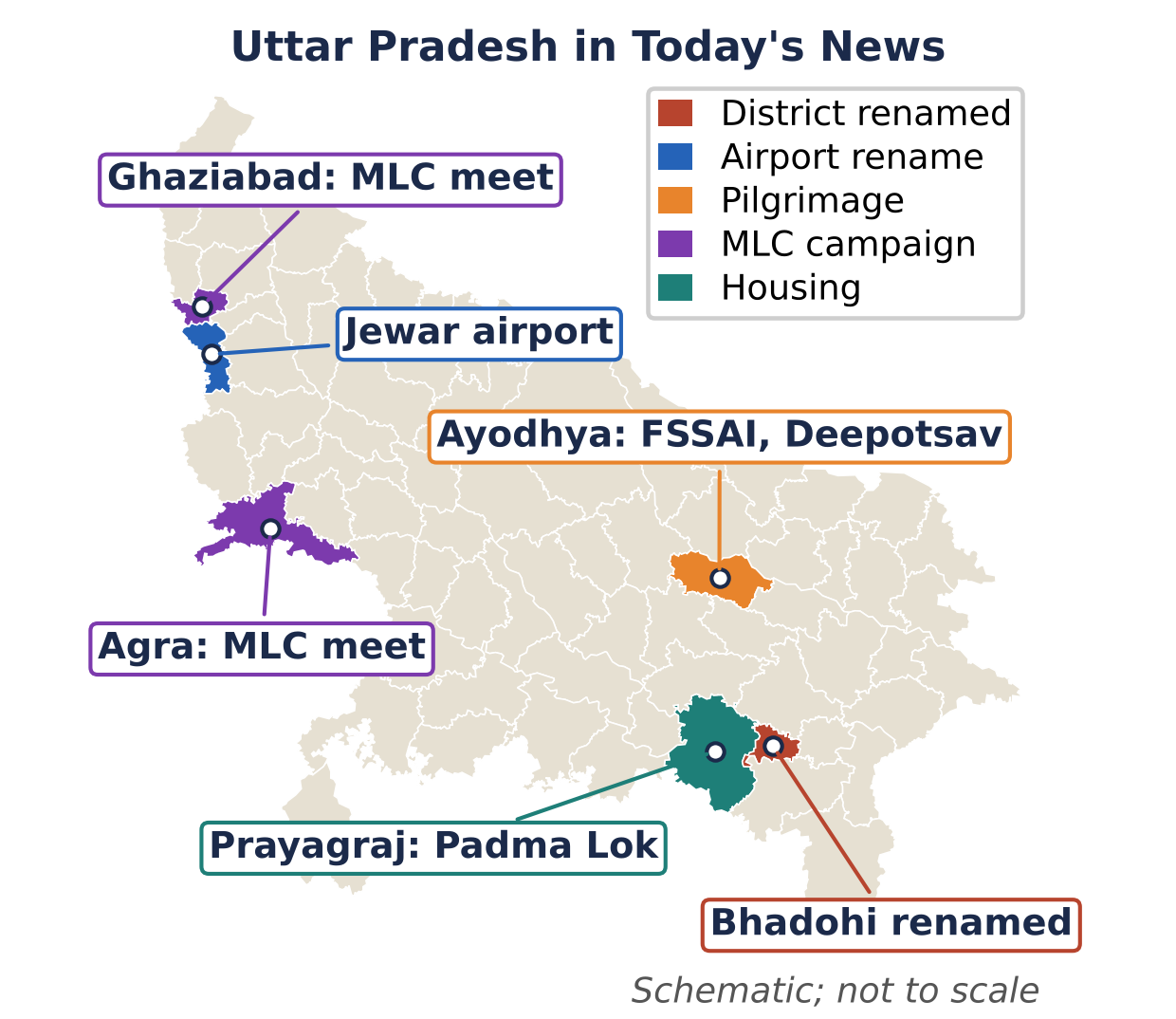
Locator map 'Uttar Pradesh in Today's News' highlighting Sant Ravidas Nagar Bhadohi, Gautam Buddha Nagar (Jewar airport), Ayodhya, Prayagraj, and Agra and Ghaziabad (MLC voter meets). — StudyForGS
9. Ease-of-business trio: Model Building Regulations, Startup Procurement & Interest Waiver
GS-III: Urbanisation, investment climate | GS-VI: UP governance reforms
Context
Three Cabinet approvals target faster approvals, government market access for startups and clearance of tax arrears.
Key facts
Model Building Regulations-2026 for industrial authorities (Noida, Greater Noida, YEIDA): FAR cap removed for plots on roads wider than 45 m.
Deemed approval in 60 days for plans by licensed experts — residential plots up to 500 sq m, commercial up to 200 sq m; high-rises need a structural audit every 5 years.
Startup Procurement Scheme-2026: a dedicated UP Startup E-Marketplace run by the UP Startup Mission.
Interest Waiver Scheme-2026: a 3-month window waiving interest and penalty on tax dues up to 31 Dec 2025.
Way forward
Deemed approvals and higher FAR curb discretion and delays, but must be matched by strong structural-safety and fire audits to protect residents.
Concept
FAR (Floor Area Ratio) = total built-up floor area ÷ plot area; a higher FAR allows denser, taller construction.
10. First BIMSTEC Home Ministers' Meeting adopts the Delhi Declaration
BIMSTEC: founded 6 June 1997 (Bangkok Declaration); 7 members; Secretariat in Dhaka.
Way forward
Extends India's Neighbourhood First and Act East policies into hard security, giving the Bay of Bengal a regional security architecture of its own.
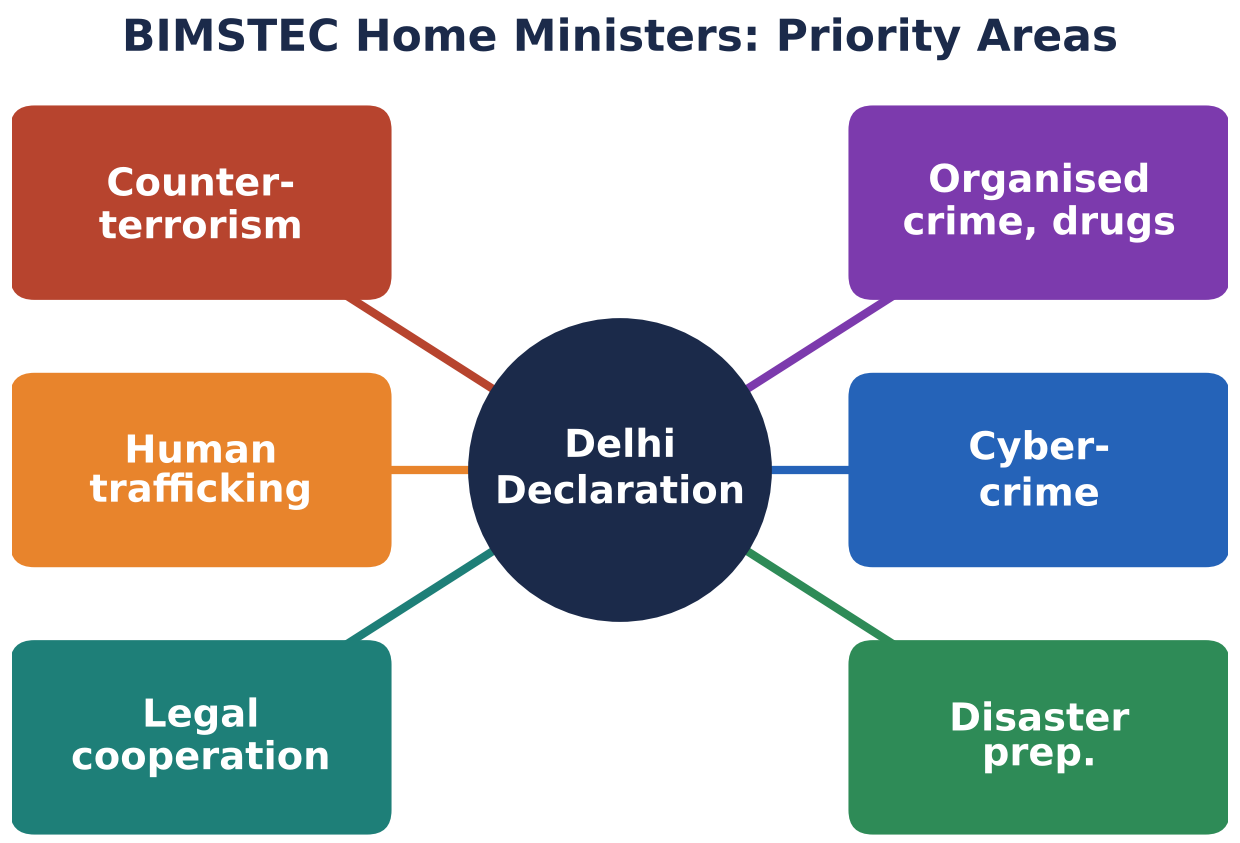
Mind map with the Delhi Declaration at the centre and six priority areas: counter-terrorism, organised crime and drugs, human trafficking, cybercrime, legal cooperation and extradition, and disaster preparedness. — StudyForGS
11. Global Innovation Index 2026: India ranked 38th of 139 economies
ECONOMYUPPSC: Prelims + Mains GS-III
Syllabus linkage
GS-III: Innovation, S&T, indices & reports
Context
WIPO's 19th Global Innovation Index keeps India at 38th, with a strong outputs score.
Key facts
India: 38th overall; 49th in innovation inputs, 25th in outputs; 1st among 36 lower-middle-income economies.
Top 5: Switzerland, Sweden, USA, Republic of Korea, Singapore.
India 1st in ICT services exports; clusters — Bengaluru 25th, Delhi 27th.
Way forward
The input–output gap shows India converts limited R&D and institutional inputs into strong outputs; raising R&D spending is the next lever.
12. Lakshadweep declared India's first fully literate UT under ULLAS
NATIONALUPPSC: Prelims + Mains GS-II
Syllabus linkage
GS-II: Education, government schemes
Context
Administrator Praful Patel announced the milestone on 12 Oct after all identified learners cleared the literacy test.
Key facts
All 1,113 identified non-literates passed the FLNAT (Foundational Literacy & Numeracy Assessment Test).
Mizoram was the first fully literate State (May 2025).
Way forward
A benchmark for UP, whose adult-literacy gap remains large; doorstep assessment shows how last-mile learners can be reached.
Data point of the day
1,725
AC electric buses approved for UP cities 18 cities, 12-year GCC model; Lucknow and Kanpur get 300 each.
Prelims rapid-fire
Deepotsav 2026 (10th edition): Ayodhya, 5–7 Nov — 33 lakh diyas at Ram ki Paidi and Saryu ghats.
Padma Lok Awas Yojana: about 600 flats by Prayagraj Development Authority on reclaimed land; foundation stone on 15 Oct.
State Highway-84 (Mainpuri): to be widened to four lanes (Cabinet, 9 Oct).
Paddy procurement policy: approved for Kharif Marketing Season 2026-27.
70th State-Level School Kabaddi Championship: held at Jubilee Inter College, Gorakhpur.
Anganwadi workers & helpers: one additional saree each sanctioned by the Cabinet.
Practice MCQs — UPPSC Prelims pattern
Q1. With reference to Uttar Pradesh's Sustainable Aviation Fuel Manufacturing Promotion Policy-2026, consider the following statements: 1. UPNEDA is the nodal agency for the policy. 2. 'Mega' units are those with capital investment above ₹1,500 crore. 3. Eligible units get 100% electricity-duty exemption for up to 10 years. Which of the statements given above are correct?
1 and 2 only
1 and 3 only
2 and 3 only
1, 2 and 3
Show answer
Answer: B Mega units are ₹500–1,500 crore; units above ₹1,500 crore are 'Ultra-mega'. Statements 1 and 3 are correct.
Q2. Consider the following statements about the State Legislative Council: 1. One-twelfth of its members are elected by graduates of at least three years' standing residing in the State. 2. One-twelfth are elected by teachers of at least three years' standing in institutions not lower than secondary school. 3. A law of Parliament abolishing a Council is a constitutional amendment under Article 368. Which of the statements given above are correct?
1 and 2 only
2 and 3 only
1 and 3 only
1, 2 and 3
Show answer
Answer: A Art. 171(3) provides the graduate and teacher quotas. Under Art. 169(3), a law creating or abolishing a Council is not deemed an amendment under Art. 368. UP's graduate–teacher seats go to the polls on 23 Oct.
Mains practice question
Q. Uttar Pradesh is shifting from MoU-led investment promotion to execution-led industrialisation. Discuss with reference to recent policy measures such as UP-AIM, the SAF Policy-2026 and the Model Building Regulations, and the challenge of regional balance. (125 words, 8 marks)
Hint / approach
Intro: trillion-dollar goal and investment MoUs. Body: sector policies (AI, SAF), approval reforms (deemed approval, FAR), land supply (UPSIDA sites in Bundelkhand/Vindhya), skilling (₹1,725-cr zones). Challenges: western UP concentration, land acquisition, safety audits. Conclude with district-level execution and regional equity.
📌 One-line revision: UP-AIM → AI centres in 75 districts | SAF policy → UPNEDA, 10-yr duty waiver | 1,725 e-buses / 18 cities | MLC polls 23 Oct (Art. 171) | Ram temple FSSAI 103/114