Thursday, 24 September 2026 · IST · Uttar Pradesh + National · 8 items · 2 MCQs
Uttar Pradesh's governance and economy stories lead today's UPPSC digest: a 23-proposal Cabinet clearance covering a ₹200-crore Mathura ethanol plant, 20% reservation for ex-Agniveers, a Toy Manufacturing Policy and homebuyer protection worth ₹2,912 crore. UP also retained its rank as India's No.1 state with 77 GI tags, while the Vishwakarma Shram Samman 2.0 scheme and a Prayagraj–Varanasi–Ayodhya transport plan strengthen livelihoods and faith-tourism. Nationally, Semicon 2.0 (₹1.27 lakh crore) and the rationalised GST 2.0 slabs remain exam-hot.
Today at a glance — things to remember
Today in UP: H1N1 case in Barabanki triggers Rapid Response Team screening; seasonal flu surveillance reinforced.
CM Model Composite School (Kannauj) inspected for on-time completion — integrated pre-primary to upper-primary campus.
Farmers' mahapanchayat on 7 October to demand sugarcane price of ₹600/quintal.
UP Cabinet clears 23 proposals: ₹200-cr Mathura ethanol plant (3.96 crore litres/yr), 20% ex-Agniveer quota, Toy Policy 2025.
Lucknow Development Authority to take over a stalled hi-tech township, protecting ~5,000 homebuyers (liability cap ₹2,912 cr).
Vishwakarma Shram Samman 2.0 & Swadeshi Mela: new Margin Money loan portal, toolkits, ODOP market linkage.
~₹50,000 crore committed for 7 new expressways; UPEIDA awards a ₹221-crore toll-collection contract.
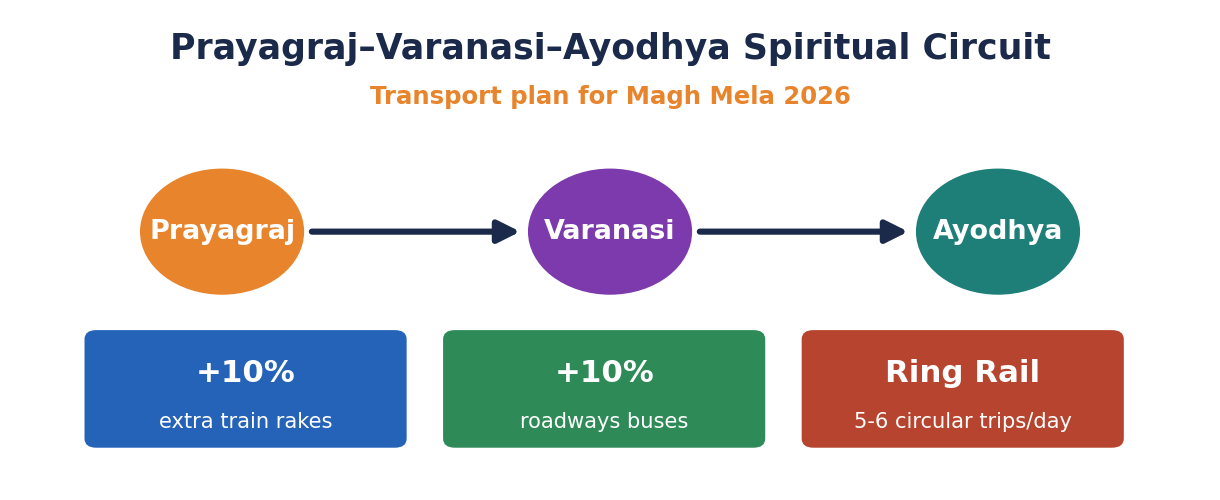
Prayagraj–Varanasi–Ayodhya circuit: +10% extra rakes and buses plus ring-rail for Magh Mela 2026.
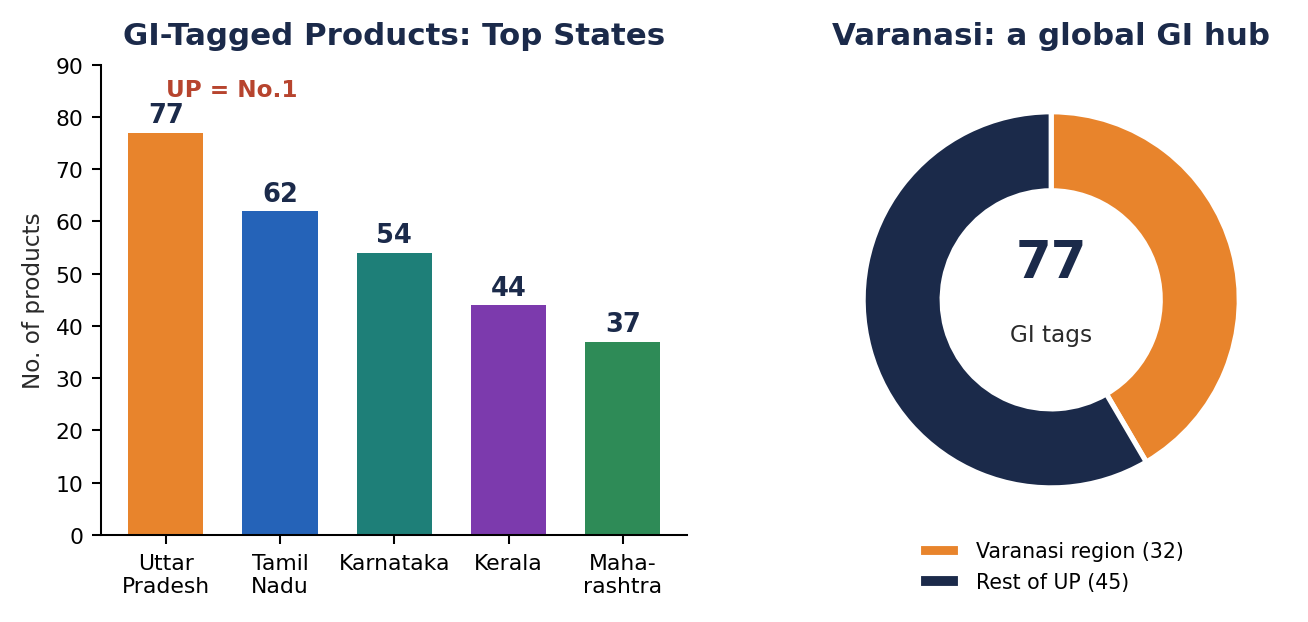
UP is India's No.1 state with 77 GI tags; Varanasi region alone has ~32.
National: Semicon 2.0 outlay ₹1.27 lakh crore; GST 2.0 slabs simplified to 0%, 5%, 18% and 40%.
Detailed notes
1. Health, education, sport and farm — the day's UP roundup
GS-II (Governance, Health, Education); UP-special GS-V/GS-VI (Human resource & social sector in UP)
Context
A snapshot of the day's grassroots UP developments across health, schooling, farm prices and sport.
Key facts
Health watch: a confirmed H1N1 (swine-flu) case in a 60-year-old woman (Barabanki) triggered Rapid Response Team screening and a KGMU-Lucknow referral, with seasonal influenza monitoring reinforced across districts.
Education: a state minister inspected an under-construction CM Model Composite School (Kannauj), pushing timely completion; composite schools club pre-primary to upper-primary on one campus to cut dropouts.
Agriculture: a farmers' mahapanchayat has been called for 7 October, with a demand to raise the sugarcane state advised price to ₹600/quintal.
Sport: three Kanpur players were selected for the Junior State Kabaddi Championship at Ayodhya.
Way forward
Grassroots health, schooling, farm prices and sport recur in UPPSC on governance and social-sector delivery.
Concept
IDSP (Integrated Disease Surveillance Programme) enables early detection and response to outbreaks like H1N1 through district-level Rapid Response Teams.
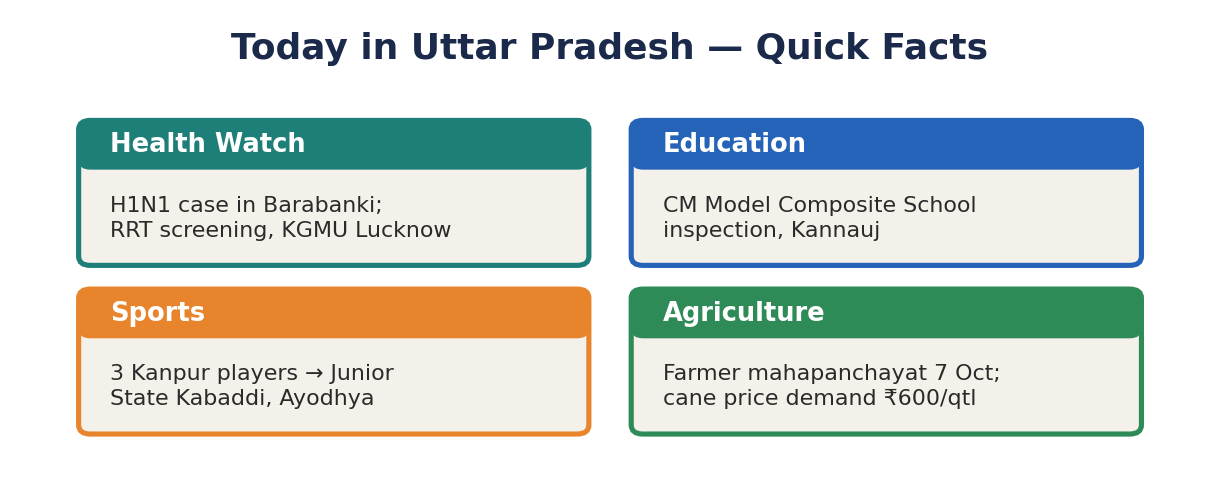
Four colour cards summarising today's UP items: health (H1N1, Barabanki), education (composite school, Kannauj), sport (kabaddi, Ayodhya) and agriculture (farmer mahapanchayat). — StudyForGS
2. UP Cabinet clears 23 proposals — industry, housing and welfare push
The Cabinet converted a set of policy proposals into on-ground schemes spanning industry, housing and welfare.
Key facts
A ₹200-crore ethanol plant at Chhata (Mathura) revives a defunct sugar mill, targeting ~3.96 crore litres a year from cane and rice — boosting the ethanol-blending economy.
A 20% horizontal-style reservation was approved for ex-Agniveers in state recruitments across departments and forces.
A Toy Manufacturing Promotion Policy 2025 (5-year term) aims to make UP a toy hub, focusing on eastern UP and Bundelkhand.
The Lucknow Development Authority will take over a stalled hi-tech township, protecting ~5,000 homebuyers with a liability cap of ₹2,912 crore.
Way forward
Ethanol, ex-Agniveer welfare and homebuyer protection are high-yield UPPSC facts across polity, economy and governance.
Concept
Ethanol Blending Programme (EBP) blends ethanol with petrol to cut crude imports and support cane farmers; India targets 20% blending.
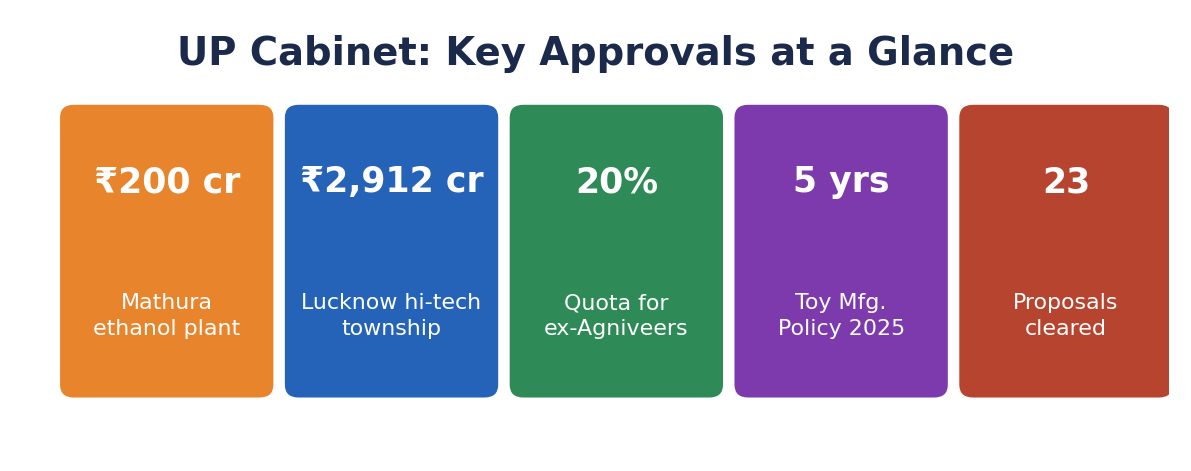
Five stat tiles of key UP Cabinet approvals: ₹200 cr Mathura ethanol plant, ₹2,912 cr Lucknow township, 20% ex-Agniveer quota, 5-year Toy Policy, 23 proposals cleared. — StudyForGS
3. Vishwakarma Shram Samman 2.0 & Swadeshi Mela empower artisans
An artisan-focused scheme paired with a Swadeshi Mela to boost traditional crafts under 'Vocal for Local'.
Key facts
The scheme links traditional artisans (carpenters, potters, blacksmiths, tailors) with skill training, modern toolkits and collateral-light credit under 'Vocal for Local'.
A new Margin Money Loan portal was launched with cheque and toolkit distribution to beneficiaries in Lucknow.
The initiative dovetails with ODOP (One District One Product) to widen market access and branding for local crafts.
Way forward
Artisan self-employment schemes anchor UP's MSME and rural-livelihood story — asked in both Prelims and Mains (inclusive growth).
Concept
ODOP promotes one signature product per district to build clusters, skilling, credit and export linkages.
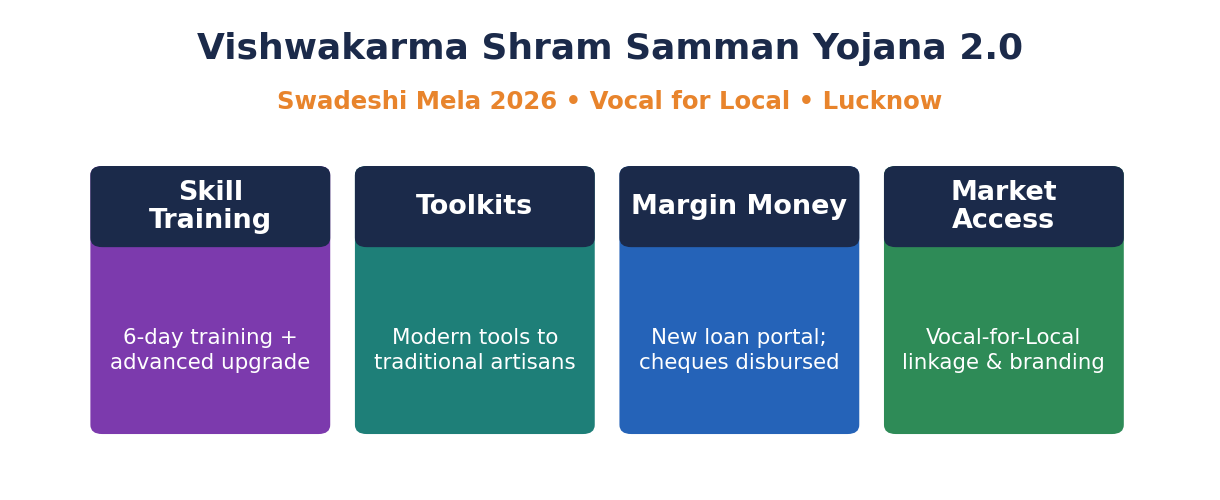
Four pillars of the Vishwakarma Shram Samman 2.0 scheme: skill training, toolkits, margin-money loans and market access under Vocal for Local. — StudyForGS
4. Expressway and connectivity drive keeps UP India's infra front-runner
GS-III (Infrastructure, Economy); UP-special GS-V (Infrastructure development in UP)
Context
UP is deepening its expressway network and O&M ecosystem to anchor industry and logistics.
Key facts
The state has committed to a large multi-expressway programme (about ₹50,000 crore for seven new expressway projects) to deepen east-west and north-south links.
UP already operates/builds one of India's densest expressway networks, anchoring industrial corridors and logistics parks.
Toll-collection and O&M contracts under the state expressway authority (UPEIDA) reflect a maturing PPP and revenue model.
Way forward
Expressways drive investment and industrialisation along corridors — a favourite UPPSC infrastructure-economy theme.
Concept
UPEIDA (Uttar Pradesh Expressways Industrial Development Authority) plans, builds and manages the state's expressways and adjoining industrial corridors.
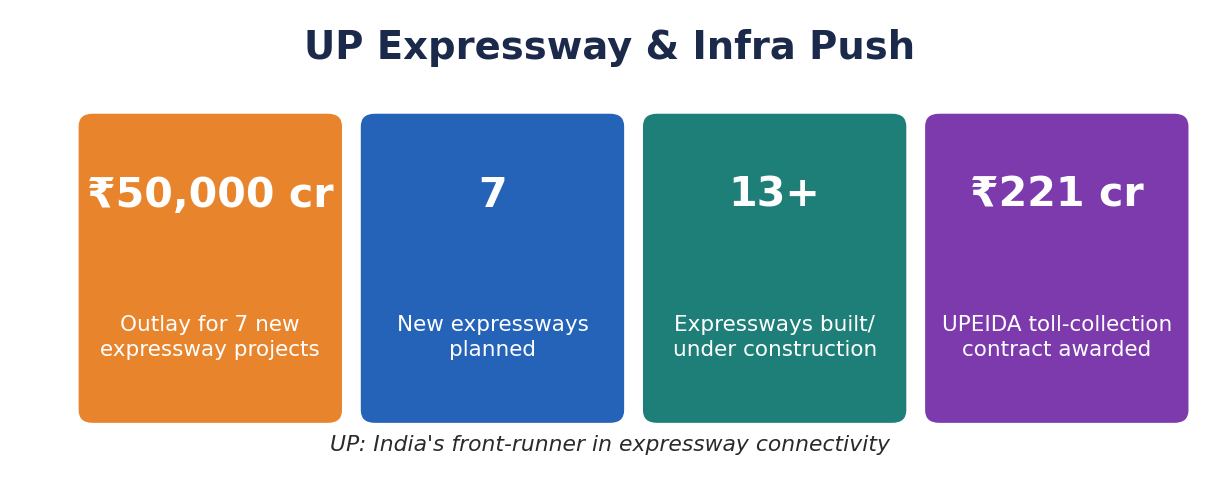
Four stat tiles on UP infrastructure: ₹50,000 crore for 7 new expressways, 13+ expressways built/under construction, and a ₹221-crore UPEIDA toll contract. — StudyForGS
5. Prayagraj–Varanasi–Ayodhya circuit gets a Magh Mela transport plan
A coordinated transport plan across three faith cities to manage the Magh Mela pilgrim surge.
Key facts
Railways and roadways were directed to add ~10% extra capacity (rakes and buses) over the previous Magh Mela to manage pilgrim surges.
A 'ring-rail' style circular service connects the three faith cities, easing crowd flow across the spiritual circuit.
Tenders and ground works are being front-loaded so infrastructure is ready before the mela season.
Way forward
The faith-tourism circuit is a growth engine for eastern UP and a governance-logistics case study for Prelims and Mains.
Concept
Faith/pilgrimage tourism circuits combine culture, connectivity and crowd management to drive regional economic growth.
Flow diagram of the Prayagraj–Varanasi–Ayodhya circuit with three linked city nodes and boxes for +10% train rakes, +10% buses and a ring-rail service for Magh Mela 2026. — StudyForGS
6. Uttar Pradesh stays India's No.1 state for GI-tagged products
UP retained its national lead in Geographical Indication tags, protecting region-specific crafts and produce.
Key facts
UP leads the country with 77 GI (Geographical Indication) tags, protecting the identity of region-specific crafts and produce.
The Varanasi region alone accounts for ~32 GI products — among the densest GI clusters in the world.
GI protection boosts artisan incomes, exports and ODOP branding for products like Banarasi silk, Bhadohi carpets and various regional foods and crafts.
Way forward
GI tags recur across Prelims and Mains — a signature UP strength.
Concept
A GI tag certifies a product's geographical origin and reputation; it is granted for 10 years and is renewable.
A bar chart showing UP first with 77 GI tags among top states, plus a donut chart highlighting Varanasi region's ~32 of UP's 77 GI products. — StudyForGS
7. Semicon 2.0: India deepens its chip ecosystem with a ₹1.27 lakh-crore push
India's second-phase semiconductor mission scales up manufacturing, design and talent.
Key facts
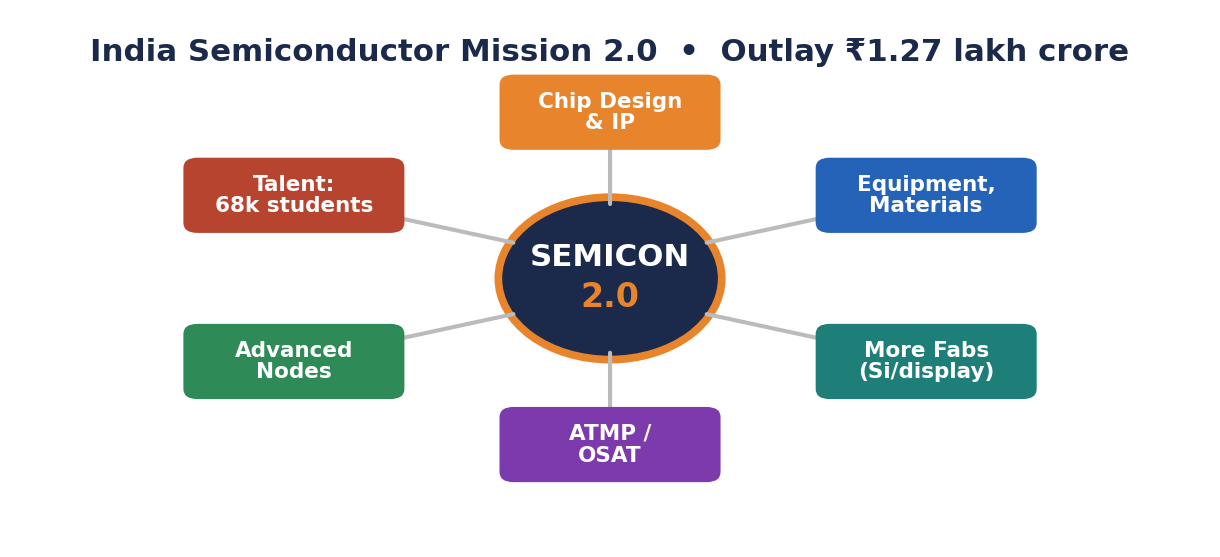
India Semiconductor Mission 2.0 carries an outlay of about ₹1.27 lakh crore to build fabs, design, equipment, materials and packaging (ATMP/OSAT).
Six pillars span chip design and IP, domestic equipment/materials, more fabs, advanced ATMP, sub-28nm nodes and large-scale talent development.
An indigenous 64-bit microprocessor line (developed by a national computing centre) signals a self-reliance thrust in strategic electronics.
Way forward
A strategic, exam-hot theme on self-reliance and high-tech manufacturing.
Concept
ATMP/OSAT (Assembly, Testing, Marking, Packaging / Outsourced Semiconductor Assembly and Test) are the back-end stages that turn fabricated wafers into usable chips.
A mind-map with 'Semicon 2.0' at the centre and six branches — chip design & IP, equipment & materials, more fabs, ATMP/OSAT, advanced nodes and talent — with the ₹1.27 lakh crore outlay noted. — StudyForGS
GI tags — UP: 77 products, India's No.1 state for GI tagging.
Varanasi: ~32 GI products — a global Geographical-Indication hub.
Farmer mahapanchayat: called for 7 Oct; demand to raise cane price to ₹600/quintal.
Kabaddi: 3 Kanpur players picked for the Junior State Championship, Ayodhya.
Practice MCQs — UPPSC Prelims pattern
Q1. Uttar Pradesh recently retained its position as India's leading state in a particular category. It is the No.1 state in India for:
Number of operational expressways
Number of GI (Geographical Indication) tagged products
Installed solar capacity
Number of international airports
Show answer
Answer: b UP leads India with 77 GI tags; the Varanasi region alone has ~32. GI tags protect region-specific goods and boost artisan incomes and exports.
Q2. With reference to 'Semicon 2.0' (India Semiconductor Mission 2.0), consider the following statements: 1. It aims to build fabrication units, chip design and packaging (ATMP/OSAT) capacity. 2. It has an outlay of about Rs 1.27 lakh crore. Which is/are correct?
1 only
2 only
Both 1 and 2
Neither 1 nor 2
Show answer
Answer: c Semicon 2.0 (outlay ~₹1.27 lakh crore) spans design, fabs, equipment/materials, ATMP/OSAT, advanced nodes and talent — so both statements are correct.
Mains practice question
Q. Discuss how Geographical Indication (GI) tagging and the One District One Product (ODOP) scheme together strengthen Uttar Pradesh's rural economy and traditional crafts. (150 words)
Hint / approach
Link GI's identity protection with ODOP's market access, skilling and credit; cite Banarasi silk, Bhadohi carpets; note income, exports, employment and preservation of traditional knowledge.
📌 One-line revision: UP = No.1 in GI tags (77) • ex-Agniveers get 20% state quota • Mathura ethanol plant ₹200 cr • Semicon 2.0 outlay ₹1.27 lakh crore.