Friday, 6 November 2026 · IST · Bihar + National · 11 items · 2 MCQs
Bihar received ₹10,845 crore — the second-largest share — as the Centre advanced the November tax devolution of ₹1,09,019 crore ahead of the festive season, while CM Samrat Choudhary set a target of 3 lakh projects under the VB-G RAM G rural employment mission. The state also unveiled a ₹2.57 lakh crore clean-energy investment roadmap and October GST data showed Bihar's collections up 24%. Nationally, the Union Cabinet cleared a 92 GWh grid-scale storage VGF scheme and a ₹2,814 crore critical-mineral processing scheme, and Nepal PM Balendra Shah prepares for his first bilateral visit to India from 22 November.
Today at a glance — things to remember
Bihar gets ₹10,845 cr of the ₹1,09,019 cr advance tax devolution (UP first: ₹19,208 cr).
VB-G RAM G: 125 days of guaranteed rural work, Centre–state cost sharing of 60:40.
Bihar target: projects under VB-G RAM G to double from 1.5 lakh to 3 lakh.
Bihar's clean-energy roadmap is worth ₹2.57 lakh cr: 24 GW of RE + 6 GWh of storage by 2030.
Bihar's peak power demand has grown from ~700 MW (2005) to ~10,000 MW today.
Patna–Purnia Expressway (NE-9): 245 km, ₹12,052 cr, six districts.
Bihar's GST in October 2026 was ₹1,827 cr, up 24%; the all-India gross was ₹2.31 lakh cr (+22.9%).
Cabinet VGF of ₹14,500 cr for 92 GWh of storage: 60 GWh pumped hydro + 30 GWh BESS.
Fast Track Special Courts extended to 2031; courts to rise from 779 to 850.
Nepal PM Balendra Shah's first bilateral India visit is due from 22 Nov; 7 Bihar districts border Nepal.
Detailed notes
1. CM reviews VB-G RAM G: rural works to double to 3 lakh projects
GS-II: Bihar economy, rural employment and poverty; Prelims: centrally sponsored schemes, the right-to-work law.
Context
On 5 Nov 2026, CM Samrat Choudhary chaired a review of the Viksit Bharat – Guarantee for Rozgar and Ajeevika Mission (Gramin), the law that replaced MGNREGA. He told officials to speed up asset creation, with district magistrates (DMs) monitoring progress.
Key facts
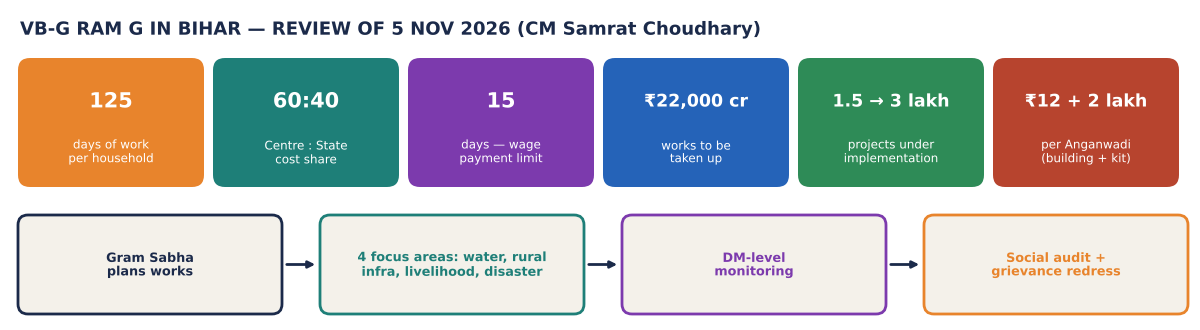
125 days of guaranteed wage work per rural household per year; Centre:state cost sharing of 60:40.
Wages are to be paid within 15 days; projects worth ₹22,000 crore are to be taken up.
Projects under implementation are to rise from 1.5 lakh to 3 lakh.
Each Anganwadi centre gets ₹12 lakh for its building plus ₹2 lakh for furniture and learning material.
There are four focus areas: water security, rural infrastructure, livelihoods and disaster management, with social audits to check the work.
Way forward
Converge the mission with Jal-Jeevan-Hariyali and flood-season planning in north Bihar, use geo-tagging of assets, and keep wage payments on time.
Concept
Social audit: verification of works by the Gram Sabha, a practice that comes from MGNREGA (2005). Centrally Sponsored Scheme (CSS): a scheme the Centre co-funds and the states implement.
Stat tiles and flowchart of the VB-G RAM G mission in Bihar: 125 days of work, 60:40 cost sharing, wages within 15 days, ₹22,000 crore of works, projects rising from 1.5 lakh to 3 lakh, and four focus areas. — StudyForGS
2. Bihar gets ₹10,845 crore as Centre advances November tax devolution
GS-II: Centre–state financial relations and Bihar's finances; Prelims: Art. 270 and Art. 280, the Finance Commission.
Context
On 5 Nov 2026, the Finance Ministry released the November instalment of ₹1,09,019 crore five days early (the normal date is 10 Nov), citing the festive season and the need to speed up states' capital spending.
Key facts
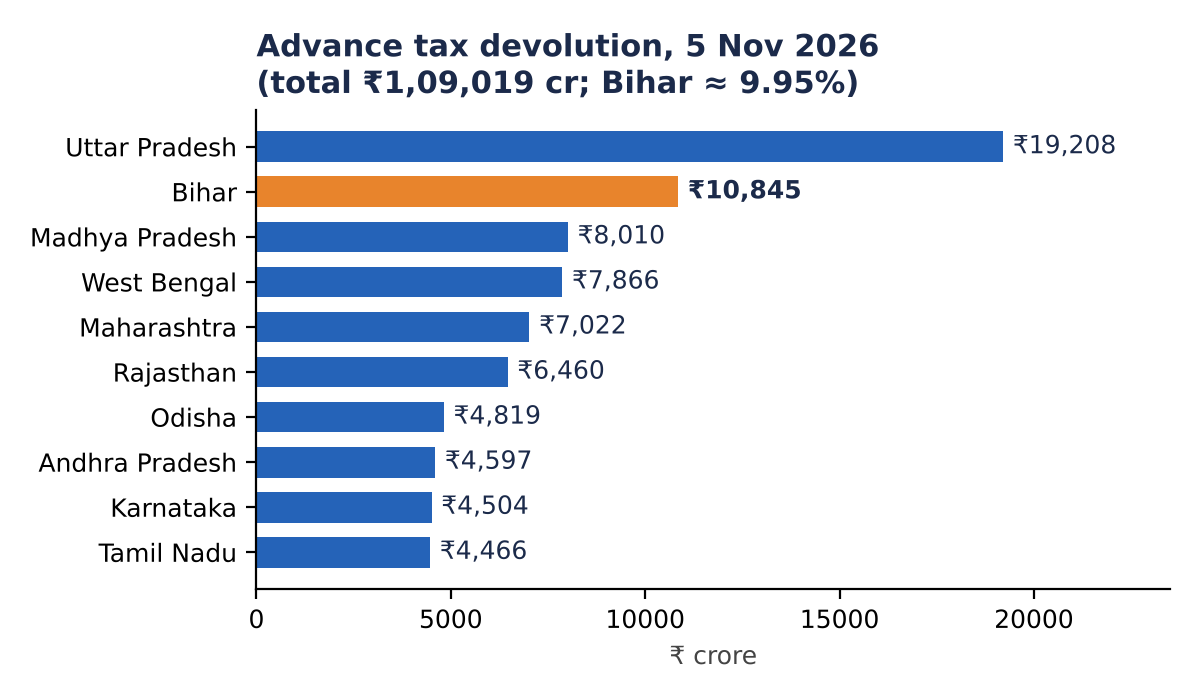
Top shares: UP ₹19,208 cr, Bihar ₹10,845 cr (~9.95%), MP ₹8,010 cr, WB ₹7,866 cr.
Under the 16th Finance Commission, states get 41% of the divisible pool.
Criteria weights: income distance 42.5%, population 17.5%, and area, forest, demographic performance and contribution to GDP at 10% each.
Budget estimate (BE) of states' share for FY27: ₹15.26 lakh crore; H1 releases totalled nearly ₹7 lakh crore.
Way forward
Bihar should front-load capex on roads, bridges and flood works, and push its own tax revenue so it relies less on central transfers.
Concept
Income distance: the gap between a state's per-capita income and that of the richest state; a poorer state like Bihar gains more. The 16th FC (Chair: Arvind Panagariya) covers 2026–31.
Horizontal bar chart of the November 2026 tax devolution by state: Uttar Pradesh ₹19,208 crore, Bihar ₹10,845 crore (highlighted), Madhya Pradesh ₹8,010 crore, West Bengal ₹7,866 crore, Maharashtra ₹7,022 crore, Rajasthan ₹6,460 crore and others. — StudyForGS
GS-II: infrastructure and energy in Bihar, and the role of science and technology; Prelims: PM-KUSUM, PM Surya Ghar.
Context
At a national renewable energy summit at Bharat Mandapam, New Delhi (4 Nov), Bihar showcased an investment pipeline of ₹2,57,316 crore across generation, transmission and distribution. Projects worth ₹78,400 crore are already underway.
Key facts
The Bihar Renewable Energy Policy 2025 targets 24 GW of RE and 6 GWh of storage by 2030.
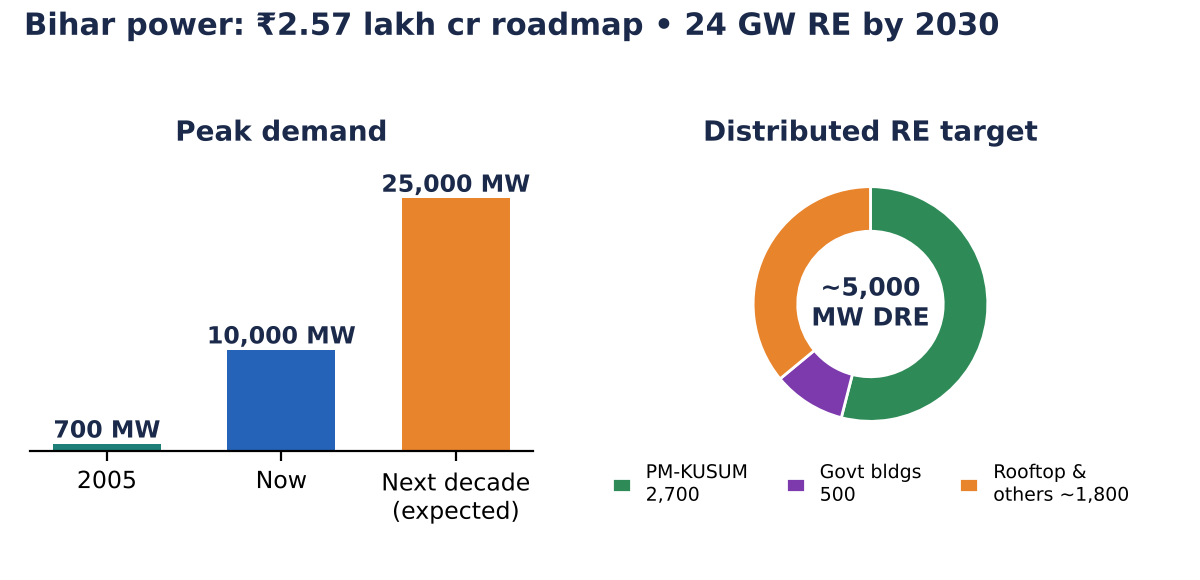
Peak demand: ~700 MW (2005) → ~10,000 MW now → ~25,000 MW expected within a decade.
Flagship: the 301 MW Kajra solar project (Lakhisarai) with a 523 MWh BESS.
Distributed RE target of ~5,000 MW: 2,700 MW under PM-KUSUM, 500 MW on government buildings, and rooftops for 15 lakh homes.
Nearly 1 crore smart meters have been installed; both discoms are profitable.
Way forward
Bihar has little land for large solar parks, so it should push floating solar on reservoirs, agri-solar and pumped storage in Kaimur and Rohtas, and get investors to sign power purchase agreements (PPAs) quickly.
Concept
BESS: a battery energy storage system that shifts daytime solar power to the evening peak. AT&C loss: aggregate technical and commercial loss in power distribution.
Two-part chart: bars of Bihar's peak power demand rising from about 700 MW in 2005 to about 10,000 MW now and about 25,000 MW expected; and a donut of the 5,000 MW distributed renewable target split between PM-KUSUM 2,700 MW, government buildings 500 MW and rooftop and others about 1,800 MW. — StudyForGS
4. Patna–Purnia Expressway (NE-9) set for launch during PM's proposed Bihar visit
GS-II: Bihar's geography, transport infrastructure and regional development (the Kosi–Seemanchal region); Prelims: districts and the route.
Context
An NDA meeting chaired by the CM reviewed preparations for PM Narendra Modi's proposed visit around 20–21 Nov, which marks one year of the state government. Construction of the Patna–Purnia Expressway is slated to begin, and an event is planned at the Rajapakar (Vaishali) industrial park.
Key facts
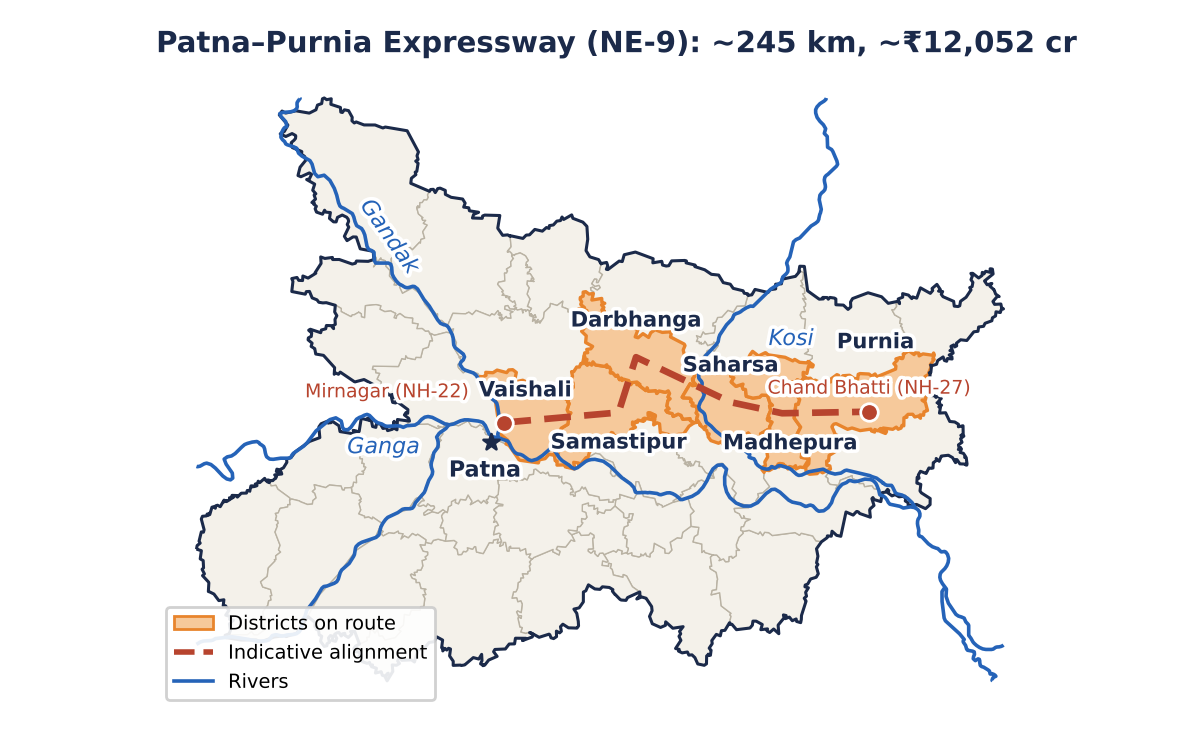
Bihar's greenfield six-lane expressway: ~245 km, cost ~₹12,052 crore, design speed 120 km/h.
The route runs from Mirnagar (NH-22, Vaishali) to Chand Bhatti (NH-27, Purnia).
Districts on the route: Vaishali, Samastipur, Darbhanga, Saharsa, Madhepura, Purnia.
It cuts travel from Patna to Purnia from 7–8 hours to about 3 hours, and will link to the Patna Ring Road.
Way forward
The alignment crosses the Kosi floodplain, so it needs enough cross-drainage and embankment-safe design. Logistics parks along the corridor can lift the economy of the Seemanchal region.
Concept
A greenfield project is built on new land with no existing road, while a brownfield project upgrades an existing one. The Kosi is called the 'Sorrow of Bihar' because it frequently changes course.
Map of Bihar highlighting the six districts on the Patna–Purnia Expressway (Vaishali, Samastipur, Darbhanga, Saharsa, Madhepura, Purnia), with an indicative dashed alignment, Patna marked, and the Ganga, Gandak and Kosi rivers shown in blue. — StudyForGS
5. Bank accounts mandatory for all government-school students by 31 December
GS-II: welfare delivery in Bihar and education initiatives; Prelims: DBT, PM Jan Dhan Yojana (2014).
Context
On 5 Nov, the state government directed that every government-school student must have a bank account, either individual or joint, so that scholarships and scheme benefits reach them directly through DBT.
Key facts
A special campaign runs until 31 December.
Headmasters will coordinate with local banks, giving priority to students eligible for scholarships.
Schools will keep students' birth certificates on record so that no child is left out.
Way forward
Link the accounts to Aadhaar-seeded DBT, run doorstep bank-mitra camps and add financial-literacy modules to classes.
Concept
DBT (2013) sends benefits directly to bank accounts and cuts leakage. JAM trinity: Jan Dhan + Aadhaar + Mobile.
6. 155 festival special buses for Chhath; traffic fines via UPI apps from 16 Nov
GS-I: Bihar's culture (the Chhath festival, migration); GS-II: state transport administration and e-governance.
Context
Transport Minister Damodar Rawat flagged off 155 inter-state special buses from the Phulwarisharif depot in Patna for migrants returning for Diwali and Chhath. The services run from 5 to 20 Nov.
Key facts
32 buses are run by BSRTC and 123 under PPP; the fleet is to rise to 200.
Routes: Delhi 77, Haryana 60, Jharkhand 12, UP 3, West Bengal 3.
E-challans can be paid through BBPS on UPI apps from 16 Nov (proposed), with API integration by NIC.
Way forward
Make festival transport a permanent, demand-based plan, and include all transport payments in the digital system.
Concept
Chhath: a festival of sun worship (Kartik Shukla Shashthi) with offerings at dusk and dawn, central to Bihar's identity. BBPS: the Bharat Bill Payment System run by NPCI.
7. Nepal PM Balendra Shah's first India visit from 22 Nov: aid, power and pending disputes on the agenda
GS-II: India's foreign policy with its neighbours; Bihar's geography (the Indo-Nepal border, Kosi and Gandak treaties); Prelims: border districts.
Context
After Foreign Secretary Vikram Misri's two-day visit to Kathmandu (ending 5 Nov), Nepal PM Balendra Shah, in office since 27 Mar 2026, is set for a four-day visit from 22 Nov, with talks with PM Modi on 23 Nov.
Key facts
Nepal is seeking $2 billion after the 26 Aug floods in the Rasuwa–Bhotekoshi area: $1 bn in credit lines, $500 mn in grants and $500 mn for reconstruction.
Projects on the agenda: the Lower Arun hydropower project, the Siliguri–Charali petroleum pipeline, the Bhairahawa integrated check post (ICP) and the Pancheshwar project (Mahakali Treaty, 1996).
Unresolved boundary issues: Kalapani and Susta.
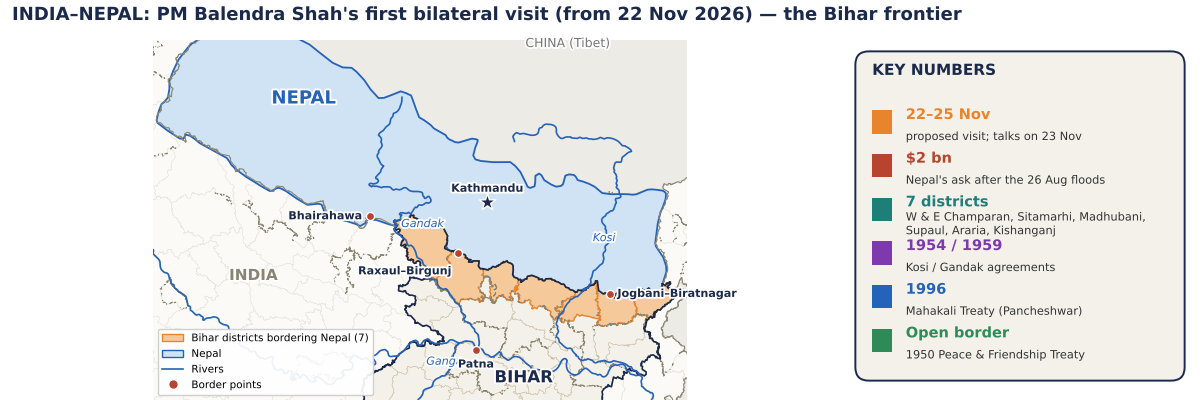
7 Bihar districts border Nepal, from West Champaran to Kishanganj.
Way forward
Joint flood forecasting and Kosi high dam studies would directly cut floods in north Bihar. Faster cross-border rail and ICPs at Raxaul and Jogbani would help trade.
Concept
Kosi Agreement (1954) and Gandak Agreement (1959): India–Nepal treaties on barrages and irrigation that are central to north Bihar. The 1950 Treaty of Peace and Friendship provides for an open border.
Map of Nepal and Bihar: the seven Bihar districts bordering Nepal are highlighted, with the Gandak, Kosi and Ganga rivers, the points Kathmandu, Patna, Raxaul–Birgunj and Jogbani–Biratnagar marked, and a side panel listing visit dates and key asks. — StudyForGS
8. Cabinet clears ₹14,500 crore VGF for 92 GWh grid-scale energy storage
GS-II: the role of science and technology in energy security; Prelims: VGF, pumped storage, domestic content.
Context
On 4 Nov 2026, the Union Cabinet approved a viability gap funding (VGF) scheme for FY27–FY31 to firm up renewable power and supply round-the-clock electricity. It is expected to attract ₹97,600 crore of investment.
Key facts
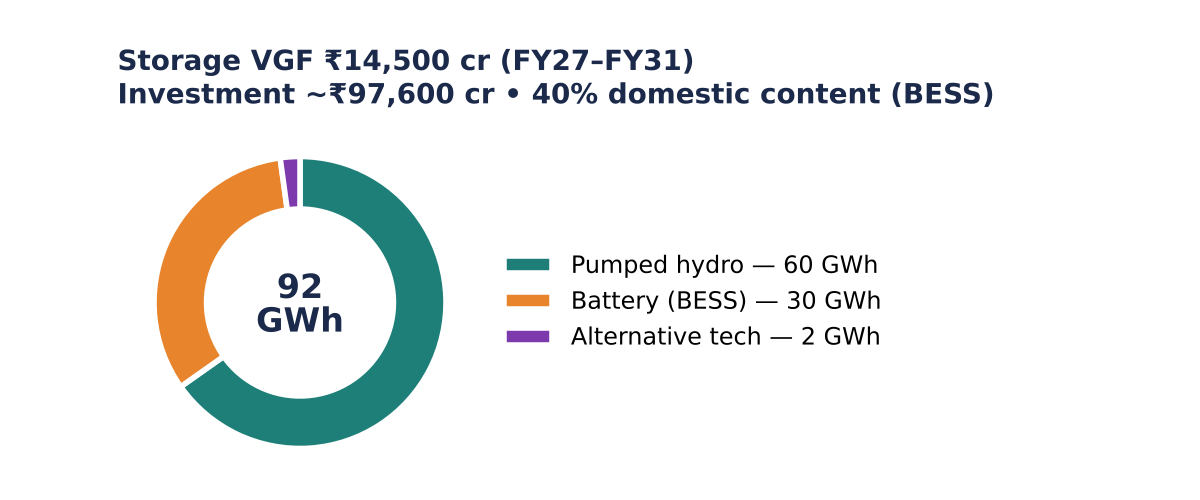
92 GWh in total: 60 GWh pumped hydro, 30 GWh BESS and 2 GWh of alternative technologies.
Capacity is allocated through tariff-based competitive bidding; discoms are eligible.
BESS projects need a minimum domestic content of 40%.
The scheme adds about 170% of current grid storage; India needs 411 GWh by 2031–32.
Way forward
States like Bihar, with a fast-rising evening peak, should bid early. Battery recycling and safety standards need to keep pace.
Concept
VGF: a one-time capital grant that makes an otherwise unviable project bankable. Pumped storage: water is pumped uphill when power is surplus and released through turbines at peak demand.
Donut chart of the 92 GWh storage target under the VGF scheme: pumped hydro 60 GWh, battery energy storage 30 GWh and alternative technologies 2 GWh, with the ₹14,500 crore outlay at the centre. — StudyForGS
9. ₹2,814 crore capex scheme to refine lithium and nickel at home
ECONOMYBPSC: Prelims + Mains GS-II (Economy – Industry & Resources)
Syllabus linkage
GS-II: industrial policy, mineral security and science and technology; Prelims: critical minerals, KABIL, NCMM.
Context
The Cabinet (4 Nov) approved a 30% capital subsidy to set up processing plants that make battery-grade lithium and nickel compounds. Processing is the main chokepoint in India's supply chain for these minerals.
Key facts
4 plants: two lithium plants (≥30 kt each) and two nickel plants (≥50 kt each); cobalt comes as a by-product.
Caps: ₹500 cr per lithium plant and ₹900 cr per nickel plant; nodal ministry: Ministry of Mines; runs FY27–FY31.
India's list has 30 critical minerals (2023); the National Critical Mineral Mission (NCMM) (Jan 2025) has an outlay of ₹16,300 cr.
Way forward
India needs secure overseas feedstock through KABIL (Argentina and Australia), R&D on recycling and strict environmental norms for effluents.
Concept
Critical minerals are essential to the economy but face supply risk. KABIL (2019) is a joint venture of NALCO, HCL and MECL. Bihar link: the Jamui gold and Banka/Gaya mineral blocks.
10. Fast Track Special Courts extended to 2031 with ₹3,788 crore outlay
GS-II: governance and regulatory reforms, and the aviation infrastructure (UDAN) relevant to Bihar's airports; Prelims: ICAO, the Chicago Convention.
Context
The Centre has notified new rules under the Bharatiya Vayuyan Adhiniyam, 2024, replacing the Aircraft Rules, 1937. They take effect from 1 Jan 2027.
Key facts
The rules cover registration ('VT' prefix), airworthiness, licensing, aerodromes and penalties.
Airlines must show the full fare with a breakdown; the Centre can issue directions in extraordinary situations.
The rules are aligned with the ICAO annexes; the Adhiniyam replaced the Aircraft Act, 1934.
Way forward
Make the DGCA autonomous and well staffed, and define 'extraordinary' fare situations clearly. This will help regional routes (UDAN) to Darbhanga and Purnia.
Concept
The Chicago Convention (1944) created ICAO, headquartered in Montreal. The DGCA became a statutory body in 2020.
Data point of the day
₹1,827 crore (+24% YoY)
Bihar's GST collection, October 2026 This is up from ₹1,478 crore in October 2025. All-India gross GST was ₹2,31,290 crore (+22.9%), the second-highest monthly figure since July 2017. Import GST jumped 42.2% and domestic GST rose 15.8%. Net GST was ₹2,03,356 crore (+25.6%).
Prelims rapid-fire
The Kajra solar-plus-storage project (301 MW + 523 MWh) is in Lakhisarai district, Bihar.
Bihar's Transport Minister is Damodar Rawat; BSRTC stands for the Bihar State Road Transport Corporation.
The Cabinet approved VISTAR (₹4,371.10 cr, 2026–31) for statistics reform, including the 8th Economic Census.
SC (5 Nov): the 24-hour window for producing a person before a magistrate runs from detention, not formal arrest (Art. 22(2)).
COP31 of the UNFCCC is to be held in Antalya, Türkiye, from 9 to 20 Nov 2026.
Bihar's Deputy CMs: Vijay Kumar Chaudhary and Bijendra Prasad Yadav.
Practice MCQs — BPSC Prelims pattern
Q1. Consider the following statements about the VB-G RAM G framework recently reviewed in Bihar:
1. It guarantees 125 days of wage employment per rural household per year.
2. The Centre and states share its cost in a 60:40 ratio.
3. It replaced the Mahatma Gandhi NREGA, 2005.
Which of the statements given above are correct?
1 and 2 only
2 and 3 only
1 and 3 only
1, 2 and 3
Show answer
Answer: D All three statements are correct: VB-G RAM G guarantees 125 days of work, its cost is shared 60:40 between the Centre and the states, and the 2025 Act replaced MGNREGA.
Q2. Under the 16th Finance Commission's formula for distributing central taxes among states, which criterion carries the highest weight?
Population
Income distance
Area
Forest cover
Show answer
Answer: B Income distance carries 42.5%, followed by population at 17.5%; the other four criteria carry 10% each. Because of this weighting, a low-income state like Bihar gets nearly 10% of the devolution pool.
Mains practice question
Q. Bihar aims for 24 GW of renewable energy by 2030 even though its peak demand has risen about fourteen-fold since 2005. Discuss the opportunities and constraints of this transition, and suggest a strategy suited to the state's geography. (BPSC Mains GS-II, 8 marks)
Hint / approach
Start with the data (700 → 10,000 MW, the ₹2.57 lakh cr pipeline). Opportunities: PM-KUSUM, rooftop solar, Kajra BESS, the new central storage VGF. Constraints: land scarcity, the flood-prone plains and evening peaks. Strategy: floating and agri-solar, pumped storage in Kaimur, and strong discoms. Conclude with jobs and energy security.
📌 One-line revision: Remember Bihar ₹10,845 cr (devolution), 125 days and 60:40 (VB-G RAM G), 24 GW by 2030 (Bihar RE), NE-9 at 245 km (Patna–Purnia), 92 GWh (storage VGF) and 7 border districts (Nepal).