Bihar floods hit 47 lakh across 15 districts; state pushes an integrated sugar-ethanol policy, while the Supreme Court flags a uniform law on court deposits
Monday, 21 September 2026 · IST · Bihar + National · 11 items · 2 MCQs
Bihar's September flood crisis dominates the state file, with over 47 lakh people affected across 15 districts as the Ganga at Patna crossed its 2016 peak. On the economy, Bihar is scaling an integrated sugar-ethanol-CBG complex model and its Mithila Makhana ecosystem. Nationally, the Supreme Court sought a uniform law on money deposited during appeals, the Semiconductor Mission entered a design-and-fabrication Phase 2, and India's crude oil mix stayed tilted towards Russia (51%) amid fresh US sanctions pressure.
Today at a glance — things to remember
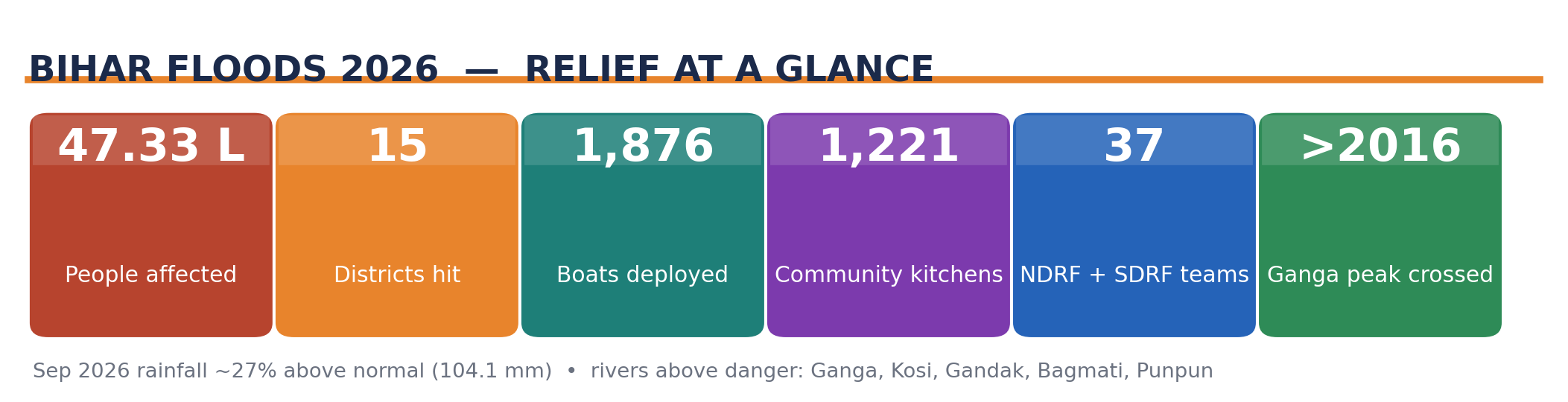
Bihar floods: 47.33 lakh people affected across 15 districts
Ganga at Patna's Gandhi Ghat crossed its previous 2016 record
1,876 boats, 1,221 community kitchens, 37 NDRF/SDRF teams deployed
Bihar Sugar Industry Investment Promotion Policy-2026 pushes integrated complexes
Target of 25 new sugar mills in Bihar over the next five years
Mithila Makhana GI ecosystem backed by the National Makhana Board
Supreme Court seeks uniform national law on court deposits
Semiconductor Mission Phase 2: about Rs 1.27 lakh crore committed
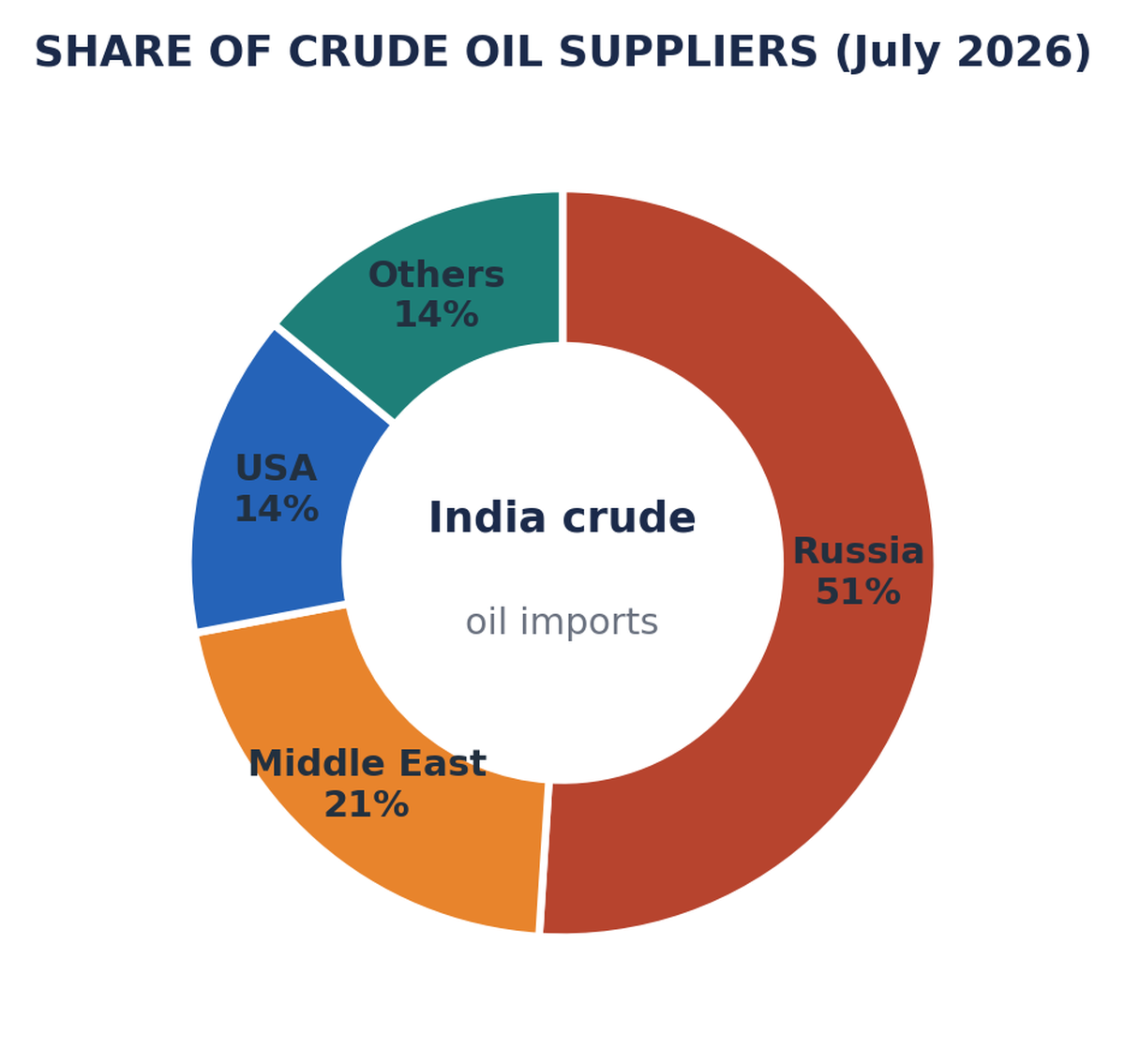
Russia stayed India's top crude supplier at 51% (July 2026)
RBI holds a neutral stance with repo at 5.25%; CPI 4.82% (Aug 2026)
Detailed notes
1. Bihar Floods 2026: 47 Lakh Affected as Ganga Breaches 2016 Peak
Prelims: Bihar rivers, flood-prone districts, embankments. Mains GS-II: Bihar geography, river systems and disaster response.
Context
Bihar's worst September flooding in years continued to swell through mid-month as the Ganga, Kosi, Gandak, Bagmati and Punpun flowed above danger levels, forcing mass evacuation and relief operations.
Key facts
47.33 lakh people affected across 15 districts, including Bhagalpur, Patna, Saran, Vaishali and Katihar.
The Ganga at Gandhi Ghat, Patna crossed its previous maximum recorded level of 2016.
Prelims: sugar belt districts, ethanol blending. Mains GS-II: Bihar economy, agro-industry and investment policy.
Context
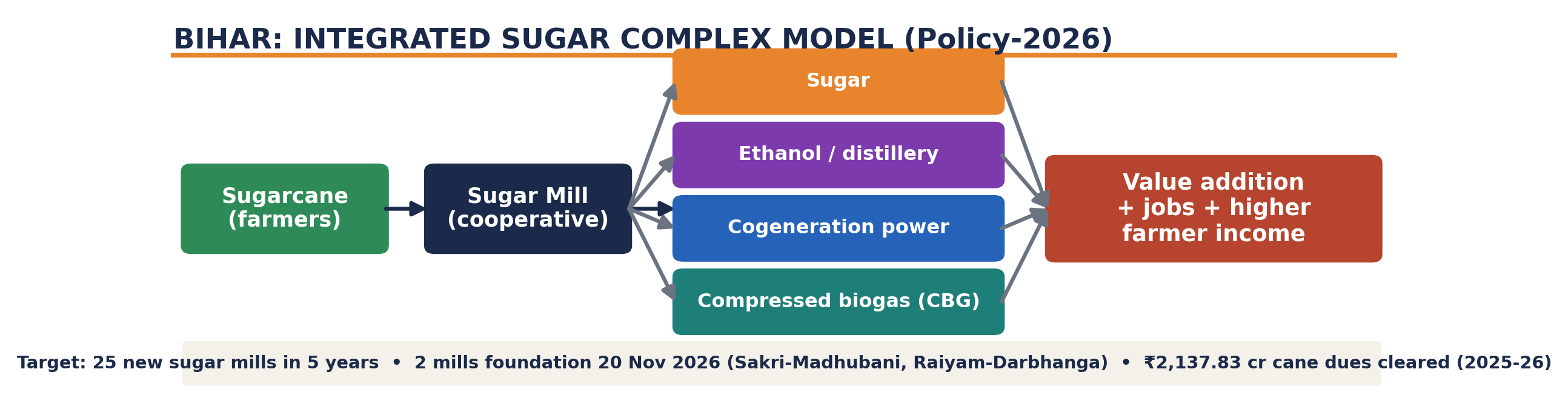
Under the Bihar Sugar Industry Investment Promotion Policy-2026, the state is promoting integrated sugar complexes that pair mills with distilleries, cogeneration and compressed biogas units.
Key facts
Target of 25 new sugar mills in Bihar over five years (Sugarcane Industries Dept.).
Foundation of 2 mills on 20 Nov 2026 at Sakri (Madhubani) and Raiyam (Darbhanga).
Integrated model links sugar + ethanol + cogen power + CBG for value addition.
Rs 2,137.83 crore sugarcane dues cleared for 2025-26; 266 acres secured for Motipur mill.
Way forward
Align new capacity with the Ethanol Blending Programme (E20) and climate-resilient cane varieties to lift farmer incomes.
Concept
Bihar's sugar belt lies in north-west (Champaran, Gopalganj, Siwan). Ethanol supports energy security and cuts crude import dependence.
Flowchart: sugarcane to cooperative sugar mill branching into sugar, ethanol, cogeneration power and compressed biogas, driving jobs and farmer income. — StudyForGS
3. Mithila Makhana: GI Crop Anchored by the National Makhana Board
Prelims: GI tags of Bihar, Makhana Board. Mains GS-II: Bihar agriculture, food processing and FPOs.
Context
Bihar is deepening its makhana (fox-nut) value chain, building on the Mithila Makhana GI tag and the National Makhana Board announced in the Union Budget, with a state Makhana Vikas Yojana.
Key facts
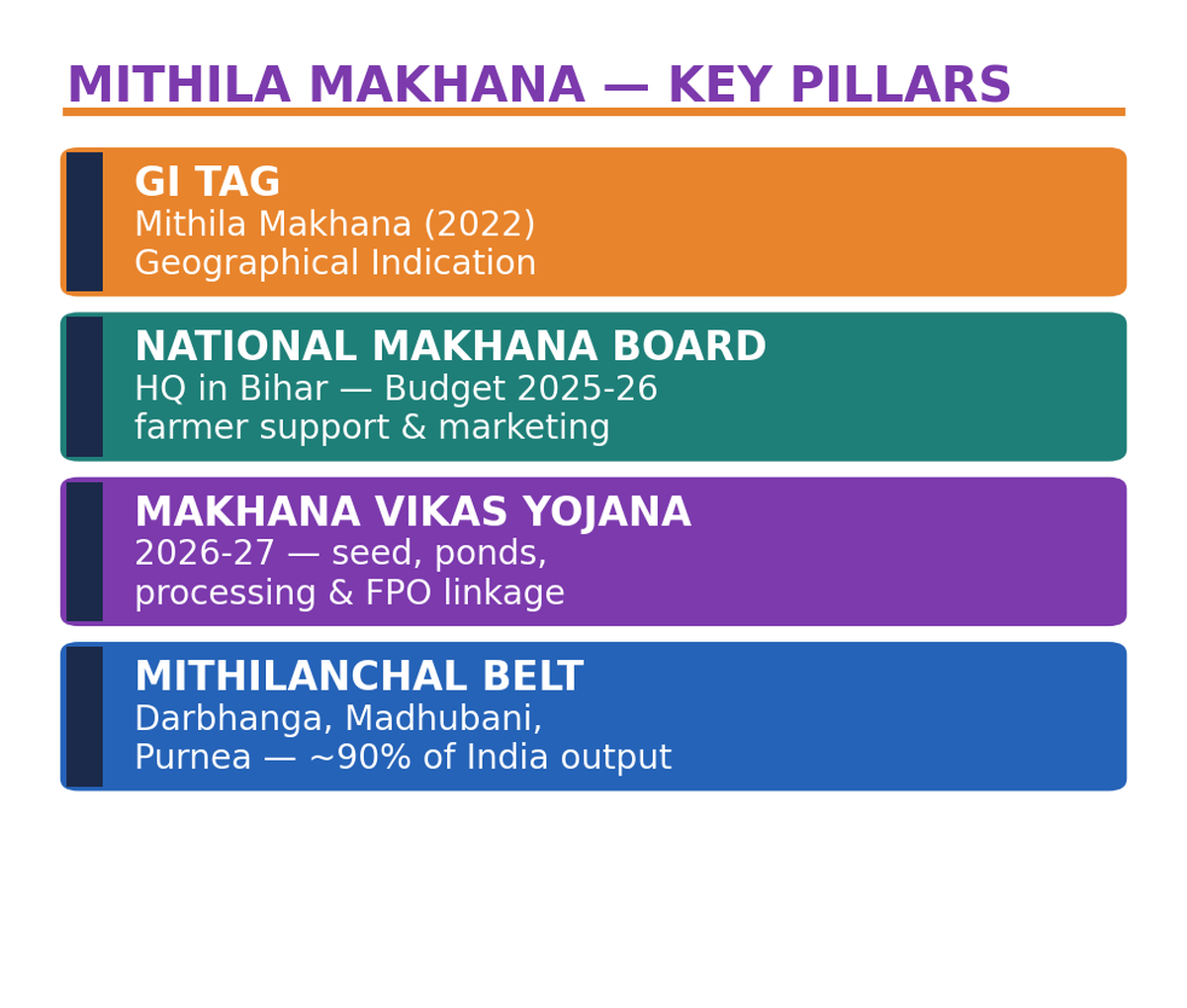
Mithila Makhana holds a Geographical Indication (GI) tag (granted 2022).
National Makhana Board (Budget 2025-26) is headquartered in Bihar.
Bihar grows nearly 90% of India's makhana, centred on Darbhanga, Madhubani, Purnea.
Way forward
Scale mechanised processing, cold chains and branded exports to raise farmer margins across Mithilanchal.
Concept
GI tag: sign for goods with a specific geographical origin (TRIPS/GI Act 1999). Other Bihar GIs: Shahi Litchi, Katarni rice, Magahi paan, Bhagalpuri silk.
Four pillars of the Mithila Makhana ecosystem: GI tag 2022, National Makhana Board in Bihar, Makhana Vikas Yojana 2026-27, and the Mithilanchal belt producing ~90% of output. — StudyForGS
4. ADB to Back Bihar with Over $1 Billion for Industry and Social Sectors
Bihar has been lining up over $1 billion of Asian Development Bank support to modernise industry, tourism, irrigation, energy, health and education under a multi-sector reform plan.
Key facts
Support of over $1 billion (about Rs 9,000 crore) across sectors.
New industrial hubs planned at Gaya and Muzaffarpur to boost manufacturing and logistics.
Funds target the Buddhist Circuit, irrigation modernisation and smart-grid energy.
Includes Bihar Health and Medical Education Transformation and school-readiness reforms.
Way forward
Use PPP models and skilling to convert external finance into durable jobs and higher own-revenue.
Concept
ADB (est. 1966, HQ Manila) is a regional multilateral development bank; India is a founding member and a large borrower.
5. Women-Centric Welfare: Mukhyamantri Mahila Rojgar Yojana Scales Up
Prelims: Bihar welfare schemes. Mains GS-II: women empowerment, self-employment and DBT.
Context
Bihar continues its flagship women's self-employment scheme, transferring seed capital directly to women to start micro-enterprises, later scalable with further support.
Key facts
Initial grant of Rs 10,000 each transferred to lakhs of women via DBT.
Second phase offers scaling support of up to Rs 2 lakh for viable enterprises.
Targets Jeevika self-help group members across rural Bihar.
Part of a wider push on women-led development and financial inclusion.
Way forward
Pair capital with market linkage, credit and skilling so micro-units survive beyond the first year.
Concept
DBT curbs leakage by routing benefits straight to bank accounts; Jeevika is Bihar's rural livelihoods (SHG) mission.
6. Bihar Metro Web Widens Beyond Patna's First Corridor
After Patna Metro's first phase began operations, Bihar is planning metro networks in more cities to ease urban mobility and support planned industrial growth.
Key facts
Patna Metro first phase became operational in October 2025.
Metro/rapid transit planned for Muzaffarpur, Gaya, Darbhanga and Bhagalpur.
Urban transport tied to new industrial hubs and tourism circuits.
Aims to cut congestion and vehicular emissions in growing cities.
Way forward
Integrate metro with feeder buses and TOD (transit-oriented development) to maximise ridership.
Concept
TOD concentrates dense, mixed-use development around transit stations to boost public-transport use and revenue.
7. Supreme Court Seeks a Uniform National Law on Court Deposits
Prelims: Law Commission, judicial process. Mains GS-II: judiciary, judicial reforms.
Context
The Supreme Court flagged the absence of a uniform framework for money deposited in courts during appeals and referred the matter to the Law Commission for a national model.
Key facts
Bench of Justices P.S. Narasimha and Alok Aradhe referred the issue to the Law Commission.
Current system forces repeated case-by-case decisions on investment, renewal and interest.
The court suggested studying the US Court Registry Investment System as a model.
Aim: consistent, transparent handling of large sums parked in litigation.
Way forward
A statutory framework can standardise investment of court deposits and protect litigants' interest earnings.
Concept
The Law Commission of India is a non-statutory body that recommends legal reforms to the government.
8. FCRA Amendment Bill 2026: Foreign Funds to Vest with Government on Cancellation
POLITYBPSC: Prelims + Mains GS-II (Governance)
Syllabus linkage
Prelims: FCRA, NGO regulation. Mains GS-II: governance, role of civil society.
Context
A proposed amendment to the foreign-contribution law would vest the foreign contributions and assets of an organisation in a government-designated authority when its registration is cancelled.
Key facts
Foreign funds/assets to vest in a designated authority upon licence cancellation.
About 22,496 FCRA registrations cancelled since 2015; roughly 14,466 active.
Domestic philanthropy projected near Rs 1.43 lakh crore; CSR spend about Rs 22,563 crore (FY25).
Seen as tightening oversight of foreign funding of NGOs.
Way forward
Balance national-security safeguards with due process and the space for legitimate civil-society work.
Concept
FCRA (2010) regulates acceptance and use of foreign contributions by individuals and associations in India.
9. Semiconductor Mission Phase 2 Shifts from Assembly to Fabrication
Prelims: India Semiconductor Mission, chip value chain. Mains GS-II: role and impact of science & technology.
Context
The second phase of the India Semiconductor Mission moves the focus from assembly and testing towards design, fabrication, equipment and materials to deepen the domestic value chain.
Key facts
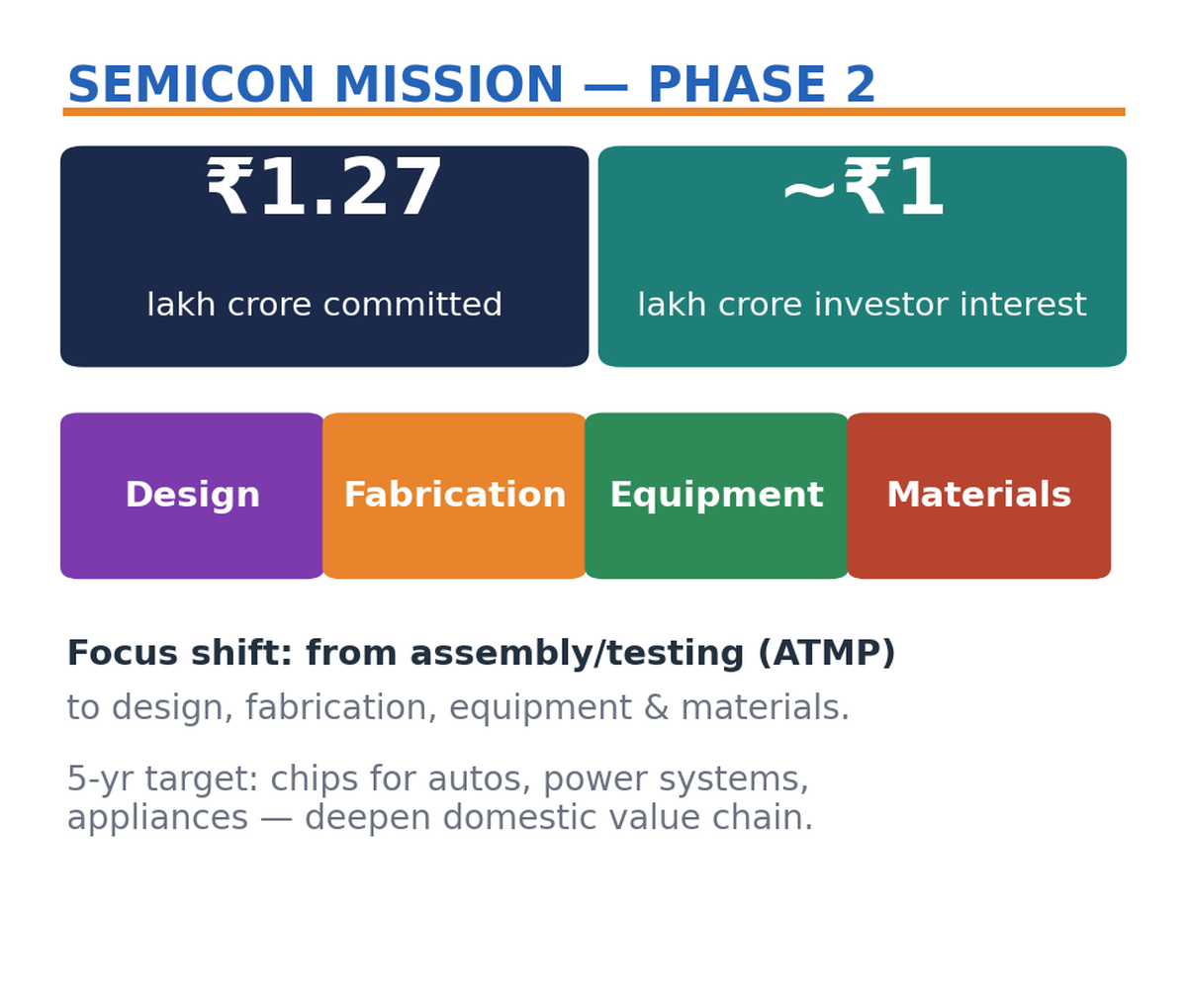
About Rs 1.27 lakh crore committed under the mission's next phase.
Investor interest of roughly Rs 1 lakh crore received.
Focus shifts from ATMP (assembly/testing) to design, fabrication, equipment, materials.
Five-year target: chips for automobiles, power systems and appliances.
Way forward
Build talent pipelines, fab-grade infrastructure and materials supply to reduce import reliance.
Concept
ATMP = Assembly, Testing, Marking and Packaging - the back-end of chip-making; fabrication is the front-end.
Semiconductor Mission Phase 2 tiles: Rs 1.27 lakh crore committed, about Rs 1 lakh crore investor interest, and a shift to design, fabrication, equipment and materials. — StudyForGS
10. Russia Stays India's Top Crude Supplier Amid Fresh US Sanctions Pressure
IRBPSC: Prelims + Mains GS-II (International Relations & Economy)
Syllabus linkage
Prelims: crude oil trade, sanctions. Mains GS-II: India's external sector and energy security.
Context
New US legislation authorises steep tariffs on buyers of Russian oil, putting India's energy strategy in focus as Russia remained its single largest crude supplier through mid-2026.
Key facts
Russia = 51% of India's crude oil imports (July 2026).
US law authorises up to 100% tariffs on Russian-oil buyers, stacking on existing duties.
Any levy needs a presidential waiver justification to the US Congress.
India balances energy affordability against external pressure and diversification.
Way forward
Diversify sourcing, expand strategic reserves and accelerate the shift to renewables to cut import risk.
Concept
Energy security = reliable, affordable supply. India imports over 85% of its crude needs, so price and source matter.
Donut chart of India's crude oil suppliers in July 2026: Russia 51%, Middle East 21%, USA 14%, others 14%. — StudyForGS
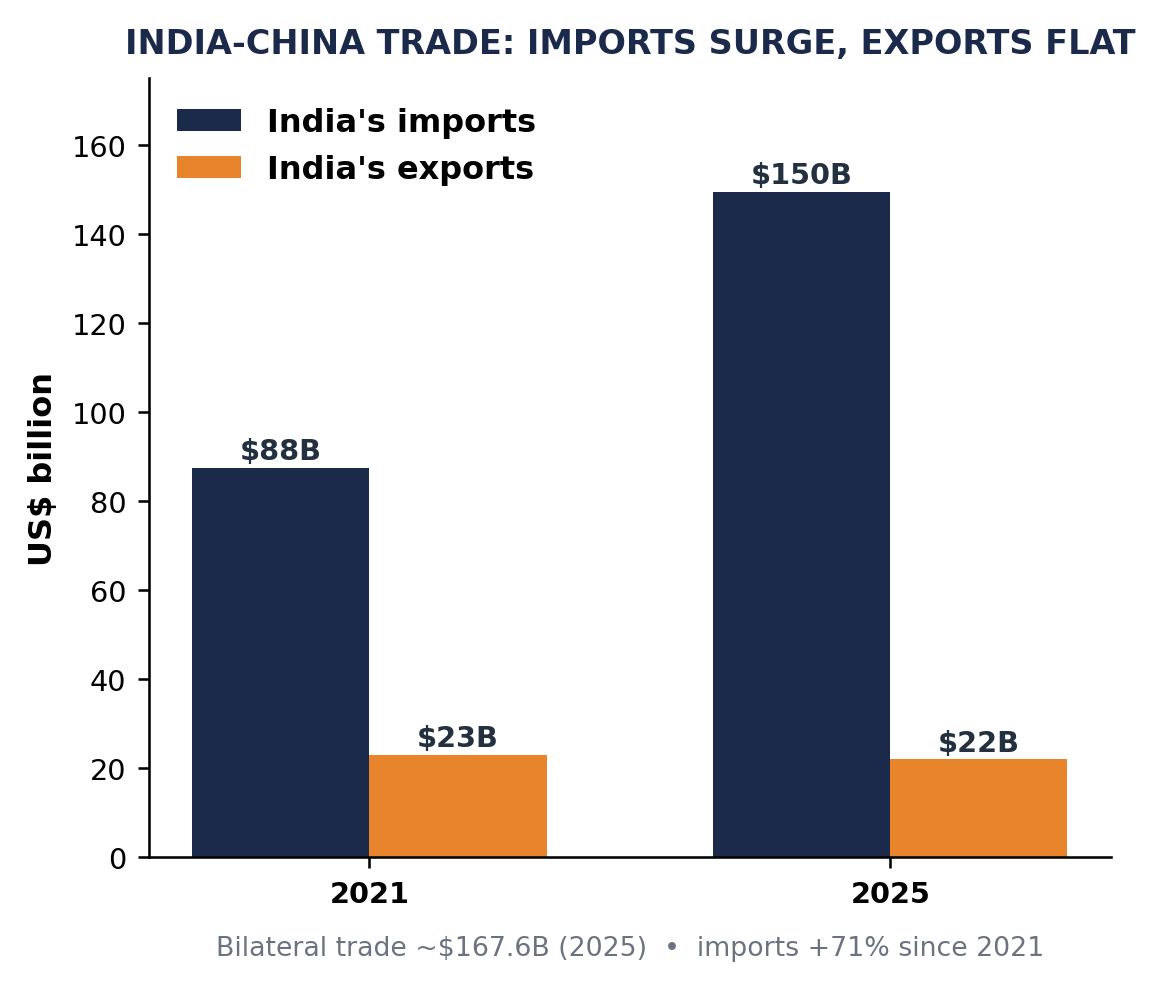
India's trade gap with China kept widening as imports of intermediate and capital goods climbed sharply while exports remained largely flat over the last few years.
Key facts
Bilateral trade about $167.6 billion (2025).
Imports up 71% from $87.5B to $149.5B (2021-2025); exports roughly flat.
About 70% of imports are intermediate goods; 22% capital goods.
Rising import dependence in electronics and machinery components.
Trade deficit = imports exceed exports. Heavy reliance on one partner for inputs is a supply-chain vulnerability.
Grouped bar chart of India-China trade: imports rise from $88B (2021) to $150B (2025) while exports stay near $22-23B. — StudyForGS
Data point of the day
Repo 5.25% | CPI 4.82% | Core 4.2%
India's Real Policy Rate Turns Modestly Positive With retail inflation (CPI) at 4.82% in August 2026 and the RBI repo rate at 5.25% under a neutral stance, the real policy rate is mildly positive. Food inflation stood at 5.95% and bank credit growth at 19.1%.
Prelims rapid-fire
Mithila Makhana carries a GI tag; the National Makhana Board is based in Bihar.
Patna Metro first phase started operations in October 2025.
RBI repo rate is 5.25% with a neutral monetary-policy stance.
Russia supplied 51% of India's crude oil imports in July 2026.
The Kosi is called the 'Sorrow of Bihar'; the Kosi-Mechi link aids flood control.
Shahi Litchi (Muzaffarpur) and Katarni rice (Bhagalpur) are Bihar GI products.
Practice MCQs — BPSC Prelims pattern
Q1. With reference to Mithila Makhana, consider the following statements:
1. It has been granted a Geographical Indication (GI) tag.
2. The National Makhana Board is headquartered in Bihar.
Which of the statements is/are correct?
1 only
2 only
Both 1 and 2
Neither 1 nor 2
Show answer
Answer: C Mithila Makhana received a GI tag (2022) and the National Makhana Board announced in the Union Budget is based in Bihar. Hence both statements are correct.
Q2. Which of the following rivers is popularly known as the 'Sorrow of Bihar'?
Gandak
Bagmati
Kosi
Punpun
Show answer
Answer: C The Kosi, notorious for shifting its course and causing severe floods in north Bihar, is called the 'Sorrow of Bihar'.
Mains practice question
Q. Bihar remains India's most flood-prone state even as it pursues rapid agro-industrial growth. Examine the challenges of river management in north Bihar and suggest a sustainable strategy that also supports the state's economy.
Hint / approach
Cover Kosi/Gandak/Bagmati behaviour and embankment limits; link relief data (47 lakh affected) to preparedness; discuss Kosi-Mechi link, forecasting and how sugar-ethanol and makhana value chains fit climate-resilient development.
📌 One-line revision: Remember today: Bihar floods hit 47.33 lakh across 15 districts (Ganga above 2016 peak); Sugar Policy-2026 targets 25 mills; Mithila Makhana is GI-tagged; SC seeks a uniform court-deposit law; Semicon Phase 2 ~Rs 1.27 lakh crore; Russia = 51% of India's crude; repo 5.25%, CPI 4.82%.